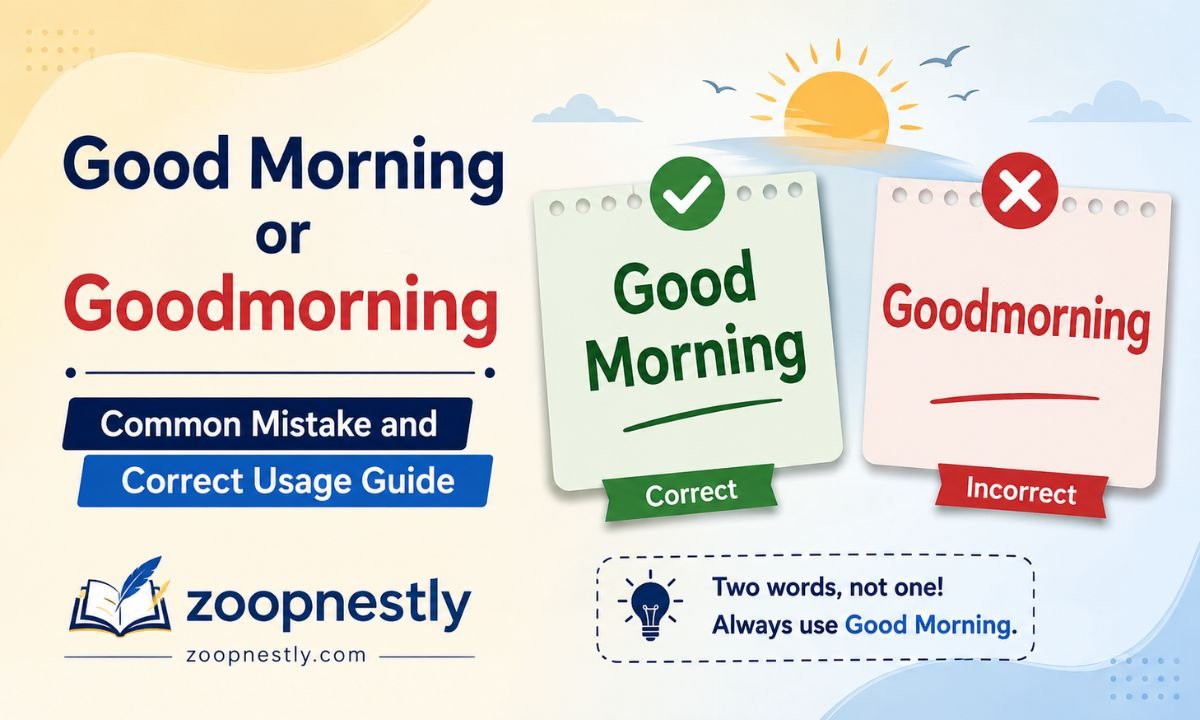
Good Morning or Goodmorning: Common Mistake and Correct Usage Guide
You type “Goodmorning” into a text message, and your phone underlines it in red. Now you’re second-guessing yourself. Is it one word or two? This mix-up trips up plenty of writers, and the debate over goodmorning or good morning shows up constantly in emails, captions, and casual texts.
The confusion makes sense, since English loves bending its own rules. Here’s the clear, simple answer so you never have to guess again.
Quick Answer
Good morning is the correct spelling in standard English. It is always written as two separate words, whether you’re greeting someone in person, writing an email, or posting online. Goodmorning as one word is a common misspelling, not an accepted variant, and most style guides and dictionaries do not recognize it.
The Short Answer: Good Morning Is Correct
If you only remember one thing from this article, remember this: “good morning” takes a space. It functions as an adjective (good) modifying a noun (morning), and English keeps those two words apart. You’ll see this same pattern in “good afternoon,” “good evening,” and “good night.” None of these greetings merge into a single word in formal writing.
Autocorrect tools, spell checkers, and grammar apps like Grammarly consistently flag “goodmorning” as an error. That’s a strong practical signal, even before you get into the grammar rules behind it.
Why People Confuse Goodmorning and Good Morning
The mix-up isn’t random. A few things push people toward writing it as one word:
- Speed and habit. When texting fast, spaces get dropped, and “goodmorning” starts to feel normal after enough repetition.
- Other compound words. English does merge some phrases into one word over time (think “today” or “goodbye”), so it’s easy to assume “good morning” followed the same path. It didn’t.
- Visual influence from other languages. Some languages write their equivalent greeting as a single word, which can carry over into English habits for bilingual speakers.
- Casual social media style. Hashtags and captions often smash words together for style, which normalizes the wrong spelling in everyday feeds.
Understanding why the error happens makes it easier to catch yourself before you make it.
American English vs British English
This isn’t a regional spelling difference like “color” versus “colour.” Both American and British English treat this greeting the same way: two words, no exceptions. You won’t find a British publication or American style guide that endorses “goodmorning” as correct.
The confusion sometimes comes from “goodbye,” which is one word in both dialects. But “goodbye” evolved from the phrase “God be with ye” over centuries of use, gradually fusing into a single word. “Good morning” never went through that same linguistic shift, so it stayed as two separate words.
The Grammar Behind Good Morning
Here’s the simple grammar explanation. “Good” is an adjective. “Morning” is a noun. When an adjective describes a noun, English typically keeps them as separate words unless the phrase has fully merged through long-term common usage (like “breakfast,” which came from “break” and “fast”).
“Good morning” hasn’t merged. It still functions as a two-word phrase, and treating it otherwise breaks a basic grammar rule that applies across similar greetings:
| Phrase | Correct Form |
| Good morning | Two words |
| Good afternoon | Two words |
| Good evening | Two words |
| Good night | Two words |
| Goodbye | One word |
Notice the pattern. Time-of-day greetings stay separate. “Goodbye” is the outlier, not the rule.
Common Mistakes with Goodmorning or Good Morning
Beyond the basic spelling, a few related errors show up often:
- Writing “Good Morning” with unnecessary capital letters in the middle of a sentence. Only capitalize both words if it starts a sentence, a greeting line, or a title.
- Adding a hyphen, like “Good-morning.” This isn’t standard and looks outdated in modern writing.
- Using it without a comma in direct address, such as “Good morning John” instead of “Good morning, John.” The comma matters because you’re directly addressing someone.
- Confusing it with “morning good,” a reversed order that some non-native speakers write by mistake.
Catching these small errors makes your writing look more polished, especially in professional emails.
Good Morning in a Sentence: Real Examples

Seeing the phrase in context makes the correct usage stick. Here are a few natural examples:
- “Good morning! I hope you slept well.”
- She sent a quick “good morning” text before starting her workday.
- “Good morning, everyone. Let’s get started with today’s meeting.”
- He always says good morning to his neighbors on his walk.
- The email opened with a simple “Good morning, Sarah,” followed by the request.
Notice that when it starts a sentence or greeting, both words are typically capitalized. Mid-sentence, only “Good” is capitalized if it begins a quoted greeting.
DISCOVER MORE : Loosing vs. Losing: Understanding the Difference and Correct Usage
Comparison Table: Goodmorning vs Good Morning
| Feature | Good Morning (Correct) | Goodmorning (Incorrect) |
| Word count | Two words | One word |
| Recognized by dictionaries | Yes | No |
| Accepted in formal writing | Yes | No |
| Flagged by spell check | No | Yes |
| Common in casual texting | Sometimes seen, still wrong | Sometimes used |
| Grammar structure | Adjective + noun | Not a recognized compound |
This table sums up why sticking with two words is the safer, correct choice in every writing context.
What Good Morning Really Means
“Good morning” is more than a scheduled greeting. It’s a way of wishing someone well as their day begins. The phrase carries a small but genuine gesture of goodwill, whether it’s said to a coworker in the hallway, a family member at breakfast, or a stranger passed on a walk.
It works as both a greeting and a farewell in certain contexts. If you’re leaving a room or ending a brief morning conversation, “good morning” can also serve as a polite way to say goodbye for that moment.
How to Say Good Morning in Spanish

If you’re learning Spanish or communicating with Spanish-speaking contacts, the equivalent phrase is “Buenos días.” Like the English version, it’s written as two words, and it’s used the same way, as a greeting during the morning hours. A few quick notes:
- “Buenos días” literally translates to “good days,” using the plural form.
- It’s used until roughly midday, similar to English.
- After midday, Spanish speakers switch to “Buenas tardes” (good afternoon).
Knowing this helps if you’re writing bilingual greetings for business, social media, or personal messages.
Good Morning Quotes and Messages
A short, thoughtful good morning message can brighten someone’s day. Here are a few simple message ideas you can use or adapt:
- “Good morning! Wishing you a calm and productive day ahead.”
- “Rise and shine. Good morning to you.”
- “Good morning! Coffee’s ready whenever you are.”
- “Sending good morning wishes your way.”
Keep messages short and genuine. Overly long morning texts can feel more like a chore to read than a warm greeting.
Texting and Casual Writing: Does Goodmorning Ever Work?
Even in casual texting, sticking with “good morning” is the better habit. Language does evolve through informal use, but “goodmorning” hasn’t gained acceptance the way some texting shorthand has (like “gonna” or “lol”). It still reads as a typo rather than an intentional stylistic choice, which can make written messages look careless, especially in work emails or professional chats.
If you want a shorter, casual feel, better options include “morning!” or “mornin‘,” both of which are widely understood as relaxed greetings without misspelling the phrase.
Frequently Asked Questions
Is “Goodmorning” ever correct?
No. “Goodmorning” is not recognized as correct in any standard English dictionary or style guide. The correct form is always two words: “good morning.”
Why do some people write it as one word?
It usually comes down to typing speed, habit, or confusion with words like “goodbye,” which did merge into one word over time. “Good morning” never went through that same change.
Should “Good Morning” be capitalized in an email?
Capitalize both words if it starts the email as a greeting line, like “Good Morning, Team.” If it appears mid-sentence, only capitalize “Good” if it starts a new sentence.
Is there a comma after “Good morning”?
Yes, when addressing someone directly. Write “Good morning, Alex,” not “Good morning Alex.” The comma separates the greeting from the person’s name.
What’s the difference between “Good morning” and “Morning”?
“Morning” alone is a shortened, more casual greeting often used among friends or coworkers. “Good morning” is the fuller, more formal version, suitable for professional writing and polite conversation.
Conclusion
The rule is simple and consistent: write it as good morning, two separate words, every time. Whether you’re drafting a formal email, sending a quick text, or writing a caption, this small detail affects how polished and accurate your writing looks. Now that you know the reasoning behind it, from grammar structure to common mistakes, you won’t have to second-guess this greeting again.

James Walker is a content writer and language researcher with over 5 years of experience in meanings, definitions, and language-related topics. He enjoys simplifying complex terms into clear, easy-to-understand explanations. Through ZoopNestly.com, he helps readers find accurate and reliable information.