Relieving or Reliving: Which Word Do You Actually Need?
You typed a sentence, paused, and stared at it. Something felt off. Was it relieving or reliving? One letter apart, yet they mean completely different things, and picking the wrong one can quietly confuse your reader or make your writing look careless. If you’ve ever hesitated over relieving or reliving while drafting an email, caption, or essay, you’re not alone, and the fix is simpler than you think.
Quick Answer
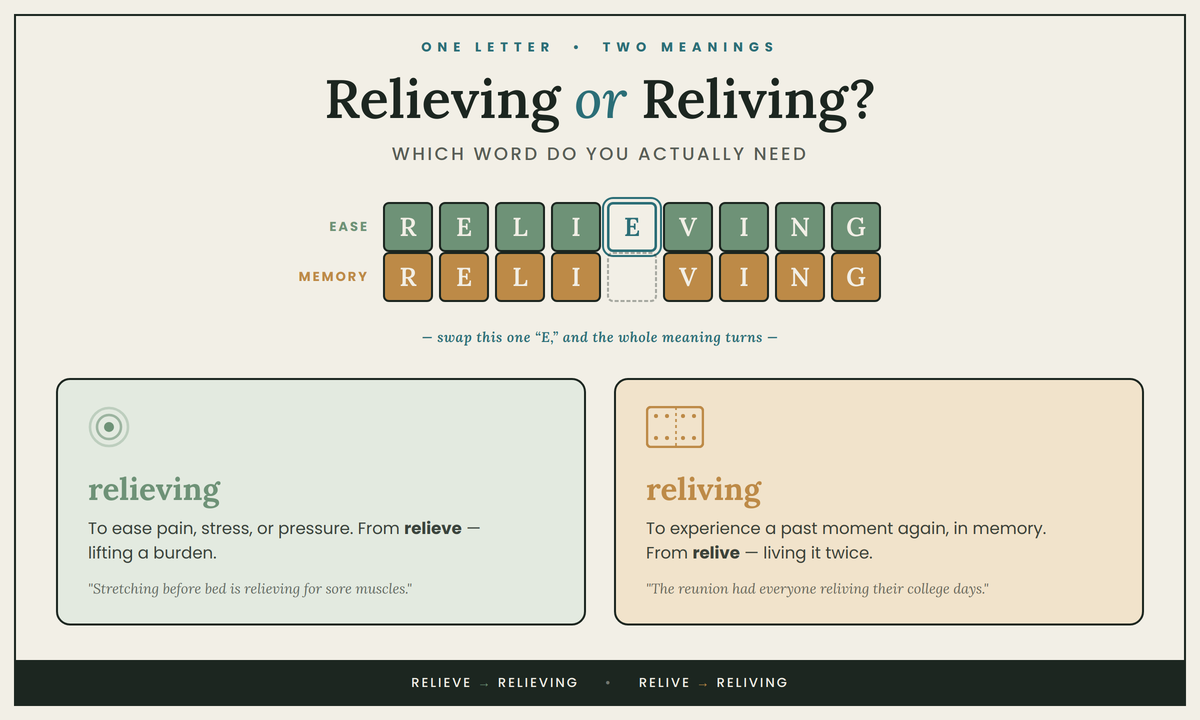
Relieving means easing pain, stress, or pressure (from relieve). Reliving means experiencing something from the past again in your mind (from relive). If you’re describing comfort or relief, use relieving. If you’re describing a memory playing out again, use reliving.
Relieving vs Reliving: The Core Difference
The confusion makes sense. Both words end in “-ing,” both have three syllables, and both come from the same visual shape on the page. But their roots point in opposite directions.
- Relieving comes from the verb relieve, meaning to reduce or remove discomfort.
- Reliving comes from the verb relive, meaning to go through an experience again, usually in memory.
One is about taking something away (pain, worry, pressure). The other is about bringing something back (a moment, a memory, an experience). Once you anchor the meaning to the root verb, the spelling stops feeling random.
What Does “Relieving” Mean?
Relieving describes the act of making a burden lighter. It applies to physical pain, emotional stress, financial pressure, or even a simple everyday task.
Examples:
- Stretching before bed is relieving for sore muscles.
- It was relieving to hear the flight wasn’t cancelled.
- The new hire is relieving some of the workload on the team.
You’ll also see it in medical and workplace contexts, since easing pressure of any kind, physical or mental, falls under this word.
What Does “Reliving” Mean?
Reliving describes mentally or emotionally stepping back into a past moment. It’s tied to memory, storytelling, and nostalgia rather than comfort.
Examples:
- Watching old home videos felt like reliving her childhood.
- He kept reliving the embarrassing moment in his head.
- The reunion had everyone reliving their college days.
Notice that reliving doesn’t require the memory to be pleasant. You can relive a happy trip or a stressful argument. The word only describes the act of mentally returning, not how it feels.
Where These Words Come From

Both words trace back to Latin, though through slightly different paths.
Relieve comes from the Latin relevare, meaning “to raise up” or “lighten.” Over time, English narrowed this to mean lifting a burden, physical or emotional. Add the suffix “-ing” and you get the present participle relieving.
Relive is a more direct English formation: the prefix re- (“again”) plus live. It literally means to live through something a second time. Add “-ing” and you get reliving, with the silent “e” dropped, a standard spelling rule when adding a vowel suffix.
This is actually a useful memory trick: if you can mentally split the word into re + live, it’s about experiencing something again. If not, you’re likely dealing with relieve.
Relieving or Reliving: Side-by-Side Comparison
| Feature | Relieving | Reliving |
| Root verb | Relieve | Relive |
| Core meaning | Easing pain, stress, or pressure | Experiencing a past moment again |
| Common context | Health, emotions, workload, finance | Memory, nostalgia, storytelling, trauma recall |
| Typical tone | Comfort, relief | Reflection, nostalgia, or distress |
| Example sentence | The medicine is relieving her headache. | She’s reliving her wedding day through photos. |
| Grammar form | Present participle of relieve | Present participle of relive |
Common Mistakes to Avoid
Most mix-ups happen for one of these reasons:
- Autocorrect confusion. Phones sometimes swap one for the other since they’re both common words.
- Rushed writing. Under time pressure, people type by sound rather than meaning.
- Assuming they’re synonyms. They aren’t. Relieving is about removing something negative; reliving is about repeating an experience, positive or negative.
- Using “reliving” when describing comfort. For example, “Reliving stress” is incorrect. You relieve stress; you don’t relive it unless you’re recalling a stressful memory.
A quick fix: before publishing, search your draft for both words and ask, “Am I describing relief, or a memory?” That single question resolves nearly every mix-up.
How to Choose the Right Word in Context
Ask yourself two questions:
- Is something being reduced or eased? Use relieving.
- Is a past event being experienced again, in thought or in action? Use reliving.
If your sentence involves pain, stress, tension, or pressure going down, relieving fits. If your sentence involves memory, nostalgia, flashbacks, or repeating a past experience, reliving fits.
For writers producing content for a general audience, it helps to read the sentence aloud and replace the “-ing” word with its base verb. “Relieve stress” makes sense. “Relive stress” sounds unnatural in most cases, which signals you picked the wrong word.
DISCOVER MORE : Women or Woman: The Simple Rule That Ends the Confusion for Good
Real-World Examples in Everyday Writing

Emails and messages:
- “Thanks for relieving me on the project this week.”
- “I keep reliving that awkward meeting in my head.”
Journalism and reports:
- “The new policy is aimed at relieving pressure on hospital staff.”
- “Survivors described reliving the disaster every time they heard sirens.”
Social media posts:
- “This song has me reliving every summer of high school.”
- “Finally relieving some stress with a weekend off.”
Academic or formal writing:
- “The intervention was effective in relieving symptoms of anxiety.”
- “Participants reported reliving traumatic memories during the exercise.”
Across all these settings, the pattern holds: relieving reduces something, reliving repeats something.
Grammar Notes: Verb Forms and Collocations
Both words follow standard English participle rules, but here’s how they behave across tenses:
| Base Verb | Past Tense | Present Participle |
| Relieve | Relieved | Relieving |
| Relive | Relived | Reliving |
Common collocations with relieving:
- Relieving pain
- Relieving stress
- Relieving pressure
- Relieving symptoms
Common collocations with reliving:
- Reliving memories
- Reliving the past
- Reliving a moment
- Reliving childhood
Learning these pairings helps because native speakers rarely combine “relieving” with words like “memories” or “reliving” with words like “pain.” Trusting the collocation is often a faster gut check than analyzing grammar.
Can Both Words Appear in the Same Sentence?
Yes, and it actually makes for a clean, natural sentence when the context calls for it. For example: “Reliving old family stories was surprisingly relieving, like finally letting go of something I’d been holding onto.” Here, reliving describes the act of remembering, while relieving describes the emotional result. This combination shows up often in writing about therapy, grief, and personal growth, where recalling the past can genuinely ease present tension.
Quick Self-Test
Try filling in the blank with the correct word:
- The physiotherapist focused on ___ the tension in his shoulder. (relieving)
- She spent the evening ___ her graduation day through old photos. (reliving)
- Taking a walk is often ___ after a stressful day. (relieving)
- He couldn’t stop ___ the accident in his nightmares. (reliving)
If you got all four, you’ve got the distinction locked in.
Frequently Asked Questions
Is it “relieving stress” or “reliving stress”?
It’s relieving stress. You reduce or ease stress, you don’t experience it again on purpose. “Reliving stress” would only apply if you were specifically recalling a past stressful event.
What is the noun form of relieve and relive?
The noun form of relieve is relief. The noun form of relive doesn’t have a single common word; instead, people typically say “reliving” as a gerund, as in “the reliving of old memories.”
Is “relieving” always positive?
Usually, yes. Relieving describes reducing something negative, like pain or pressure, so it typically carries a positive connotation. However, it can appear in neutral or clinical contexts too, such as medical reports.
Can “reliving” describe a happy memory?
Yes. Reliving simply means experiencing a past moment again, regardless of whether that moment was happy, sad, or stressful. Context determines the emotional tone, not the word itself.
Do British and American English spell these words differently?
No. Both relieving and reliving are spelled the same way in British and American English. There’s no regional variation for either word.
Final Thoughts
The words relieving and reliving look similar but point in opposite directions: one lightens a burden, the other brings back a memory. Once you connect each word to its root verb, relieve or relive, the right choice becomes almost automatic. Next time you pause mid-sentence, ask whether you’re describing relief or a memory replaying itself, and the correct word will follow naturally.

James Walker is a content writer and language researcher with over 5 years of experience in meanings, definitions, and language-related topics. He enjoys simplifying complex terms into clear, easy-to-understand explanations. Through ZoopNestly.com, he helps readers find accurate and reliable information.