Emaculate vs Immaculate: What’s the Difference?
You typed it fast, stared at it for a second, and something felt off. Was it “emaculate” or “immaculate”? You’re not imagining things. This mix-up trips up even confident writers, because the word sounds almost the same either way when spoken aloud. The problem is that only one spelling exists in standard English, and using the wrong one in an email, resume, or social post can quietly undercut your credibility. Emaculate vs immaculate confusion is more common than most people admit.
Quick Answer
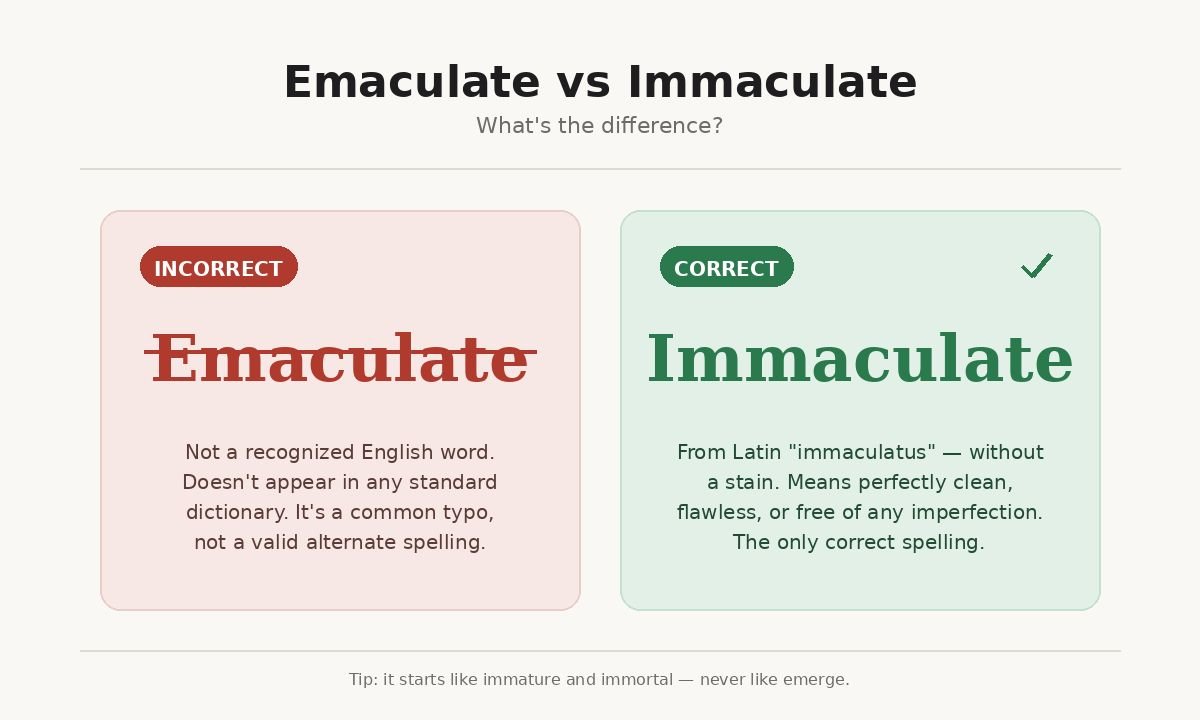
Immaculate is the correct spelling. It means perfectly clean, free of flaws, or completely spotless. Emaculate is not a real word in standard English, it’s simply a common misspelling caused by how the “im-” prefix gets slurred in casual speech. If you’re choosing between the two, always go with immaculate.
What Does Immaculate Mean?
At its core, immaculate describes something with absolutely no imperfections, stains, or mistakes. It’s a strong word. You wouldn’t call a room “somewhat immaculate,” because the word already implies total perfection.
It shows up in a few related but distinct contexts:
- Physical cleanliness — a spotless kitchen, a freshly detailed car
- Flawless execution — an immaculate performance, an immaculate plan
- Moral or spiritual purity — most notably in the religious phrase “Immaculate Conception”
As an adjective, immaculate always modifies a noun to signal that nothing is out of place. There’s no verb form (you can’t “immaculate” something) and the adverb form, immaculately, is used to describe how something was done.
Is “Emaculate” a Real Word?
No. Emaculate is not listed in any standard English dictionary. It has no accepted meaning, no grammatical function, and no historical usage as a legitimate word. If you search for it, you’ll mostly find other people asking the same question you are right now, or content correcting the mistake.
So why does it feel so natural to type? A few reasons:
- The unstressed “im” sound at the start of immaculate often gets swallowed in fast speech, making it sound closer to “em”
- Autocorrect doesn’t always catch it because “emaculate” resembles real words closely enough to slip through on some devices
- Visually, im- and em- prefixes are easy to confuse since both appear in common English words (immature vs. emerge, for example)
The takeaway: if you ever see “emaculate” in writing, treat it as a typo, not an alternative spelling.
Emaculate vs Immaculate: Side-by-Side Comparison
| Feature | Immaculate | Emaculate |
| Real word? | Yes | No |
| Found in dictionaries? | Yes | No |
| Correct spelling? | Yes | No |
| Meaning | Perfectly clean, flawless | None (misspelling) |
| Safe to use in writing? | Yes | Never |
Where Does “Immaculate” Come From?
Understanding the word’s origin makes the correct spelling much easier to remember. Immaculate comes from the Latin word immaculatus, formed from in- (meaning “not”) and macula (meaning “spot” or “stain”). Put together, it literally means “not stained” or “without a spot.”
That single detail explains the entire spelling. The word starts with im-, not em-, because it’s built on the negative prefix “in-” (which shifts to “im-” before certain consonants, as it does in words like impossible and immature). There is no “e” involved anywhere in its root.
Once you connect immaculate to “in + macula,” the spelling tends to stick for good.
How to Remember the Correct Spelling
If the Latin root doesn’t stay with you, try one of these simple memory tricks:
- Link it to similar words: immaculate starts the same way as immature and immortal, both common “im-” words
- Break it into syllables: im-MAC-u-late, emphasizing that it starts with “im,” not “em”
- Picture the meaning: “in + spot” = “not spotted” = immaculate
A quick mental checklist before you hit publish:
- Does it start with “im,” not “em”?
- Does it have two Cs? (No, just one — a second common error)
- Does it end in “-ate,” not “-it” or “-et”?
How to Use Immaculate in a Sentence
Seeing the word in context helps lock in both the spelling and the meaning. Here are examples across the situations where immaculate fits naturally.
Describing cleanliness:
- The hotel room was immaculate, with not a speck of dust anywhere.
- She keeps her workshop immaculate, even after a full day of projects.
Describing performance or execution:
- His timing during the presentation was immaculate.
- The surgical team worked with immaculate precision.
Describing appearance:
- He showed up to the interview in an immaculate suit.
- Her handwriting is immaculate, almost like a font.
Notice that immaculate rarely needs an intensifier like “very” or “extremely.” Since the word already means “completely without flaw,” pairing it with modifiers like that can sound redundant, though it’s not technically wrong in casual speech.
DISCOVER MORE : Encorporate vs Incorporate: Which Word Should You Use?
When Should You Actually Use Immaculate?
Immaculate works best when you want to communicate total, standout perfection, not just “pretty good” or “clean enough.” It’s a strong word, so it carries more weight than everyday alternatives.
Good fits:
- A house that’s spotless before a home showing
- A flawless win streak or record
- A perfectly maintained vintage car
Less natural fits:
- Describing something that’s simply “okay” or “decent”
- Casual, low-stakes contexts where a simpler word like “clean” or “neat” would read more naturally
Because immaculate is a bit formal, using it constantly in casual writing can start to feel overdone. Save it for moments where the level of perfection genuinely deserves it.
Immaculate vs Perfect vs Impeccable
These three words overlap, but they’re not interchangeable in every context.
| Word | Best Used For | Nuance |
| Immaculate | Cleanliness, flawlessness in appearance or execution | Emphasizes absence of stains or flaws |
| Perfect | General excellence in any category | Broadest meaning, works almost anywhere |
| Impeccable | Behavior, taste, timing, or judgment | Emphasizes faultlessness in conduct or style |
For example, you’d more naturally say someone has “impeccable manners” rather than “immaculate manners,” even though both words point toward flawlessness. Immaculate leans toward the visual and tangible, while impeccable leans toward behavior and standards.
Words Similar to Immaculate
Synonyms: spotless, pristine, flawless, pure, unblemished, faultless, perfect, unsullied
Antonyms: dirty, stained, flawed, messy, imperfect, tarnished, sloppy
Choosing the right synonym depends on tone. “Pristine” works well for something newly clean, while “flawless” fits performance or execution better than physical cleanliness.
Other Common Spelling Mistakes Worth Knowing
“Emaculate” isn’t an isolated case. Several English words get misspelled for similar reasons, usually because of how prefixes sound in casual speech:
- Definitely often misspelled as “definately”
- Separate often misspelled as “seperate”
- Embarrass often misspelled as “embarass” (missing a letter, not a prefix swap)
- Irregardless, which many people use though “regardless” is the standard form
Recognizing the pattern behind these errors, usually a mismatch between how a word sounds and how it’s actually built, can help you catch similar mistakes before they happen.
Immaculate Conception: A Quick Note
You’ve likely heard the phrase “Immaculate Conception” in a religious context. It’s worth knowing this term has a specific theological meaning tied to Catholic doctrine, referring to the belief that Mary was conceived without original sin. It’s a fixed phrase, always spelled “immaculate,” and it’s a helpful real-world anchor for remembering the correct spelling since it appears often in religious, historical, and cultural discussions.
Key Takeaways

- Immaculate is the only correct spelling; emaculate is a common misspelling with no dictionary presence
- The word comes from Latin, meaning “without a spot” or “without stain”
- It’s used to describe extreme cleanliness, flawless execution, or spotless appearance
- Related but distinct words include perfect, impeccable, and pristine
- A simple way to remember it: immaculate starts like immature and immortal, never like “emerge”
Frequently Asked Questions
Is “emaculate” ever an accepted alternative spelling of immaculate?
No. Dictionaries and style guides recognize only “immaculate” as correct. “Emaculate” is considered a spelling error, not a regional or informal variant.
How do you pronounce immaculate?
It’s pronounced ih-MAK-yuh-lit. The stress falls on the second syllable, which is part of why the first syllable can sound less distinct in casual speech.
What part of speech is immaculate?
Immaculate is an adjective. It describes a noun, as in “an immaculate lawn” or “an immaculate record.” There’s no verb form of the word.
Can immaculate be used for people, not just objects?
Yes. You can describe a person’s appearance, reputation, or conduct as immaculate, though “impeccable” is often a more natural fit when describing behavior specifically.
What’s the easiest way to avoid misspelling immaculate?
Remember that it shares its “im-” prefix with words like immature and immortal. If you catch yourself typing “em-” instead, that’s your signal to pause and correct it.
Final Thought
The confusion between emaculate and immaculate almost always comes down to sound, not logic. Once you connect the word to its Latin root and its family of “im-” prefixed relatives, the spelling stops being a guessing game. Immaculate is the only correct choice, and now you have the reasoning to remember it for good.

James Walker is a content writer and language researcher with over 5 years of experience in meanings, definitions, and language-related topics. He enjoys simplifying complex terms into clear, easy-to-understand explanations. Through ZoopNestly.com, he helps readers find accurate and reliable information.