Encode or Incode: What’s the Correct Spelling?
You’re typing a message about converting data or text into another format, and your fingers hesitate between two words: encode or incode. Spellcheck doesn’t flag either one loudly enough, and now you’re second-guessing something you probably learned correctly years ago. This mix-up happens more often than you’d think, especially among non-native English speakers and people copying phrases they’ve seen online. The truth about encode vs incode is simpler than the confusion suggests, and clearing it up takes less than five minutes.
Quick Answer
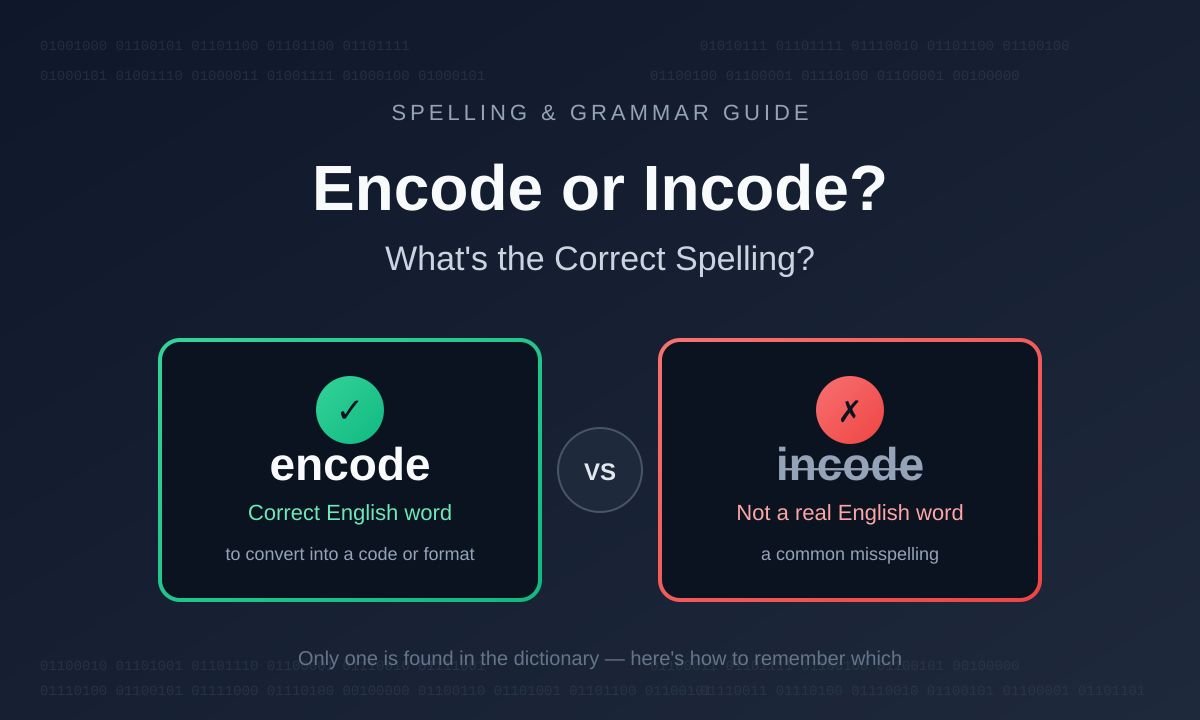
Encode is the correct English word. It means to convert information into a specific format, code, or system, such as turning text into binary or audio into a digital file. Incode is not a standard English word and should not be used in writing, whether casual, technical, or academic.
What Does Encode Mean?
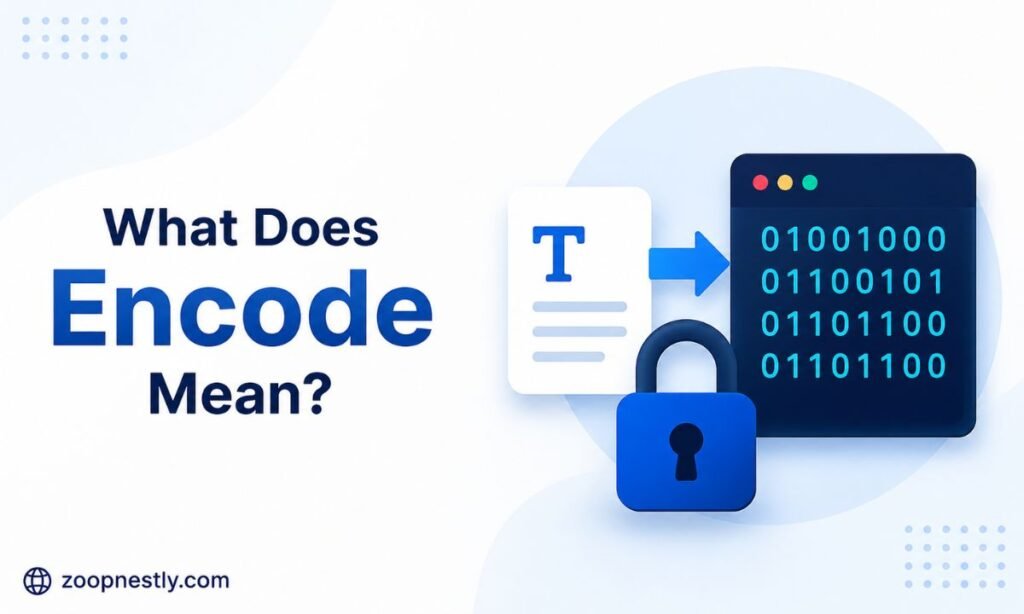
At its core, encode means to change data from one form into another so it can be stored, transmitted, or processed. The word comes from the prefix “en-” (meaning “to put into”) combined with “code.” So literally, to encode something is to put it into code.
Encode in Computer Science
In computing, encoding converts human-readable information, like text, images, or sound, into a format machines can process efficiently. Every file you open, every webpage you load, and every video you stream relies on some form of encoding happening in the background.
Encode in Everyday English
Outside of tech, encode still means to convert or embed information. You might say a smile “encodes” a feeling, or that a story encodes a lesson. It’s a word about transformation and representation, not just computers.
Real-World Examples of Encoding
Encoding shows up in more places than most people realize:
- A QR code encodes a web address into a scannable pattern.
- Morse code encodes letters into dots and dashes.
- DNA encodes genetic instructions using four chemical bases.
- MP3 files encode sound waves into compressed digital data.
Example Sentences
- “The app will encode your password before saving it.”
- “We need to encode this video for faster streaming.”
- “Her tone encoded more anger than her words did.”
Common Types of Encoding
Not all encoding works the same way. Here’s a quick breakdown of the types you’ll encounter most often.
| Type | What It Does | Common Use |
| Character encoding | Converts letters and symbols into numeric codes | Text files, websites |
| Binary encoding | Converts data into 0s and 1s | Computer storage and processing |
| URL encoding | Converts special characters for safe web transmission | Web addresses, forms |
| Audio/video encoding | Compresses media into digital formats | Streaming, file sharing |
Is Incode a Real Word?
No, incode is not a recognized word in standard English dictionaries. It doesn’t appear in Merriam-Webster, Oxford, or Cambridge dictionaries as an independent term. When people write “incode,” they almost always mean “encode.” The two words sound close enough, and the prefixes “en-” and “in-” both suggest movement inward, which is likely why the mix-up happens.
There’s one narrow exception worth noting: “InCode” appears as a proper noun in some company or product names. That’s branding, not grammar, and it doesn’t make “incode” a valid general English word.
Why Do People Confuse These Two Words?
A few patterns explain most of the mix-ups:
- Prefix confusion. “En-” and “in-” both exist in English and often mean similar things (“enclose” vs “inside”), so it’s easy to swap them by habit.
- Phonetic similarity. Said quickly, “encode” and “incode” sound almost identical.
- Autocorrect gaps. Some spellcheckers don’t flag “incode” because it resembles a valid word structure, even though it isn’t one.
- Non-native speaker patterns. In some languages, prefix rules differ, which makes “in-” feel more natural than “en-” for this type of word.
Encode vs Incode: Side-by-Side Comparison
| Feature | Encode | Incode |
| Standard English word | Yes | No |
| Found in dictionaries | Yes | No |
| Used in programming | Yes | No |
| Grammatically correct | Yes | No |
| Common in casual typos | No | Yes |
The Grammar Behind Why Only “Encode” Works
English word formation follows patterns, and “encode” fits one that’s well established. The prefix “en-” attaches to nouns to create verbs meaning “to put into” that state, such as “enable,” “enclose,” and “encode.” “Incode” doesn’t follow any recognized prefix-plus-root pattern in English, which is part of why it never made it into dictionaries.
Correct vs Incorrect Usage
- ❌ “Please incode this file before uploading.”
- ✅ “Please encode this file before uploading.”
- ❌ “The system incodes user data automatically.”
- ✅ “The system encodes user data automatically.”
How to Use Encode Correctly in Writing
Encode works as a regular verb and follows standard conjugation rules.
| Form | Word |
| Base form | encode |
| Past tense | encoded |
| Present participle | encoding |
| Third person singular | encodes |
Example sentences by tense:
- “The developer encodes the message before sending it.”
- “Yesterday, the system encoded thousands of files.”
- “We are currently encoding the video for upload.”
Encode vs Decode vs Encrypt: Know the Difference
These three words get lumped together often, but they mean different things.
| Term | Meaning | Reversible By |
| Encode | Convert data into a different format for compatibility or efficiency | Decoding |
| Decode | Convert encoded data back to its original form | N/A |
| Encrypt | Convert data into a secure format to hide it from unauthorized access | Decryption with a key |
The key distinction: encoding is about compatibility and structure, while encryption is about security and privacy. Encoded data is meant to be easily reversible by anyone who knows the format. Encrypted data is meant to be unreadable without a specific key.
Text Encoding vs Encryption in Practice
Imagine sending the word “hello” through a system.
Encoding might convert it into binary (01101000 01100101…) so a computer can process it. Anyone with the right decoder can read it instantly.
Encryption might scramble it into something like “Xk9#mQ2” using a secret key. Without that key, the original message stays hidden.
Both processes transform data, but only one is designed to keep secrets.
DISCOVER MORE : Emaculate vs Immaculate: What’s the Difference?
What Happens When Writers Use “Incode” by Mistake
Picture a technical document, blog post, or job application that includes the sentence: “This function will incode the user input.” A careful reader, recruiter, or editor will likely notice the error immediately. In professional or technical writing, a mistake like this can signal a lack of attention to detail, even if the rest of the content is strong.
Swapping “incode” for “encode” fixes the sentence instantly and removes any doubt about the writer’s grasp of the subject. It’s a small correction with a noticeable impact on how polished the writing feels.
Common Mistakes to Avoid
- Using “incode” in place of encode. Always default to “encode” in any English context.
- Treating encode and encrypt as interchangeable. They serve different purposes, even though both transform data.
- Ignoring context. “Encode” applies broadly, from casual writing to advanced programming, so context should guide word choice, not the other way around.
Where You’ll See “Encode” Used Most
- Computer science: Data structures, algorithms, and compression all rely on encoding.
- Web development: URLs, forms, and APIs frequently require encoding special characters.
- Digital communication: Text messages, emails, and media files are encoded before transmission and decoded upon arrival.
A Note on “Incode” in Tagalog

Some readers searching this topic are actually thinking of a different word entirely: “i-encode,” a common term in Filipino English and Tagalog that means “to type” or “to enter data,” as in “i-encode ang datos” (encode the data). This is a legitimate regional usage pattern in the Philippines, distinct from the English error “incode.” If you’re writing for a Filipino audience in that context, “encode” (often written with the “i-” verb marker) is understood as “to type into a system,” which is a slightly different but related meaning from the technical definition above.
Quick Practice
Fill in the blank: “The app will ___ your file before saving it.” (encode / incode)
Fix the sentence: “We need to incode this message for security.” → “We need to encode this message for security.”
If you chose “encode” both times, you’ve got it.
Key Takeaways
- Encode is the correct, dictionary-recognized English word.
- Incode is not a standard word and should be avoided in writing.
- Encoding means converting data into a different, usable format.
- Encoding is different from encryption, which focuses on security.
- In Filipino English, “i-encode” refers to typing or entering data, a separate regional usage.
Frequently Asked Questions
Is “incode” ever correct in English?
No. Standard English dictionaries do not recognize “incode” as a word. The correct term in every context is “encode.”
What does encode mean in simple terms?
To encode means to convert information, like text, sound, or images, into a different format so it can be stored, sent, or processed more easily.
Is encode the same as encrypt?
No. Encoding changes data format for compatibility, and it’s easily reversible. Encryption secures data to prevent unauthorized access and requires a key to reverse.
Why do people confuse encode and incode?
The words sound similar, and the prefixes “en-” and “in-” are both common in English, which makes the swap an easy typo or memory slip.
What’s an example of encoding in real life?
A QR code is a everyday example. It encodes a web address or piece of text into a scannable pattern that a phone camera can decode instantly.
Final Thoughts
The debate over encode vs incode really isn’t a debate at all. Encode is the correct, established English word, backed by dictionaries, computer science, and everyday usage. Incode simply isn’t part of standard English, aside from its role in some brand names or as a regional Filipino English term with a different meaning. Once you know the difference, using the right word becomes second nature, whether you’re writing code, a text message, or a technical report.

James Walker is a content writer and language researcher with over 5 years of experience in meanings, definitions, and language-related topics. He enjoys simplifying complex terms into clear, easy-to-understand explanations. Through ZoopNestly.com, he helps readers find accurate and reliable information.