Reevaluation vs Re-evaluation: Which Form Should You Use?
You typed the word, stared at it, and something felt off. Was it reevaluation or re-evaluation? Spell-check didn’t flag either one, and now you’re second-guessing a word you use all the time. That small hesitation can slow down an email, a report, or a school assignment. The good news: both reevaluation and re-evaluation are correct, and once you know the rule, you’ll never pause on this word again.
Quick Answer
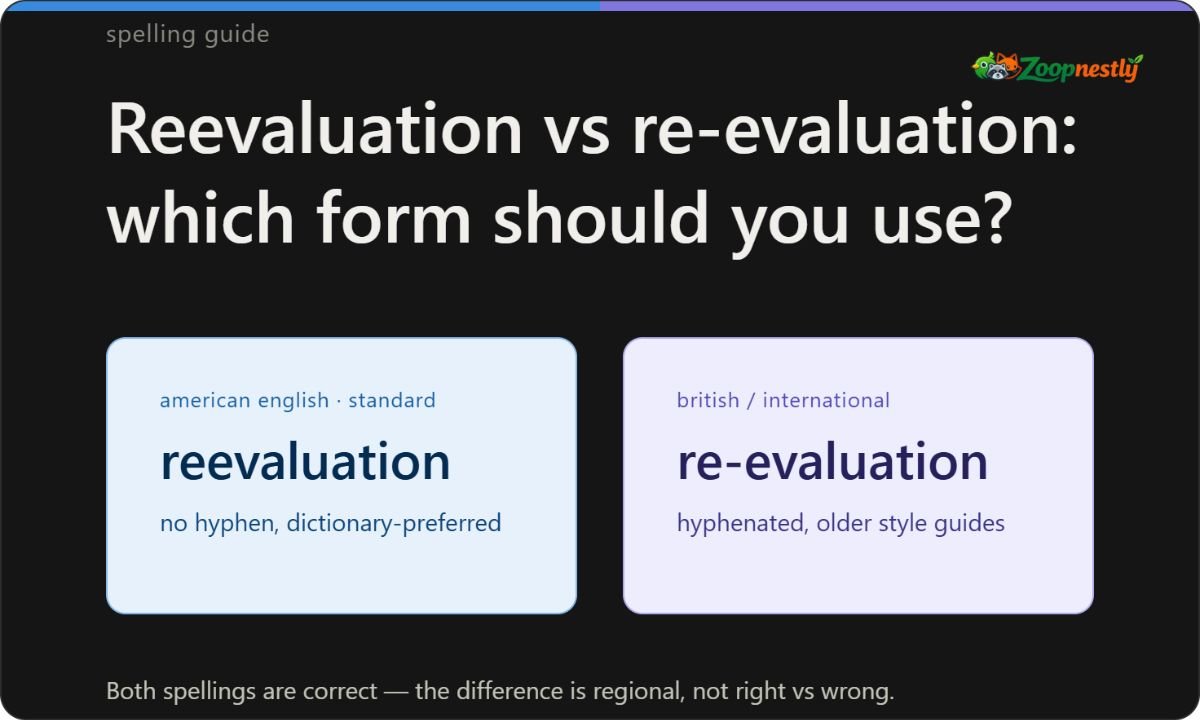
Reevaluation (no hyphen) is the standard spelling in modern American English and is preferred by most style guides. Re-evaluation (with a hyphen) is a valid British English variant and is sometimes used in American writing for clarity or emphasis. Both mean the act of assessing something again.
What Does Reevaluation Mean?

Reevaluation means examining or judging something a second time, usually because circumstances changed or new information came in. It combines the prefix “re-” (again) with “evaluation” (an assessment or judgment).
You’ll see it in workplaces, schools, hospitals, and courtrooms. A manager might request a reevaluation of a budget. A teacher might conduct a reevaluation of a student’s progress. A doctor might schedule a reevaluation after treatment.
Is It Reevaluation or Re-evaluation?
In American English, reevaluation without a hyphen is the standard, dictionary-preferred spelling. Merriam-Webster and most US style guides list it as one solid word.
Re-evaluation with a hyphen is more common in British English and in older American texts. It isn’t wrong, but it’s less common in current US writing, especially in business and journalism.
Here’s the simple rule:
- Writing for a US audience, a resume, or a business report? Use reevaluation.
- Writing for a UK or international audience, or following a house style that hyphenates “re-” words? Use re-evaluation.
Reevaluation vs Re-evaluation: Key Differences
| Feature | Reevaluation | Re-evaluation |
| Region | American English | British/International English |
| Hyphen | No | Yes |
| Style guide preference | AP, Chicago, Merriam-Webster | Some UK/Oxford style guides |
| Formal writing | Preferred | Acceptable, less common |
| Readability | Slightly faster to read | Clarifies word boundaries |
Neither spelling changes the meaning of the word. The choice comes down to region, house style, and personal or organizational preference.
Why Do Writers Add or Drop the Hyphen in Reevaluation?

English handles the prefix “re-” inconsistently. Some words always keep the hyphen (re-cover vs recover, where the hyphen prevents confusion with a different word). Others have dropped it over time as the combined word became familiar.
“Reevaluation” falls into the second group. Early print and typewritten documents often hyphenated “re-” prefixed words to avoid awkward double vowels (like the double “e” in reevaluation). As word processors and modern typography made double vowels easier to read, dictionaries gradually accepted the closed, unhyphenated form.
Some writers still add the hyphen out of habit, because it looks cleaner to them, or because their editor’s style guide requires it. Neither choice is a mistake, but consistency within a single document matters more than which version you pick.
DISCOVER MORE : Cartel vs Mafia: What’s the Real Difference?
When Should You Use a Hyphen With “Re-” Words?
A hyphen is genuinely necessary when leaving it out would create a different word or confuse the reader. Compare:
- re-cover (cover again) vs recover (get better)
- re-sign (sign again) vs resign (quit a job)
- re-evaluation vs reevaluation — no confusion either way, so both forms are acceptable
Since “reevaluation” doesn’t clash with another real word, the hyphen is optional rather than required.
“Reevaluation” vs “Re-evaluation” in Practice: Usage Examples
Correct Usage Examples
- The board asked for a reevaluation of the merger proposal before the vote.
- After the injury, the physical therapist scheduled a re-evaluation for next Tuesday.
- The IEP team completed the student’s annual reevaluation on schedule.
- Investors requested a full re-evaluation of the company’s risk exposure.
Incorrect Usage Examples
- ~~The report needs a re evaluation.~~ (missing hyphen entirely, unclear word boundary)
- ~~We will re-evaluate-the budget next quarter.~~ (misplaced hyphen)
- ~~She asked for a Re-Evaluation.~~ (unnecessary capitalization mid-sentence)
Context Variations
The word shifts slightly in tone depending on the field:
- Education: “reevaluation” often refers to a formal, scheduled review, such as special education testing.
- Medical: “re-evaluation” (or “reevaluation”) describes a follow-up assessment after treatment or therapy.
- Business: “reevaluation” usually means reassessing a plan, budget, or strategy.
- Legal: “re-evaluation” can refer to a court-ordered reassessment, such as a competency review.
Common Mistakes to Avoid
- Mixing spellings in one document. Pick one form and stick with it throughout.
- Adding a space instead of a hyphen. “Re evaluation” as two separate words is not standard in either American or British English.
- Overusing the hyphen with other “re-” words that don’t need one. Words like reassess, restart, and rebuild rarely need a hyphen.
- Capitalizing mid-sentence. Unless it starts a sentence or is part of a title, keep it lowercase.
- Assuming one spelling is “wrong.” Both are grammatically correct; the difference is regional and stylistic, not a matter of error.
Reevaluation Meaning in Different Fields
Beyond the general definition, the word carries specific weight in a few professional contexts worth knowing:
- Special education law: A “reevaluation” is a formally defined process under IDEA (Individuals with Disabilities Education Act) in the US, where a student’s eligibility for services is reassessed, typically every three years.
- Healthcare: Insurance and clinical documentation often use “re-evaluation” to describe a billable follow-up visit distinct from an initial evaluation.
- Finance: “Reevaluation” can describe reassessing an asset’s value, a project’s ROI, or a company’s credit risk.
Knowing the field-specific usage helps you choose the tone and formality your audience expects.
Re Evaluation Synonym: Other Words You Can Use
If “reevaluation” feels repetitive in your writing, these alternatives carry a similar meaning, though each has a slightly different shade:
| Synonym | Best Used When |
| Reassessment | General, formal contexts (business, education) |
| Review | Casual or broad contexts |
| Reappraisal | Financial or value-based judgments |
| Second look | Informal, conversational tone |
| Reconsideration | Decisions or opinions being revisited |
| Audit | Structured, formal financial or process checks |
Swapping in a synonym occasionally can make your writing feel less repetitive, especially in longer reports where “reevaluation” might otherwise appear several times.
How to Remember the Right Spelling

A simple trick: think of “reevaluation” the same way you think of “reorder” or “reorganize.” Most common “re-” words in American English drop the hyphen once they become familiar. If a word looks like it belongs in everyday business or academic writing, chances are the closed form (no hyphen) is standard.
If you’re ever unsure, ask yourself: “Would leaving out the hyphen create a different word or confuse the reader?” If not, you’re safe to write reevaluation as one word.
Reevaluation or Re-evaluation: Which Should You Choose?
For most everyday writing in the US, including emails, resumes, reports, and articles, go with reevaluation. It’s shorter, matches current dictionary guidance, and reads cleanly. Save re-evaluation for British English contexts, older style guides your organization still follows, or cases where your editor specifically prefers the hyphenated form.
Frequently Asked Questions
Is “reevaluation” one word or two?
“Reevaluation” is one word. Writing it as two separate words (“re evaluation”) is not standard in either American or British English.
Which spelling does Merriam-Webster use?
Merriam-Webster lists reevaluation as the primary spelling, without a hyphen, reflecting standard American English usage.
Is “re-evaluation” grammatically incorrect?
No. “Re-evaluation” is grammatically correct. It’s simply the more traditional or British-leaning form compared to the closed spelling.
Can I use both spellings in the same document?
You shouldn’t. Pick one spelling and use it consistently throughout a single document for a professional, polished appearance.
What’s the difference between reevaluation and reassessment?
They’re close synonyms. “Reevaluation” often implies revisiting a specific judgment or score, while “reassessment” can refer more broadly to reviewing a situation, plan, or condition.
Conclusion
Both reevaluation and re-evaluation are correct, and the choice mostly comes down to region and style preference rather than right versus wrong. For American audiences, the closed form reevaluation is the safer, more modern choice. Whichever version you pick, staying consistent throughout your writing is what actually matters for clarity and professionalism.

James Walker is a content writer and language researcher with over 5 years of experience in meanings, definitions, and language-related topics. He enjoys simplifying complex terms into clear, easy-to-understand explanations. Through ZoopNestly.com, he helps readers find accurate and reliable information.