Take Effect vs Take Affect: Which Phrase Is Correct?
You just finished writing an important email about a new policy, and your cursor hovers over one word. Should it “take effect” next month, or “take affect”? You pause, unsure, and that small hesitation costs you confidence in your own writing.
This mix-up trips up even careful writers because the words sound almost identical. The good news is that take effect or take affect has one clear, correct answer, and once you learn the simple rule behind it, you’ll never second-guess it again.
Quick Answer
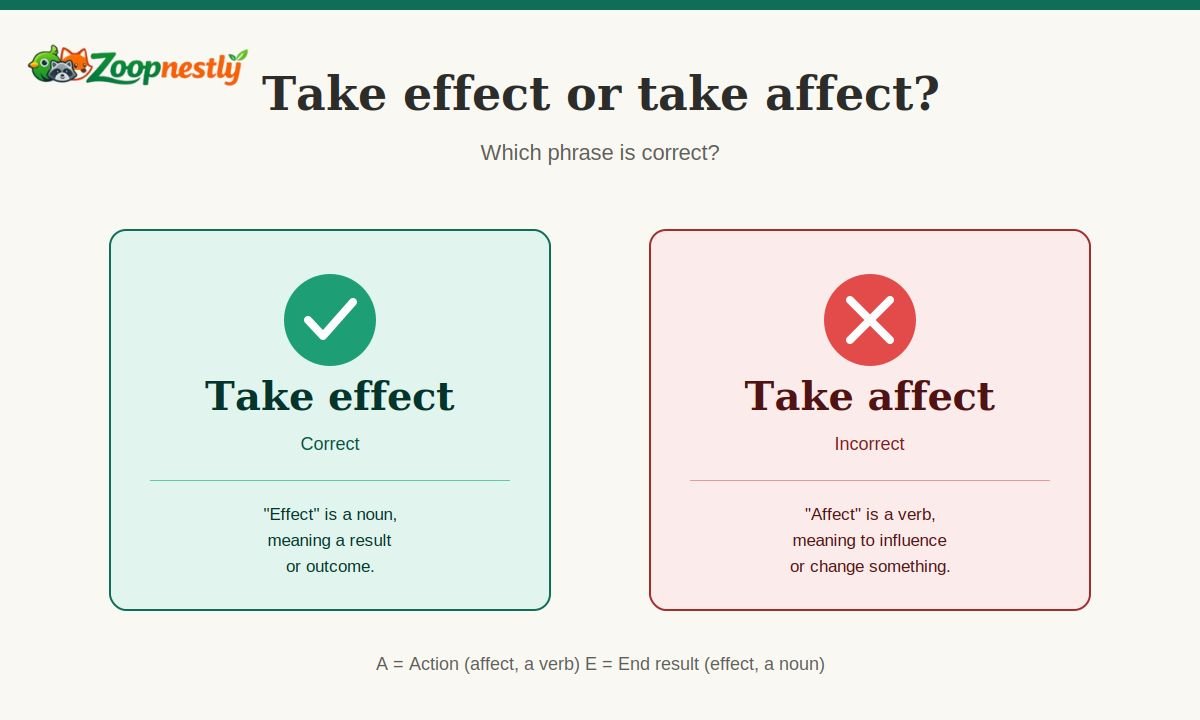
Take effect is the correct phrase. It means something begins to work or becomes official, like a law, rule, or medicine. Take affect is grammatically incorrect because “affect” is a verb meaning “to influence,” and it doesn’t fit this phrase. Use effect here, always as a noun.
What Is the Correct Phrase: Take Effect or Take Affect?
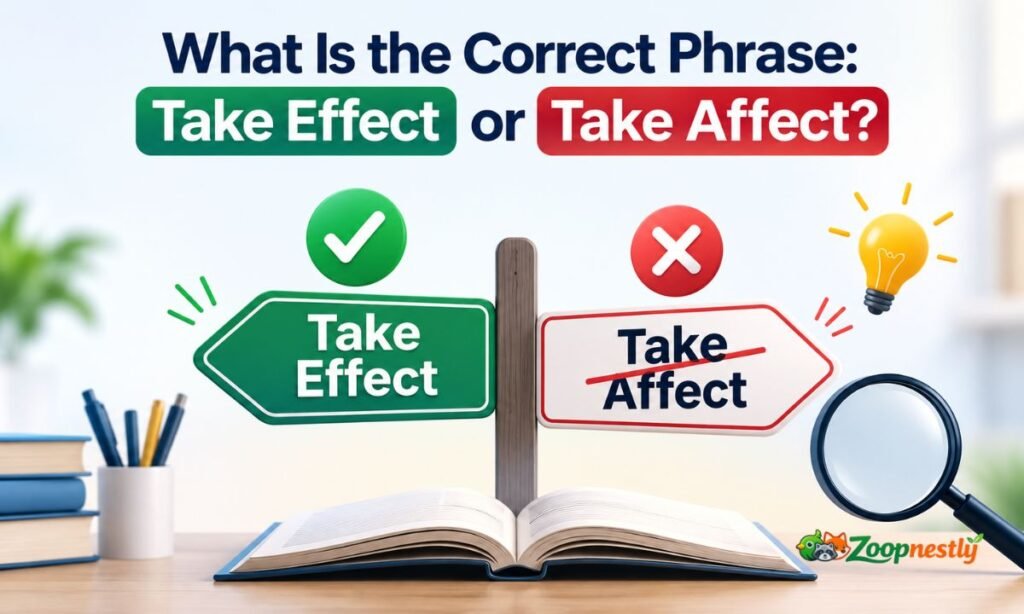
The correct phrase is always take effect, never “take affect.” This is a fixed expression, meaning the words always appear together in this exact order and can’t be swapped.
Take effect means:
- A law, rule, or policy becomes active
- A medicine or treatment starts working
- A change officially begins
Examples of “Take Effect”
- The new tax rules take effect on January 1.
- Her painkillers didn’t take effect for almost an hour.
- The updated dress code will take effect next Monday.
Is “Take Affect” Ever Correct?
No. “Take affect” is not a recognized phrase in standard English. It shows up as a common typo or mishearing, but no dictionary or style guide lists it as correct. If you see it in writing, it’s a mistake worth fixing.
Why “Effect” Belongs in This Phrase
The reason “take effect” works comes down to grammar. “Take” is a verb that needs a noun after it, and effect is that noun. It refers to the result or outcome of something starting to happen. “Affect,” on the other hand, is almost always a verb, so it can’t sit in that noun position after “take.”
Affect vs Effect: The Core Difference
Understanding the difference between these two words clears up almost every mistake people make with this phrase.
| Word | Part of Speech | Meaning | Example |
| Affect | Verb | To influence or change something | The weather can affect your mood. |
| Effect | Noun | A result or outcome | The medicine had a calming effect. |
Affect Meaning
Affect is a verb. It describes an action, something causing a change in something else.
Example: Loud noise can affect your concentration.
Effect Meaning
Effect is a noun. It names the result of that action.
Example: The loud noise had a noticeable effect on his concentration.
This is why “take effect” makes sense grammatically and “take affect” doesn’t. You’re taking a result (a noun), not performing an action (a verb).
Where You’ll See “Take Effect” in Real Life

This phrase shows up constantly across everyday and professional writing. Recognizing these contexts makes it easier to remember and use correctly.
Laws and Regulations
New legislation, city ordinances, or updated policies almost always use this phrase. Example: The parking regulation takes effect next week.
Medicine and Healthcare
Doctors, pharmacists, and patients use it to describe how long a treatment takes to work. Example: The anesthesia will take effect within minutes.
Business and Workplace Policies
HR announcements and internal memos rely on this phrase often. Example: The updated remote work policy takes effect on the first of next month.
Technology and Software
Settings, updates, and permissions changes commonly use it too. Example: Your new password settings will take effect after you restart the app.
Why Do People Confuse “Take Effect” and “Take Affect”?
A few simple reasons explain why this mistake happens so often.
- Similar pronunciation. “Affect” and “effect” sound nearly the same when spoken quickly, especially in casual conversation.
- Affect and effect are already confusing on their own. Many people mix up these two words even outside this phrase, since both relate to change and results.
- Autocorrect doesn’t always catch it. Since “affect” is a real word, spell checkers won’t flag it, even though it’s wrong in this context.
- Limited grammar exposure. Not everyone learned the noun/verb distinction between these two words in school, so the mistake feels natural rather than wrong.
DISCOVER MORE : In-Person vs In Person: A Complete Guide to Correct Usage
A Simple Trick to Remember the Rule
Here’s an easy way to lock this in permanently:
A is for Action (Affect = verb, an action that influences something). E is for End result (Effect = noun, the outcome).
Since “take” needs a noun, and effect is the noun version, effect is always your answer in this phrase. If you can replace the word with “result” or “outcome” and the sentence still makes sense, “effect” is correct.
Affect vs Effect in a Sentence: Side-by-Side Practice
Seeing both words used correctly in similar sentences helps the difference stick.
| Sentence | Correct Word | Why |
| The rumor didn’t ___ her decision. | Affect | Verb, describes influencing an action |
| The rumor had a small ___ on her decision. | Effect | Noun, describes the result |
| The rule will ___ next Friday. | Take effect | Fixed phrase, always uses “effect” |
| Cold weather can ___ your energy levels. | Affect | Verb, shows influence |
Common Mistakes to Avoid
Even confident writers slip up here sometimes. Watch for these three patterns.
Mistake 1: Writing “take affect.” This is grammatically incorrect in every context. There’s no exception.
Mistake 2: Using “affect” as a noun. “Affect” can technically function as a noun in psychology, referring to observable emotional expression, but this is rare and not what most writers mean. In everyday writing, treat “affect” strictly as a verb.
Mistake 3: Assuming both words are interchangeable. They aren’t. Mixing them randomly, even by accident, changes the meaning or grammar of your sentence.
A Quick Way to Check Your Writing
Before you hit send on an email or publish a document, try this two-second check: read the sentence aloud and ask if you’re describing an action or a result. Actions call for affect. Results call for effect. When in doubt, try substituting “impact” for the word in question. “Impact” works as both a verb and noun, so if it fits either way, test which version (affect or effect) matches your intended meaning.
Frequently Asked Questions
Is it “take effect” or “take affect” in formal writing?
It’s always take effect in formal writing. “Take affect” is considered a grammatical error and should never appear in professional, academic, or legal documents.
Can “affect” ever be used as a noun?
Yes, but only in a narrow psychological context, where it refers to a person’s visible emotional expression, such as a “flat affect.” Outside of clinical or academic writing, “affect” should be used as a verb.
What’s an easy way to remember the difference between affect and effect?
Remember: Affect = Action (verb), Effect = End result (noun). If you can swap the word with “impact” or “outcome,” use effect.
Does “take effect” always refer to laws or rules?
No. While it’s common in legal and policy writing, it also applies to medicine, technology settings, contracts, and any situation where something begins to function or apply.
Why does spell check not catch “take affect” as an error?
Spell checkers flag misspelled words, not grammar mistakes. Since “affect” is spelled correctly and is a real word, most spell checkers won’t recognize that it’s the wrong word choice in this specific phrase.
Conclusion
The rule is simple once you see it clearly: take effect is correct, and “take affect” is not. Effect works because it’s a noun describing a result, while affect is a verb describing an action. Whether you’re writing about a new law, a medication, or an updated company policy, remembering the A-for-action and E-for-end-result trick will keep your writing accurate every time.

James Walker is a content writer and language researcher with over 5 years of experience in meanings, definitions, and language-related topics. He enjoys simplifying complex terms into clear, easy-to-understand explanations. Through ZoopNestly.com, he helps readers find accurate and reliable information.