Mine As Well vs Might As Well vs Mind As Well: The Correct Usage Explained
You’re typing a text, you pause, and suddenly you’re not sure if it’s “might as well,” “mine as well,” or “mind as well.” It happens to almost everyone, because all three sound nearly identical when spoken out loud. Getting it wrong in an email or essay can make your writing look careless. The good news: only one of these is standard English, and once you learn the reason why, you’ll never second-guess it again.
Quick Answer
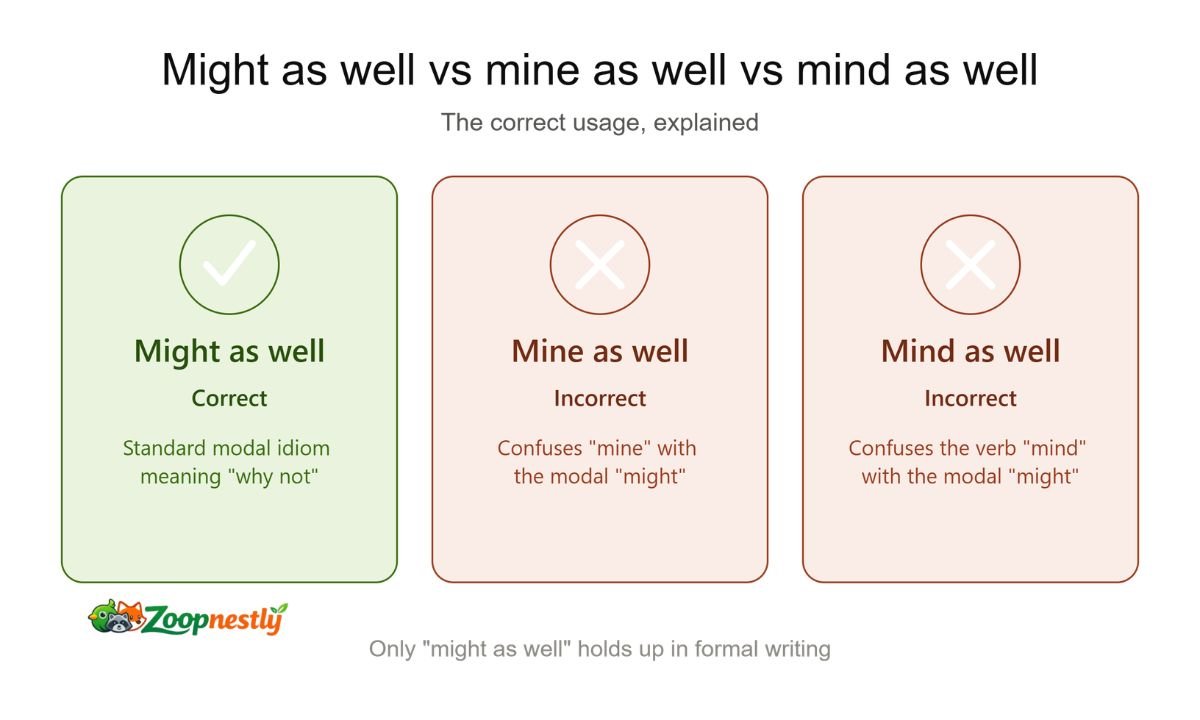
Might as well is the only grammatically correct phrase of the three. It’s a modal idiom meaning there’s no good reason not to do something, or that an action is a reasonable choice given the circumstances. Mine as well and mind as well are both mishearings of “might as well” and are considered nonstandard in formal writing.
What Does “Might As Well” Actually Mean?
“Might as well” is an idiomatic expression built from the modal verb might plus as well. It signals that, given the situation, one option is just as reasonable (or the only sensible one) as any other.
You’ll typically see it used two ways:
- Suggesting a low-stakes decision: “We’re already here, so we might as well look around.”
- Expressing mild resignation: “The bus is late anyway, so I might as well sit down.”
In both cases, the phrase carries a sense of “there’s nothing better to do” or “why not.”
Is “Mine As Well” Ever Correct?
No. “Mine as well” is not a recognized phrase in standard English grammar. Mine is a possessive pronoun (as in “this book is mine”), and it doesn’t logically combine with “as well” to express the same meaning as “might as well.”
This mix-up almost always comes from mishearing the contracted sound of “might” in fast speech, where “might as well” can come out sounding like “mine as well.” It’s an easy phrase to mishear, but it should not appear in writing.
Incorrect: I’m mine as well go to the store. Correct: I might as well go to the store.
Why “Mind As Well” Is a Common Mistake
“Mind as well” is another mishearing, and it’s actually more common than “mine as well” because “mind” is a real English word with its own separate meaning (to care about something, or to be careful).
That overlap makes the error sneak past spell checkers, since “mind” is spelled correctly, just used incorrectly here.
Incorrect: You mind as well finish your homework now. Correct: You might as well finish your homework now.
Linguists sometimes call this kind of substitution an eggcorn, a mishearing that gets reused because it still sort of makes sense to the listener, even though it isn’t the original phrase.
Might As Well vs Mine As Well vs Mind As Well: Quick Comparison
| Phrase | Grammatically Correct? | Why |
| Might as well | Yes | Standard modal idiom meaning “there’s no reason not to” |
| Mine as well | No | Confuses possessive pronoun “mine” with modal verb “might” |
| Mind as well | No | Confuses verb “mind” with modal verb “might” |
How to Use “Might As Well” in a Sentence
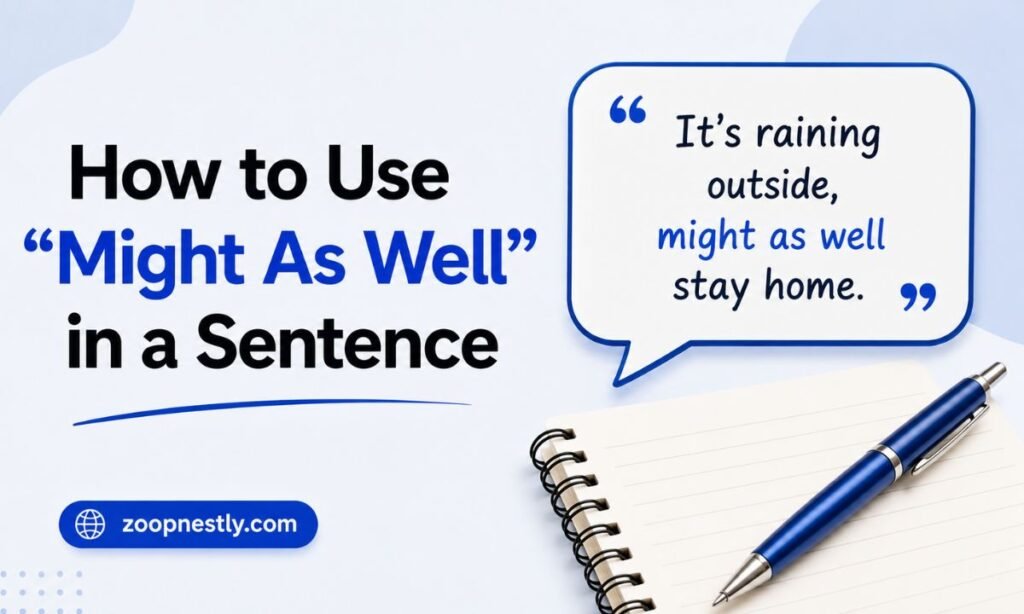
The phrase almost always follows this pattern:
Subject + might as well + base verb (+ result or reason)
- “You might as well try the new restaurant while you’re in town.”
- “Since it’s raining, we might as well stay in and watch a movie.”
- “If you’re going to complain either way, you might as well say something useful.”
Notice the verb after “might as well” stays in its base form, not the past tense or “-ing” form. That’s a small detail people often get wrong even after they’ve fixed the “might” versus “mind” mix-up.
Real-World Example Sentences
Seeing the phrase in different contexts makes it easier to remember correctly.
- At work: “The meeting’s already running long, so we might as well finish the last agenda item.”
- In a text message: “You’re already at the mall, so you might as well grab my package too.”
- In dialogue: “‘I guess I might as well tell you the truth,’ she said.”
- In writing advice: “If you’re revising the whole paragraph, you might as well rewrite the topic sentence too.”
Common Mistakes to Avoid
Beyond swapping “might” for “mine” or “mind,” a few other errors show up regularly.
- Wrong verb form: “I might as well going home” should be “I might as well go home.”
- Dropping “as”: Writing “might well” instead of “might as well” changes the meaning entirely.
- Overusing the idiom: Using “might as well” in every other sentence can make writing sound repetitive or unmotivated. Save it for moments where the “why not” tone genuinely fits.
- Ignoring context in dialogue: If you’re writing a character who deliberately mispronounces words, “mind as well” can work as stylized speech, but it should be a clear creative choice, not an accidental error.
Why This Confusion Happens So Often
The root cause is simple: spoken English often blurs word boundaries. When people say “might as well” quickly, the “t” sound in “might” softens, and the phrase can sound like “mine as well” or “mind as well” depending on regional accent and speaking speed.
This is why the mistake shows up so frequently in texting, social media, and casual writing, even among fluent English speakers. Hearing a phrase incorrectly for years, without ever seeing it written down, naturally leads to spelling it the way it sounds.
DISCOVER MORE : Input or Imput? Learn the Correct Spelling and Usage
American vs British English: Any Differences?
The good news is that “might as well” is used the same way in both American and British English. There’s no regional version that makes “mine as well” or “mind as well” acceptable.
One small stylistic difference: British English speakers occasionally favor “may as well” in more formal contexts, while American English leans slightly more toward “might as well” in everyday speech. Both are correct in either dialect, but “mine as well” and “mind as well” remain incorrect everywhere.
Might As Well vs May As Well: What’s the Difference?
“May as well” and “might as well” mean essentially the same thing and can usually be swapped without changing the sentence’s meaning.
- “We may as well leave now.”
- “We might as well leave now.”
“Might as well” is slightly more common in casual American speech, while “may as well” can sound a touch more formal or polite. Either one is grammatically correct, unlike “mine” or “mind.”
Quick Tips to Remember the Correct Phrase
- Say the sentence slowly. “Might” contains the word “might,” which relates to possibility and reasonable choice, matching the idiom’s meaning.
- Test with a synonym. Replace the phrase with “there’s no reason not to.” If the sentence still makes sense, “might as well” is the phrase you want.
- Remember the spelling link. “Might” and “might as well” share the same root idea of possibility, which “mine” and “mind” don’t.
- Read before you send. A quick proofread catches this error more reliably than a spell checker, since “mind” and “mine” are both real words.
Frequently Asked Questions
Is “mind as well” a real phrase?
No. “Mind as well” is a common mishearing of “might as well” and is not considered correct in standard English grammar, even though “mind” is a real word on its own.
Is “mine as well” grammatically correct?
No. “Mine as well” is not a standard phrase. It comes from mishearing the modal verb “might” as the possessive pronoun “mine.” The correct phrase is always “might as well.”
What does “might as well” mean in a sentence?
It means an action is a reasonable choice given the current situation, often because there’s no better alternative or no real downside to doing it. For example, “Since we’re early, we might as well grab coffee.”
Can “might as well” and “may as well” be used interchangeably?
Yes. Both phrases carry the same meaning, and either is grammatically correct in American and British English. “Might as well” is slightly more common in casual speech.
Why do people confuse “might,” “mine,” and “mind” as well?
The confusion happens because “might as well” sounds similar to “mine as well” and “mind as well” when spoken quickly. This kind of mishearing that sticks around is sometimes called an eggcorn.
Conclusion
Only “might as well” is grammatically correct. “Mine as well” and “mind as well” are common mishearings that don’t hold up in formal writing, even though they’re easy mistakes to make when you’re going by ear. The next time you hesitate over which version to use, remember the simple test: if the sentence means “there’s no reason not to,” “might as well” is always the right choice.

James Walker is a content writer and language researcher with over 5 years of experience in meanings, definitions, and language-related topics. He enjoys simplifying complex terms into clear, easy-to-understand explanations. Through ZoopNestly.com, he helps readers find accurate and reliable information.