Parent’s or Parents’? Learn the Correct Meaning and Usage
You’re typing a permission slip, a school email, or a birthday card, and suddenly you freeze. Is it your parent’s signature or your parents’ signature? One tiny apostrophe can change the whole meaning of a sentence, and getting it wrong makes even confident writers look careless.
This guide clears up the confusion around parent’s or parents’ for good, with simple rules and real examples you can apply right away.
Quick Answer
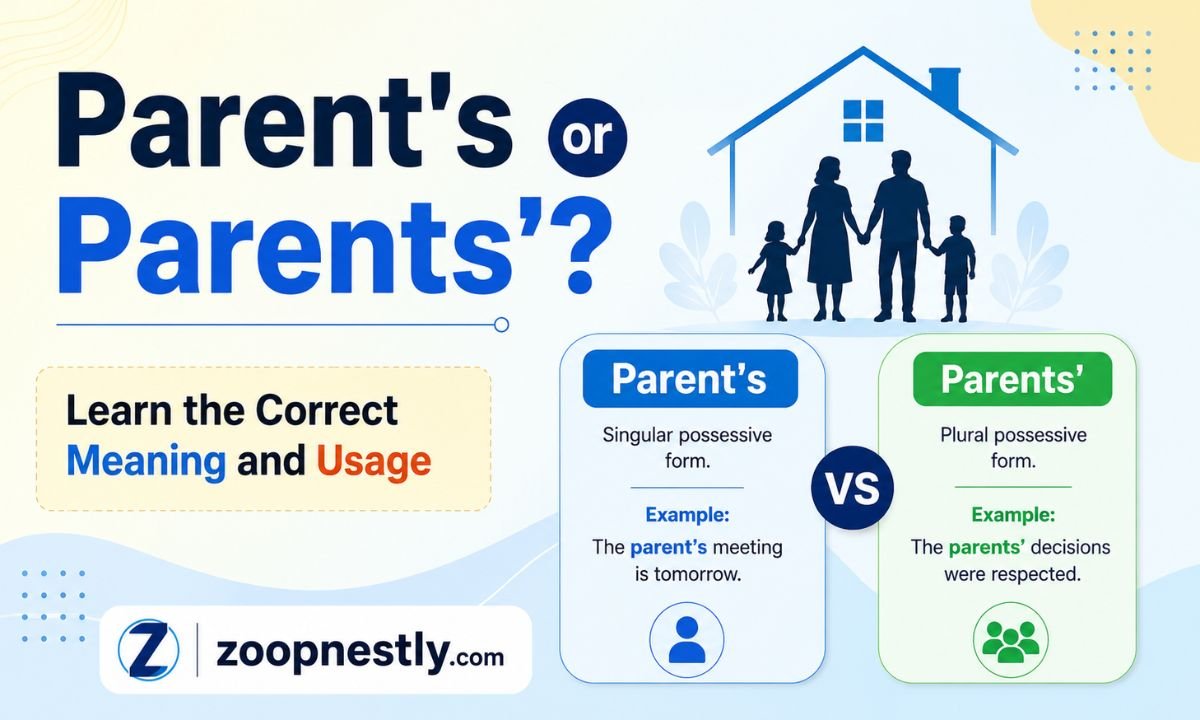
Parent’s (with the apostrophe before the “s”) means something belongs to one parent. Parents’ (apostrophe after the “s”) means something belongs to two or more parents. Parents (no apostrophe at all) is simply the plural word for more than one parent, showing no ownership. The apostrophe only shows up when you’re talking about possession, not plurality.
Parents, Parent’s, and Parents’: What Each One Actually Means
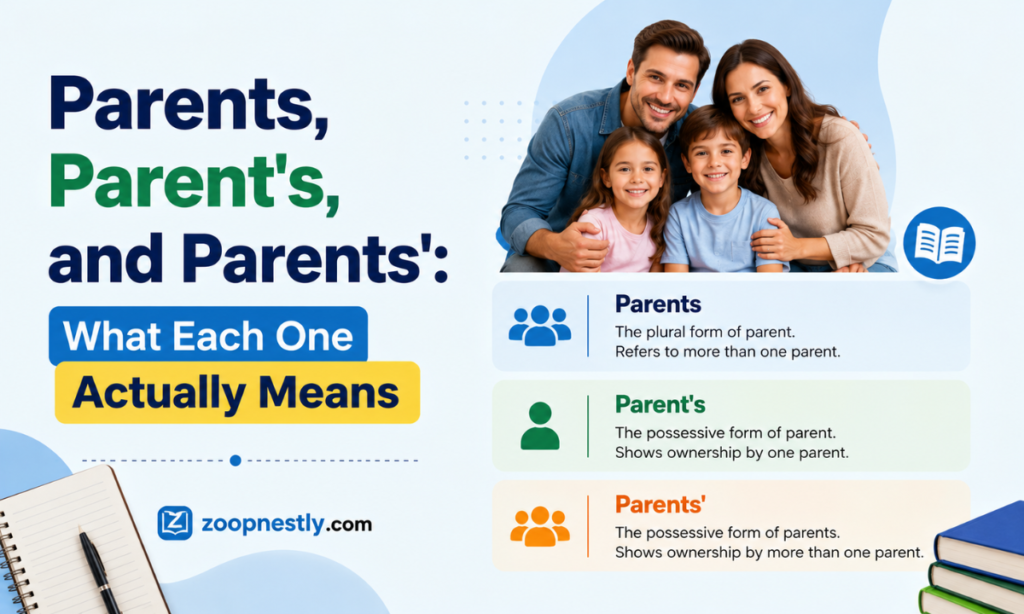
These three words look almost identical, but they do very different jobs in a sentence.
- Parents is a plain plural noun. It just means more than one parent. Example: My parents are visiting this weekend.
- Parent’s is a singular possessive. It shows that one parent owns or is connected to something. Example: My parent’s car is parked outside.
- Parents’ is a plural possessive. It shows that two or more parents own or are connected to something. Example: My parents’ car is parked outside.
The trick is remembering that plain “parents” never gets an apostrophe. The apostrophe only appears when you’re showing possession.
The Simple Rule Behind the Apostrophe
English possessives follow a consistent pattern, and once you see it, this stops being confusing.
- For a singular noun, add an apostrophe plus “s”: parent → parent’s.
- For a plural noun that already ends in “s,” just add an apostrophe after the “s”: parents → parents’.
- For a plural noun that does not end in “s” (like children), add an apostrophe plus “s”: children → children’s.
So the question isn’t really about parents specifically. It’s about whether you’re describing one person or more than one, and whether that person owns something.
Example Sentences That Show the Difference
Seeing the words in context makes the rule click faster than any explanation.
- A parent’s job is never really finished. (one parent)
- Parents’ evenings are held twice a year at the school. (multiple parents)
- The teacher asked for a parent’s signature on the form. (one signature, one parent)
- The committee reviewed the parents’ concerns about the new schedule. (concerns belonging to several parents)
- Both parents attended the meeting. (plain plural, no ownership, no apostrophe)
Notice that the meaning of the sentence, not the spelling of “parent,” decides which form you need.
Comparison Table: Parent’s vs Parents’ vs Parents
| Form | Meaning | Apostrophe Placement | Example |
| Parents | More than one parent (no ownership) | None | Both parents signed the report. |
| Parent’s | Belongs to one parent | Before the “s” | The parent’s phone number is on file. |
| Parents’ | Belongs to two or more parents | After the “s” | The parents’ phone numbers are on file. |
A Quick Test to Decide Which Form You Need
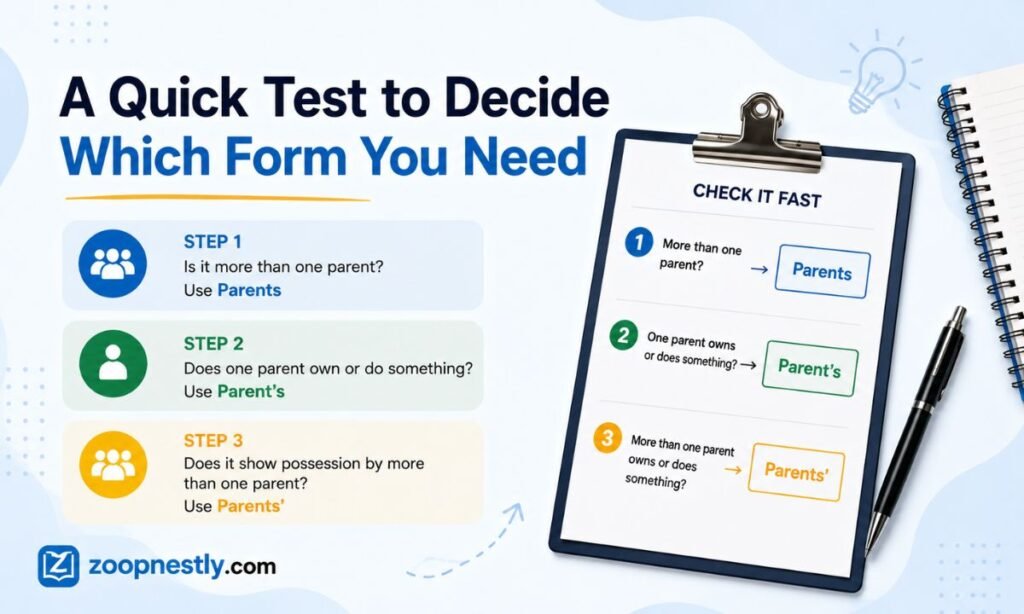
Before you type the sentence, ask yourself two questions:
- Does the word show ownership? If not, you just need “parents,” no apostrophe.
- Is it one parent or more than one? One parent gets the apostrophe before the “s.” More than one gets it after.
If you can rewrite the sentence using “of the parent” or “of the parents” and it still makes sense, you’re dealing with possession, and you need an apostrophe somewhere.
Common Mistakes People Make
Even experienced writers slip up here. Here are the errors that show up most often.
Mistake 1: Using “parents” when you mean possession. Wrong: The parents car broke down. Right: The parents’ car broke down.
Mistake 2: Adding an apostrophe when there’s no ownership at all. Wrong: My parent’s are coming over. Right: My parents are coming over.
Mistake 3: Using “parent’s” for more than one parent. Wrong: Both parent’s signatures are required. Right: Both parents’ signatures are required.
Mistake 4: Placing the apostrophe in the wrong spot for a single parent. Wrong: A parents’ consent is needed for the trip. Right: A parent’s consent is needed for the trip.
Mistake 5: Writing “parents’s,” which isn’t a real form in English. Wrong: The parents’s meeting was rescheduled. Right: The parents’ meeting was rescheduled.
Reading the sentence out loud usually helps you catch the mistake, since the apostrophe doesn’t change how the word sounds, only how it’s written.
DISCOVER MORE : Good Morning or Goodmorning: Common Mistake and Correct Usage Guide
Does British English Handle This Differently?
The good news is that this rule doesn’t change across English dialects. American, British, Australian, and Canadian English all follow the same apostrophe logic for singular and plural possessives. There’s no regional spelling variation here like there is with words such as “color” versus “colour.” What does shift by region is the phrase people use, such as “parents’ evening” being more common in the UK and “parent-teacher conference” being more common in the US, but the possessive rule itself stays the same worldwide.
How This Shows Up in Everyday Phrases
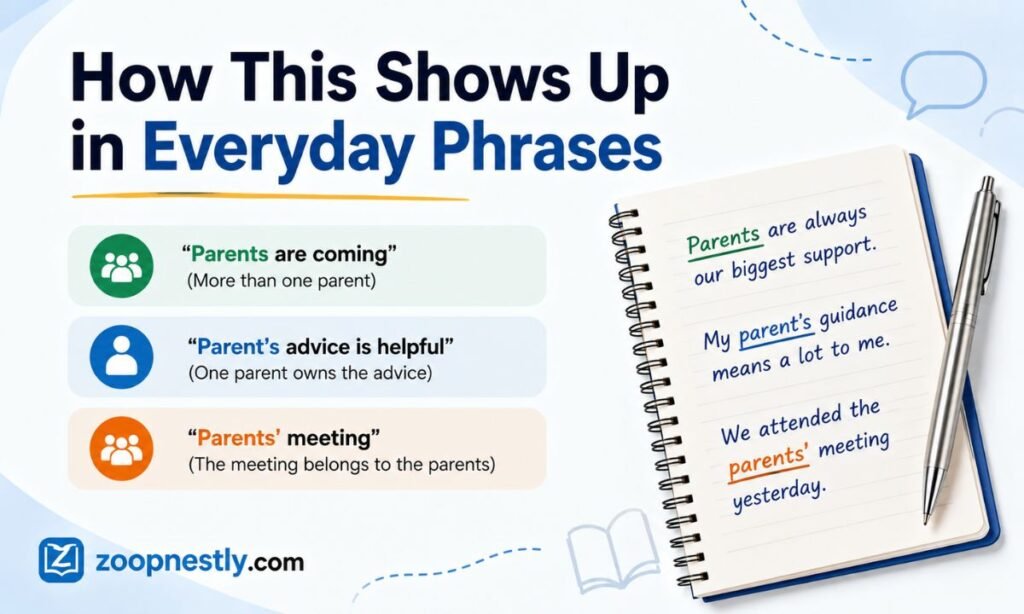
You’ll run into this choice constantly in real life, so it helps to see it in the phrases people actually search for and write.
“Parent’s meeting” or “parents’ meeting”: If the meeting is for multiple parents, which is almost always the case, “parents’ meeting” is correct. A school rarely holds a meeting for just one parent unless the context makes that clear.
“Parent’s consent” or “parents’ consent”: This depends entirely on how many parents are involved. A single-parent household would use “parent’s consent,” while a form requiring both parents would use “parents’ consent.”
“Parent’s evening” or “parents’ evening”: Since this event involves many families and many parents, “parents’ evening” is the standard form in British schools.
Forms and legal documents: Official paperwork often says “parent(s)’ signature” to cover both possibilities at once. This isn’t a grammar rule exactly, but a practical shortcut used when the number of parents involved is unknown.
Why This Word Trips People Up
Part of the confusion comes from the fact that “parents” already ends in “s” before you even add a possessive marker. Our brains expect an apostrophe plus “s” for possession, the way we’d write “dog’s” or “cat’s.” But once a word is already plural and ends in “s,” English drops the extra “s” and just tacks on the apostrophe. Words like “boys,” “teachers,” and “parents” all follow this same pattern, so once you learn it for one, you’ve learned it for all of them.
A Simple Way to Remember It for Good
Think of the apostrophe as a marker that comes right after whichever word already shows how many parents you mean.
- One parent: parent + ‘s = parent’s
- More than one parent: parents + ‘ = parents’
- No ownership at all: just parents
If you keep that order in mind, “count first, then add the apostrophe,” you’ll rarely get it wrong again.
Frequently Asked Questions
Is it “parent’s” or “parents'” for one child with two parents?
It depends on what you’re describing. If something belongs to both parents together, such as their shared address, use “parents’.” If you’re referring to just one of them, such as one parent’s phone number, use “parent’s.”
What is the plural possessive of parent?
The plural possessive of “parent” is “parents’.” You take the plural form “parents,” which already ends in “s,” and simply add an apostrophe after it.
Is “parents” ever correct without an apostrophe?
Yes. “Parents” without an apostrophe is correct whenever you’re not showing ownership. For example, “My parents work in healthcare” needs no apostrophe because nothing is being possessed.
How do you write parent-teacher meeting correctly?
“Parent-teacher meeting” is typically hyphenated and doesn’t need an apostrophe at all, since “parent” and “teacher” are functioning as descriptive words rather than possessives in that phrase.
What if I don’t know how many parents are involved?
On forms or general writing where the number of parents is unclear, many writers use “parent(s)’ signature” to cover both a single parent and multiple parents in one line.
Conclusion
The choice between parent’s, parents’, and plain parents comes down to two quick checks: are you showing ownership, and how many parents are involved? Once you apply that two-step test, the apostrophe stops being a guessing game. Keep this guide handy the next time you’re filling out a form or writing a note home, and you’ll place that apostrophe correctly every time.

James Walker is a content writer and language researcher with over 5 years of experience in meanings, definitions, and language-related topics. He enjoys simplifying complex terms into clear, easy-to-understand explanations. Through ZoopNestly.com, he helps readers find accurate and reliable information.