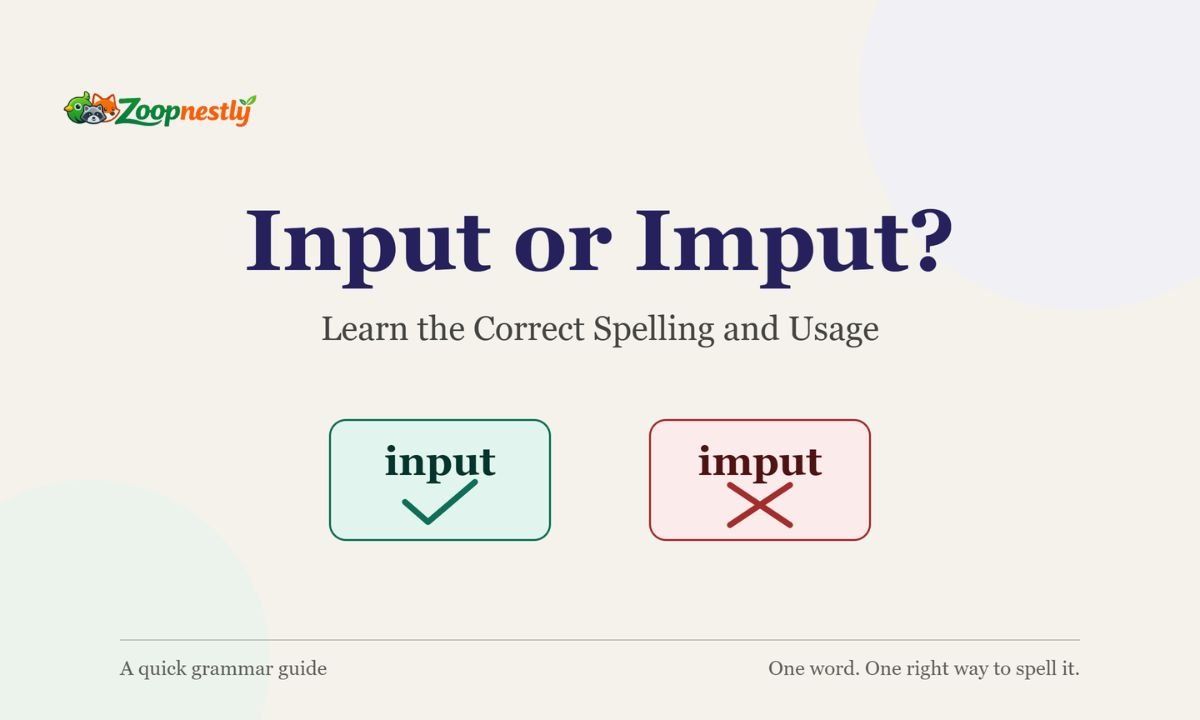
Input or Imput? Learn the Correct Spelling and Usage
You’re typing an email, your fingers move faster than your brain, and suddenly there it is: “imput.” It looks almost right. It sounds almost right. But something feels off, and now you’re second-guessing a word you’ve used a thousand times. This mix-up around input vs imput trips up more writers than you’d expect, and the fix is simpler than the confusion suggests.
Quick Answer
Input is the only correct spelling in standard English. Imput is not a real word, it’s simply a common misspelling caused by a typing slip or a mishearing of the “n” sound. Whenever you mean data, feedback, or something entered into a system, input is the word you want, every single time.
What “Input” Actually Means

At its core, input refers to something put into a system, process, or conversation. It can be a noun or a verb, and that flexibility is part of why it shows up everywhere from tech manuals to team meetings.
As a noun, input means the information, data, or resources fed into something:
- “The software needs more input before it can generate a report.”
- “Thanks for your input on the marketing plan.”
As a verb, input means the act of entering or supplying something:
- “Please input your password to continue.”
- “She input the sales figures into the spreadsheet.”
Both uses are grammatically correct and appear constantly in professional, academic, and everyday writing.
Why “Imput” Feels Right (Even Though It Isn’t)
Nobody sits down and decides to invent a new word. “Imput” happens by accident, and there’s a real linguistic reason behind it.
When you say “input” out loud, the “n” often blends into the following “p” sound. Try saying it quickly: the “n” naturally shifts toward an “m” sound because both “m” and “p” are made with your lips. This is a completely normal process in spoken language called assimilation. The problem is that English spelling doesn’t always follow pronunciation shortcuts, so what sounds like “imput” still gets written as input.
Add in fast typing, autocorrect gaps, and muscle memory, and it’s easy to see why this typo slips through so often, even in otherwise polished writing.
Is “Imput” a Word in Any Dictionary?
No. Imput does not appear as a standard entry in Merriam-Webster, Oxford, Cambridge, or any other major English dictionary. It has no accepted definition, no grammatical function, and no recognized usage in formal or informal English. If you see it in a document, it’s a spelling error, not an alternate form of the word.
This matters for anyone writing professionally. A single “imput” in a resume, report, or email can read as careless, even if the rest of the writing is strong.
Input vs Imput: Side-by-Side Comparison
| Feature | Input | Imput |
| Correct spelling | Yes | No |
| Found in dictionaries | Yes | No |
| Part of speech | Noun, verb | None (not a word) |
| Common usage | Technology, business, academia, daily conversation | Typo or mispronunciation only |
| Example sentence | “Your input helped us finalize the design.” | Not applicable |
Where “Input” Comes From

The word input entered English in the 1400s as a compound of “in” and “put,” originally used to describe something literally put into a place. Its modern, more technical meaning, especially the sense tied to data and computing, became widespread in the 20th century as electronics and computer science expanded. That’s why today “input” feels so closely linked to keyboards, forms, and systems, even though its roots are much older and more general.
Understanding this history helps explain why the word is built the way it is: “in” plus “put” makes logical sense, while “im” plus “put” does not follow any real word-formation pattern in English.
DISCOVER MORE : Ingage vs Engage: Which Spelling Is Actually Correct?
How to Use “Input” Correctly in a Sentence
Getting comfortable with input is easier when you see it across different contexts. Here are a few natural examples:
- Business: “We’re gathering input from every department before finalizing the budget.”
- Technology: “The system requires manual input for each new user.”
- Academic: “Peer input improved the clarity of the final draft.”
- Everyday conversation: “I’d love your input on which restaurant to pick.”
Notice that in every case, “input” refers to something contributed or entered, never something removed or output.
Input vs Output: A Related Distinction Worth Knowing
Since input often gets discussed alongside its natural counterpart, it helps to clarify the difference:
- Input is what goes into a process.
- Output is what comes out of it.
For example, in a computer system, typing on a keyboard is input, while the text appearing on the screen is output. Keeping this pair straight also reinforces why “input” is spelled with “in,” since it mirrors the logical opposite of “out.”
Common Mistakes Beyond “Imput”
“Imput” isn’t the only slip people make with this word. A few other patterns show up regularly:
- Inputt or inputed: extra letters added by mistake, especially in past-tense forms. The correct past tense is “input” or “inputted,” depending on style guide preference, never “inputed.”
- In put (as two words): incorrect, since it’s a single compound word.
- Imputted: a doubled-down version of the original typo, combining two errors at once.
If you’re ever unsure, a quick trick is to say the word slowly and picture the two parts: “in” and “put.” That mental split usually keeps the spelling on track.
A Note on “Impute,” a Real but Different Word

Here’s something most guides skip. There is a real English word that looks similar to “imput,” and that’s impute. It means to attribute something, often a fault or quality, to someone, as in “They imputed bad motives to her decision.” This word is legitimate, but it has a completely different meaning from input and is not interchangeable with it. Confusing the two can quietly change the meaning of a sentence, so it’s worth knowing they’re unrelated despite the similar look.
Quick Ways to Remember the Correct Spelling
A few simple habits can help lock in the correct spelling for good:
- Break the word into its two parts: in + put.
- Remember that “output” is spelled with “out,” so its partner word should logically start with “in,” not “im.”
- Read the word slowly instead of relying on how it sounds when spoken quickly.
- Use your word processor’s spell check as a backup, not a first line of defense, since some tools miss less common typos.
Frequently Asked Questions
Is “imput” ever correct in any context?
No. Imput is not a recognized word in any variety of English, formal or informal. In every case, the correct word is input.
Why do I keep typing “imput” by accident?
This usually happens because of how the word sounds when spoken quickly. The “n” sound naturally shifts toward an “m” sound before the “p,” a common effect in spoken language, even though the correct spelling keeps the “n.”
Is “input” a noun, a verb, or both?
Input works as both a noun and a verb. As a noun, it refers to information or data entered into something. As a verb, it describes the act of entering that information.
What is the plural form of “input”?
The plural is inputs, used when referring to multiple pieces of information or contributions, as in “The report combines inputs from three different teams.”
Is there a British English version of “imput”?
No. Input is spelled the same way in both American and British English. There is no regional variation that makes “imput” acceptable anywhere.
Final Thoughts
The choice between input vs imput isn’t really a close call. Input is the correct, dictionary-recognized word, while imput is simply a slip that happens when speech and spelling don’t quite line up. Once you understand where the confusion comes from, and remember the simple “in” plus “put” structure, this typo becomes an easy one to catch and correct for good.

James Walker is a content writer and language researcher with over 5 years of experience in meanings, definitions, and language-related topics. He enjoys simplifying complex terms into clear, easy-to-understand explanations. Through ZoopNestly.com, he helps readers find accurate and reliable information.