Its Self or Itself: The Simple Grammar Rule You Need to Know
You typed a sentence, paused, and stared at one word. Should it be “its self” or “itself”? You’re not imagining things. This mix-up trips up even confident writers because the two forms look almost identical but mean completely different things. Get it wrong in an email or an essay and it reads as a careless typo. The good news: its self or itself has one clear answer, and once you see the logic, you’ll never second-guess it again.
Quick Answer
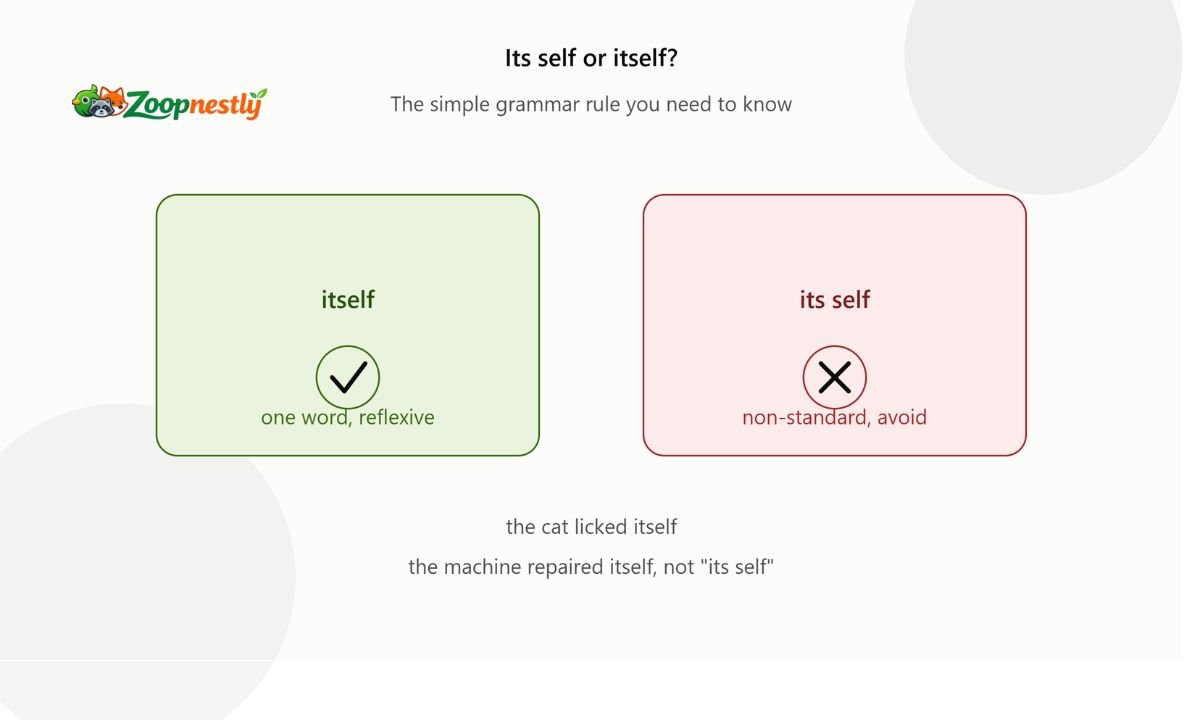
Itself is the correct word almost every time. It’s one reflexive pronoun, no apostrophe, no space. Its self (two words) is not standard English and should be avoided in normal writing. The only time “self” stands alone as a noun after “its” is in specialized psychology or philosophy contexts, and that’s rare.
What Does “Itself” Mean?
Itself is a reflexive pronoun. It refers back to a non-human subject, like an object, animal, idea, or system, showing that the subject is acting on or affecting itself.
Think of it as the non-human version of “himself” or “herself.” Just as a man might hurt himself, a machine might shut itself down.
Example: The dog scratched itself. Example: The company reorganized itself after the merger.
There’s no possessive apostrophe here because “itself” isn’t showing ownership. It’s showing that the action loops back to the subject.
Is “Its Self” Ever Correct?
Almost never in everyday writing. “Its self” splits the possessive pronoun its from the noun self, treating “self” as a standalone thing being possessed, like “its self was fragile.”
This construction shows up occasionally in academic psychology or philosophy, where writers discuss “the self” as a concept: The organization’s sense of its self changed over time. Even then, most editors would rewrite this as “its identity” or “its own identity” for clarity, since “its self” reads awkwardly to most readers.
For 99% of writing situations, including emails, blog posts, reports, and casual text, itself is the word you want.
Its vs Itself vs It’s: A Quick Comparison
These three look similar but serve completely different jobs. Here’s a side-by-side breakdown.
| Word | Type | Function | Example |
| Its | Possessive pronoun | Shows ownership | The cat licked its paw. |
| Itself | Reflexive pronoun | Subject acts on itself | The cat cleaned itself. |
| It’s | Contraction | Short for “it is” or “it has” | It’s raining outside. |
| Its self | Non-standard phrase | Rarely correct; splits possessive from noun | Avoid in most writing. |
A simple test: if you can replace the word with “it is” or “it has” and the sentence still makes sense, you need it’s. If you’re describing ownership, use its. If the subject is doing something to itself, use itself.
How to Use “Itself” Correctly
“Itself” shows up in a few common grammatical patterns. Recognizing them makes correct usage automatic.
Simple Reflexive Use
The subject performs an action that affects itself directly. The heater turns itself off after an hour.
Emphatic Use
“Itself” adds emphasis to highlight that something happened without outside help, often paired with “by.” The problem solved itself.
Predicate Position
“Itself” appears after a linking verb to restate or emphasize the subject. The city itself was quiet, even though the suburbs were busy.
Appositive Placement
“Itself” can sit right next to the noun it emphasizes, adding weight without changing meaning. Nature itself seems to reward patience.
Each of these patterns uses one word: itself. None of them ever call for “its self.”
Itself in a Sentence: Real World Examples
Seeing the word in varied contexts helps the rule stick.
- The software updates itself automatically every week.
- The building itself survived the storm, though the roof took damage.
- The idea proved itself wrong within a year.
- The engine cooled itself down using a new fan design.
- History repeats itself more often than people expect.
Notice that “itself” never needs an apostrophe or a space. It functions as one complete word in every case above.
Common Mistakes to Avoid
Even careful writers slip on this one. Here are the patterns to watch for.
Writing “its self” instead of “itself.” This is the most frequent error, usually from confusing it with phrases like “himself” (which stays one word) or overthinking the possessive form.
Confusing “its” and “it’s.” Remember: “it’s” always means “it is” or “it has.” If neither fits, drop the apostrophe.
Dropping “own” when emphasis is needed. If you mean to stress ownership, the correct phrase is “its own,” not “its self.” The team built its own tool is correct. The team built its self a tool is not.
Using “himself” or “herself” for objects or animals. Non-human subjects take “itself,” even in casual speech. A robot doesn’t fix “himself”; it fixes itself.
Adding unnecessary possessives before reflexives. Sentences like “the machine cleaned its itself” duplicate meaning. One reflexive pronoun is enough.
Overcorrecting in formal writing. Some writers try to sound more “proper” by inserting “self” as a separate word, assuming it looks more formal. It doesn’t. It looks like an error.
DISCOVER MORE :
Sais vs Says: What’s the Difference and Which Is Right?
American vs British English: Any Differences?
The core rule is identical in American and British English. Both dialects treat itself as one word and reserve its self for rare, specialized contexts.
Where style can differ slightly is emphasis. British academic writing sometimes leans on constructions like “the thing in itself,” borrowed from philosophy (notably Kant’s concept of “the thing-in-itself”), which is hyphenated as a set phrase rather than split into “its self.” American writing tends to favor simpler, more direct reflexive use without borrowing philosophical phrasing. Either way, the spelling rule doesn’t change based on region.
Idiomatic Expressions With “Itself”
English has several set phrases built around “itself” that are worth knowing, since they show up often in writing and speech.
- “In itself” — meaning “by its own nature.” The delay wasn’t a problem in itself.
- “By itself” — meaning “alone” or “without help.” The plant grew by itself, with no fertilizer.
- “Speaks for itself” — meaning something is obvious without explanation. The data speaks for itself.
- “The thing itself” — used in philosophy to distinguish an object’s true nature from perception of it.
These idioms reinforce that “itself” behaves as a fixed, single word across contexts, formal or casual.
Its Own vs Itself: When to Use Which
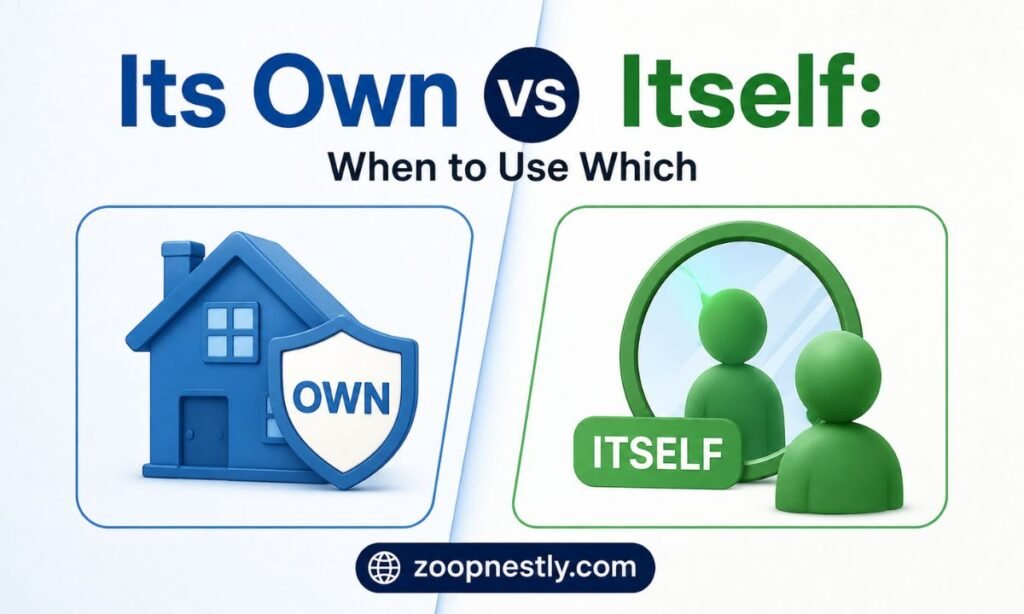
This distinction trips people up because both involve the word “its.” Use itself when the subject is acting on or referring back to itself directly. Use its own when you’re emphasizing possession or independence.
The city cleaned itself up after the flood. (reflexive action) The city has its own recovery plan. (possession/independence)
If you’re tempted to write “its self,” check whether you actually mean “its own” instead. Nine times out of ten, that’s the fix.
Practical Tips for Getting It Right Every Time
- Default to “itself.” In nearly all writing, this one word is correct.
- Never add a space. “Its self” as two words is not standard.
- Use “its own” for possession or emphasis, not “its self.”
- Read the sentence aloud. If it sounds like you’re describing ownership of a “self,” you likely need “its own,” not “its self.”
- Check apostrophes separately. “It’s” only means “it is” or “it has,” never possession or reflexive action.
- Let grammar tools help, but understand the rule yourself. Spell checkers catch typos, but knowing the logic prevents repeat mistakes.
- When teaching this rule to others, keep it simple: one word, no apostrophe, means the subject acts on itself.
Frequently Asked Questions
Is “its self” grammatically correct?
Rarely. “Its self” is only used in niche academic contexts discussing “the self” as a concept. In everyday writing, itself is always the correct choice.
What is the difference between “itself” and “its own”?
Itself shows a subject acting on or referring back to itself. Its own emphasizes possession or independence. The machine repaired itself versus the machine has its own repair system.
Why do people confuse “its” and “itself”?
Both start with “its,” and English possessive pronouns can look similar to reflexive ones. The key difference is function: “its” shows ownership, while “itself” shows the subject acting on itself.
Does “itself” ever need an apostrophe?
No. “Itself” never takes an apostrophe. Apostrophes only belong in “it’s,” which is short for “it is” or “it has.”
Can “itself” be used at the start of a sentence?
It’s uncommon but not incorrect in certain emphatic or philosophical writing, such as “Itself a mystery, the phenomenon puzzled scientists for decades.” In everyday writing, it’s clearer to keep “itself” later in the sentence.
Conclusion
The rule behind its self or itself comes down to one simple fact: itself is one word, and it almost always the correct choice. “Its self” only appears in rare academic writing about identity or philosophy, and even then, clearer alternatives usually work better. Keep “its” for possession, “it’s” for contractions, and “itself” for anything reflexive, and you’ll never trip over this pair again.

James Walker is a content writer and language researcher with over 5 years of experience in meanings, definitions, and language-related topics. He enjoys simplifying complex terms into clear, easy-to-understand explanations. Through ZoopNestly.com, he helps readers find accurate and reliable information.