Is Used vs Has Been Used vs Was Used: What’s the Difference?
You write a sentence, pause, and suddenly three verb forms are fighting for the same spot. Should it be is used, has been used, or was used? Pick the wrong one and your meaning shifts without you noticing, a habit turns into a one time event, or a finished action sounds like it’s still happening. The good news: is used vs has been used vs was used comes down to one simple question about timing, and once you see the pattern, the confusion disappears for good.
Quick Answer
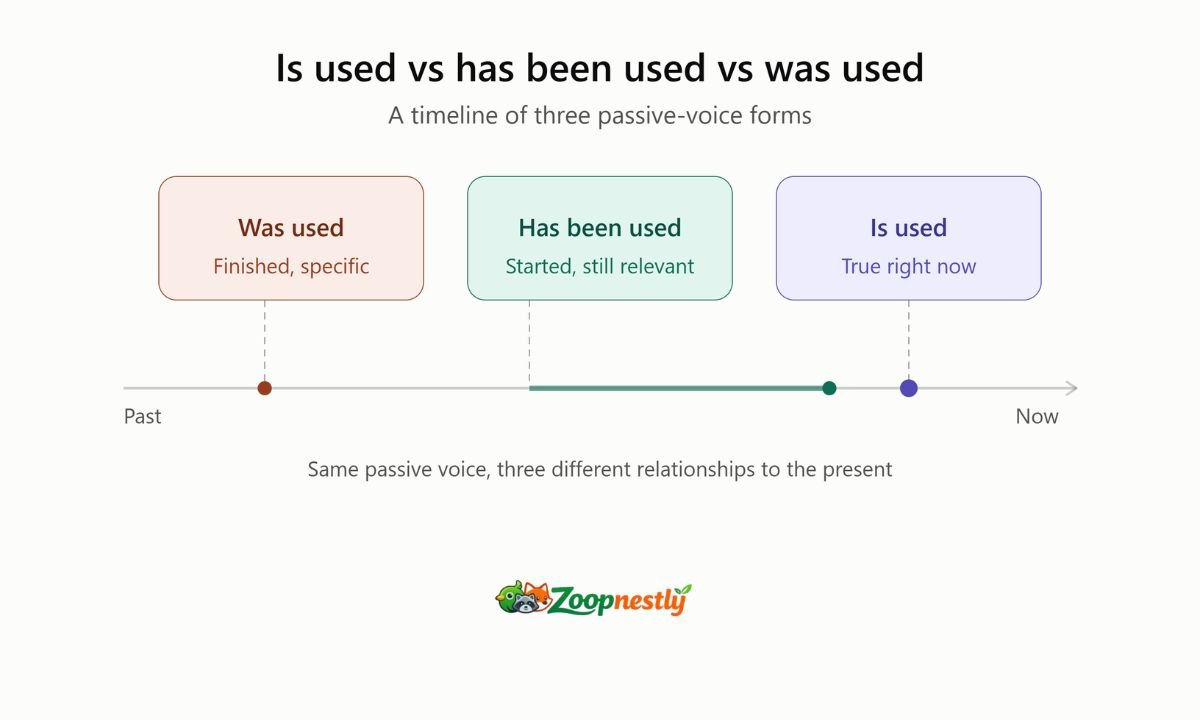
Is used describes a present habit or general fact (“This tool is used daily”). Has been used describes something that started in the past and connects to the present (“It has been used since 2020”). Was used describes a completed action at a specific past time (“It was used last year”). The difference is entirely about when and whether the action still matters now.
Why These Three Forms Confuse Writers

All three are passive voice, which means the subject receives the action instead of performing it. That shared structure is exactly why people mix them up. The real difference isn’t the passive voice itself, it’s the tense and time frame attached to it. Once you separate the grammar (passive voice) from the timing (tense), each form becomes much easier to pick correctly.
Is Used: Present Simple Passive
Is used describes something true right now, a routine, a rule, or a general fact that doesn’t change often.
- This password is used to access the account.
- Recycled steel is used in most new construction.
Use it for facts, instructions, definitions, and habits. There’s no specific start or end date attached, it’s simply how things are.
Has Been Used: Present Perfect Passive
Has been used links a past action to the present moment. Something started before now and either continues, or its effect is still relevant.
- This recipe has been used in our family for three generations.
- The software has been used by over a million people.
The key signal words are usually since, for, already, or so far. These words hint that the timeline stretches from the past right up to now.
Was Used: Past Simple Passive
Was used points to a completed action at a specific point in the past. It has no connection to the present; the action is finished and done.
- The old bridge was used until 1998.
- That excuse was used one too many times.
If you can attach a specific past date or a finished time frame, was used is almost always correct.
Comparison Table: Is Used vs Has Been Used vs Was Used
| Form | Tense | Time Frame | Example |
| Is used | Present Simple Passive | Ongoing, general, habitual | This method is used in most labs. |
| Has been used | Present Perfect Passive | Started in past, connects to now | It has been used for decades. |
| Was used | Past Simple Passive | Finished, specific past moment | It was used in the 1990s. |
Was Used or Were Used
The auxiliary verb depends on the subject, not the tense.
- Was used goes with singular subjects: he, she, it, or a singular noun. The old typewriter was used for the letter.
- Were used goes with plural subjects: they, we, or plural nouns. The old typewriters were used for the letters.
A quick trick: remove the passive phrase and check if you’d naturally say “he was” or “they were.” That agreement carries straight into the passive sentence.
Common Mistakes to Avoid
Mistake 1: Mixing the wrong auxiliary with the tense. Writing “is been used” instead of “has been used” is a frequent slip. Present perfect always needs has or have, never is.
Mistake 2: Confusing present simple passive with present perfect passive. “This tool is used since 2015” sounds off because “since” needs a present perfect structure. The correct version is “This tool has been used since 2015.”
Mistake 3: Using was used for something still relevant today. If the action still matters now, don’t reach for the past simple. “This medicine was used to treat the condition” implies it’s no longer used, which may not be true.
Mistake 4: Subject-verb agreement errors. Plural subjects need have been used, not has been used. Singular subjects need is used, not are used.
Mistake 5: Dropping a time marker that changes the meaning. Removing “since 2010” or “last year” can leave readers guessing which tense fits, so keep time markers when precision matters.
DISCOVER MORE : Tear vs Tare: What’s the Difference and When Do You Use Each?
American vs British English Differences
The core grammar rules for is used, has been used, and was used stay identical across American and British English. There’s no structural difference in how the passive voice or tenses work.
Where style does shift slightly is preference. British writing, especially in journalism, leans a bit more toward present perfect for recent news (“The policy has been used to justify the decision”), while American writing sometimes favors past simple even for fairly recent events. Neither choice is wrong, it’s a stylistic tendency rather than a grammar rule.
Idiomatic Expressions With “Used”
English also uses used in idioms that have nothing to do with passive voice, and mixing these up with the grammar forms above causes real confusion.
- Used to + base verb describes a past habit that no longer happens: I used to bike to work.
- Get used to means becoming accustomed to something: She’s getting used to the new schedule.
- Be used to means being accustomed to something already: He is used to early mornings.
Notice that “is used to” here is not the passive voice at all, it’s an idiom about familiarity. Context tells you which one you’re dealing with.
Practical Tips for Choosing the Right Form
- Ask about timing first. Is it happening now, ongoing since the past, or finished?
- Look for time markers. Words like since, ago, last year, and already often point you to the right tense.
- Check subject agreement. Singular subjects pair with is or has; plural subjects pair with are or have.
- Watch for the idiom trap. “Used to” and “be used to” aren’t passive voice forms.
- Prefer active voice when it’s clearer. “We use this daily” often reads better than “This is used daily,” especially in casual writing.
- Read sentences aloud. Your ear often catches an awkward tense faster than your eyes do.
- Avoid redundant agents. “It was used by them to build it” can usually be trimmed to “They used it to build it.”
- Double check collective nouns. Words like team or staff can take singular or plural verbs depending on context, so verify agreement carefully.
Real Sentence Fixes
Wrong: This app is used since last month. Right: This app has been used since last month. Reason: “since” signals present perfect, not present simple.
Wrong: The tools was used for the repair. Right: The tools were used for the repair. Reason: “tools” is plural, so the verb must agree.
Wrong (passive, clunky): The decision was made by the committee after long discussion. Better (active): The committee made the decision after long discussion. Reason: active voice is shorter and clearer when the agent matters.
FAQs
Is “has been used” grammatically correct?
Yes. Has been used is the present perfect passive, correct for singular subjects when an action began in the past and still connects to the present.
Can “is used” and “was used” mean the same thing?
No. Is used describes something true now, while was used describes something finished in the past with no guaranteed connection to the present.
What’s a simple synonym for “was used”?
Depending on context, you can say was applied, was utilized, or was employed. Each keeps the past, completed meaning intact.
Should I say “has been used” or “was used” for something that happened last year?
If the effect still matters now, use has been used. If it’s simply a finished event with no present link, was used fits better.
Why does “used to” not follow the same rules as “is used” or “was used”?
Because used to is an idiom describing a past habit, not a passive voice construction. It never changes form for tense the way passive verbs do.
Conclusion
The choice between is used, has been used, and was used always comes back to timing. Present simple passive states a fact happening now. Present perfect passive links the past to the present. Past simple passive closes the door on an action that’s already finished. Once you check the time frame and match your subject correctly, picking the right form becomes second nature rather than a guessing game.

James Walker is a content writer and language researcher with over 5 years of experience in meanings, definitions, and language-related topics. He enjoys simplifying complex terms into clear, easy-to-understand explanations. Through ZoopNestly.com, he helps readers find accurate and reliable information.