Referred vs Refered: What’s the Difference and Which Is Right?
You typed it, stared at it, and now something feels off. Is it “referred” or “refered”? One extra letter can turn a confident email into a second-guessing moment.
This mix-up trips up even strong writers because the doubling rule for referred isn’t obvious at first glance. By the end of this guide, you’ll know exactly which spelling to use and why, so you never pause over this word again.
Quick Answer
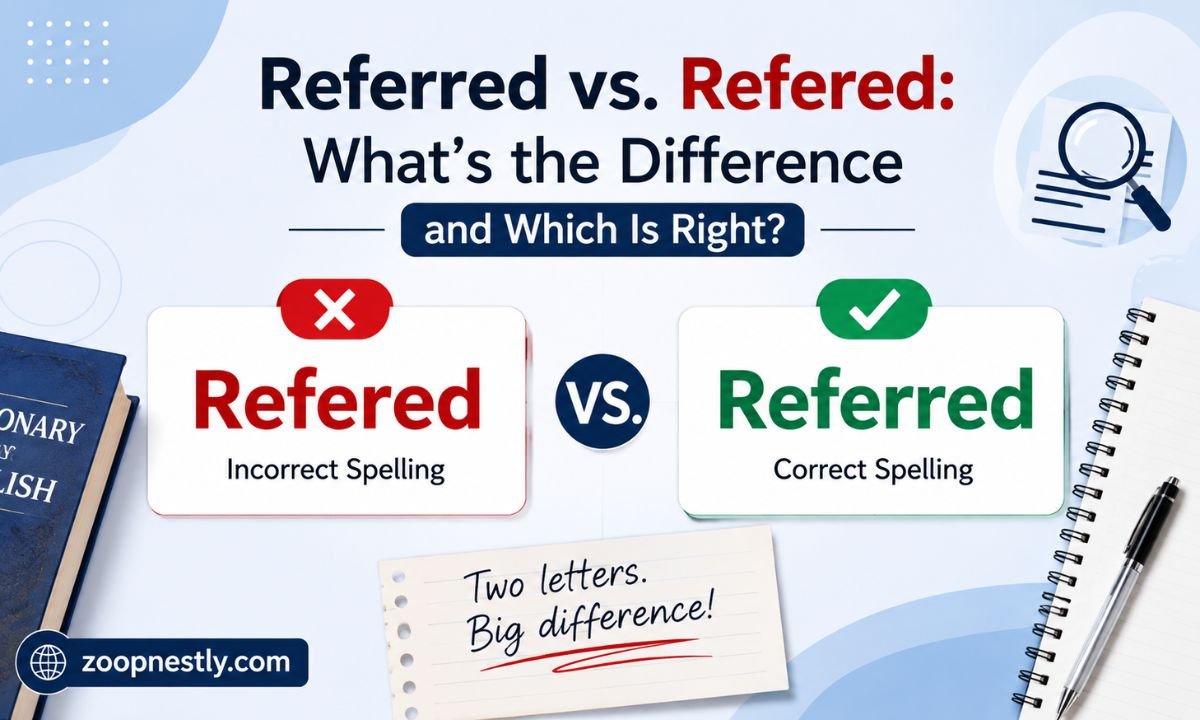
Referred is the correct spelling. Refered is always incorrect, in both American and British English. The word doubles its final “r” before adding “-ed” because the base verb “refer” ends in a stressed syllable with a single vowel followed by a single consonant.
Why “Referred” Has Two R’s

English has a spelling rule for verbs ending in a consonant preceded by a single vowel. When the stress falls on the last syllable, that final consonant gets doubled before adding a suffix like “-ed” or “-ing.”
Break down “refer”: re-FER. The stress lands on “fer,” which ends in one vowel (“e”) and one consonant (“r”). That combination triggers the doubling rule. So “refer” becomes “referred,” not “refered.”
Compare it to a word like “offer.” The stress falls on “OF-fer,” the first syllable, not the last. That’s why “offer” becomes “offered” with just one “r.” The same logic applies to “occur” (stress on the second syllable, doubles to “occurred”) versus “enter” (stress on the first syllable, stays “entered”).
Referred or Refered: The Simple Rule to Remember
Here’s a shortcut that works for most doubling questions in English:
- Find the stressed syllable. Say the word out loud and notice where the emphasis falls.
- Check the ending. Does it end in one vowel followed by one consonant?
- If yes to both, double the consonant before adding “-ed” or “-ing.”
For “refer,” both conditions are true, so you double the “r”: referred, referring. This same pattern explains why “preferred” and “transferred” also carry double letters, while words like “visited” or “happened” don’t need doubling because the stress sits on an earlier syllable.
British English vs American English Spelling
Good news here: this isn’t a US versus UK spelling split like “color” and “colour.” Both British and American English double the “r” in “referred.” You won’t find a regional variation that makes “refered” acceptable anywhere.
Where the two dialects sometimes diverge is with words like “traveled” (American) versus “travelled” (British), because American English is often more relaxed about doubling consonants when the stress isn’t on the final syllable. But “refer” ends in a stressed syllable, so both dialects agree: it’s “referred,” full stop.
Common Mistakes People Make
Even with the rule laid out, a few patterns keep causing errors. Watch for these:
- Dropping the second “r”: Writing “refered” instead of “referred,” usually from typing quickly or mishearing the word.
- Confusing it with “refer”: Forgetting to change the spelling at all when switching to past tense, and leaving it as “refer” in a sentence that needs past tense.
- Overdoubling other forms: Some writers assume every “refer” variant needs double letters, then mistakenly write “referal” instead of “referral,” which needs two r’s for a different reason (it comes from the noun form with its own spelling pattern).
- Autocorrect confusion: Some spell-checkers flag “referred” as a false positive when it’s part of a longer compound phrase, leading writers to second-guess a spelling that was already correct.
A quick trick: if you can say the word slowly and hear the stress land on “ferred,” you’ll double the “r” almost every time without needing to memorize the rule.
DISCOVER MORE : Scary or Scarry: Which Spelling Is Correct and Why?
How “Referred” Is Used in Real Writing

Seeing the word in context makes the correct spelling stick faster than any rule alone.
In Emails
“I’ve referred your case to our billing department, and they’ll follow up within two business days.”
In Reports
“The committee referred the proposal back to the finance team for further review.”
On Social Media
“My doctor referred me to a specialist last week, and I finally have an appointment.”
In Formal Writing
“The author referred to several peer-reviewed studies to support the central argument.”
In Academic or Educational Contexts
“Students who are referred for additional support often show improvement within one semester.”
Across every one of these examples, the spelling stays the same. There’s no context, tone, or setting where “refered” becomes acceptable.
Referred as an Adjective vs a Verb
“Referred” doesn’t only function as the past tense of “refer.” It also shows up as an adjective in specific phrases, most notably in medical and business language.
- Referred pain: a medical term for pain felt in a different location from its actual source, like shoulder pain caused by a heart issue.
- Referred client: a customer who came through someone else’s recommendation.
In both cases, the double “r” spelling stays consistent, since the word is built from the same root verb.
Comparison Table: Referred vs Refered
| Feature | Referred | Refered |
| Correct spelling | Yes | No |
| Used in American English | Yes | Never |
| Used in British English | Yes | Never |
| Follows consonant-doubling rule | Yes | Violates the rule |
| Appears in dictionaries | Yes | No |
| Recommended for formal writing | Yes | No |
Related Word Forms to Know
Understanding “referred” gets easier when you see how it connects to other forms of the same verb:
| Word Form | Example |
| Base verb | I will refer you to a colleague. |
| Past tense | She referred the client last month. |
| Present participle | He is referring patients to the clinic. |
| Noun (person) | The doctor gave a referral. |
| Noun (act) | The reference was helpful. |
Notice that “referral” also doubles the “r,” following the same stress pattern as “referred.”
A Simple Memory Trick

If the grammar rule feels hard to hold onto, try this instead: think of “referred” as needing “double the effort” because someone is being passed along to a new place, a new doctor, a new team, or a new resource. That mental image of “extra steps” can help you remember the extra letter.
Another option is to compare it side by side with a word you already spell correctly without thinking, like “preferred.” If you already trust that “preferred” has two r’s, “referred” follows the exact same pattern.
Referred in a Sentence: More Examples
To build extra confidence, here are a few more natural sentences using the correct spelling:
- The hiring manager referred three candidates from her network.
- I was referred to this website by a friend who found it helpful.
- The nurse referred the patient to a cardiologist for further testing.
- He often gets referred by past clients because of his reputation.
- The article referred to data from a well-known linguistics resource.
Frequently Asked Questions
Is “refered” ever correct in any dialect of English?
No. “Refered” is not accepted in American English, British English, or any other standard English dialect. It’s considered a spelling error regardless of context.
Why does “refer” double the “r” but “offer” doesn’t?
It comes down to stress. “Refer” is stressed on its final syllable, which triggers the doubling rule. “Offer” is stressed on its first syllable, so no doubling happens when adding “-ed.”
Is “referral” spelled with one r or two?
“Referral” has two r’s, just like “referred.” Both words come from the same base verb and follow the same stress-based doubling pattern.
What is “referred pain” in medical terms?
Referred pain describes pain that’s felt in a body part different from where the actual problem is. A common example is jaw or arm pain during a heart attack, even though the heart is the real source.
How can I stop misspelling “referred” in the future?
Practice saying the word aloud and noticing the stress on the second syllable. Pairing it mentally with a word you already spell correctly, like “preferred,” also helps the correct pattern stick.
Conclusion
“Referred” is the only correct spelling, and “refered” is a mistake in every form of English. The double “r” comes from a clear stress-based spelling rule, not an arbitrary exception. Once you connect “refer” to similar words like “preferred” and “occurred,” the pattern becomes much easier to remember. The next time you write about a referral, a referred patient, or a referred client, you can type it once and move on with confidence.

James Walker is a content writer and language researcher with over 5 years of experience in meanings, definitions, and language-related topics. He enjoys simplifying complex terms into clear, easy-to-understand explanations. Through ZoopNestly.com, he helps readers find accurate and reliable information.