Patients or Patient’s: The Complete Grammar Guide with Examples
You typed a sentence about the people in a waiting room, paused, and stared at the word. Is it patients or patient’s? One letter and an apostrophe stand between a correct sentence and an awkward mistake in a medical note, email, or article.
This confusion trips up even experienced writers because the words sound identical but serve completely different grammatical jobs. By the end of this guide, you’ll never second guess it again.
Quick Answer
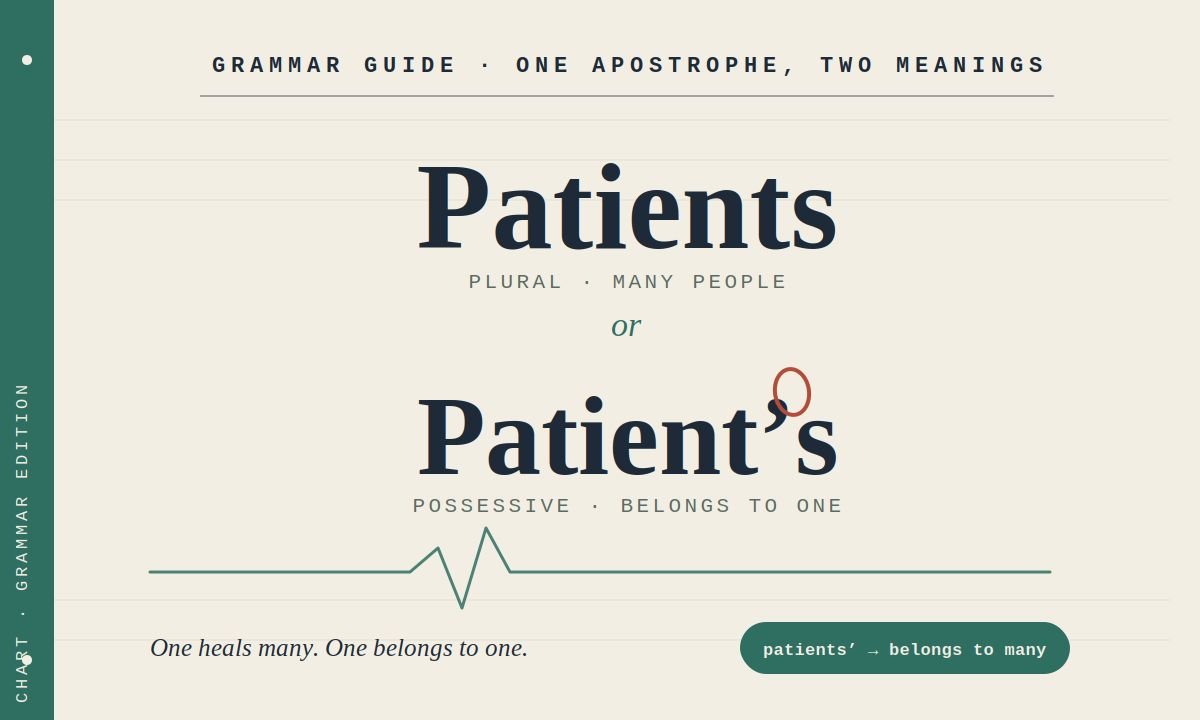
Patients is the plural noun referring to more than one person receiving medical care. Patient’s is the possessive form, showing that something belongs to one patient (for example, the patient’s chart). If you’re talking about several people, use “patients.” If you’re showing ownership by a single person, use “patient’s.”
Patients vs Patient’s: The Core Difference
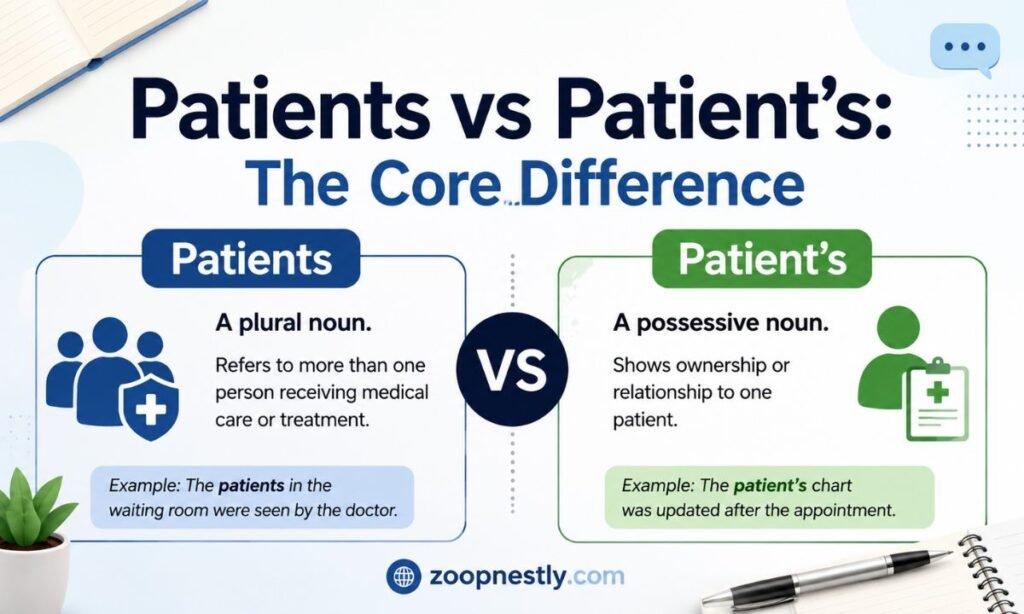
The mix-up happens because both words come from the same root, “patient,” but an apostrophe changes everything.
- Patients = more than one patient (plural noun)
- Patient’s = something belonging to one patient (singular possessive)
- Patients’ = something belonging to more than one patient (plural possessive)
That third form often gets left out of discussions, but it matters just as much. If a hospital updates records for multiple people, you’d write “the patients’ records,” not “patient’s records.”
What “Patients” Means
“Patients” is simply the plural form of “patient,” a noun describing a person under medical care or treatment. No apostrophe is involved because plural nouns in English typically just add an “s.”
Example: The clinic saw over forty patients on Monday.
Here, “patients” refers to multiple individual people. There’s no ownership or possession happening in the sentence, just a count of people.
What “Patient’s” Means
“Patient’s” is the possessive singular form. It tells you that one specific patient owns, has, or is associated with something mentioned right after it.
Example: The patient’s blood pressure was slightly elevated.
The apostrophe plus “s” shows that the blood pressure belongs to a single patient. Swap in “patients” here and the sentence breaks grammatically, because “patients” alone can’t show possession.
Where the Word “Patient” Comes From
The word “patient” traces back to the Latin word patiens, meaning “suffering” or “enduring,” from the verb pati, “to suffer or endure.” It entered English through Old French in the late Middle Ages, originally describing someone who endures pain or hardship, whether physical or emotional. Over time, English narrowed the medical sense to describe someone receiving treatment from a doctor or healthcare provider, while the adjective form (patient, meaning calm and tolerant) kept the original meaning of endurance. Both senses share the same linguistic root, which is why the word can describe both a personality trait and a person in a hospital bed.
The Full Plural and Possessive Rules
English apostrophe rules aren’t complicated once you see them side by side.
| Form | Meaning | Example |
| Patient | One person receiving care | The patient arrived early. |
| Patients | More than one person receiving care | The patients arrived early. |
| Patient’s | Belongs to one patient | The patient’s appointment was rescheduled. |
| Patients’ | Belongs to more than one patient | The patients’ appointments were rescheduled. |
The rule that trips people up most: for a regular plural noun already ending in “s” (like “patients”), you add only an apostrophe to show possession, not an apostrophe plus another “s.” So “patients'” is correct, and “patients’s” is not.
British English vs American English: Any Differences?
Good news here: the rules for “patients” and “patient’s” don’t change between British and American English. Both dialects follow the same plural and possessive conventions. Where British and American English do diverge on apostrophes is in a few edge cases, like how some British style guides handle names ending in “s” (Charles’ vs Charles’s), but “patient” follows the standard rule everywhere. If you’ve seen conflicting advice online, it likely wasn’t about this word specifically, so you can use the same form regardless of which English you’re writing in.
Which Form Should You Use? A Simple Test
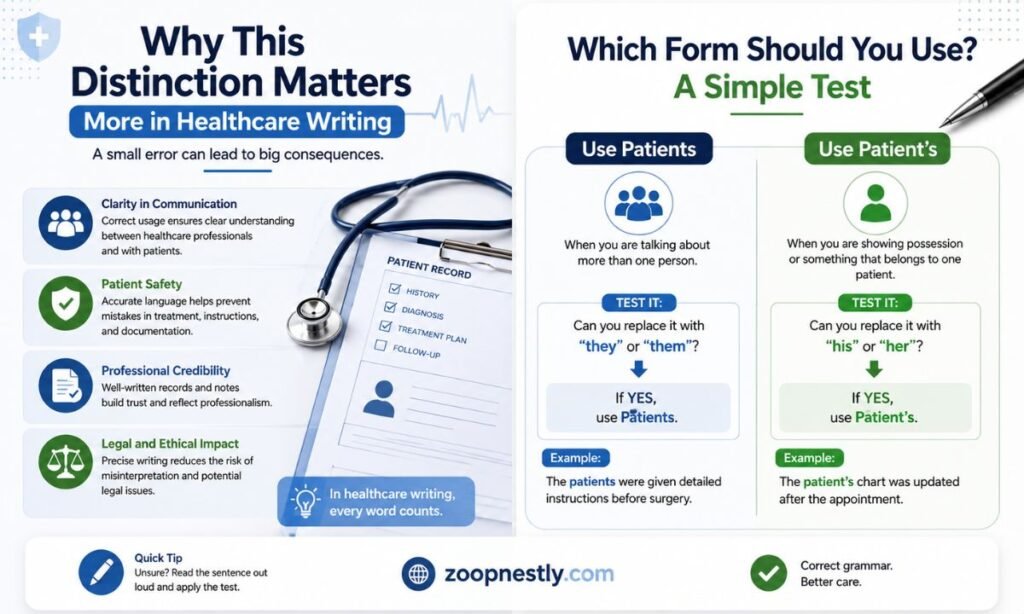
Before you write either word, ask yourself one question: Am I counting people, or showing that something belongs to them?
- If you’re counting or referring to multiple people, use patients.
- If something belongs to, describes, or is associated with one person, use patient’s.
- If something belongs to multiple people, use patients’.
A quick trick: try replacing the word with “the patient” or “the patients” and see if it still makes sense with “belongs to” inserted. The chart belongs to the patient becomes the patient’s chart. That mental test resolves almost every case.
DISCOVER MORE : Referred vs Refered: What’s the Difference and Which Is Right?
Common Mistakes with Patients or Patient’s
Even skilled writers slip up here. Watch for these specific errors:
- Using “patients” when possession is needed. Wrong: The patients medication was changed. Correct: The patient’s medication was changed.
- Adding an apostrophe to a simple plural. Wrong: We treated 20 patient’s today. Correct: We treated 20 patients today.
- Forgetting the plural possessive form. Wrong: The patients medications were changed. Correct: The patients’ medications were changed.
- Confusing “patient’s” with “patients’.” These look nearly identical but signal one person versus several. Always check whether you mean one patient or a group before placing the apostrophe.
- Autocorrect errors. Phone keyboards sometimes insert apostrophes automatically. Always double check medical or professional writing before sending it.
Patients or Patient’s in Everyday Writing
Seeing the words in real contexts makes the rule stick faster than any explanation alone.
In Emails and Reports
Please update the patient’s insurance information before the visit. All patients scheduled for Thursday need to confirm their appointments.
In News Articles
The hospital treated over 300 patients during the outbreak. A patient’s family filed a complaint after the delay.
In Social Media and Blog Posts
Grateful for every one of our patients who trusted us this year. One patient’s story changed how we approach follow-up care.
In Formal or Academic Writing
The study followed 150 patients over a two-year period. The patient’s consent was documented prior to the procedure.
Why This Distinction Matters More in Healthcare Writing
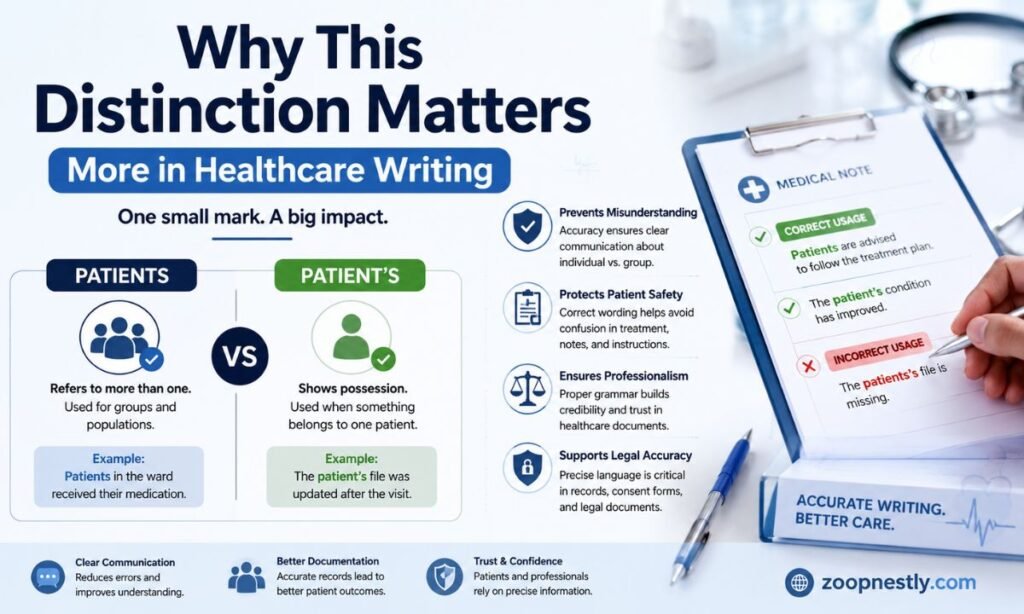
Getting this wrong isn’t just a grammar slip in medical and clinical settings, it can actually create confusion about who or what a sentence refers to. A misplaced apostrophe in a chart note, discharge summary, or internal report can make it unclear whether information applies to one patient or an entire group.
Healthcare writing, more than most fields, depends on precision, since ambiguity in documentation can affect patient safety, billing accuracy, and legal records. This is one of the practical reasons careful proofreading matters beyond just looking professional.
Synonyms and Related Terms
Depending on context, you can sometimes substitute related words, though none are exact matches for “patient”:
- Client (used in therapy, counseling, or some private practice settings)
- Case (often used clinically, as in “the case presented with…”)
- Individual (a neutral alternative in formal or research writing)
None of these carry the exact medical connotation “patient” does, so use them only when the context supports a slight shift in tone or setting.
Frequently Asked Questions
Is it “patients” or “patient’s” when referring to more than one person?
Use patients when referring to more than one person, since it’s simply the plural noun. No apostrophe is needed unless you’re also showing possession by that group, in which case you’d use “patients’.”
How do you make “patient” possessive for one person?
Add an apostrophe and an “s” to the end of “patient” to get patient’s. This shows that something belongs to or is associated with a single patient, such as “the patient’s history” or “the patient’s name.”
What is the plural possessive form of “patient”?
The plural possessive is patients’, formed by adding just an apostrophe after the existing “s” in “patients.” Use this when something belongs to more than one patient, like “the patients’ feedback.”
Why do “patients” and “patient’s” sound the same but look different?
Both words share the same pronunciation because English apostrophes don’t change how a word sounds, only how it’s spelled and what it means. The apostrophe is a written signal, not a spoken one, which is exactly why the two forms get confused so often in writing.
Is “patients’s” ever correct?
No. Patients’s is never correct in standard English. Once a plural noun already ends in “s,” you only add an apostrophe to show possession, forming “patients'” instead.
Conclusion
The difference between patients or patient’s comes down to one simple question: are you counting people, or showing ownership? Use patients for multiple people, patient’s for something belonging to one person, and patients’ when it belongs to several. Once that test becomes second nature, this common grammar mix-up disappears from your writing for good.

James Walker is a content writer and language researcher with over 5 years of experience in meanings, definitions, and language-related topics. He enjoys simplifying complex terms into clear, easy-to-understand explanations. Through ZoopNestly.com, he helps readers find accurate and reliable information.