Nominator vs Nominee: How Are They Different?
Picture this: you just got an email saying you’ve been nominated for an award, and a friend mentions they “nominated” you last week. Suddenly you’re wondering who did what. This mix-up happens constantly with nominator vs nominee, and using the wrong term in a legal form, insurance policy, or election document can cause real confusion. This guide breaks down exactly who does the choosing and who gets chosen, so you never mix them up again.
Quick Answer
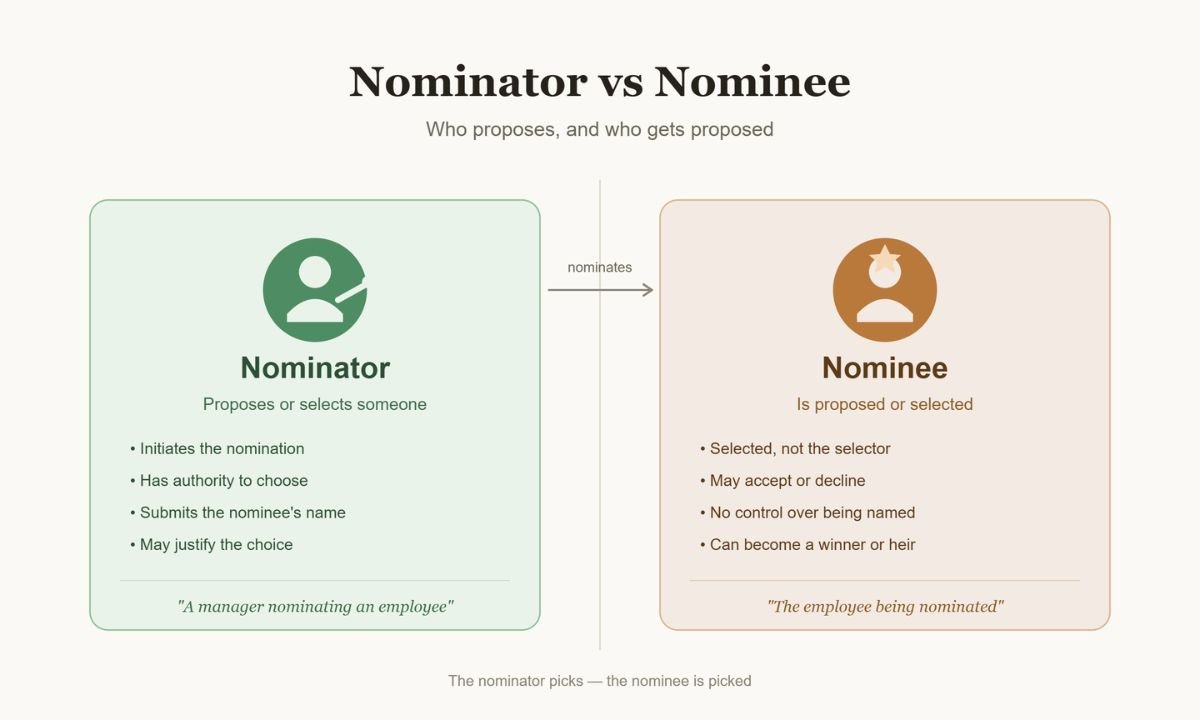
A nominator is the person or group who proposes, suggests, or names someone for a role, award, position, or benefit. A nominee is the person who gets chosen or proposed. In short: the nominator picks, and the nominee is picked. One acts, the other receives the action.
What Is a Nominator?

A nominator is the individual, committee, or organization responsible for putting a name forward. This could mean recommending a coworker for an award, naming a beneficiary on a life insurance policy, or proposing a candidate for a board seat.
The nominator holds the decision-making power at this stage. Without a nominator, there’s no nomination in the first place. Think of the nominator as the starting point of the entire process.
Key traits of a nominator:
- Initiates the nomination
- Has the authority or standing to make the choice
- Submits the nominee’s name through a formal or informal process
- May need to justify or support the nomination with reasons or documentation
What Is a Nominee?
A nominee is the person, entity, or option that has been proposed or selected by the nominator. The nominee doesn’t choose this status; it’s given to them. Being a nominee usually means you’ve been recognized, considered, or designated for something, whether that’s an award, a legal right, a financial benefit, or a political race.
A nominee can accept or decline the nomination, but they don’t create it. That’s the core distinction that trips people up.
Key traits of a nominee:
- Is selected, not the selector
- May need to accept the nomination formally
- Often has no control over who nominates them
- Can go on to become a winner, appointee, or beneficiary depending on the context
Nominator vs Nominee: The Key Difference
| Feature | Nominator | Nominee |
| Role | Person who proposes or selects | Person who is proposed or selected |
| Action | Nominates | Is nominated |
| Control | Chooses who to name | Has no control over being chosen |
| Response | Submits the nomination | Accepts or declines it |
| Example | A manager nominating an employee | The employee being nominated |
The simplest way to remember this: the -or ending (nominator) points to the doer of the action, similar to “actor” or “director.” The -ee ending (nominee) points to the receiver of the action, similar to “employee” or “trainee.”
How the Nomination Process Works
Most nomination processes follow a similar pattern, whether it’s for an award, a job, or a legal benefit.
- The nominator identifies a candidate. This could be based on merit, relationship, eligibility, or personal judgment.
- The nomination is submitted. This might be a written form, an online submission, or a verbal proposal, depending on the context.
- The nominee is notified. In many formal processes, the nominee must be informed and given the chance to accept or decline.
- A decision or vote follows. A panel, committee, or voting body reviews the nomination and decides the outcome.
- The result is announced. The nominee either moves forward (wins, is appointed, or is confirmed) or the nomination ends there.
Not every nomination requires all five steps. A simple insurance nomination, for instance, skips voting entirely since it’s a personal financial decision.
Nominator vs Nominee in Insurance

In an insurance policy, the nominee is the person the policyholder designates to receive the payout or benefits if something happens to them. The nominator, in this case, is the policyholder themselves.
For example, when you buy a life insurance policy and list your spouse to receive the payout, you are the nominator and your spouse is the nominee. It’s worth noting that a nominee in insurance sometimes acts as a trustee who passes the funds to the rightful legal heirs, rather than being the final owner of the money. This depends on local insurance law and the specific policy terms.
Nominator vs Nominee in Banking
Banking works similarly to insurance. When you open a bank account, you can name a nominee who will have access to or ownership of the funds if you pass away. As the account holder, you’re the nominator.
This nomination doesn’t override a will in every jurisdiction, so it’s smart to check local regulations. The nominee typically needs to provide identification and proof of the nomination to claim the funds.
Nominator vs Nominee in Elections and Politics
In political contexts, a nominator might be a political party, a group of voters, or an official body that puts forward a candidate. The nominee is the candidate who has been selected to represent that party or group in an election.
For example, a political party’s selection committee (the nominator) chooses a candidate to run for office. Once selected, that candidate becomes the party’s nominee. The public then votes, and the nominee may go on to win the actual election.
DISCOVER MORE : Encode or Incode: What’s the Correct Spelling?
Nominator vs Nominee in Awards and Scholarships
Award shows and scholarship programs are where most people first encounter these terms. A nominator could be a fan, a peer, a teacher, or a review committee. The nominee is whoever they’ve put forward for consideration.
For example, a film academy member (nominator) submits a film for Best Picture consideration. The film’s cast and crew become nominees. If they win, they move from nominee to award recipient.
Scholarship committees often allow self-nomination, meaning the applicant is both the nominator and the nominee, which is a helpful exception to keep in mind.
Nominator vs Nominee in Corporate Governance
In business settings, a nominator is often a shareholder, board member, or nominating committee that proposes candidates for leadership roles like a board of directors seat. The nominee is the individual proposed for that position.
There’s also the concept of a nominee shareholder, someone who holds shares on behalf of another person or entity, often for privacy or administrative reasons. This is a slightly different use of “nominee” but follows the same logic: the nominee acts on behalf of, or is designated by, someone else.
Common Mistakes When Using Nominator and Nominee
Mistake 1: Using the terms interchangeably. Some people say “nominee” when they mean “nominator,” especially in casual writing. Remember, the nominator does the nominating; the nominee receives it.
Mistake 2: Confusing a nominee with a beneficiary. In insurance and banking, a nominee often manages or receives funds temporarily, while the beneficiary may be the legal owner under a will. These roles can overlap, but they aren’t always identical, and mixing them up in legal documents can cause disputes.
Mistake 3: Assuming a nominee has decision-making power. A nominee is selected, not selecting. They may accept or decline, but they don’t control the nomination process itself.
Example Sentences
Using “nominator”:
- The nominator submitted three names for the community service award.
- As the policy’s nominator, she chose her son to receive the benefit.
- Each nominator must explain why their candidate deserves the nomination.
Using “nominee”:
- The nominee accepted the award on behalf of the entire team.
- As the nominee for the scholarship, he had to submit an essay.
- The bank confirmed the nominee’s identity before releasing the funds.
Related Terms Worth Knowing

- Nomination: The formal act of proposing someone or something.
- Beneficiary: A person legally entitled to receive assets, benefits, or proceeds, which may or may not be the same as the nominee.
- Candidate: A broader term for someone being considered for a role, often used alongside “nominee” in elections.
- Appointee: Someone formally selected to fill a role, typically after the nomination stage is complete.
Why This Difference Actually Matters
Getting nominator and nominee mixed up isn’t just a grammar issue. In legal and financial documents, using the wrong term can create ambiguity about who has authority and who is the intended recipient. Insurance claims, bank account transfers, and even corporate votes can be delayed or disputed over unclear wording. Knowing the difference protects you from paperwork errors and helps you fill out forms correctly the first time.
Frequently Asked Questions
Is a nominee the same as a winner?
No. A nominee is someone proposed or shortlisted for consideration. A winner is a nominee who was ultimately selected or awarded the position, prize, or title.
Can someone be both a nominator and a nominee?
Yes. In cases like scholarship self-nominations or small organizations, one person can nominate themselves, making them both the nominator and the nominee.
Does a nominee have any legal rights?
It depends on the context. In insurance and banking, a nominee often has the right to receive or manage funds temporarily, though this can differ from full legal ownership, which may belong to a beneficiary or heir.
What is the difference between a nominee and a beneficiary in insurance?
A nominee is designated to receive the insurance payout on behalf of the policyholder, sometimes acting as a trustee for the legal heirs. A beneficiary is typically the person legally entitled to the funds under a will or succession law. These roles can overlap but aren’t always the same.
Who chooses the nominator in a formal process?
This depends on the setting. In elections, a party’s internal rules decide who qualifies as a nominator. In insurance or banking, the account holder or policyholder is automatically the nominator since they’re the one making the designation.
Final Thoughts
The difference between nominator vs nominee comes down to action versus reception. The nominator proposes, chooses, or names; the nominee is the one proposed, chosen, or named. Whether you’re filling out an insurance form, voting in an election, or submitting someone for an award, keeping these two roles straight will help you avoid confusion and fill out documents correctly the first time.

James Walker is a content writer and language researcher with over 5 years of experience in meanings, definitions, and language-related topics. He enjoys simplifying complex terms into clear, easy-to-understand explanations. Through ZoopNestly.com, he helps readers find accurate and reliable information.