Gasses or Gases: Which Spelling Is Actually Correct?
You’re typing a report, an email, or maybe a chemistry assignment, and you stop mid-sentence. Is it “gasses” or “gases”? Both look familiar, both feel half-right, and spell check hasn’t flagged either one. That small hesitation is common, and it usually comes down to one thing: gasses or gases depends on whether you’re using the word as a noun or a verb. Once you know the rule, you’ll never second-guess it again.
Quick Answer
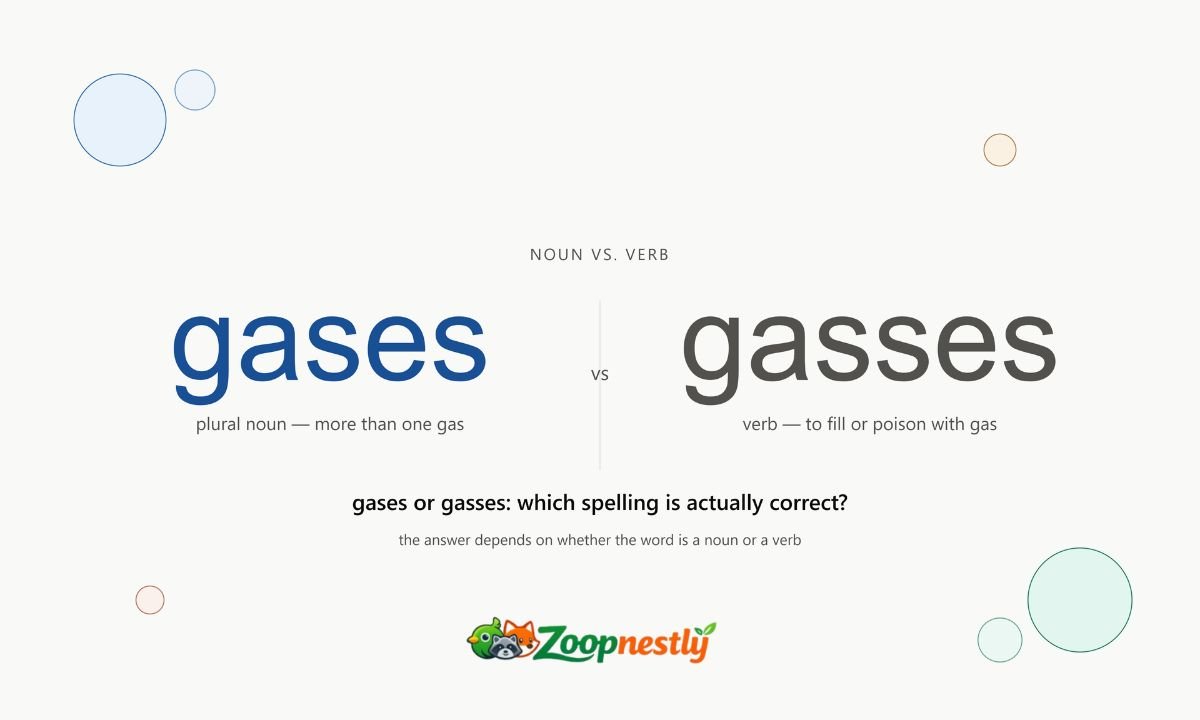
Gases is the correct plural noun for substances like oxygen, nitrogen, or carbon dioxide. Gasses is a verb form, used when something “gasses” a room or an engine “gasses up.” If you’re talking about more than one gas, write gases. If you’re describing an action, gasses is correct.
Why This Word Trips People Up

Most English nouns ending in a single “s” double that consonant before adding “-es” (think “gassed” or “bussed”). Gas seems like it should follow the same pattern, so many writers instinctively type “gasses” for the plural. But English doesn’t apply that rule consistently, and gas is one of the exceptions. The standard plural noun is gases, with a single “s,” in both American and British English.
Gases vs. Gasses: Noun or Verb?
The real difference isn’t regional. It’s grammatical. Here’s the breakdown:
- Gases (noun) — more than one type of gas. Example: “Nitrogen and oxygen are the two most abundant gases in Earth’s atmosphere.”
- Gasses (verb) — the present-tense form of “to gas,” meaning to poison, fill, or supply with gas. Example: “The exterminator gasses the building every spring to control pests.”
So when someone writes “the tank gasses up quickly,” that’s a verb describing an action. When someone writes “the tank holds different gases,” that’s a noun describing substances.
Comparison Table
| Word | Part of Speech | Meaning | Example |
| Gases | Noun (plural) | More than one gas | “Greenhouse gases trap heat in the atmosphere.” |
| Gasses | Verb (present tense) | To fill, poison, or supply with gas | “He gasses up the car before long trips.” |
| Gassed | Verb (past tense) | Already filled or exposed to gas | “The soldiers were gassed during the attack.” |
| Gassing | Verb (present participle) | Currently filling or exposing to gas | “The technician is gassing the greenhouse.” |
Is It a British vs. American English Thing?
No, and this is where a lot of confusion starts. Unlike words such as “colour” and “color,” the noun gases doesn’t change spelling between American and British English. Both use “gases” for the plural noun. The confusion likely comes from other words where doubling the consonant is standard across dialects, like “busses” (a less common but accepted plural of bus) or “gassed” as a verb. Gas simply doesn’t follow that same doubling pattern when it’s a noun.
Which Spelling Should You Use?

In almost every case, if you’re writing about the plural of gas as a substance, chemical, or element, use gases. This applies to:
- Science and chemistry writing
- News articles about pollution, emissions, or energy
- Business and technical reports
- Everyday communication, including emails and texts
Reserve gasses for the rare moments you’re conjugating the verb “to gas.” This verb form doesn’t come up often outside specific contexts like refueling, extermination, or historical references to chemical warfare.
A Simple Test You Can Use
Ask yourself: can I replace the word with “fills with gas” or “poisons”? If yes, you likely need gasses. Can you replace it with “types of gas” or “several gases”? Then you need gases. This quick substitution test works faster than memorizing grammar rules.
Common Mistakes Writers Make
Using “gasses” as a plural noun
This is the most frequent error. Writers see the double “s” pattern in verbs like “gassed” and “gassing” and assume the plural noun follows suit. It doesn’t. “The car has three gasses in its exhaust” should read “three gases.”
Assuming it’s a spelling variant, not a grammar rule
Some writers treat “gasses” and “gases” like “color” and “colour,” picking whichever looks more familiar. But this isn’t a stylistic choice. It’s a functional one based on whether the word is acting as a noun or a verb.
Overcorrecting in technical writing
In an effort to sound precise, some writers avoid “gases” altogether and switch to “gas” as an uncountable noun, even when referring to distinct types. “The mixture contains various gas” is incorrect. When you mean multiple distinct substances, gases is the right countable plural.
DISCOVER MORE : Unconsolable or Inconsolable? Learn the Correct Usage in English
Real-World Examples
Seeing the words in context makes the rule easier to remember.
Correct uses of gases:
- “The lab tested air samples for toxic gases.”
- “Natural gases like methane and propane are used for heating.”
- “Industrial gases are stored in pressurized tanks.”
Correct uses of gasses:
- “The factory gasses its storage tanks weekly for safety inspections.”
- “The mechanic gasses the vehicle before the test drive.”
How the Words Appear in Different Writing Contexts
| Context | Preferred Word | Example |
| Scientific reports | Gases | “Greenhouse gases are measured in parts per million.” |
| News writing | Gases | “The report linked rising gases to industrial output.” |
| Business emails | Gases | “Please confirm the gases used in the shipment.” |
| Casual conversation | Gases | “My car runs better on premium gases.” (informal use) |
| Verb-based instructions | Gasses | “The technician gasses the chamber before testing.” |
Notice that gasses rarely appears outside instructional or verb-heavy sentences. If you’re unsure which to use, gases is statistically the safer default for almost any writing situation involving the plural noun.
Where This Word Shows Up Most
Understanding when each spelling gets used in real life helps cement the rule.
- Chemistry and physics rely on “gases” constantly, since the topic revolves around classifying different types (noble gases, greenhouse gases, inert gases).
- Environmental writing uses “gases” when discussing emissions, pollution, and climate topics.
- Automotive and industrial writing may use either word, depending on whether the sentence describes types of fuel gases or the action of gassing up equipment.
- Historical and medical writing occasionally uses “gasses” as a verb when referencing chemical exposure.
Related Grammar Concepts Worth Knowing

A few related rules help explain why gas behaves the way it does:
- Words ending in a single consonant don’t always double that consonant before adding a suffix. It depends on syllable stress and vowel patterns, which is why “gas” doesn’t follow the same rule as “bus” in every case.
- Countable vs. uncountable nouns: Gas can be uncountable (as a general substance, like “gas prices”) or countable when referring to distinct types (like “greenhouse gases”).
- Noun-verb pairs: English has many words that look similar as nouns and verbs but follow different pluralization or conjugation rules. Gas and gasses is one example among several.
Frequently Asked Questions
Is “gasses” ever correct as a plural noun?
No. Gases is the accepted plural noun in standard English. “Gasses” only functions correctly as a verb form, such as in “the engine gasses up” or “the room gasses quickly.”
Do British and American English spell this word differently?
No. Both British and American English use gases as the plural noun. This is one of the rare cases where the two dialects agree completely.
What is the past tense of “gas” as a verb?
The past tense is gassed, with a doubled “s.” For example, “The building was gassed for pest control last week.”
Can “gas” be both singular and plural without changing form?
In casual speech, people sometimes use “gas” as an uncountable noun, like “we’re low on gas.” But when referring to multiple distinct types, the correct plural is gases, not “gas” or “gasses.”
Why does “gas” not double its consonant like “bus” does in “busses”?
English spelling rules for doubling consonants aren’t fully consistent across all short words. Gas simply became standardized with a single “s” in its plural noun form, while some other short words followed different patterns over time.
Final Takeaway
The rule is simpler than it feels in the moment. Gases is the plural noun you’ll use for substances, chemicals, and elements. Gasses is the verb form, describing an action involving gas. Once you separate the noun from the verb, the right spelling becomes automatic, no matter which side of the Atlantic you’re writing from.

James Walker is a content writer and language researcher with over 5 years of experience in meanings, definitions, and language-related topics. He enjoys simplifying complex terms into clear, easy-to-understand explanations. Through ZoopNestly.com, he helps readers find accurate and reliable information.