Women or Woman: The Simple Rule That Ends the Confusion for Good
You’re halfway through an email, and your cursor just froze on one word. Is it “every woman in this room” or “every women in this room”? You’ve written it both ways before, and now you can’t remember which one was correct. This mix-up trips up even confident writers, because women or woman looks like a spelling choice when it’s actually a grammar rule about number. Once you see the pattern, you’ll never second-guess it again.
Quick Answer
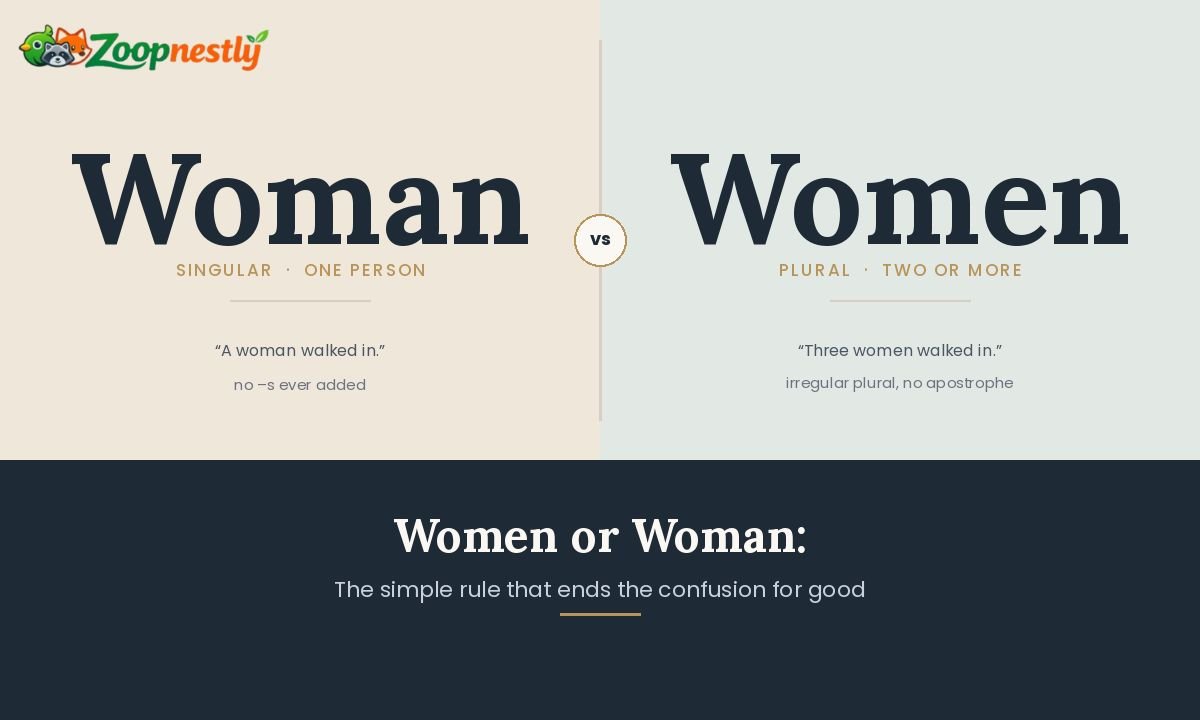
Woman is singular, meaning one adult female. Women is plural, meaning two or more. The easiest test: if you can swap in “one,” use woman; if you can swap in “many,” use women. There’s no British vs. American spelling difference here, both forms are used identically worldwide.
Woman vs. Women: What Each Word Actually Means
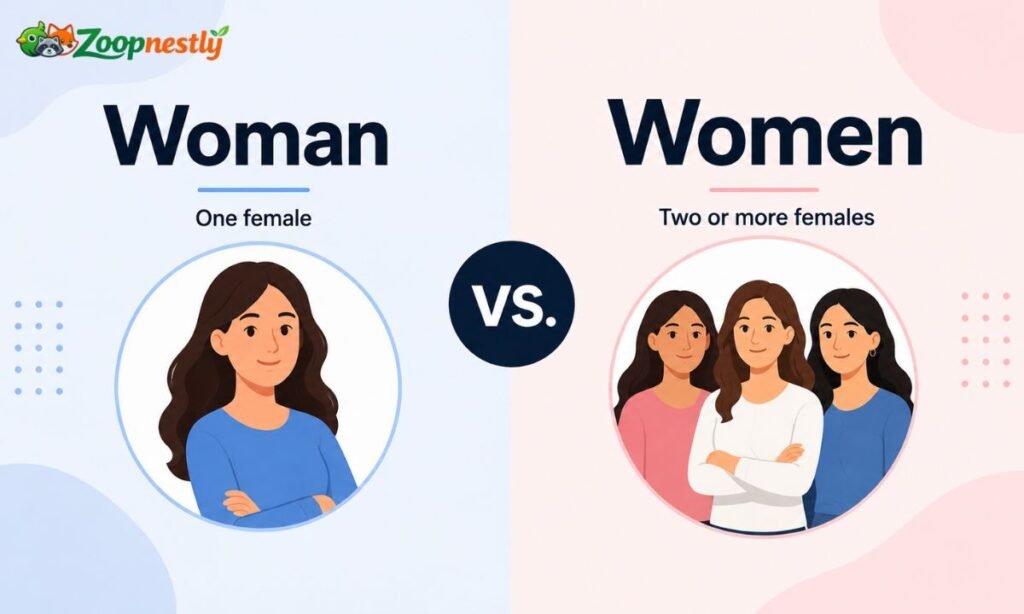
Woman (Singular)
Woman refers to a single adult female human being. You’d use it any time you’re talking about one person.
- That woman is my manager.
- She became a woman she was proud of.
- A woman walked into the office and asked for directions.
Women (Plural)
Women is the plural form, used for two or more adult female humans. It’s an irregular plural, which is exactly why people get stuck. English usually adds an “-s” for plurals (cat → cats), but this pair doesn’t follow that pattern.
- Three women joined the meeting late.
- Women in this field often mentor newcomers.
- The award celebrates women who lead in science.
Why “Women” Doesn’t Follow the Normal Plural Rule
Most English nouns become plural with “-s” or “-es.” Woman is an exception because of how the word evolved historically. It comes from Old English roots where “man” originally meant “person” (of any gender), and “wif-man” specifically meant a female person. Over centuries, the compound shifted in spelling and pronunciation, but the irregular plural pattern stuck. That’s why “woman” becomes “women” instead of “womans,” the same way “man” becomes “men” instead of “mans.”
Knowing this history isn’t just trivia. It explains why no amount of memorizing spelling tricks will help unless you understand that this is an irregular plural, similar to child/children or foot/feet.
The Pronunciation Difference (This Is the Real Trick)
Here’s something most guides skip: the two words don’t just look different, they sound different, and that’s actually the fastest way to catch your own mistakes when reading aloud.
- Woman is pronounced with a short “uh” sound in the first syllable: WUH-muhn.
- Women is pronounced with a short “ih” sound in the first syllable: WIH-min.
If you’re ever unsure which spelling you meant while writing, try saying the sentence out loud. Your ear often catches the right word before your eyes do.
Is There a British vs. American Spelling Difference?
No. Unlike words such as “colour/color” or “organise/organize,” woman and women are spelled and used the same way in British English, American English, Australian English, and every other major English variety. The only variable is singular versus plural, not region. If you see a source claiming otherwise, it’s mixing up unrelated spelling conventions with basic grammar.
DISCOVER MORE : Organizing or Organising? US vs UK Spelling Explained
Which Form Should You Use? A Quick Decision Guide
Ask yourself one question: how many people am I talking about?
| Situation | Correct Word | Example |
| Talking about one person | Woman | She is a talented woman. |
| Talking about more than one person | Women | They are talented women. |
| Using “a” or “one” before it | Woman | A woman called earlier. |
| Using “some,” “many,” “these,” or a number 2+ | Women | Many women called earlier. |
| Subject-verb agreement with “is/was” | Woman | The woman is here. |
| Subject-verb agreement with “are/were” | Women | The women are here. |
Grammar Rules That Control Women or Woman
Getting this right comes down to subject-verb agreement and article usage. Here are the rules that matter most:
- Singular subjects need singular verbs. The woman speaks fluently. Not “the woman speak.”
- Plural subjects need plural verbs. The women speak fluently. Not “the women speaks.”
- Articles matter. Use “a” or “an” only with woman (a woman), never with women. Women pairs with “the,” “some,” “many,” or a number.
- Possessives follow the same base word. Singular possessive is woman’s (the woman’s coat). Plural possessive is women’s (the women’s coats). Don’t confuse this with the irregular plural itself, the apostrophe placement is a separate rule layered on top.
Common Mistakes People Make (And How to Fix Them)
Mistake 1: Adding “-s” to woman. ❌ Three womans arrived. ✅ Three women arrived. Woman never takes an “-s” because it’s already irregular.
Mistake 2: Using women with a singular verb. ❌ The women is waiting outside. ✅ The women are waiting outside.
Mistake 3: Mixing up the possessive forms. ❌ The woman’s are meeting at noon. (This should describe multiple people, not use an apostrophe.) ✅ The women are meeting at noon.
Mistake 4: Confusing “women’s” with “woman’s” in brand or event names. ✅ Woman’s March is wrong if referring to a large group event. ✅ Women’s March is correct because it involves many participants.
Real-World Examples: Women or Woman in Everyday Writing

In Emails
“I spoke with the woman at the front desk about your delivery.” “Several women on the team requested flexible hours this quarter.”
In News Writing
“A woman was recognized for her volunteer work in the community.” “Women across the region reported longer commute times this year.”
On Social Media
“Shoutout to every woman who’s ever juggled three deadlines at once.” “Women supporting women is the whole vibe today.”
In Formal or Business Writing
“The committee selected one woman to represent the department.” “Women in leadership roles increased by a noticeable margin this year, according to internal reports.”
Related Terms You Might Also Mix Up
- Women’s vs. womens: “Womens” is not a standard English word. The correct possessive is always women’s (with the apostrophe before the “s”).
- Woman’s vs. womans: Same rule. “Womans” is never correct; use woman’s for the singular possessive.
- Female vs. woman: “Female” is broader and can describe any species or be used as an adjective (female employee). “Woman” specifically refers to an adult human female and works best as a noun.
FAQs About Women or Woman
Is it “one woman” or “one women”?
It’s always one woman. Any number of “one” pairs only with the singular form.
What’s the plural of woman?
The plural of woman is women. It’s an irregular plural, so it doesn’t follow the usual “add -s” pattern.
Why do people confuse the spelling of women and woman?
The words look nearly identical and differ by a single letter, but the pronunciation and grammatical role are completely different. This visual similarity, combined with an irregular plural pattern, is the main source of confusion.
Is “womens” ever correct without an apostrophe?
No. “Womens” without an apostrophe is not standard English. If you mean the plural, use women. If you mean the possessive, use women’s.
Do British and American English spell these words differently?
No. Both woman and women are spelled the same way across all major English-speaking regions. There is no regional variation for this particular word pair.
Conclusion
The choice between women or woman always comes down to counting: one person means woman, two or more means women. Once you lock in that single rule, along with the correct possessive forms and subject-verb agreement, the confusion disappears for good. Next time your cursor freezes on this word, just ask yourself how many people you’re describing, and the right spelling will follow naturally.

James Walker is a content writer and language researcher with over 5 years of experience in meanings, definitions, and language-related topics. He enjoys simplifying complex terms into clear, easy-to-understand explanations. Through ZoopNestly.com, he helps readers find accurate and reliable information.