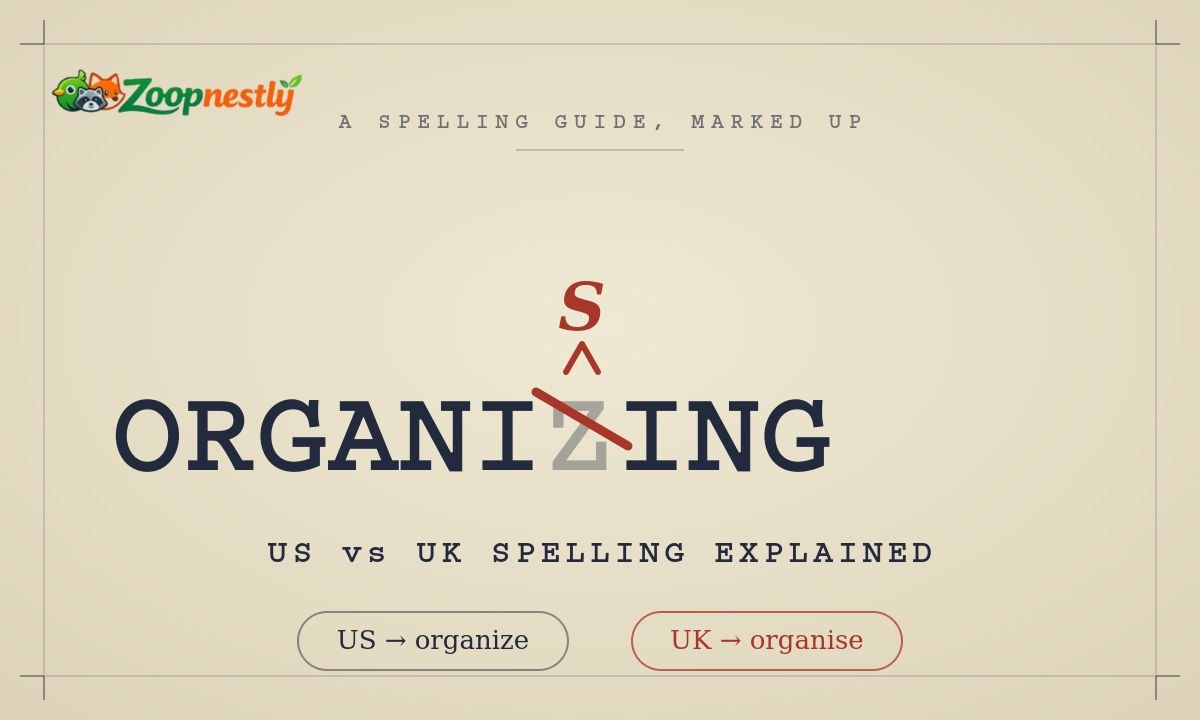
Organizing or Organising? US vs UK Spelling Explained
You typed the word, stared at it for a second, and now you’re not sure if it looks right. Is it organizing or organising? This tiny spelling choice trips up writers, students, and even native speakers all the time.
The good news is that the fix is simple once you know the rule. This guide breaks down exactly when to use each spelling so you never second-guess yourself again.
Quick Answer
Organizing is the American English spelling, and organising is the British English spelling. Both mean the same thing: arranging things in a structured way. Use “organizing” if you’re writing for a US audience, and “organising” if you’re writing for the UK, Australia, or most Commonwealth countries.
Organizing or Organising: What’s Actually Different?
The two words mean exactly the same thing. There’s no difference in definition, pronunciation, or grammar. The only difference is the letter used before “-ing”: a z in American English and an s in British English.
This isn’t unique to this one word either. It’s part of a much bigger pattern that affects hundreds of English verbs.
- Organize (US) vs Organise (UK) — base verb
- Organizing (US) vs Organising (UK) — present participle
- Organized (US) vs Organised (UK) — past tense
- Organizer (US) vs Organiser (UK) — the person or tool that organizes
Once you learn the pattern for one word, it applies to dozens of others.
Why Do Two Spellings Exist?
The split goes back further than most people expect, and it isn’t purely a British vs American thing. Many of these “-ize” verbs actually come from Greek roots (like “-izein”), and British English originally used “-ize” too. Over time, British publishing houses and dictionaries, particularly influenced by French spelling conventions, shifted toward “-ise” for many of these words.
American English, shaped heavily by lexicographer Noah Webster in the early 1800s, kept closer to the Greek-influenced “-ize” ending as part of a broader effort to standardize and simplify American spelling.
So technically, “organize” isn’t an American invention. It’s closer to the word’s older form, while “organise” reflects a later British stylistic shift.
American English vs British English: The Core Rule
Here’s the simplest way to remember it:
If you’re writing for American readers, use “z.” If you’re writing for British, Australian, Canadian, or Indian English readers, use “s.”
A quick note on Canada: Canadian English is a mix of both systems, but “organizing” with a z is more common there, closely following US conventions in everyday writing.
There’s one more wrinkle worth knowing. Some British style guides, including the Oxford English Dictionary, actually accept “organize” as a valid British spelling too, since it reflects the word’s Greek origin. This is often called Oxford spelling. However, in everyday UK writing, news, and most style guides (including the BBC and The Guardian), “organise” is the standard choice.
Comparison Table
| Feature | American English | British English |
| Base word | Organize | Organise |
| Present participle | Organizing | Organising |
| Past tense | Organized | Organised |
| Person/tool | Organizer | Organiser |
| Common in | US, and often Canada | UK, Australia, India, most Commonwealth countries |
| Style guide preference | AP Style, Chicago Manual | Oxford (mixed), Guardian, BBC (“-ise”) |
Which Spelling Should You Use?
The honest answer is: it depends entirely on your audience, not on which version is “more correct.” Neither spelling is wrong. Here’s how to decide:
- Writing for a US company, blog, or app? Use “organizing.”
- Writing for a UK, Australian, or Commonwealth audience? Use “organising.”
- Writing for a global or mixed audience? Pick one spelling and stay consistent throughout the entire piece. Mixing both looks like a typo, even though each word is technically correct on its own.
- Not sure who’s reading? Default to American English if your platform primarily serves US users, since it’s the most widely used version online.
Consistency matters more than which version you pick. A document that switches between “organizing” and “organising” halfway through reads as sloppy, even to readers who don’t consciously notice spelling.
Organizing or Organising in Everyday Writing
Spelling choices show up differently depending on where you’re writing. Here’s how it plays out in real situations.
Emails and Business Writing
If your company is based in the US, stick with “organizing” even if a client is British, unless you know they specifically prefer UK spelling. Match your company’s established style, not the reader’s location, unless told otherwise.
Social Media and Marketing
Social platforms have a global audience, so there’s no single right answer. Many US-based brands default to “organizing” since American English dominates global search behavior, but UK brands should stick with “organising” to sound authentic to their home audience.
News and Journalism
News outlets almost always follow their home country’s style guide. The BBC and Reuters (UK desk) use “organising.” The Associated Press and most US outlets use “organizing.” This is why the same story can look spelled differently depending on which outlet published it.
Academic and Formal Writing
Universities and academic journals typically specify a required spelling convention in their submission guidelines. Always check the specific style guide (APA, MLA, Harvard referencing, etc.) rather than assuming based on the subject matter.
DISCOVER MORE : Thumb In or Thumb Out? The Real Answer, Explained Clearly
Common Mistakes with Organizing or Organising
A few mix-ups happen often enough that they’re worth calling out directly:
- Mixing spellings in one document. Writing “organizing” in one paragraph and “organised” in another is the most common error, especially when copying from multiple sources.
- Assuming one version is more “correct.” Neither spelling is grammatically superior. This isn’t a right-vs-wrong issue, it’s a regional preference.
- Forgetting related words follow the same rule. People often fix “organizing” but leave “organiser” or “organised” unchanged in the same piece.
- Auto-correct switching mid-document. If your device’s language setting changes, spellcheck can silently swap spellings without you noticing. Always proofread manually after switching language settings.
- Assuming this affects all “-ing” words. This pattern only applies to specific verbs ending in “-ize/-ise,” not every English word ending in “-ing.”
Other Words That Follow the Same Pattern
If you’re writing for a UK or US audience, these common words follow the exact same “z vs s” rule as “organizing”:
| American (z) | British (s) |
| Realize / Realizing | Realise / Realising |
| Recognize | Recognise |
| Specialize | Specialise |
| Apologize | Apologise |
| Customize | Customise |
| Analyze* | Analyse* |
*Note: “Analyze/Analyse” is a slight exception. It follows the same US/UK split, but it’s spelled with a “z” or “s” throughout, not just before “-ing.”
World Health Organization or Organisation?
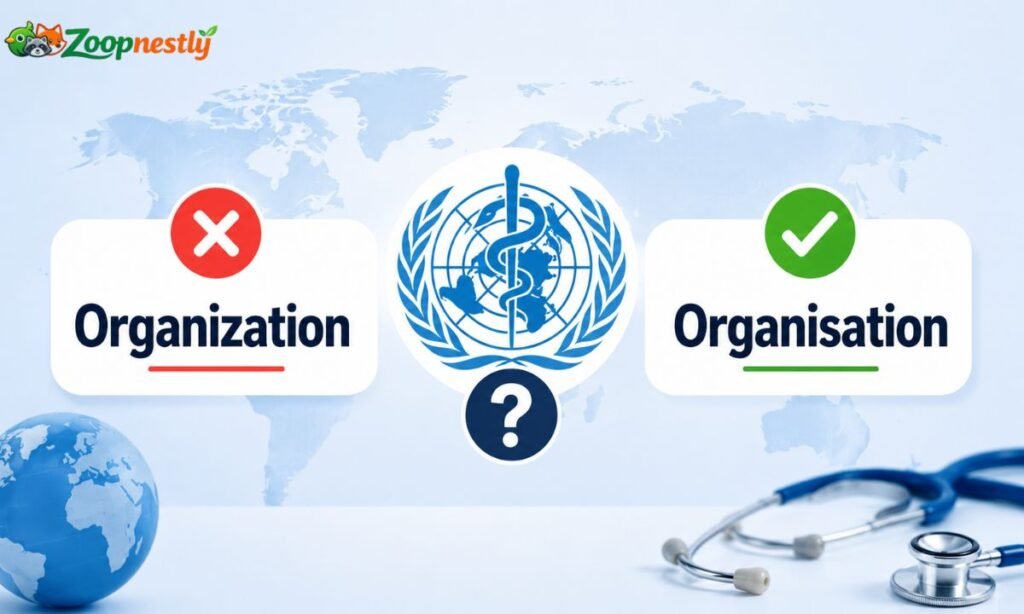
This one confuses people because it seems like an exception, but it isn’t. The World Health Organization officially uses American spelling with a “z” in its name, regardless of the country you’re writing from or which English variant you normally use. This is because it’s the organization’s official registered name, similar to a brand name that doesn’t change based on regional spelling preferences.
The same applies to other officially named organizations. Always check how the entity spells its own name, since official names override regional spelling conventions.
Example Sentences
Seeing the words in context makes the difference easier to remember:
- American: “She spent the weekend organizing her closet by color.”
- British: “She spent the weekend organising her wardrobe by colour.”
- American: “The organizer sent out the event schedule this morning.”
- British: “The organiser sent out the event schedule this morning.”
Notice how the rest of the sentence often carries other US/UK spelling differences too, like “color” vs “colour.”
Frequently Asked Questions
Is “organizing” or “organising” grammatically correct?
Both are grammatically correct. “Organizing” is standard in American English, while “organising” is standard in British English. Neither is a spelling mistake on its own.
Which spelling does Google prefer?
Google doesn’t favor one spelling over the other for ranking purposes. It shows results based on the searcher’s location and language settings, so both spellings rank well for their respective regions.
Can I use both spellings in the same document?
It’s best to pick one and use it consistently throughout. Mixing “organizing” and “organising” in the same piece looks inconsistent, even though both are individually correct.
Does Microsoft Word or Google Docs flag the wrong version?
Yes, if your document’s language setting is set to a specific English variant (like “English (US)” or “English (UK)”), spellcheck will flag the opposite spelling as incorrect, even though it’s valid in another region.
Is “organising” more formal than “organizing”?
No. Formality has nothing to do with this spelling difference. It’s purely a regional preference, not a marker of formal versus casual writing.
Conclusion
There’s no wrong choice between organizing and organising, only the right choice for your audience. American English uses “organizing,” British and Commonwealth English use “organising,” and the key is staying consistent once you pick a lane. Match your spelling to your reader’s region, keep it uniform throughout your writing, and you’ll never have to second-guess this one again.

James Walker is a content writer and language researcher with over 5 years of experience in meanings, definitions, and language-related topics. He enjoys simplifying complex terms into clear, easy-to-understand explanations. Through ZoopNestly.com, he helps readers find accurate and reliable information.