Beloved or Loved? Understanding the Key Difference
You just wrote “my beloved wife” in a card, then wondered if “my loved wife” would have sounded just as sincere. It wouldn’t, and that small swap changes the entire feel of the sentence. Many writers use beloved vs loved interchangeably, not realizing one carries deep, lasting affection while the other simply states that love exists. Picking the wrong one can flatten your message or make it sound overly formal. Here’s how to tell them apart and use each one correctly.
Quick Answer
Beloved is an adjective that means “dearly loved” and carries a stronger, more emotional or reverent tone, often used for people, memories, or things held in deep affection over time. Loved is the past tense or past participle of the verb “love,” used to state that someone or something was or is loved, in a more neutral, everyday way. Use beloved for warmth and sentiment; use loved for simple, factual statements about love.
Beloved and Loved: Core Meaning
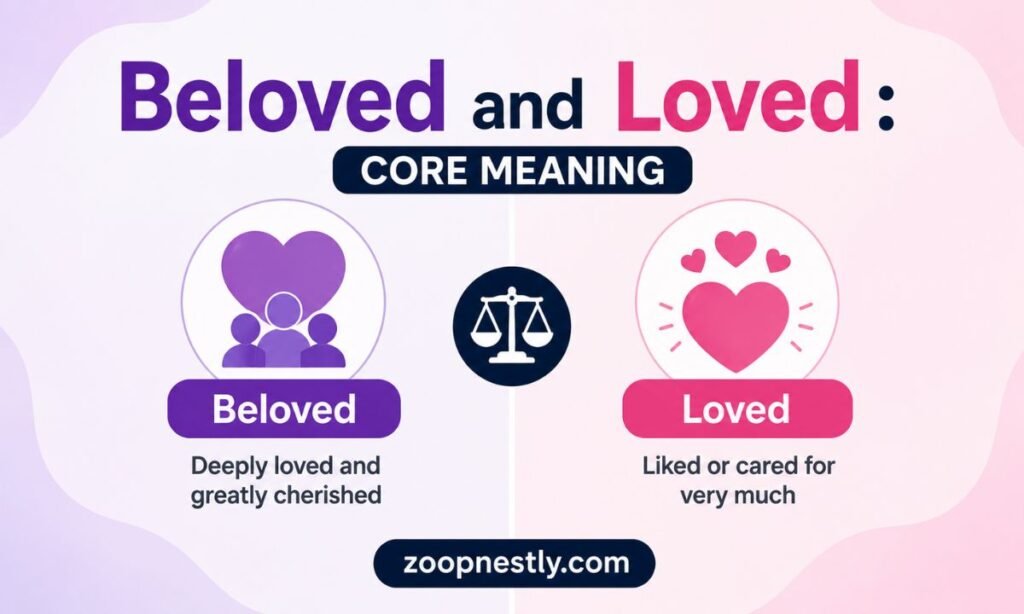
Loved comes directly from the verb “love.” It works as a simple past tense (“She loved her job”) or a past participle in passive constructions (“He is loved by everyone”). It’s neutral and functional. It tells you love exists or existed, without adding much emotional weight beyond that.
Beloved started as the past participle of “belove,” an older verb that’s no longer used on its own. Over time, “beloved” became its own standalone adjective. It means someone or something is dearly, deeply loved, often over a long period. It shows up in wedding vows, eulogies, dedications, and literature because it carries a sense of reverence that plain “loved” doesn’t.
Think of it this way: “loved” reports a fact. “Beloved” expresses a feeling.
Grammar Difference: Verb vs Adjective
This is the part most people miss. “Loved” functions as a verb form. It needs a subject and often an object:
- “I loved that movie.”
- “She was loved by her students.”
“Beloved” functions as an adjective. It describes a noun directly and usually sits before it:
- “My beloved grandmother taught me to cook.”
- “The beloved teacher retired after 30 years.”
You can’t use “beloved” the way you’d use a regular verb. You wouldn’t write “I beloved that movie.” That sentence breaks grammatically because “beloved” isn’t conjugated like “love, loved, loving.”
Contextual Examples
Seeing both words in real sentences makes the difference click faster.
Using “loved”:
- “He loved his job, even on the hard days.”
- “The children loved the story their grandfather told them.”
- “She felt loved by her whole family.”
Using “beloved”:
- “The beloved family dog passed away peacefully at age fourteen.”
- “This beloved novel has sold millions of copies worldwide.”
- “Her beloved hometown never left her heart.”
Notice how “beloved” sentences tend to describe something cherished across time, not just a single moment of affection.
Beloved vs Loved Comparison Table
| Feature | Beloved | Loved |
| Part of speech | Adjective | Verb (past tense/participle) |
| Position in sentence | Usually before the noun | After subject or in passive form |
| Tone | Warm, deep, often reverent | Neutral, factual |
| Common use | People, memories, keepsakes, tributes | Everyday statements about affection |
| Typical settings | Weddings, eulogies, literature, dedications | Casual speech, general writing |
| Example | “My beloved friend” | “I loved my friend” |
Common Mistakes to Avoid
Mistake 1: Using “beloved” as a verb. Wrong: “I beloved her for years.” Right: “I loved her for years” or “She was my beloved for years” (as a noun).
Mistake 2: Overusing “beloved” in casual writing. “Beloved” carries emotional weight. Sprinkling it into everyday texts or emails (“my beloved coworker sent the report”) can sound exaggerated or insincere. Save it for moments that genuinely call for that depth.
Mistake 3: Forgetting “beloved” can also be a noun. “Beloved” doesn’t only describe something; it can name it. “She was his beloved” means she was the person he cherished most. This usage is common in romantic and religious writing.
Mistake 4: Mismatching tense with “loved.” Since “loved” is a verb form, it must agree with the sentence’s tense and subject. “She have loved him” is incorrect; it should be “She has loved him.”
How to Pronounce Beloved

This word trips people up because it has two valid pronunciations depending on its role in the sentence:
- As an adjective before a noun, it’s often pronounced with three syllables: bih-LUV-id (as in “my beloved friend”).
- In some contexts, especially poetic or biblical text, and as a noun, it’s pronounced with two syllables: bih-LUVD (as in “she was his beloved”).
Both pronunciations are correct. The three-syllable version is more common in everyday American speech when “beloved” modifies a noun directly.
American vs British English Usage
There’s no major spelling difference between American and British English for either word. Both regions use “beloved” and “loved” the same way grammatically. The difference is more about tone and frequency. British English, particularly in formal or literary writing, tends to lean on “beloved” slightly more often in obituaries and tributes. American English uses it just as correctly, but everyday American speech often favors simpler alternatives like “dear” or “cherished” in casual contexts, reserving “beloved” for genuinely sentimental writing.
DISCOVER MORE : To Fast or Too Fast: The Right Choice for Clear Writing
Idiomatic and Common Expressions
Certain phrases have become fixed expressions with “beloved” specifically, and swapping in “loved” would sound off:
- “Dearly beloved, we are gathered here today” (wedding ceremony opening)
- “Beloved community” (a phrase associated with unity and shared belonging)
- “Beloved memory” (referring to a cherished recollection)
You won’t find equivalent fixed idioms built around “loved” in the same way, since “loved” stays functional rather than ceremonial.
Synonyms for Beloved and Loved
Knowing alternatives helps you avoid repetition and pick the most accurate word for your tone.
Synonyms for beloved: cherished, treasured, adored, dear, precious, darling
Synonyms for loved: cared for, adored, appreciated, valued, treasured
Note that “treasured” and “adored” can work for both, depending on context, but “cherished” and “precious” lean more toward the emotional weight of “beloved.”
When to Choose Beloved Over Loved
Use beloved when:
- Writing a tribute, eulogy, or dedication
- Describing someone who holds deep, lasting significance
- Aiming for a formal or literary tone
- Referring to something iconic or long-cherished (“a beloved classic”)
Use loved when:
- Making a simple statement about affection
- Writing in a conversational or everyday tone
- Using it as part of a verb phrase (“is loved,” “was loved”)
- The emotional weight of “beloved” would feel too heavy for the context
Practical Tips for Choosing the Right Word

- Ask if you’re describing a feeling or reporting a fact. If it’s a feeling that runs deep, lean toward “beloved.” If you’re just stating that love happened, “loved” works fine.
- Check the sentence structure. If the word needs to function as a verb, “beloved” won’t fit grammatically.
- Consider the setting. Formal, ceremonial, or literary writing suits “beloved.” Casual conversation or straightforward writing suits “loved.”
- Read it out loud. If “beloved” feels like it’s overselling the moment, switch to “loved” or a simpler alternative.
Quick Revision and Grammar Check
Before finalizing your writing, check these three things:
- Does “beloved” appear before a noun or stand alone as a noun? If it’s trying to act as a verb, revise it.
- Does “loved” match your sentence’s tense? Check subject-verb agreement.
- Does the tone match the context? A wedding speech can carry “beloved.” A quick text message probably doesn’t need it.
Frequently Asked Questions
Is “beloved” more formal than “loved”?
Yes. Beloved generally sounds more formal and emotionally weighted, while loved is neutral and works in both casual and formal writing.
Can “beloved” be used as a noun?
Yes. “Beloved” can refer to a person who is deeply loved, as in “she was his beloved.” This usage is common in romantic and poetic writing.
Is it grammatically correct to say “I beloved you”?
No. “Beloved” is not a verb form, so it cannot be conjugated like “love” or “loved.” Use “I loved you” or “you are my beloved” instead.
Why do wedding ceremonies use “dearly beloved” instead of “dearly loved”?
“Dearly beloved” is a traditional, fixed phrase in wedding ceremonies. It carries a formal, reverent tone that “dearly loved” doesn’t replicate in the same idiomatic way.
Does “beloved” only apply to people?
No. “Beloved” can describe places, objects, books, pets, or traditions that hold deep, lasting significance, such as “a beloved family recipe” or “a beloved hometown.”
Conclusion
The choice between beloved vs loved comes down to grammar and emotional depth. “Loved” is a simple, flexible verb form that states a fact. “Beloved” is an adjective (and sometimes a noun) that expresses deep, lasting affection, often reserved for meaningful people, memories, or moments. Once you recognize the grammatical difference and match the tone to your context, choosing between the two becomes second nature.

James Walker is a content writer and language researcher with over 5 years of experience in meanings, definitions, and language-related topics. He enjoys simplifying complex terms into clear, easy-to-understand explanations. Through ZoopNestly.com, he helps readers find accurate and reliable information.