Propose or Purpose? Learn the Correct Meaning and Usage
You’re typing an email, and your cursor hovers between two words that look almost identical. One has an “o,” the other doesn’t, but that’s not really the problem, is it? You know they mean different things, yet the second you need to use one, your brain blanks. That’s the classic propose vs purpose mix-up, and it trips up even confident writers. Here’s how to stop guessing for good.
Quick Answer
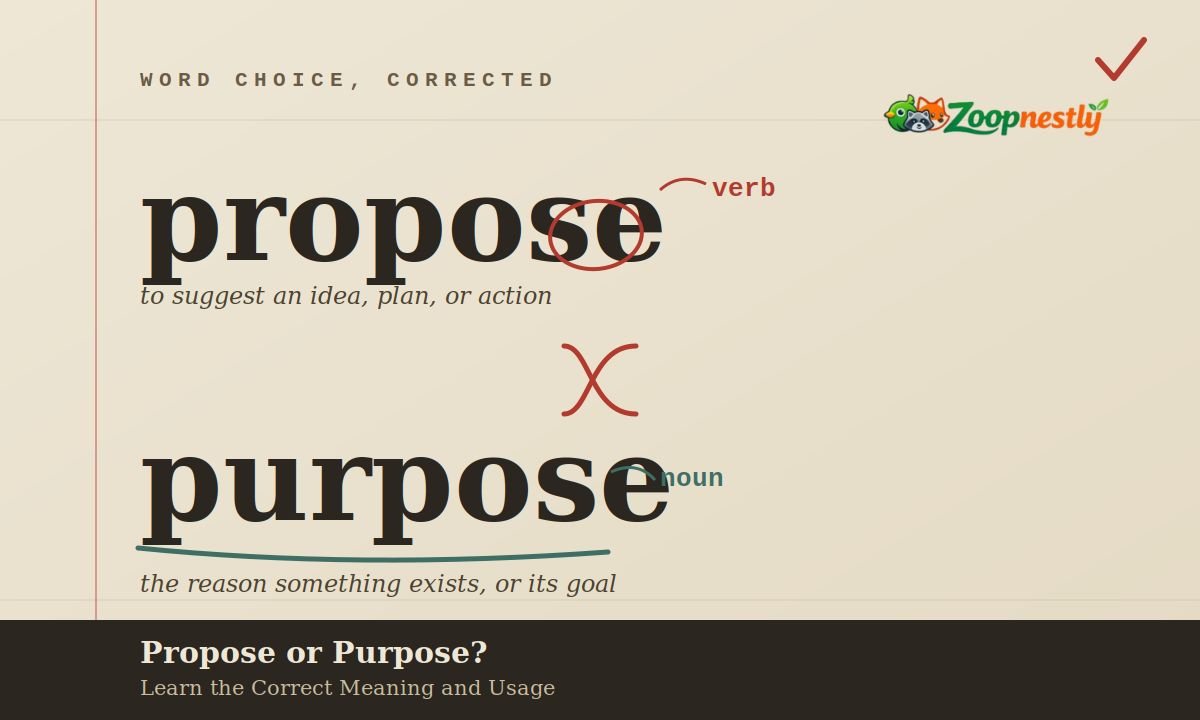
Propose is a verb that means to suggest an idea, plan, or action, or to ask someone to marry you. Purpose is a noun that means the reason something exists or the goal behind an action. If you’re suggesting something, use “propose.” If you’re talking about a reason or intention, use “purpose.”
What’s the Real Difference Between Propose and Purpose?
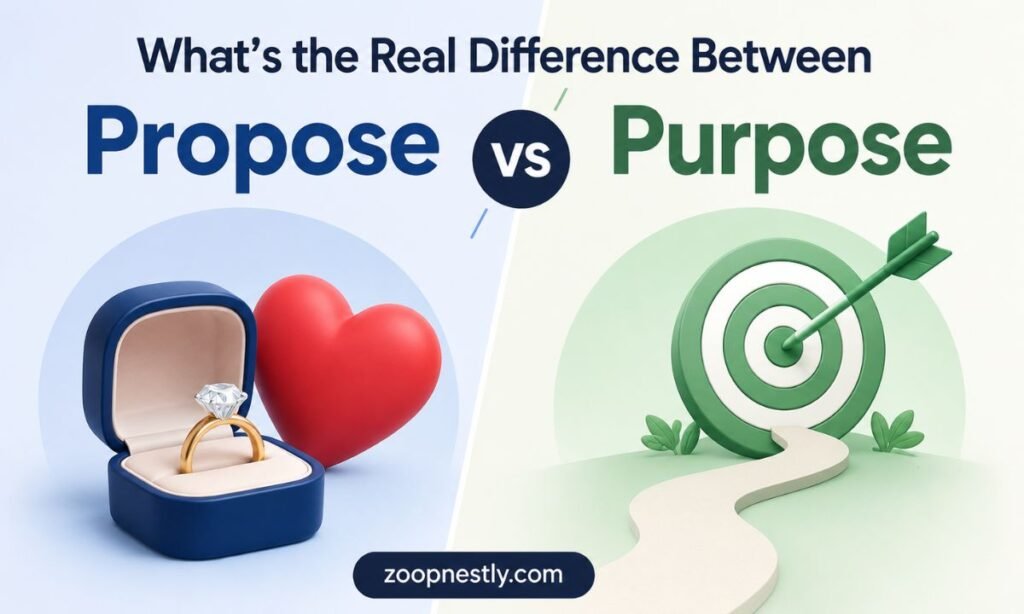
The confusion mostly comes down to how similar these words look and sound. But grammatically, they don’t overlap at all.
Propose is almost always a verb. It describes an action, specifically the act of putting an idea forward for consideration.
Purpose is almost always a noun. It describes a thing, specifically the reason or intention behind something.
Once you separate them by function (action vs. thing), the rest becomes much easier.
What Does “Propose” Mean?
To propose means to suggest a plan, idea, or course of action for others to consider. It’s what happens in meetings, negotiations, debates, and yes, marriage proposals.
Common contexts where “propose” shows up:
- Suggesting a business plan or policy change
- Nominating someone for an award or position
- Asking someone to marry you
- Offering a theory or hypothesis
Example sentences:
- The manager will propose a new schedule at Monday’s meeting.
- Scientists propose that the change is linked to rising temperatures.
- He plans to propose to his girlfriend this weekend.
Notice the pattern: someone is actively putting an idea out there for approval or consideration.
What Does “Purpose” Mean?
Purpose refers to the reason something exists, the goal behind an action, or a person’s sense of direction in life. Unlike “propose,” it’s a noun, not an action.
Common contexts where “purpose” shows up:
- The intended function of an object or tool
- The goal of a project or task
- A person’s sense of meaning or motivation
- The intent behind a decision
Example sentences:
- The purpose of the meeting is to review last quarter’s sales.
- This tool has one main purpose: cutting wire cleanly.
- She finally found her sense of purpose after switching careers.
If you can replace the word with “reason,” “goal,” or “intention” and the sentence still makes sense, “purpose” is the right choice.
Propose vs Purpose at a Glance
| Feature | Propose | Purpose |
| Part of speech | Verb | Noun |
| Meaning | To suggest or offer an idea | A reason or goal |
| Common use | Meetings, plans, marriage | Intentions, function, meaning |
| Example | “I propose we start earlier.” | “What’s the purpose of this form?” |
| Related forms | Proposal, proposed, proposing | Purposeful, purposefully, purposeless |
Propose vs Purpose Pronunciation
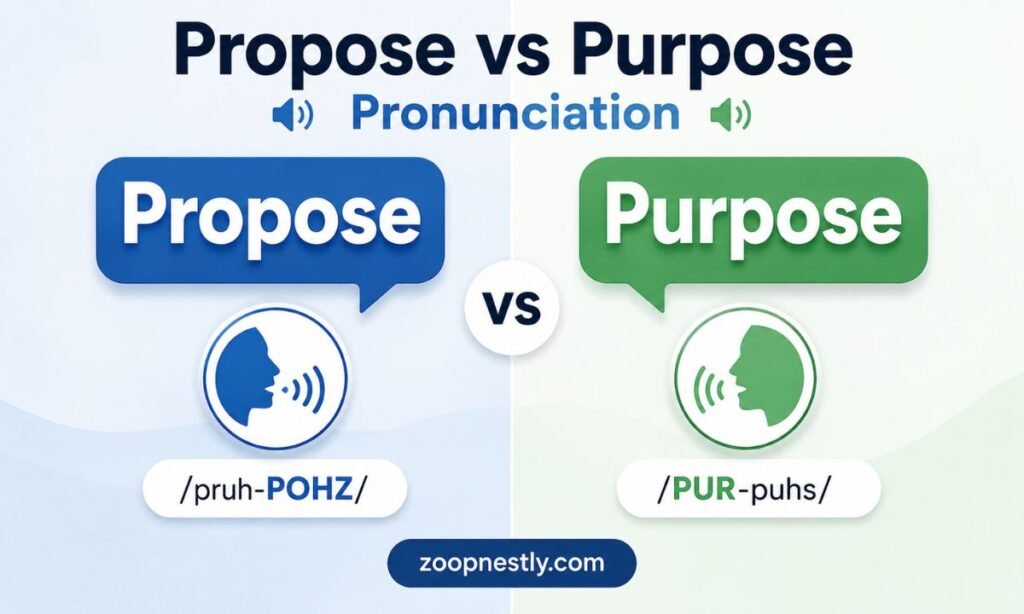
Even though they’re spelled similarly, they don’t sound the same once you break them down.
- Propose: pruh-POHZ (stress on the second syllable, ends with a “z” sound)
- Purpose: PUR-pus (stress on the first syllable, ends with a soft “s” sound)
Saying both words out loud a few times helps train your ear to catch the difference, which often prevents the writing mistake before it happens.
How to Use “Propose” in a Sentence
Since “propose” is a verb, it needs a subject performing the action. Watch how it changes form depending on tense:
- Present: I propose we change the vendor.
- Past: The committee proposed a new budget last week.
- Future: She will propose an alternative route.
- Gerund form: Proposing changes without data rarely works well.
A helpful test: if you can add “to” before it and it still makes sense as an action (“to propose an idea”), you’re using the verb correctly.
How to Use “Purpose” in a Sentence
“Purpose” functions as a noun, so it usually follows an article (“a,” “the”) or a possessive (“its,” “my,” “her”).
- The purpose of this letter is to confirm your appointment.
- What’s the purpose of that switch on the wall?
- He works out with a clear purpose in mind.
A quick test: if the sentence answers “why” or “what for,” “purpose” is almost certainly correct.
Propose or Purpose for Marriage?
This is where a lot of people genuinely get stuck, and it’s an easy one to fix once you know the rule.
When someone asks another person to marry them, the correct word is always propose, never “purpose.” You “propose marriage” or you “propose to” someone. “Purpose” has no romantic or marital meaning at all, even though the phrase sounds like it could fit.
Correct: He got down on one knee to propose. Incorrect: He got down on one knee to purpose.
If you remember nothing else from this article, remember that marriage proposals only ever involve the word “propose.”
DISCOVER MORE : Beloved or Loved? Understanding the Key Difference
Common Mistakes to Avoid
Most errors with these two words fall into a few predictable patterns:
- Using “purpose” as a verb. “I purpose that we meet Friday” is incorrect. It should be “I propose that we meet Friday.”
- Using “propose” where a noun is needed. “What’s the propose of this meeting?” is incorrect. It should be “What’s the purpose of this meeting?”
- Confusing “proposal” and “purpose.” A proposal is the suggested plan itself; a purpose is the reason behind it. They’re related but not interchangeable.
- Autocorrect swaps. Because the words share letters, spell-checkers sometimes “correct” one into the other, especially on mobile devices. Always proofread manually before sending important messages.
Simple Tricks to Remember the Difference

If the grammar rules don’t stick right away, try one of these memory shortcuts:
- “Propose” has an “o” for “offer.” You offer or suggest an idea when you propose.
- “Purpose” rhymes with “reason.” Not literally, but both end in that soft “s” sound, and both answer “why.”
- Think of a proposal as an action step and a purpose as the destination. You propose a plan to achieve a purpose.
Pick whichever trick clicks for you and it’ll likely stay with you the next time you hit that mental pause.
Related Word Forms Worth Knowing
Understanding the family of words around “propose” and “purpose” makes both easier to use correctly.
- Proposal (noun): a plan or suggestion put forward. “The board rejected the proposal.”
- Proposed (adjective/past tense): suggested or offered. “The proposed budget cuts jobs.”
- Purposeful (adjective): done with intention. “She walked with purposeful strides.”
- Purposefully (adverb): in an intentional way. “He purposefully avoided the topic.”
- Purposeless (adjective): lacking direction or intent. “The meeting felt purposeless.”
Knowing these related forms helps you recognize the root word even when it’s dressed up differently in a sentence.
Frequently Asked Questions
Is it “propose” or “purpose” when suggesting an idea?
Use propose. It’s the verb form for offering a suggestion, plan, or idea for others to consider.
Can “purpose” ever be used as a verb?
Rarely, and mostly in older or formal writing, “purpose” can mean “to intend.” In everyday modern English, though, it’s treated as a noun, so stick with “propose” for suggesting something.
What’s the difference between “propose” and “proposal”?
“Propose” is the action of suggesting something, while “proposal” is the noun for the suggestion itself. You propose an idea, and that idea becomes a proposal.
Why do people confuse propose and purpose so often?
The two words share several letters and a similar rhythm when spoken quickly, which makes it easy to type one when you mean the other, especially under time pressure.
How do I quickly check which word I need in a sentence?
Ask whether the word is doing an action or naming a reason. If it’s an action (suggesting something), use “propose.” If it’s a reason or goal, use “purpose.”
Conclusion
The propose vs purpose confusion usually comes down to one simple check: is the word acting, or is it naming a reason? “Propose” suggests or offers, and “purpose” explains why. Once that distinction feels natural, you’ll catch the mix-up before it ever reaches your reader, whether you’re drafting a work email, planning a proposal, or just trying to get your point across clearly.

James Walker is a content writer and language researcher with over 5 years of experience in meanings, definitions, and language-related topics. He enjoys simplifying complex terms into clear, easy-to-understand explanations. Through ZoopNestly.com, he helps readers find accurate and reliable information.