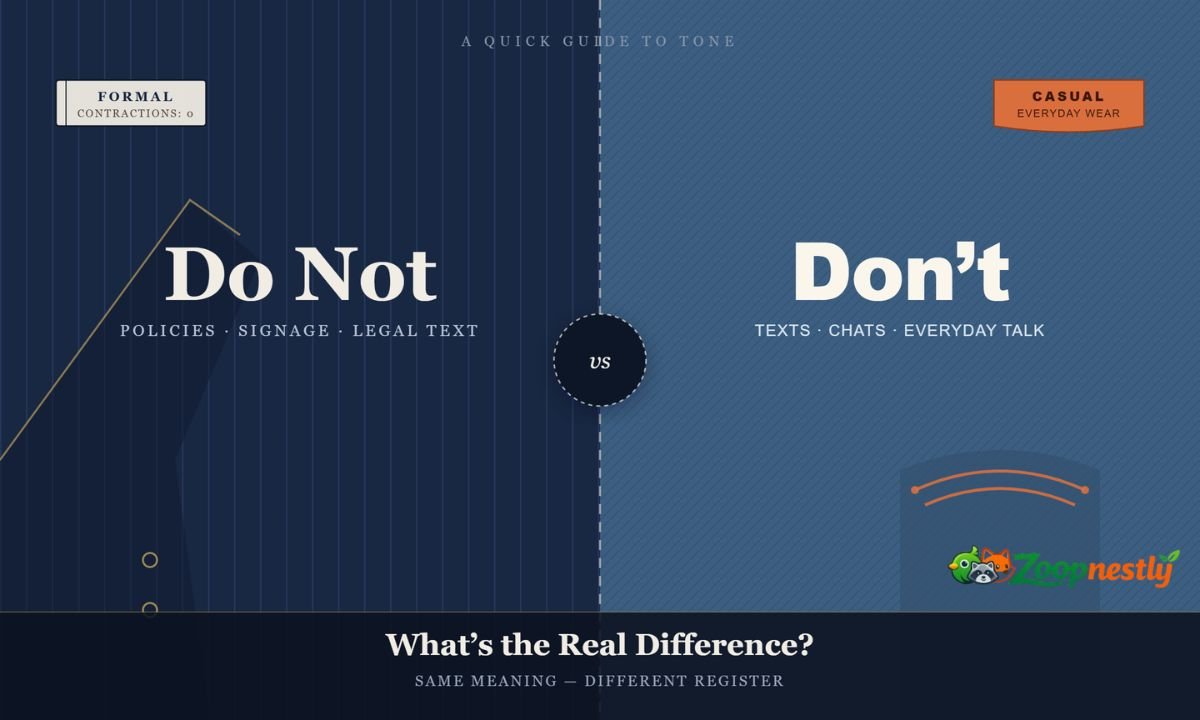
Do Not vs Don’t: What’s the Real Difference?
You’re halfway through an email to your boss and your cursor stalls on one word. Should it be “do not” or “don’t”? Pick wrong and a formal message can sound stiff, or a casual note can feel oddly bossy. This mix-up trips up even confident writers because do not vs don’t isn’t really about grammar rules. It’s about tone, context, and what you want your words to feel like.
Quick Answer
Do not and don’t mean exactly the same thing grammatically. Do not is the full, uncontracted form used in formal writing, legal text, and emphatic statements. Don’t is the contraction used in speech, casual writing, and everyday communication. Neither is more “correct” than the other; the choice depends on your audience and tone.
The Basic Idea: Same Meaning, Different Register
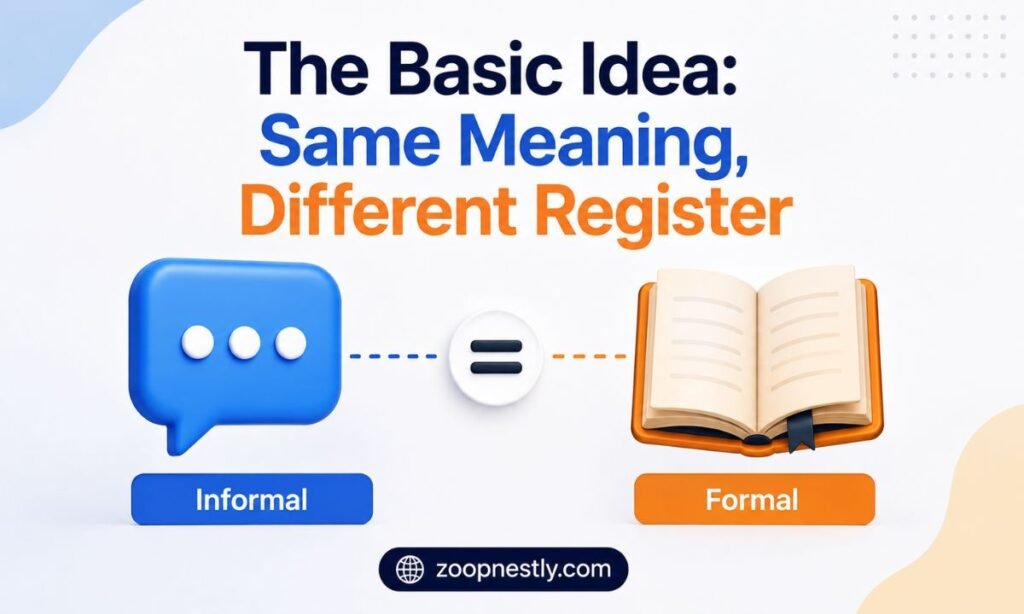
“Do not” and “don’t” both negate the verb “do.” There’s no rule in English grammar that makes one version more accurate than the other. The difference lives entirely in register, which is just a fancy word for how formal or casual your language sounds.
Think of it like clothing. “Do not” is a suit. “Don’t” is jeans and a t-shirt. Both are appropriate, just for different occasions.
- Do not leave the door unlocked.
- Don’t leave the door unlocked.
Same instruction. Same meaning. Different feel.
Where “Do Not” Fits Best
Use the full form “do not” when you want your writing to sound serious, official, or emphatic.
Formal and legal writing Contracts, policies, safety notices, and academic papers almost always use “do not.” It reads as precise and authoritative.
- Employees do not have access to the server room after hours.
- Do not operate this equipment without protective gear.
Professional communication Business emails to clients, official announcements, and reports often lean on “do not” to sound polished.
- We do not currently offer refunds on digital products.
Emphasis Sometimes “do not” is chosen on purpose, even in casual speech, to stress a point. Saying it slowly and fully adds weight.
- I do not want to go to that meeting. (stronger than “I don’t want to go”)
Where “Don’t” Fits Best
The contraction “don’t” is the natural choice for everyday speech and relaxed writing.
Conversational tone Texts, chats, blog posts, and most spoken English use contractions because that’s how people actually talk.
- I don’t have time today.
- Don’t forget your umbrella.
Casual or friendly writing Marketing copy, social media captions, and personal emails often use “don’t” to sound approachable rather than distant.
- Don’t miss our weekend sale.
Dialogue in fiction Characters in stories almost always speak in contractions unless the writer is deliberately making them sound formal, robotic, or old-fashioned.
Example Sentences Side by Side
| Situation | Do Not (Formal) | Don’t (Casual) |
| Warning sign | Do not enter without authorization. | Don’t go in there. |
| Email to a colleague | Please do not share this file externally. | Please don’t share this with anyone else. |
| Instructions | Do not remove the safety cover. | Don’t take the cover off. |
| Advice to a friend | I do not recommend that route. | I don’t think you should go that way. |
| Social media post | We do not tolerate hate speech. | We don’t put up with that here. |
Don’t vs Didn’t: A Related Mix-Up
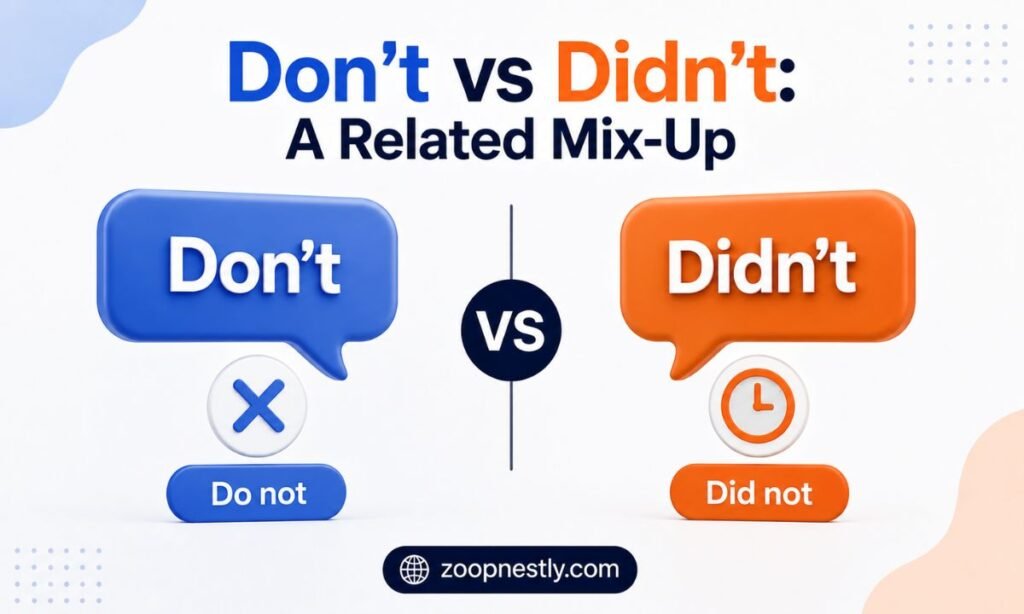
“Don’t” and “didn’t” get confused because they look and sound similar, but they refer to different tenses.
- Don’t is the contraction of “do not,” used for present tense actions or general habits.
- Didn’t is the contraction of “did not,” used for past tense actions.
Examples:
- I don’t eat meat. (a current habit)
- I didn’t eat meat yesterday. (a specific past event)
Mixing these up changes the timeline of your sentence, so it’s worth double checking which tense you actually mean.
Common Mistakes and How to Fix Them
Mistake 1: Using “don’t” in formal documents Contracts, resumes, and official reports should stick to “do not” for a consistent, professional tone.
- Wrong: Applicants don’t need to submit references.
- Better: Applicants do not need to submit references.
Mistake 2: Mixing contracted and uncontracted forms in the same piece Consistency matters. If your document uses “do not” throughout, don’t suddenly switch to “don’t” in one sentence, and vice versa.
- Inconsistent: Do not submit late applications. Also, don’t forget the cover letter.
- Consistent: Do not submit late applications. Also, do not forget the cover letter.
Mistake 3: Confusing “don’t” with “doesn’t” “Don’t” pairs with I, you, we, and they. “Doesn’t” pairs with he, she, and it.
- Wrong: She don’t like coffee.
- Correct: She doesn’t like coffee.
Mistake 4: Overusing “do not” in casual writing Using the full form everywhere can make friendly content feel cold or robotic. Blog posts, captions, and casual emails usually read better with contractions.
American vs British English
Both American and British English use “do not” and “don’t” the same way. There’s no regional rule that favors one form over the other. The choice comes down to formality, not geography. That said, British English style guides tend to be slightly more accepting of contractions in semi-formal writing, like internal memos, compared to some strict American corporate style guides.
DISCOVER MORE : To Early or Too Early: Which Phrase Is Grammatically Correct?
When Style Guides Disagree
Not every organization agrees on when to contract. Some notes worth knowing:
- AP Style (used by journalists) generally allows contractions to keep writing natural and readable.
- Academic style guides like APA and MLA often prefer “do not” in formal papers, though contractions are increasingly accepted in less formal academic writing.
- Legal writing almost always avoids contractions entirely to prevent ambiguity.
If you’re writing for a specific publication or company, check their style guide first. When in doubt, match the tone of the piece around you.
Idiomatic and Special Uses
Some expressions only work with one form.
- “Don’t” appears in fixed phrases like “Don’t mention it” or “I don’t think so,” which sound unnatural with “do not.”
- “Do not” shows up in official warnings and signage, like “Do Not Disturb” or “Do Not Enter,” where the full form signals seriousness at a glance.
These fixed expressions have become standard through common usage, so swapping the form usually sounds off, even if it’s grammatically fine.
Does It Change Meaning in Questions or Negative Emphasis?
Negation with “do” also shows up in questions and emphatic statements, and the same formality rule applies.
- Do you not see the problem? (formal, emphatic)
- Don’t you see the problem? (casual, more common in speech)
Both are grammatically correct. The uncontracted version in a question often sounds more pointed or incredulous, while the contracted version sounds like ordinary conversation.
Quick Checklist: Which Should You Use?
- Writing a legal document, policy, or academic paper? Use “do not.”
- Writing a text, email to a friend, or social post? Use “don’t.”
- Want your sentence to sound firm or emphatic? Use “do not.”
- Want your writing to sound friendly and natural? Use “don’t.”
- Writing a warning sign or safety notice? Use “do not.”
- Writing dialogue for a casual character? Use “don’t.”
- Not sure? Match the tone of the surrounding text and stay consistent.
Frequently Asked Questions
Is “don’t” grammatically incorrect?
No. “Don’t” is a standard, fully accepted contraction of “do not.” It’s appropriate in speech and most everyday writing.
Should I avoid contractions in professional emails?
Not necessarily. Many professional emails use contractions to sound approachable. Save the full “do not” for more formal or official communication, like policies or client-facing documents.
Can I use “do not” and “don’t” in the same document?
You can, but it’s best to stay consistent within a single section or type of content. Switching randomly can make writing feel uneven.
What’s the difference between “don’t” and “doesn’t”?
“Don’t” is used with I, you, we, and they. “Doesn’t” is used with he, she, and it. Both mean “do not” or “does not,” just matched to different subjects.
Why do signs always say “Do Not” instead of “Don’t”?
Signage uses “do not” because the full form reads as more authoritative and serious at a glance, which matters for warnings and safety instructions.
Final Thoughts
The do not vs don’t choice isn’t about right or wrong. It’s about matching your words to your audience and purpose. Use “do not” when you want precision, formality, or emphasis. Use “don’t” when you want your writing to sound natural and conversational. Once you start noticing the tone shift between the two, picking the right one becomes second nature.

James Walker is a content writer and language researcher with over 5 years of experience in meanings, definitions, and language-related topics. He enjoys simplifying complex terms into clear, easy-to-understand explanations. Through ZoopNestly.com, he helps readers find accurate and reliable information.