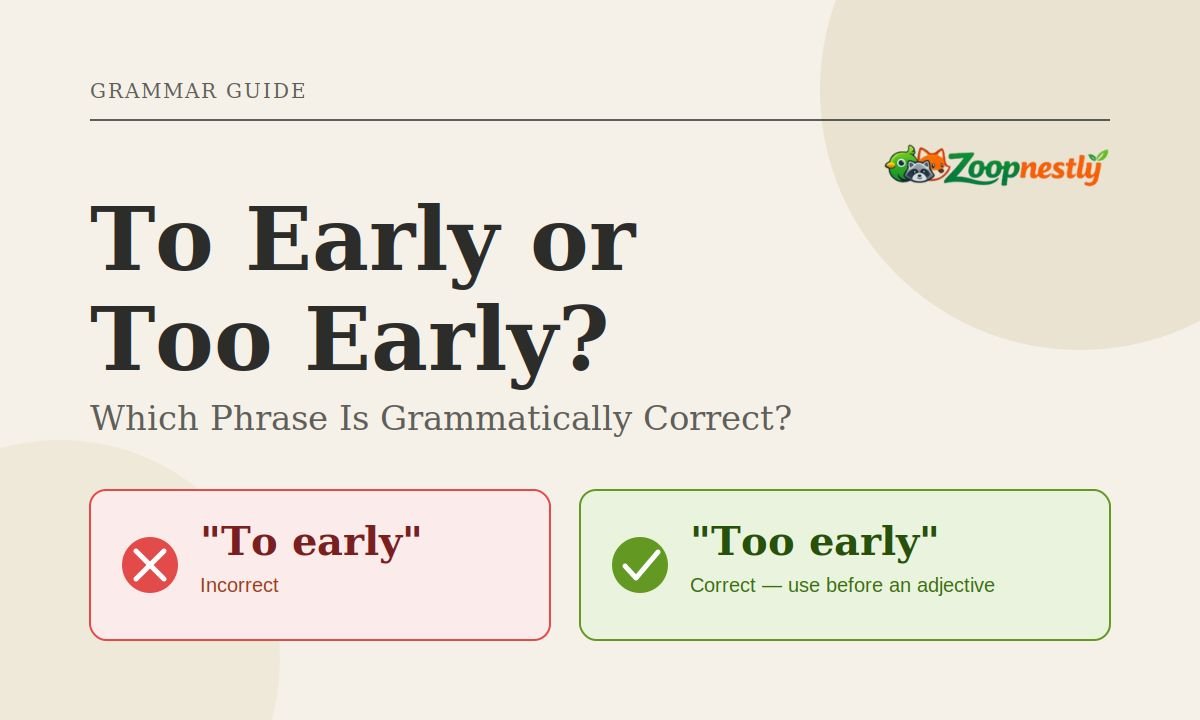
To Early or Too Early: Which Phrase Is Grammatically Correct?
You’re texting a friend about leaving for the airport, and your fingers type “is it to early to leave?” Something feels off, but you’re not sure why. This mix-up between to early or too early trips up even confident writers, because the two words sound identical but play completely different roles in a sentence. Once you see the pattern, you’ll never second-guess it again.
Quick Answer
Too early is the correct phrase, not “to early.” Too means “excessively” or “more than needed,” so it’s the word you use before an adjective like “early.” To is a preposition showing direction or connection (as in “go to bed”), and it can never modify an adjective on its own.
To vs Too: The Core Difference
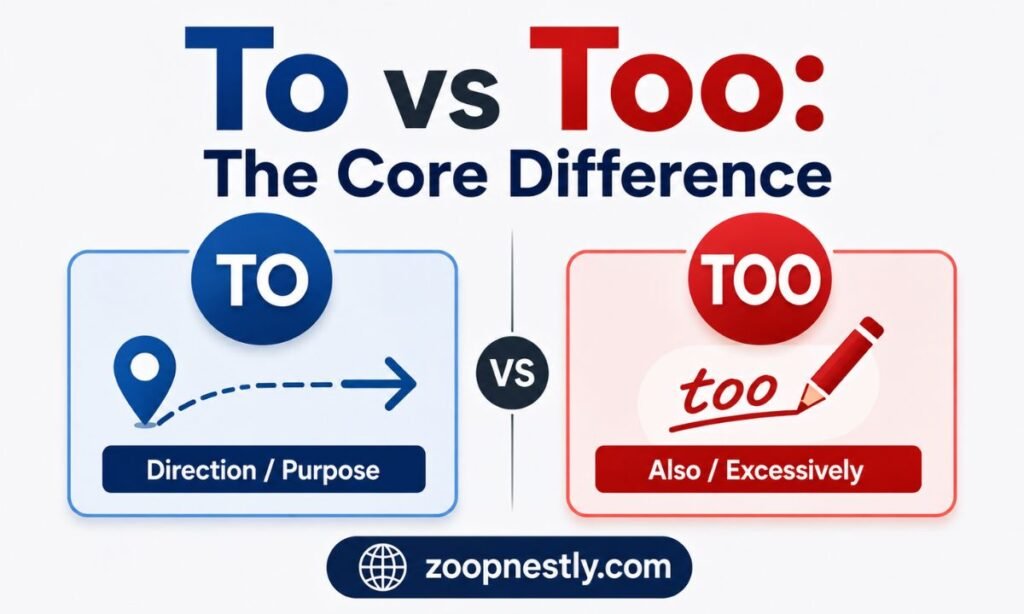
The confusion comes down to two small words that sound exactly alike but do different jobs.
To is a preposition or part of an infinitive verb. It points toward a place, time, person, or action.
- I’m going to the store.
- She wants to leave.
Too is an adverb meaning “excessively,” “also,” or “as well.” It intensifies an adjective or another adverb.
- The coffee is too hot.
- I want to come too.
Since “early” is an adjective, only too can pair with it correctly. “To early” has no grammatical function in English, which is why it always reads as a typo rather than an alternate spelling.
Why “Too Early” Is the Correct Form
Think about what the sentence is actually saying. When you write “it’s too early to leave,” you’re describing a degree, meaning the timing exceeds what’s appropriate or expected. That’s exactly the job of too.
“To” simply cannot do this. It has no meaning attached to intensity or excess. Try removing “early” from a sentence with “to” and see if it still makes sense on its own: “I went to” doesn’t work without a destination. But “too” can stand alone and still carry meaning: “Me too.”
That structural difference is the fastest way to confirm which word belongs.
To Early or Too Early in a Sentence
Here’s how the correct and incorrect forms look side by side.
Correct Usage Examples
- It’s too early to tell if the plan will work.
- We arrived too early for the movie, so we waited outside.
- Don’t you think 6 a.m. is too early to call someone?
- The doctor said it’s too early to diagnose anything.
- She woke up too early and couldn’t fall back asleep.
Incorrect Usage Examples
- ~~It’s to early to tell.~~
- ~~We got there to early.~~
- ~~Is 6 a.m. to early to call?~~
None of these incorrect versions form a complete grammatical thought, because “to” has nothing to attach to after “early.”
Context Variations
“Too early” shifts slightly depending on context, but the spelling never changes.
- Time-based: “It’s too early for lunch.”
- Developmental: “It’s too early in the pregnancy to know the gender.”
- Emotional/social: “It felt too early to say I love you.”
- Professional: “It’s too early in the project to estimate costs.”
To Early vs Too Early: Quick Comparison
| Phrase | Correct? | Why |
| Too early | Yes | “Too” correctly modifies the adjective “early” |
| To early | No | “To” cannot modify an adjective; it needs a noun or verb after it |
| Too early to tell | Yes | Common phrase meaning insufficient information exists yet |
| To early to tell | No | Grammatically incomplete and meaningless |
Common Mistakes with “To Early or Too Early”
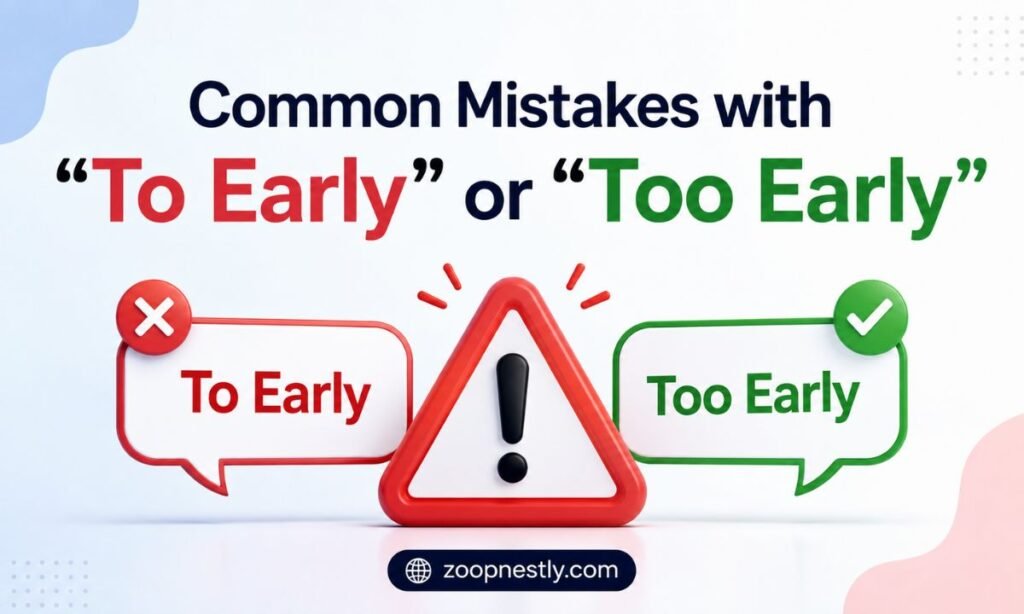
This mix-up isn’t about not knowing grammar. It usually comes down to speed, autocorrect, or the fact that the words are homophones.
- Typing too fast: Your brain says “too” but your fingers drop the extra “o.”
- Autocorrect gone wrong: Some keyboards default to the shorter word “to” if you type quickly.
- Confusing it with “two”: Some writers also slip and use “two early,” which is a different error entirely, since “two” is a number.
- Assuming interchangeability: Some assume “to” and “too” are stylistic variants. They’re not. They serve entirely separate grammatical purposes.
A simple proofreading pass, reading your sentence out loud, usually catches this instantly.
How Do You Remember the Difference?
A few memory tricks make this permanent:
- Count the O’s. “Too” has two O’s, and it often relates to “too much” or “also” (also has extra meaning, just like the extra O).
- Swap test. Replace the word with “also.” If the sentence still makes sense, “too” is correct. “It’s too early” becomes “it’s also early”-ish in logic (excess), while “to early” fails the swap completely.
- Ask what follows. If the next word is a noun or verb (to school, to run), use “to.” If the word before it is an adjective or adverb being intensified (too fast, too early), use “too.”
These tricks work because they target the actual grammatical function, not just memorization.
DISCOVER MORE : Unselect or Deselect: Which One Should You Actually Use?
Is “Too Early” Formal or Informal?
Too early works in both formal and informal writing. It’s not slang, and it’s not casual shorthand. You’ll see it in:
- Business emails: “It’s too early to confirm the launch date.”
- Academic writing: “It is too early in the research to draw conclusions.”
- Everyday conversation: “Ugh, it’s too early for this.”
The phrase itself doesn’t change tone. What changes is the surrounding sentence structure and word choice around it.
Too Early Synonyms and Alternatives
Depending on context, you can swap “too early” for other phrases without losing meaning:
- Premature
- Ahead of schedule
- Before its time
- Not yet time
- Prematurely
- Jumping the gun
Example: “It’s premature to announce the results” carries a similar meaning to “It’s too early to announce the results,” though “premature” often sounds more formal.
“Too Early” vs Similar Phrases
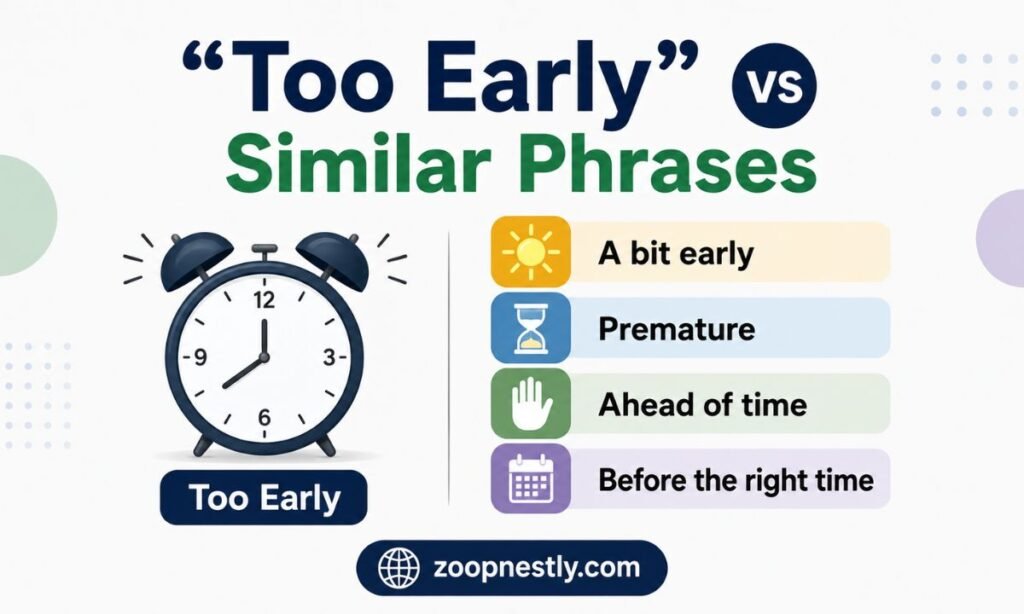
It helps to see how “too early” compares to related time expressions people often confuse it with.
| Phrase | Meaning | Example |
| Too early | Before the appropriate or expected time | Too early to leave |
| Too soon | Very close in time to something else, often unexpected | Too soon to move on |
| Ahead of time | Done in advance, often intentionally | Prepared ahead of time |
| Premature | Happening before proper development or readiness | A premature decision |
While these phrases overlap, “too early” is the most neutral and widely used option in everyday English.
A Simple Test You Can Apply Right Now
Next time you’re unsure whether to write “to early” or “too early,” ask yourself: is this word describing an amount or degree? If yes, it’s “too.” If the word is connecting to a destination, action, or noun, it’s “to.” This one question resolves the confusion almost every time, regardless of the sentence.
Frequently Asked Questions
Is it “too early” or “to early”?
It’s always too early. “To early” is grammatically incorrect because “to” cannot modify an adjective like “early.”
Why do people confuse “to” and “too”?
Because they’re homophones, meaning they sound identical when spoken. The confusion happens in writing, not speech, since your ear can’t tell the difference.
Can “to early” ever be correct?
No. There’s no grammatical context in standard English where “to early” is the correct phrase. It’s always a mistake for “too early.”
What’s an easy way to remember “too” means “excessive”?
Remember that “too” has two O’s, just like the idea of “too much” involves more than one of something.
Is “too early” the same as “premature”?
They’re close in meaning but not identical. “Too early” is neutral and simple, while “premature” often implies something happened before it was properly ready or developed, which can carry a slightly more formal or clinical tone.
Final Thoughts
The rule behind to early or too early is simple once you separate what each word actually does. “To” points toward something. “Too” adds intensity or degree. Since “early” needs a word that shows excess, “too early” is the only correct choice. Keep the two-O trick in mind, and you’ll never mix them up again.

James Walker is a content writer and language researcher with over 5 years of experience in meanings, definitions, and language-related topics. He enjoys simplifying complex terms into clear, easy-to-understand explanations. Through ZoopNestly.com, he helps readers find accurate and reliable information.