Unselect or Deselect: Which One Should You Actually Use?
You’re writing button copy or documentation, and you type “unselect.” Then you second-guess yourself and change it to “deselect.” Then you switch back. Sound familiar? This tiny word choice trips up writers, developers, and designers constantly, because both terms look correct and both show up in real software. The good news: there’s a clear, practical answer to unselect or deselect, and once you know it, you’ll never hesitate again.
Quick Answer
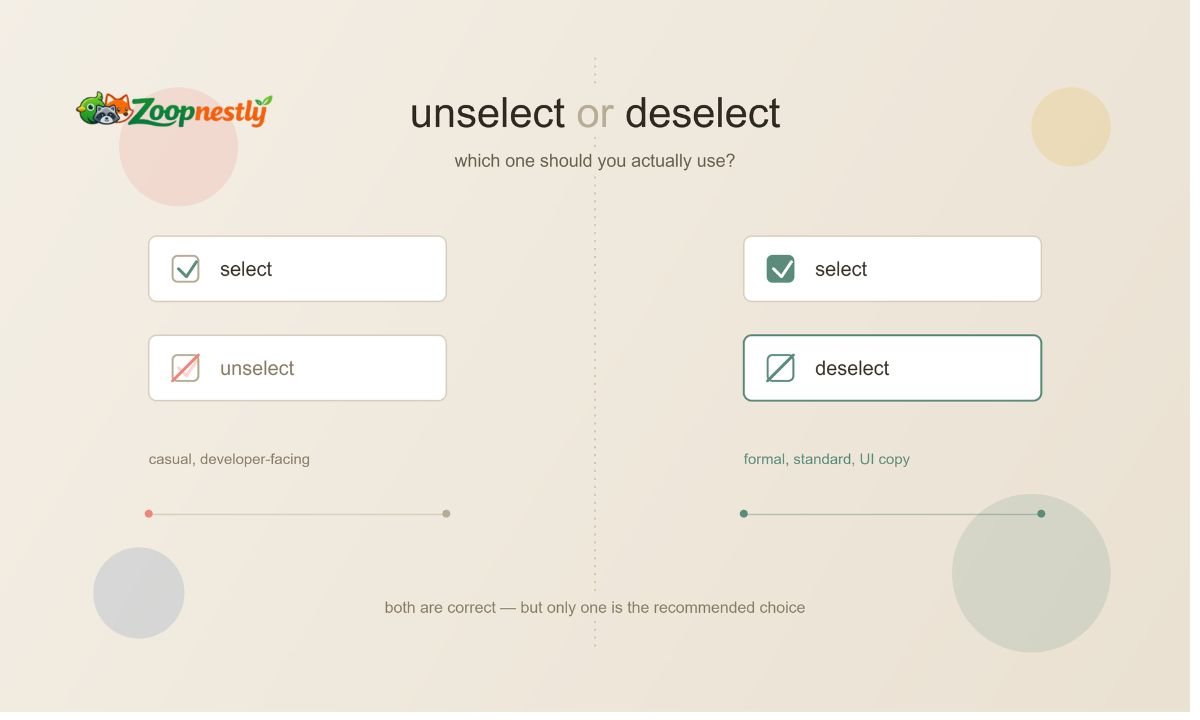
Deselect is the standard, widely accepted term for removing a selection, and it’s the one style guides and major software companies favor. Unselect is technically valid and understood by everyone, but it’s less common and sounds slightly informal. For UI copy, documentation, or anything formal, choose deselect.
What Do Unselect and Deselect Actually Mean?
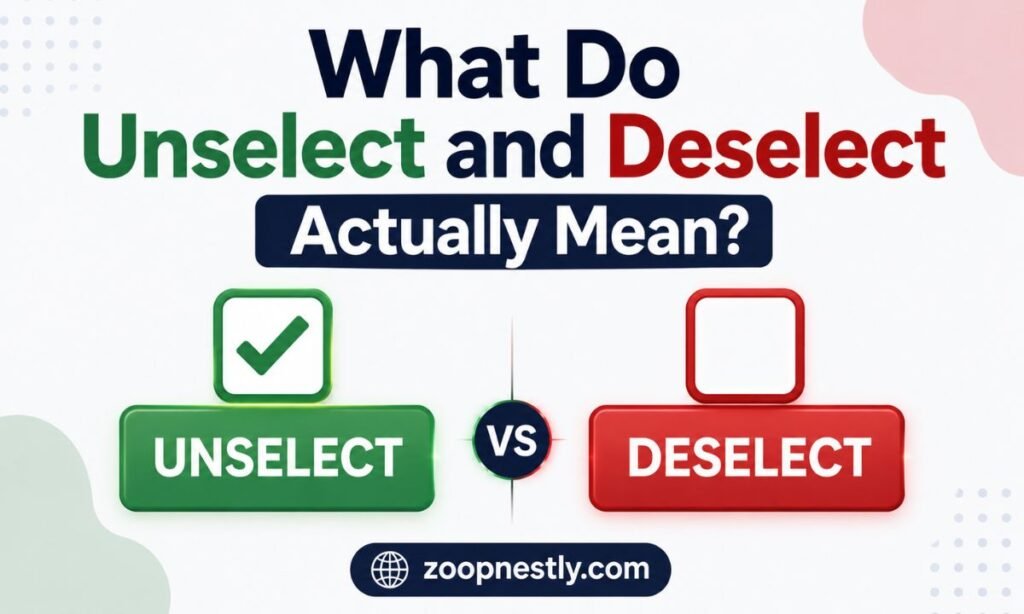
Both words describe the same action: reversing a selection. If you’ve clicked a checkbox, highlighted text, or picked an item from a list, unselecting or deselecting it means undoing that choice.
- Deselect: to remove the selected status from an item
- Unselect: to cancel or reverse a selection
Semantically, they’re identical. The difference isn’t meaning, it’s usage and register. English forms negative or reversive verbs two main ways: the prefix de- (which implies reversing a process, like decode or defrost) and the prefix un- (which implies negating a state, like unlock or untie). Both prefixes work on “select,” which is exactly why this confusion exists.
Which One Is Correct: Unselect or Deselect?
Both are grammatically correct English words. Neither is a typo or an error. But “correct” and “preferred” aren’t the same thing.
Deselect is the term you’ll find in style guides for major operating systems, design systems, and technical writing standards. It reads as more precise and slightly more formal, which is why it dominates professional software interfaces.
Unselect is common in casual speech and in some codebases, especially where developers name functions or variables. It’s not wrong, but it can feel a notch less polished in user-facing text.
If you need one rule to remember: when in doubt, deselect wins in professional contexts, and unselect is acceptable in casual or conversational ones.
Unselect vs Deselect: Quick Comparison
| Factor | Deselect | Unselect |
| Formality | More formal, standard | More casual |
| Common in UI copy | Yes, widely used | Less common |
| Common in code/dev naming | Sometimes | Frequently |
| Dictionary status | Widely recognized | Recognized, less standard |
| Recommended for documentation | Yes | Use sparingly |
Real-World Examples by Context
Seeing both words in actual use makes the distinction much clearer than any rule alone.
Desktop File Manager
“Hold Ctrl and click a file to deselect it from the group.”
File managers on Windows, macOS, and Linux almost always use “deselect” in menus and help text, since it matches the formal tone of system documentation.
Web Form Checkbox
“Click the checkbox again to deselect this option.”
Checkbox behavior is one of the most common places this word appears, and “deselect” is the near-universal standard here.
Command-Line Tool
git reset can unselect staged files before a commit.
Developer tools and command-line documentation lean more casual, so “unselect” shows up more often in this space, especially in comments and internal tooling.
Design Documentation
“The component should visually indicate when an item is deselected, using a border change instead of color alone.”
Design systems and accessibility documentation typically favor “deselect” because it aligns with formal spec writing.
Mobile App Toggle
“Tap the icon again to unselect the filter.”
Mobile apps sometimes use “unselect” in casual, friendly copy aimed at everyday users, particularly in social or lifestyle apps.
Common Mistakes to Avoid
Getting the word right is only half the battle. Here’s where writers commonly slip up.
Mixing both forms in the same interface. If your app says “Select All” and “Deselect All” on one screen but “Unselect” somewhere else, it looks inconsistent and unpolished. Pick one term and use it everywhere.
Using “unselect” as a noun. Neither word works as a noun. You wouldn’t write “click the unselect,” you’d write “click deselect” or “click the deselect option.”
Confusing verb tense. “I deselected the item” is correct past tense. “I deselect the item” works for present tense instructions. Mixing tenses mid-sentence confuses readers, especially in step-by-step instructions.
Dangling modifiers with evidential phrases. Avoid sentences like “After deselecting, the list refreshes automatically,” without clarifying who or what performs the action. Be explicit: “After you deselect the item, the list refreshes automatically.”
Casual language in formal documentation. Using “unselect” in a formal spec or enterprise product manual can read as inconsistent with the rest of your tone. Match your word choice to your document’s overall formality.
Is There a Better Synonym for Unselect or Deselect?
Sometimes neither word fits the tone you want. Useful alternatives include:
- Clear selection (common in toolbars and menus)
- Remove from selection
- Toggle off
- Uncheck (specific to checkboxes)
- Cancel selection
“Uncheck” deserves special mention. It’s the correct, more specific term when you’re literally talking about a checkbox, rather than a highlighted item or list selection. Using “deselect” for a checkbox isn’t wrong, but “uncheck” is often clearer to everyday users.
American vs British English Differences
There isn’t a strong regional split here the way there is with words like “colour” versus “color.” Both unselect and deselect appear in American and British technical writing.
That said, deselect shows up slightly more consistently across major operating systems regardless of region, since most global software companies standardize their terminology across English variants for localization purposes. If you’re localizing an interface into British English, you generally don’t need to change this term at all, unlike true spelling differences.
Idiomatic Expressions and Natural Pairings
Certain words pair naturally with “select” and “deselect” in everyday English. Recognizing these collocations helps your writing sound more natural.
- “Select or deselect” is the most common paired phrase in instructions
- “Check or uncheck” pairs specifically with checkboxes
- “Toggle” is often used as a verb when an action switches between two states repeatedly, rather than a one-time selection
When to Use Toggle Instead of Deselect
Use toggle when an action flips back and forth between two states with a single control, like a light switch. Use deselect when you’re specifically describing the removal of a selection, especially from a group or list. “Toggle the filter on and off” reads naturally, while “deselect the filter on and off” doesn’t, since deselect implies a single directional action.
Words Built with the De- Prefix
The de- prefix is common in technical English because it clearly signals reversal of a process: deactivate, decompress, deselect, decode. This is part of why “deselect” feels more at home in technical writing than “unselect,” which uses the more general-purpose un- prefix found in everyday words like unlock or unwrap.
Unselect or Deselect in Excel
Microsoft Excel’s own interface and help documentation consistently use deselect when describing how to remove cells, rows, or ranges from a current selection. For example, holding Ctrl while clicking a cell will deselect that specific cell from a larger selected range.
If you’re writing tutorials, macros, or internal documentation referencing Excel, matching Microsoft’s own terminology (deselect) keeps your content consistent with what users will see in the actual software.
DISCOVER MORE : Dammit or Damnit: Which Word Should You Use?
Practical Tips for Choosing the Right Word

Pick one term and stick with it. Consistency matters more than which specific word you choose. Switching between “unselect” and “deselect” within the same product or document creates unnecessary confusion.
Match your register to your audience. Formal documentation, enterprise software, and accessibility guidelines lean toward “deselect.” Casual apps, internal tools, and developer comments can comfortably use “unselect.”
Favor clear, direct commands in UI copy. “Deselect all” is clearer than “remove selection status from all items.” Short, direct verbs work best in interfaces.
Watch for ambiguous modifiers. Always make it clear what is being deselected and by whom, especially in instructional writing.
Be deliberate with API and function naming. If you’re naming a function, deselectItem() reads as more standard across codebases than unselectItem(), though both are used in practice.
Consider accessibility and keyboard shortcuts. Screen reader announcements should clearly state when an item has been deselected, not just visually indicate it, so users relying on assistive technology aren’t left guessing.
Keep help text and error messages consistent. If an error message says “no item selected,” don’t have another message say “please unselect first” if your product otherwise uses “deselect.”
Think about localization early. Choosing one consistent term makes translation and localization far easier, since translators can create a single, reliable mapping instead of juggling two English synonyms.
Follow your style guide. If your company or project has a documentation style guide, defer to it. If none exists, “deselect” is the safer default.
Test terminology with real users when possible. If you’re unsure which term your specific audience responds to better, simple user testing or feedback on early drafts can settle the debate faster than internal opinion.
Frequently Asked Questions
Is unselect a real word?
Yes, “unselect” is a real, recognized English word. It’s grammatically valid and understood by virtually all English speakers, though it’s less common than “deselect” in formal and technical writing.
Which is more common, unselect or deselect?
Deselect is more common overall, especially in software interfaces, style guides, and technical documentation. “Unselect” appears more often in casual speech and some developer-facing tools.
Can I use unselect and deselect interchangeably?
You can, since they mean the same thing, but mixing both within the same document or product creates inconsistency. Pick one term and use it throughout for a more professional, polished result.
What’s the difference between deselect and uncheck?
“Uncheck” specifically refers to removing a checkmark from a checkbox. “Deselect” is broader and applies to any kind of selection, including highlighted text, list items, or files, not just checkboxes.
Should I use deselect in formal writing?
Yes. “Deselect” is the safer, more standard choice for formal writing, technical documentation, and professional software interfaces, since it’s more widely adopted across major style guides and platforms.
Conclusion
Both unselect and deselect are correct English words with the same meaning, but they’re not perfectly interchangeable in practice. Deselect is the more standard, professional choice, especially for UI copy and formal documentation, while unselect fits comfortably in casual or developer-facing contexts. The real key isn’t picking the “right” word once, it’s staying consistent with whichever one you choose across your entire product or document.

James Walker is a content writer and language researcher with over 5 years of experience in meanings, definitions, and language-related topics. He enjoys simplifying complex terms into clear, easy-to-understand explanations. Through ZoopNestly.com, he helps readers find accurate and reliable information.