Channel vs Chanel: Correct Word Choice Made Easy
You meant to write “Chanel No. 5,” but your fingers typed “Channel No. 5.” Or maybe you wrote about “changing the Chanel” on TV without even noticing. This channel vs Chanel mix-up catches even careful writers off guard, because the two words look and sound almost identical. Mix them up in an email, article, or caption, and you risk looking careless. Here’s the clear, simple breakdown that fixes the confusion for good.
Quick Answer
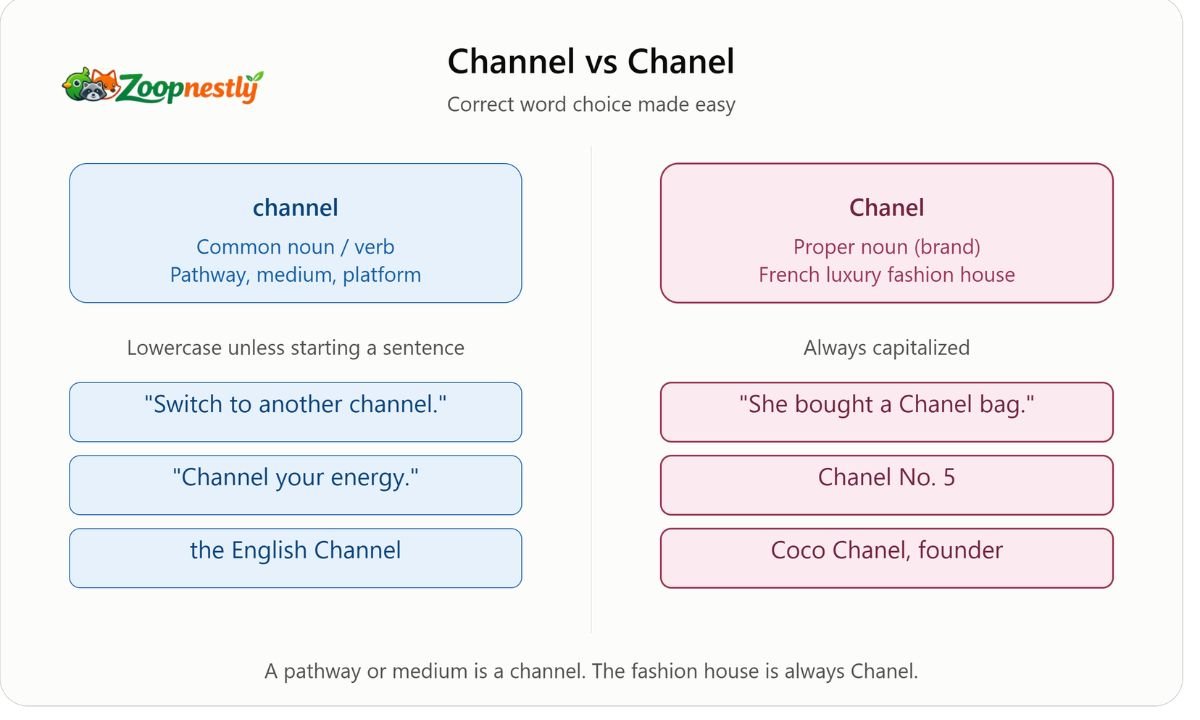
Channel is a common English word meaning a pathway, medium, or platform, such as a TV channel, a communication channel, or a body of water. Chanel is a proper noun, the name of the French luxury fashion house founded by Coco Chanel. The words sound similar but have no linguistic connection, and they’re never interchangeable in writing.
Channel vs Chanel: The Core Difference
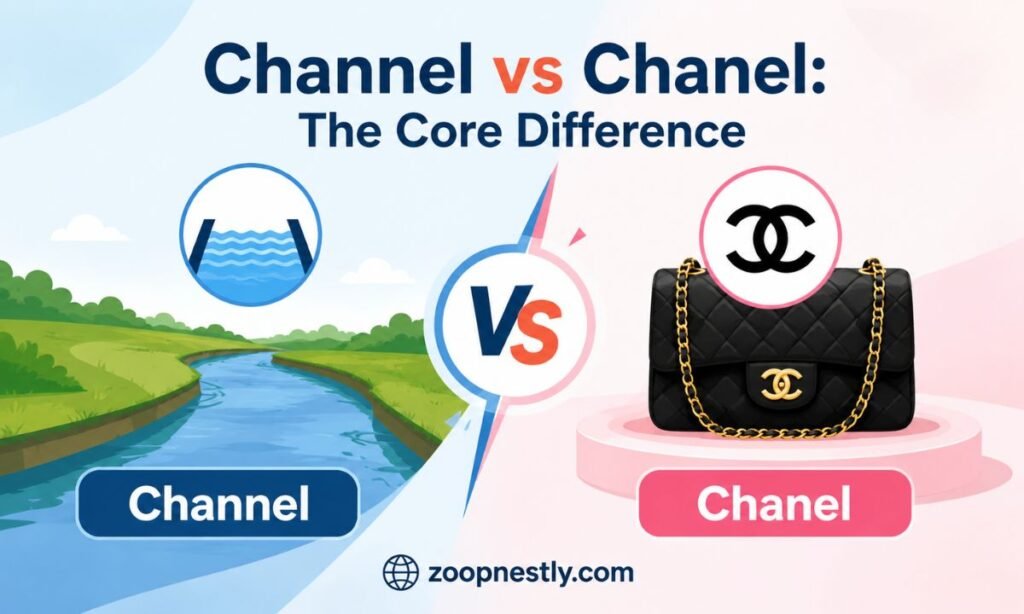
The fastest way to remember the difference is this: channel is a regular noun and verb used in everyday English, while Chanel is a brand name that always refers to the fashion company or its founder, Gabrielle “Coco” Chanel.
Because “Chanel” is a proper noun, it’s always capitalized, no matter where it appears in a sentence. “Channel,” on the other hand, follows normal capitalization rules and is only capitalized at the start of a sentence or in a title.
| Feature | Channel | Chanel |
| Word type | Common noun / verb | Proper noun (brand name) |
| Meaning | Passage, medium, platform, or to direct something | French luxury fashion house |
| Capitalization | Lowercase unless starting a sentence | Always capitalized |
| Example use | “Switch to another channel.” | “She bought a Chanel handbag.” |
| Related forms | channels, channeling, channeled | Chanel-branded, House of Chanel |
What Does “Channel” Mean?
“Channel” comes from the Old French word chanel, which traces back to the Latin canalis, meaning pipe or canal. Over centuries, English speakers stretched the word to cover anything that carries something from one point to another, whether that’s water, information, or energy.
In modern use, “channel” shows up in several contexts:
- Media: a TV or radio channel, like a news channel or a cooking channel
- Communication: a channel of communication, such as email, phone, or social media
- Geography: a narrow stretch of water connecting two larger bodies, like the English Channel
- Technology: a data channel or broadcast channel used to transmit signals
- Business: a distribution channel or sales channel
Channel as a Noun and a Verb
“Channel” isn’t just a noun. It also works as a verb, meaning to direct something toward a particular outcome or purpose.
| Form | Example Sentence |
| Noun | “This YouTube channel has a million subscribers.” |
| Verb | “She decided to channel her frustration into painting.” |
| Noun (geography) | “Ships crossed the channel at dawn.” |
| Verb (past tense) | “He channeled all his savings into the new business.” |
A simple trick to spot the verb form: if the sentence describes someone directing energy, emotion, or resources somewhere, “channel” is acting as a verb.
Channel in Communication and Media

When people talk about a “channel” in business or marketing, they usually mean the route a message takes to reach an audience. Email, social media, print ads, and word of mouth are all communication channels.
In broadcasting, “channel” refers to a specific frequency or platform, like Channel 4 or a streaming channel on a video platform. Businesses also use “channel” to describe how products reach customers, such as a retail channel or an online sales channel.
Channel in Geography
Geographically, a channel is a natural or artificial waterway that connects two larger bodies of water. The most famous example is the English Channel, which separates southern England from northern France. Smaller channels exist in rivers, harbors, and irrigation systems, where they guide water flow in a controlled direction.
This meaning is one of the oldest uses of the word, and it’s the reason “channel” carries the sense of “a defined path something travels through,” whether that something is water, data, or an idea.
Channel vs Strait
People sometimes confuse “channel” with “strait,” since both describe narrow waterways. The difference is subtle: a strait is a naturally formed narrow passage between two larger bodies of water, like the Strait of Gibraltar, while a channel can be natural or artificially created, and is often wider or used for navigation, like the English Channel. In everyday writing, the two terms overlap enough that either can describe a narrow sea passage, but “strait” leans more toward strictly natural formations.
DISCOVER MORE : Studder vs Stutter: Which Word Should You Use?
What Is Chanel?
“Chanel” refers to the French luxury fashion house founded in 1910 by Gabrielle “Coco” Chanel. The brand is known worldwide for its perfumes, most notably Chanel No. 5, along with its handbags, tweed jackets, and haute couture designs. “Chanel” is always a proper noun, so it never changes form the way “channel” does. You won’t see “chanels” or “chaneling,” because it names a specific company, not a general concept.
| Detail | Information |
| Founder | Gabrielle “Coco” Chanel |
| Founded | 1910 |
| Known for | Perfume, handbags, haute couture, tweed suits |
| Word type | Proper noun (brand name) |
| Common products | Chanel No. 5, Chanel Classic Flap Bag |
Why People Confuse Channel and Chanel
The confusion comes down to sound and spelling, not meaning. Both words are pronounced almost the same way in casual speech, and the letter swap between “an” and “ha” is easy to miss when typing quickly. Autocorrect sometimes makes it worse by “fixing” one spelling into the other, especially on mobile keyboards.
There’s also a cultural factor. Because Chanel is such a recognizable name, some writers assume it’s simply a stylized spelling of “channel,” when in fact the two words have completely separate origins: one is French for a family surname turned brand, and the other is rooted in Latin for “pipe” or “canal.”
Channel vs Chanel in Fashion Writing
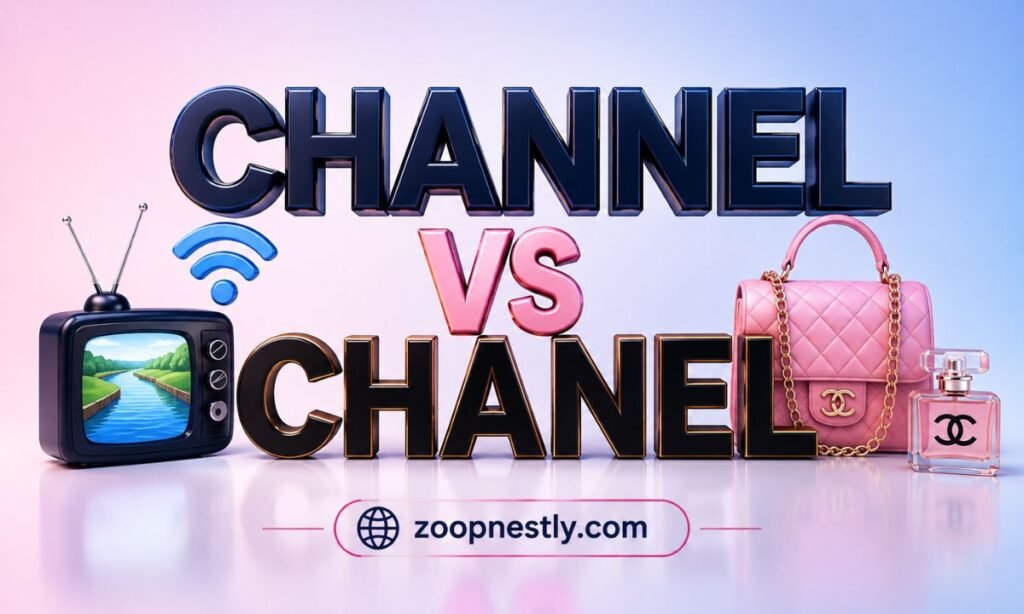
This is where the mix-up causes the most visible mistakes. Fashion and lifestyle writers sometimes accidentally write “Channel bag” instead of “Chanel bag,” which changes the meaning entirely (or makes no sense at all). A “channel” bag isn’t a real product category, while a “Chanel bag” refers to a specific, recognizable designer item.
| Correct | Incorrect |
| Chanel handbag | Channel handbag |
| Chanel perfume | Channel perfume |
| Chanel No. 5 | Channel No. 5 |
| Distribution channel | Distribution Chanel |
If you’re writing about the brand, always double-check for the capital “C” and the “ha” spelling. If you’re writing about a pathway, platform, or medium, “channel” is almost always correct.
Example Sentences: Channel vs Chanel
- “Turn the TV to the sports channel.”
- “She saved for months to buy her first Chanel bag.”
- “Our support team is available through multiple channels.”
- “Coco Chanel changed the fashion industry forever.”
- “He tried to channel his nervous energy into practice.”
- “The perfume counter had a whole display of Chanel products.”
Common Mistakes to Avoid
- Writing “Channel No. 5” instead of “Chanel No. 5”
- Lowercasing “Chanel” when referring to the brand
- Using “channel” when you mean a specific product from the fashion house
- Assuming “channel” and “Chanel” are different spellings of the same word
- Forgetting that “channel” can be a verb, not just a noun
Quick Practice
Test what you’ve learned with these quick exercises.
Fill in the Blanks
- She switched the TV to a cooking ______.
- He bought his mother a ______ scarf for her birthday.
- Try to ______ your energy into something productive.
Answers: 1. channel 2. Chanel 3. channel
Multiple Choice
Which sentence is correct? A) “I love my new Channel perfume.” B) “I love my new Chanel perfume.”
Answer: B
FAQs
Is it Chanel or Channel bag?
It’s Chanel bag, referring to the handbags made by the French luxury brand Chanel. “Channel bag” is a common misspelling and isn’t a recognized product term.
Why do people spell Chanel as Channel?
The mistake happens because the two words sound similar when spoken and are easy to mix up while typing quickly. Autocorrect can also swap one spelling for the other on some devices.
Is channel always lowercase?
Yes, unless it starts a sentence or appears in a title. “Channel” is a common noun and verb, so it doesn’t get special capitalization like a brand name does.
Can channel be used as a verb?
Yes. “Channel” as a verb means to direct energy, resources, or emotions toward something specific, as in “channel your creativity into your work.”
What is the difference between a strait and a channel?
A strait is typically a natural narrow passage between two larger bodies of water, while a channel can be natural or artificial and is often used for navigation. The English Channel is a well-known example of the latter.
Conclusion
The difference between channel and Chanel comes down to one simple rule: “channel” is an everyday word for a pathway, medium, or platform, while “Chanel” is always the name of the luxury fashion brand. Once you remember that Chanel is a proper noun tied to Coco Chanel’s fashion house, the spelling mix-up becomes much easier to avoid, whether you’re writing about a TV show, a business strategy, or a designer handbag.

James Walker is a content writer and language researcher with over 5 years of experience in meanings, definitions, and language-related topics. He enjoys simplifying complex terms into clear, easy-to-understand explanations. Through ZoopNestly.com, he helps readers find accurate and reliable information.