
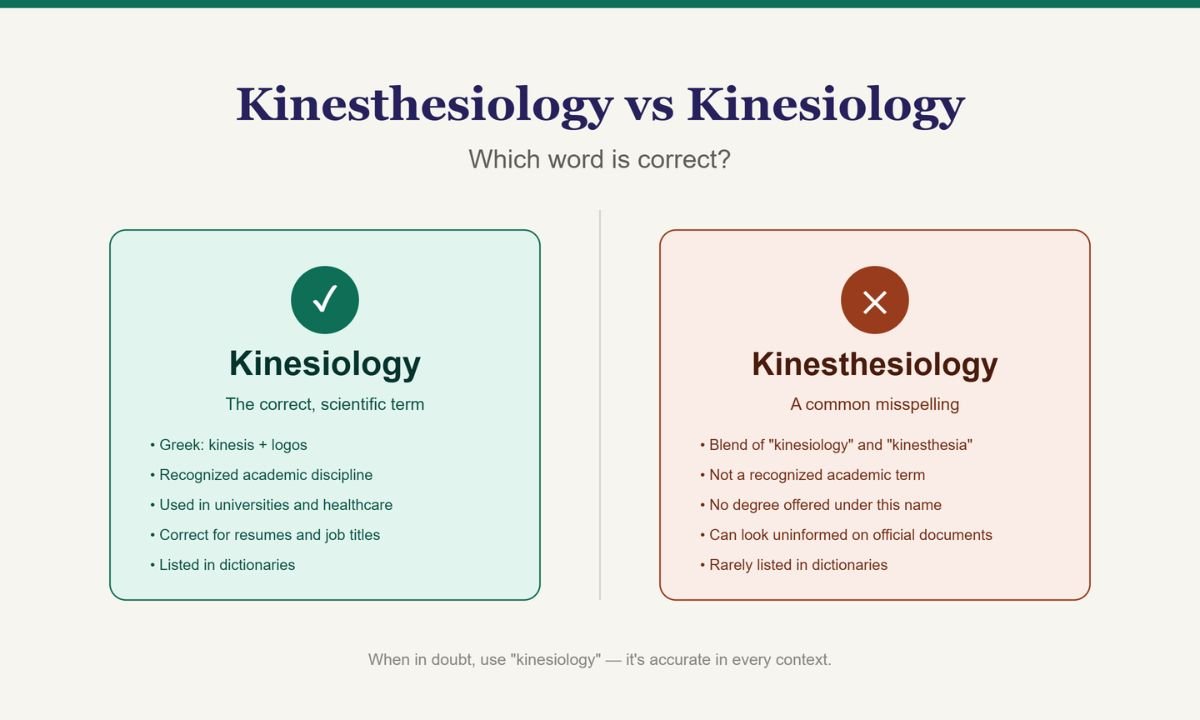
Kinesthesiology vs Kinesiology: Which Word Is Correct?
Picture this: you’re filling out a college application and pause over the major you want to circle. Is it “kinesiology” or “kinesthesiology”? Spellcheck doesn’t complain either way, and a quick search shows both terms floating around online. That small hesitation matters more than you’d think, because using the wrong term on a resume, transcript, or job application can make you look uninformed. The debate over kinesthesiology vs kinesiology comes down to one word being the accepted scientific term and the other being a common misspelling that stuck around.
Quick Answer
Kinesiology is the correct, scientifically recognized term for the study of human movement, muscles, and physical performance. Kinesthesiology is not a standard academic or medical term. It’s a common misspelling that blends “kinesiology” with “kinesthesia” (the sense of body position and movement). If you’re choosing a degree, career, or medical term, kinesiology is the one to use.
Kinesiology: The Actual Scientific Term

Kinesiology comes from the Greek words kinesis (movement) and logos (study). It’s the formal academic discipline that examines how the human body moves, why muscles and joints work the way they do, and how physical activity affects health and performance. Universities offer bachelor’s, master’s, and doctoral degrees in kinesiology. Hospitals, gyms, sports teams, and research labs all use this exact term in job titles and academic departments.
Core Areas Kinesiology Covers
Kinesiology isn’t one narrow subject. It typically blends several related sciences:
- Biomechanics — how forces act on the body during movement
- Exercise physiology — how the body responds and adapts to physical activity
- Motor control and learning — how the brain directs movement and coordination
- Anatomy and physiology — the structural and functional basis for movement
- Sports psychology — the mental side of performance and motivation
Where “Kinesthesiology” Comes From
“Kinesthesiology” isn’t in most dictionaries, and no accredited university offers a degree by that name. It appears to be a blend of two real words: kinesiology and kinesthesia. Because both terms relate to movement and both start similarly, people mix them up in speech and writing, and the error has spread across blogs, forums, and even some casual job listings.
What Kinesthesia Actually Means
Kinesthesia is a real term, but it means something different from kinesiology. It refers to the body’s ability to sense its own position, movement, and effort, often called proprioception. For example, closing your eyes and still knowing where your arm is in space is your kinesthetic sense at work. Kinesthesia is a sensory function, while kinesiology is a field of study. Confusing the two is where “kinesthesiology” tends to creep in.
Kinesthesiology vs Kinesiology: Side-by-Side Comparison
| Feature | Kinesiology | Kinesthesiology |
| Status | Recognized scientific term | Non-standard, informal usage |
| Origin | Greek: kinesis + logos | Blend of “kinesiology” and “kinesthesia” |
| Used in academia | Yes, official degree name | No, not offered as a degree |
| Used in healthcare | Yes | No |
| Dictionary listed | Yes | Rarely, and often flagged as nonstandard |
| Correct for resumes/job titles | Yes | No |
Which Term Should You Actually Use?

Always use kinesiology in academic writing, resumes, job applications, and professional conversations. It’s the term recognized by universities, employers, and medical institutions. If you’re ever unsure while writing or speaking, default to kinesiology, since it’s accurate in every context where the other word might appear.
You may still hear or see “kinesthesiology” used casually online or in informal conversation. When that happens, it’s almost always meant as kinesiology, just misspelled or misremembered.
Common Mistakes to Avoid
Using “kinesthesiology” on official documents. This can raise questions from admissions officers or hiring managers about attention to detail.
Mixing up kinesthetic learning with kinesiology. Kinesthetic learning describes a hands-on learning style. It’s related to movement but isn’t the same as the academic field of kinesiology.
Assuming both spellings are interchangeable in citations. Academic databases and journals index under “kinesiology,” so searching the wrong term can mean missing relevant research.
What Does a Kinesiologist Actually Do?
A kinesiologist studies and applies movement science to help people move better, recover from injury, or improve athletic performance. Day to day work can include:
- Assessing posture, gait, and movement patterns
- Designing exercise and rehabilitation programs
- Working alongside physical therapists, athletic trainers, or sports coaches
- Educating clients on injury prevention and movement efficiency
Kinesiologists work in hospitals, rehab clinics, gyms, corporate wellness programs, and research settings.
Is a Kinesiologist a Doctor?
No, a kinesiologist is not a medical doctor unless they’ve separately completed medical school. A kinesiology degree focuses on movement science, exercise, and biomechanics, not diagnosing or treating disease. Some kinesiology graduates go on to become physical therapists, chiropractors, or physicians, but that requires additional, separate education beyond a kinesiology degree.
Kinesiologists can assess movement, recommend exercise programs, and support recovery, but they generally cannot diagnose medical conditions or prescribe medication. Scope of practice varies by state and by whether the kinesiologist holds additional certifications.
DISCOVER MORE : Channel vs Chanel: Correct Word Choice Made Easy
Kinesiology vs Physiotherapy: What’s the Difference?
People often confuse kinesiology with physiotherapy because both deal with movement and recovery. A physiotherapist (physical therapist) is a licensed healthcare provider trained to diagnose and treat movement impairments, often after injury or surgery. A kinesiologist typically focuses more broadly on exercise, performance, and movement science, and in many regions doesn’t require the same level of clinical licensing. Some kinesiologists go on to become physiotherapists after further training.
Kinesiology Degree: What to Expect
A kinesiology degree usually blends classroom science with hands-on lab work. Common subjects include:
- Human anatomy and physiology
- Biomechanics
- Exercise physiology
- Nutrition science
- Motor learning and development
- Research methods and statistics
Degree levels range from associate and bachelor’s degrees to master’s and doctoral programs, depending on career goals. Students aiming for clinical or research roles often continue past a bachelor’s degree.
What Degree Is Closest to Kinesiology?
Exercise science is the closest related degree, often overlapping heavily with kinesiology in coursework. Sports science and athletic training are also closely related, though athletic training usually includes more clinical, injury-focused training.
Kinesiology Career Options
A kinesiology background opens doors to several career paths:
| Career | Typical Focus |
| Athletic trainer | Injury prevention and on-field care |
| Exercise physiologist | Testing and improving physical performance |
| Physical therapist (with further schooling) | Clinical rehabilitation |
| Strength and conditioning coach | Athletic performance training |
| Corporate wellness coordinator | Workplace health programs |
| Occupational therapist (with further schooling) | Helping patients regain daily function |
Kinesiology Salary: What to Expect
Salaries in kinesiology-related fields vary widely based on role, location, and additional certifications. Entry-level positions like fitness or wellness coordinators tend to pay less than clinical roles such as physical therapy, which require graduate-level education and licensing. Roles that combine a kinesiology background with a specialized certification, like strength and conditioning or athletic training, often see better pay than general fitness roles. For the most accurate and current salary figures, government labor statistics or industry salary reports are the most reliable sources.
Why Study Kinesiology? Benefits Worth Knowing
Kinesiology offers a flexible foundation for many health and fitness careers. Benefits include:
- A strong science base applicable to healthcare, coaching, and research
- Multiple career paths from one degree
- Growing demand tied to interest in preventive health and fitness
- A natural stepping stone into physical therapy, medicine, or sports science graduate programs
Is Kinesiology a Real Science?

Yes. Kinesiology is a legitimate, evidence-based science taught at accredited universities and applied in hospitals, research labs, and sports organizations worldwide. It draws on anatomy, physiology, physics, and psychology to study human movement.
That said, the term “applied kinesiology,” a specific alternative therapy involving muscle testing to diagnose health issues, is different and is viewed skeptically by mainstream medicine due to limited scientific support. This is a separate concept from academic kinesiology and shouldn’t be confused with it.
Can a Kinesiologist Diagnose Medical Conditions?
Generally, no. Diagnosing medical conditions falls under the scope of licensed physicians, and in some cases, physical therapists or chiropractors with specific diagnostic training. Kinesiologists assess movement and function but typically refer clients to appropriate medical professionals for diagnosis and treatment of underlying conditions.
Kinesiology vs Exercise Science vs Sports Science
These three fields overlap significantly, and many programs use the terms loosely:
- Kinesiology is the broadest term, covering movement science as a whole.
- Exercise science often focuses more specifically on how exercise affects the body.
- Sports science tends to emphasize athletic performance and competition.
In practice, coursework across these degrees is often nearly identical, and the differences come down more to program branding than strict academic boundaries.
Frequently Asked Questions
Is kinesthesiology a real word?
Not officially. It’s a common misspelling or blend of “kinesiology” and “kinesthesia” and isn’t recognized as a standard academic or scientific term.
What is the correct spelling: kinesiology or kinesthesiology?
Kinesiology is the correct spelling and the term recognized by universities, dictionaries, and healthcare fields.
What’s the difference between kinesiology and kinesthesia?
Kinesiology is the study of human movement as an academic field. Kinesthesia is the body’s sense of its own position and movement, a physical sensory function.
Do you need a medical degree to become a kinesiologist?
No. A kinesiology degree is separate from medical school. Kinesiologists can pursue further education, like physical therapy or medicine, but it isn’t required to work in the field.
Which degree is better, kinesiology or exercise science?
Neither is inherently better. They overlap heavily, and the right choice depends on your specific career goals and which program offers stronger coursework or hands-on opportunities in your area of interest.
Key Takeaways
- Kinesiology is the correct, scientifically accepted term for the study of human movement.
- Kinesthesiology is a non-standard misspelling, not a recognized academic or medical term.
- Kinesthesia refers to the body’s sense of position and movement, a separate concept from kinesiology as a field.
- Kinesiologists are not medical doctors unless they complete separate medical training.
- Kinesiology overlaps closely with exercise science and sports science, though program names vary by school.
Conclusion
The confusion between kinesiology and kinesthesiology is understandable, since the words look and sound similar. But only one holds up in classrooms, clinics, and career listings: kinesiology. Whether you’re picking a college major, writing a resume, or just settling a debate, sticking with the correct term keeps you accurate and credible. If movement science interests you, kinesiology offers a well-established path into healthcare, fitness, coaching, and research, backed by real degrees and real career opportunities.

James Walker is a content writer and language researcher with over 5 years of experience in meanings, definitions, and language-related topics. He enjoys simplifying complex terms into clear, easy-to-understand explanations. Through ZoopNestly.com, he helps readers find accurate and reliable information.