Home Made or Homemade: Which Is Correct?
You typed a recipe caption or a product label and your cursor just froze. Should it be “home made” or “homemade”? You are not alone. This tiny spacing choice trips up writers, marketers, and students every day, and getting it wrong can make a polished piece of writing look careless. The good news is the answer to home made vs homemade is simpler than it feels once you see the pattern.
Quick Answer
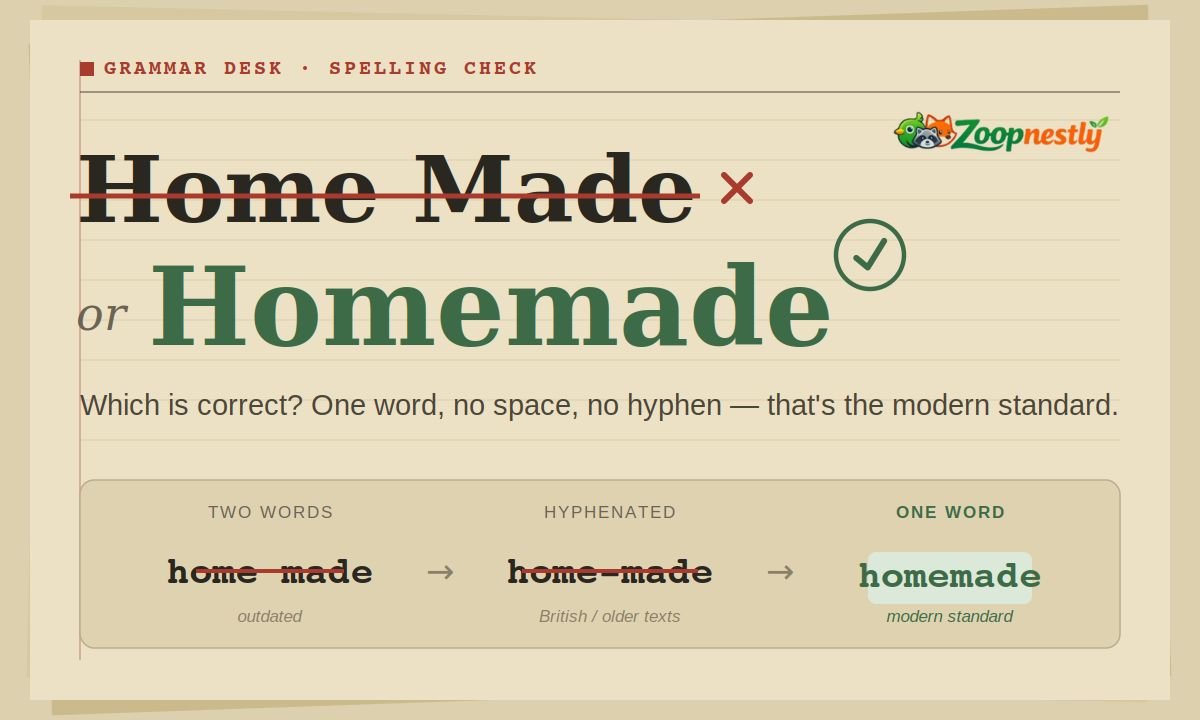
Homemade is the correct, standard spelling in modern English. It’s one word, no space, no hyphen. Home made (two words) is considered incorrect or outdated in current usage, and home-made (hyphenated) still appears occasionally in British English or older texts, but most style guides now favor the single-word form.
That answer covers the core question, but there’s more worth knowing if you want to use the word confidently in writing, marketing copy, or everyday conversation.
What Home Made vs Homemade Actually Means
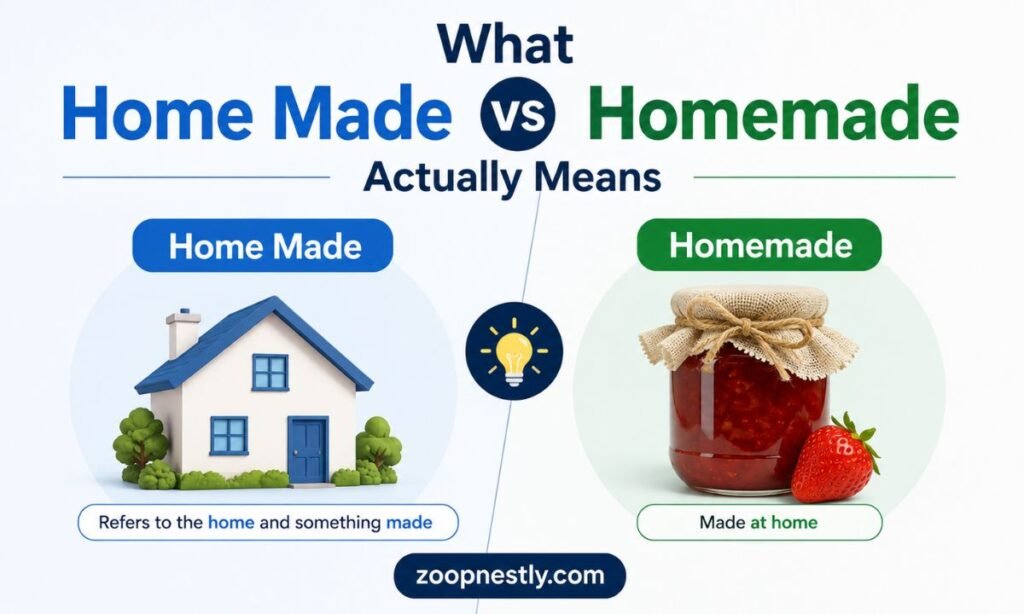
Both versions point to the same idea: something made at home rather than bought ready-made from a store or factory. A homemade pie, a homemade gift, a homemade website project. The meaning never changes based on spacing. What changes is whether your writing looks current or dated.
Think of it like “email” versus “e-mail.” The hyphenated form used to be standard. Language moved on, and the compact version won.
Why Homemade Became One Word
English constantly compresses phrases that get used together often enough. When two words repeatedly show up side by side describing one concept, they tend to merge over time. This happens in stages:
- Two separate words – home made
- Hyphenated compound – home-made
- Closed compound – homemade
“Homemade” has been through all three stages and settled into its closed form decades ago. Dictionaries like Merriam-Webster and Oxford list it as a single word without a hyphen, which is the strongest signal that this is the accepted modern spelling.
Home-Made vs Homemade: Does the Hyphen Still Matter?
Mostly, no. In everyday American English, the hyphen is unnecessary and often flagged by grammar checkers. You’ll still spot “home-made” in some British publications, older cookbooks, or brand packaging that hasn’t updated its style, but it’s not the modern default.
A simple rule: if you’re writing for a US audience, skip the hyphen. If you’re editing older or British content, leave existing hyphenated instances alone rather than “fixing” them, since style consistency within a document matters more than chasing a single “correct” form.
Home Made vs Homemade Comparison Table
| Form | Status | Common Context |
| Homemade | Standard, modern, preferred | Everyday US English, marketing, recipes |
| Home-made | Older or regional variant | British English, vintage packaging |
| Home made | Considered incorrect | Rare, often a spacing mistake |
If you only remember one row, remember the first one.
Homemade vs Handmade: What’s the Difference
These two get confused because they both suggest something personal rather than mass-produced, but they answer different questions.
- Homemade describes where something was made. It’s usually about food or items produced at home instead of a factory.
- Handmade describes how something was made. It’s about hand craftsmanship rather than machine production, and it applies to items like jewelry, furniture, or pottery, whether made at home or in a workshop.
A candle made by hand in a home studio could technically be both homemade and handmade. A frozen pizza baked at home, though, is homemade but not handmade, since a machine made the dough.
| Term | Focus | Typical Use |
| Homemade | Location (made at home) | Food, baked goods, gifts |
| Handmade | Method (made by hand) | Crafts, jewelry, artisan goods |
Homemade vs Store-Bought: What’s the Difference
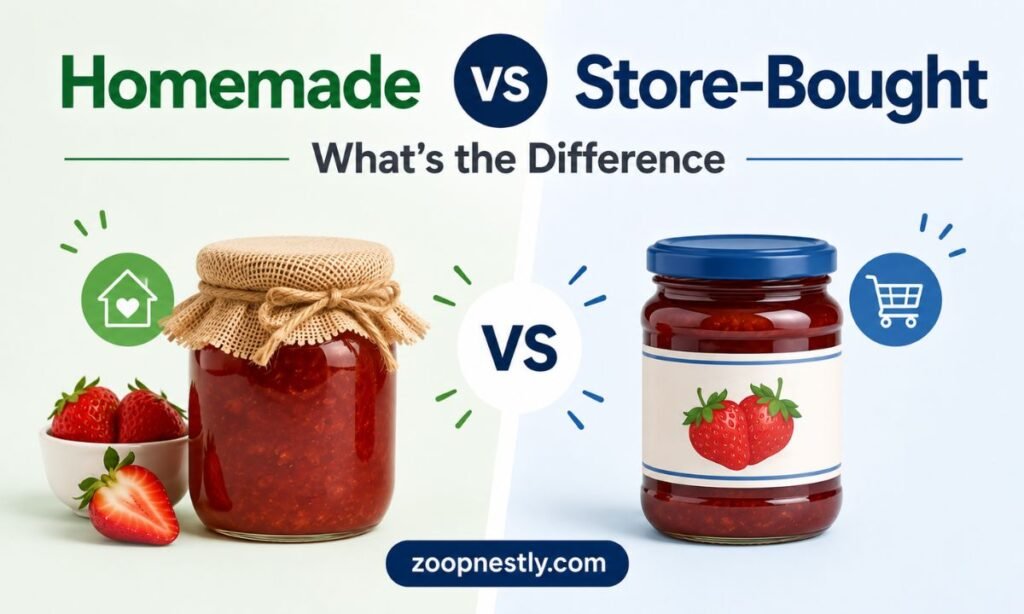
This comparison shows up constantly in food writing and recipe blogs. Store-bought means purchased ready-made from a shop, while homemade means prepared from scratch at home.
The distinction matters because homemade often implies fresher ingredients and more control over what goes into the final product, while store-bought usually means convenience and consistency. Neither is automatically better. A homemade sauce might taste richer, but a store-bought one saves time on a busy weeknight.
DISCOVER MORE : Scoup vs Scoop: What’s the Difference?
Homemade vs Home-Cooked: Are They the Same?
Not quite, and this nuance is often missed. Home-cooked specifically refers to meals prepared and cooked at home, usually implying a fresh, hot dish made from scratch that day. Homemade is broader. It can describe cooked meals, but also baked goods, crafts, skincare products, or anything else assembled at home rather than bought.
A jar of homemade jam sitting in your pantry for weeks is still homemade, but it wouldn’t typically be called home-cooked, since “cooked” suggests a meal eaten fresh.
Common Mistakes With Home Made vs Homemade
A few patterns cause the most confusion:
- Writing it as two words in formal or professional content. “Home made” reads as a spacing error to most modern readers and spellcheckers.
- Overusing the hyphen out of habit. “Home-made” isn’t wrong, but it can look inconsistent if the rest of your writing follows current, unhyphenated style.
- Confusing homemade with handmade when describing craft items, which mixes up location of production with method of production.
- Assuming “homemade” always means food. It applies to anything made at home, including gifts, decorations, or small projects.
- Inconsistent spelling within the same document, switching between “homemade” and “home-made” in different sections.
Sticking with the single-word form solves most of these issues automatically.
Homemade in Real Sentences
Seeing the word in context makes the correct usage easier to remember.
- She brought a tray of homemade cookies to the office party.
- His homemade website took a weekend to build, but it works well.
- The bakery’s homemade bread outsells the packaged loaves.
- We gave grandma a homemade card instead of buying one.
- This soup tastes better than anything store-bought, and it’s completely homemade.
Notice how “homemade” functions as an adjective before a noun in every example. It never stands alone as the subject of a sentence.
Synonyms and Related Terms for Homemade
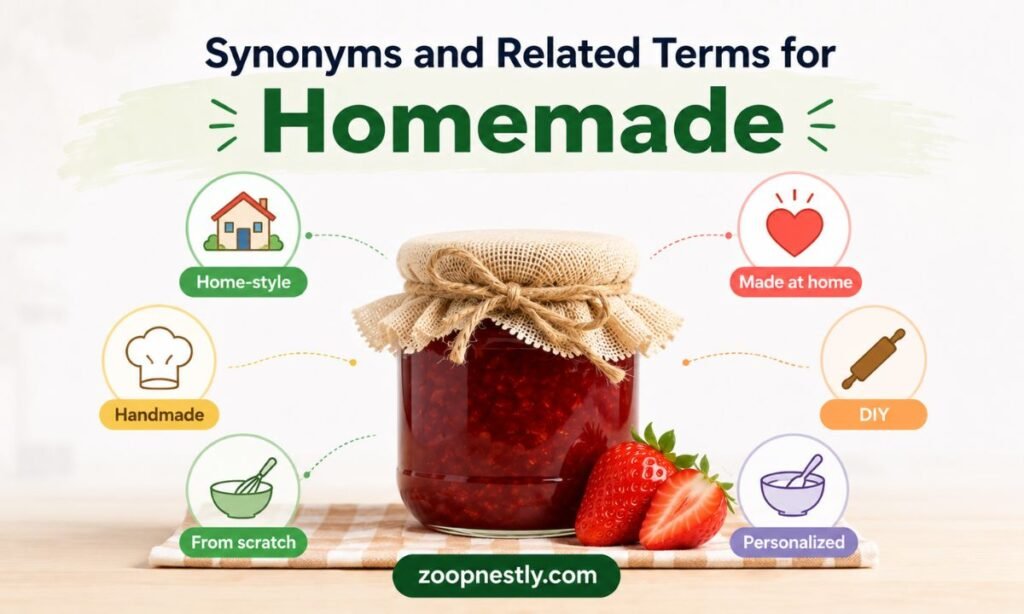
If you want variety in your writing, several words carry a similar meaning depending on context:
- Home-cooked – for meals made fresh at home
- From scratch – emphasizes starting with raw ingredients
- DIY – for projects, crafts, or repairs done personally
- Artisanal – for small-batch, often handcrafted food or goods
- Homegrown – specifically for produce grown at home, not purchased
None of these are exact substitutes, so choose based on what you’re actually describing rather than swapping words purely for variety.
Frequently Asked Questions
Is “homemade” one word or two words?
Homemade is one word in standard modern English. Writing it as “home made” (two words) is considered a common spelling mistake in current usage.
Is “home-made” with a hyphen still acceptable?
It’s not wrong, but it’s less common today. “Home-made” still appears in some British English writing and older texts, though most modern style guides and dictionaries list “homemade” without a hyphen as the standard form.
What is the difference between homemade and handmade?
Homemade refers to where something was made, typically at home instead of a factory. Handmade refers to how something was made, meaning it was crafted by hand rather than by machine. An item can be both at once.
Can “homemade” describe things other than food?
Yes. While it’s most often used for food, homemade can describe anything made at home, including gifts, crafts, cleaning products, or small home projects.
Why did “home made” turn into “homemade”?
English naturally compresses commonly paired words over time. “Home made” first became hyphenated as “home-made,” then merged into the single closed compound “homemade” as usage settled, which is now the accepted spelling in modern dictionaries.
Conclusion
When it comes to home made vs homemade, the single word wins in modern English. “Homemade” is the standard, dictionary-approved spelling for anything made at home rather than bought ready-made, whether that’s a pie, a gift, or a small project. Save the hyphenated “home-made” for older or British texts, and skip the two-word version entirely. Once you commit to “homemade,” you’ll never second-guess that spacing again.

James Walker is a content writer and language researcher with over 5 years of experience in meanings, definitions, and language-related topics. He enjoys simplifying complex terms into clear, easy-to-understand explanations. Through ZoopNestly.com, he helps readers find accurate and reliable information.