Stared vs Starred: Common Mistakes and How to Avoid Them
You typed a sentence, paused, and stared at the screen wondering if it should actually say “starred.” It’s a small mix-up, but it changes the entire meaning of your sentence. One word describes a fixed, intense look. The other describes being featured in something, usually a movie, show, or list. Understanding stared vs starred takes just a few minutes, and once it clicks, you’ll never second-guess it again.
Quick Answer
Stared is the past tense of “stare,” meaning to look at something fixedly for a long time. Starred is the past tense of “star,” meaning to feature someone in a leading role or to mark something with a star symbol. Example: “She stared at the poster of the actor who starred in her favorite film.”
Stared vs Starred: The Core Difference
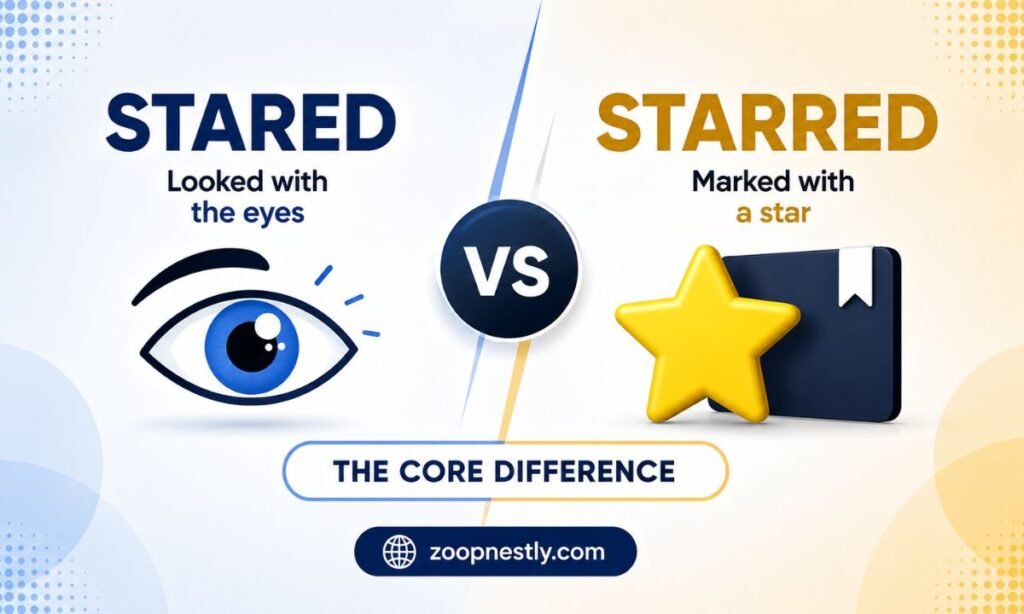
Both words look almost identical, but they come from completely different root verbs.
- Stare → to look at something continuously, often without blinking, usually out of surprise, confusion, or focus.
- Star → to hold the leading role in a performance, or to mark something as notable using a star symbol.
Add “-d” to each verb for the past tense, and you get stared and starred. The extra “r” in “starred” isn’t random. It comes from doubling the final consonant of “star” before adding “-ed,” a standard spelling rule for short verbs ending in a single vowel plus a consonant.
Quick Comparison Table
| Word | Base Verb | Meaning | Example |
| Stared | Stare | Looked fixedly | He stared out the window for an hour. |
| Starred | Star | Featured in a lead role / marked with a star | She starred in three award-winning films. |
Why the Spelling Differs
This is where most confusion starts. Both “stare” and “star” are short, one-syllable words, so people assume the past tense should look similar. But English spelling rules treat them differently based on syllable structure.
“Stare” ends in a silent e. When you add “-d,” you simply drop the “e” and attach “-d,” giving you “stared.”
“Star” ends in a consonant after a single vowel (a-r). Following the doubling rule for short stressed syllables, you double the final consonant before adding “-ed,” giving you “starred.”
This same pattern shows up in other word pairs, like “care/cared” versus “car/carred” (though “carred” isn’t a real word, the spelling logic still applies to verbs like “star” and “stir/stirred”).
How to Use “Stared” in a Sentence
Use stared when describing someone looking at something intensely, often without moving their eyes away.
Examples:
- The dog stared at the treat in my hand.
- She stared blankly at the exam questions.
- He stared out at the ocean, lost in thought.
- The children stared in awe at the fireworks.
Stared often pairs with prepositions like “at,” “into,” or “out,” and it frequently signals emotion such as shock, confusion, admiration, or deep concentration.
How to Use “Starred” in a Sentence
Use starred when talking about someone playing a lead role, or when marking an item as important using a star symbol.
Examples:
- Tom Hanks starred in several classic 1990s films.
- I starred the emails I need to reply to first.
- The musical starred a cast of first-time performers.
- She starred alongside two other well-known actors.
Notice that “starred” can be used both for people (acting) and for actions (marking something). This dual meaning is one reason the word trips people up.
Stared vs Starred: Side-by-Side Meaning Table
| Feature | Stared | Starred |
| Root word | Stare | Star |
| Part of speech | Verb (past tense) | Verb (past tense) |
| Core meaning | Looked fixedly | Featured in a role / marked with a star |
| Common context | Emotions, reactions, focus | Movies, shows, lists, ratings |
| Typical preposition | at, into, out | in, alongside |
Common Mistakes When Using Stared and Starred
Even confident writers slip up here. Here are the most frequent errors and how to fix them.
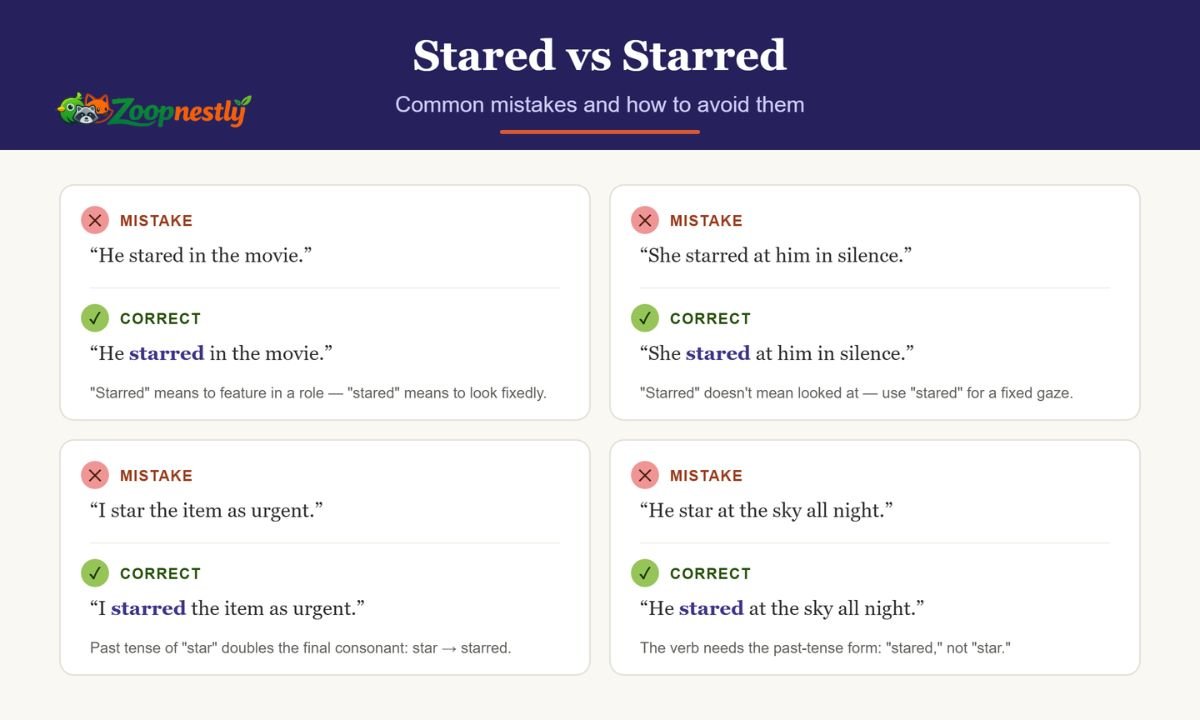
| Mistake | Why It’s Wrong | Correction |
| “He stared in the movie.” | “Stared” doesn’t mean acted in something | He starred in the movie. |
| “She starred at him in silence.” | “Starred” doesn’t mean looked at | She stared at him in silence. |
| “I star the item as urgent.” (past context) | Missing past tense doubling | I starred the item as urgent. |
| “He star at the sky all night.” | Verb not conjugated | He stared at the sky all night. |
A simple rule of thumb: if the sentence involves eyes and attention, you want “stared.” If it involves acting, roles, or marking, you want “starred.”
Why People Confuse Stared and Starred

The confusion isn’t really about meaning. It’s about how similar the words look and sound in casual speech. When spoken quickly, “stared” and “starred” can sound almost identical, especially in American English where the “t” softens into a quick “d” sound. Add to that the fact both are past-tense, one-syllable-feeling verbs, and it’s easy to see why even native speakers pause before typing one or the other.
Autocorrect tools don’t always catch the error either, since both spellings are valid English words. That means spellcheck won’t flag a wrong choice, only human proofreading (or careful reading) will.
Staring vs Starring: The Present Tense Versions
The confusion doesn’t stop at past tense. The present participle forms, staring and starring, follow the same logic.
- Staring → currently looking fixedly. “She is staring at her phone.”
- Starring → currently in a lead role, or currently the featured attraction. “The film is starring a new actor this year.”
Just like the past tense, “star” doubles its final consonant before adding “-ing,” giving “starring” with two r’s.
How Do You Spell “Starred”? A Simple Breakdown
If you’re unsure how many letters go where, break it down step by step:
- Start with the base word: star
- Double the final consonant: starr
- Add the past tense ending: starred
That’s it. Three r’s would be a spelling mistake (“starrred”), and one r would technically spell a different, incorrect word. The correct spelling always has exactly two r’s.
DISCOVER MORE : Symptomatology or Symptomology: Which Term Is Correct?
Synonyms and Related Words
Knowing related vocabulary can help reinforce the difference and expand your own writing.
| Word | Related To | Similar Meaning |
| Gazed | Stared | Looked steadily, often softer in tone |
| Glared | Stared | Looked with anger or intensity |
| Featured | Starred | Was prominently included |
| Headlined | Starred | Led a performance or event |
| Ogled | Stared | Looked with obvious interest (informal) |
Using synonyms like these can help you avoid repeating “stared” or “starred” too often in longer pieces of writing.
Pronunciation Differences
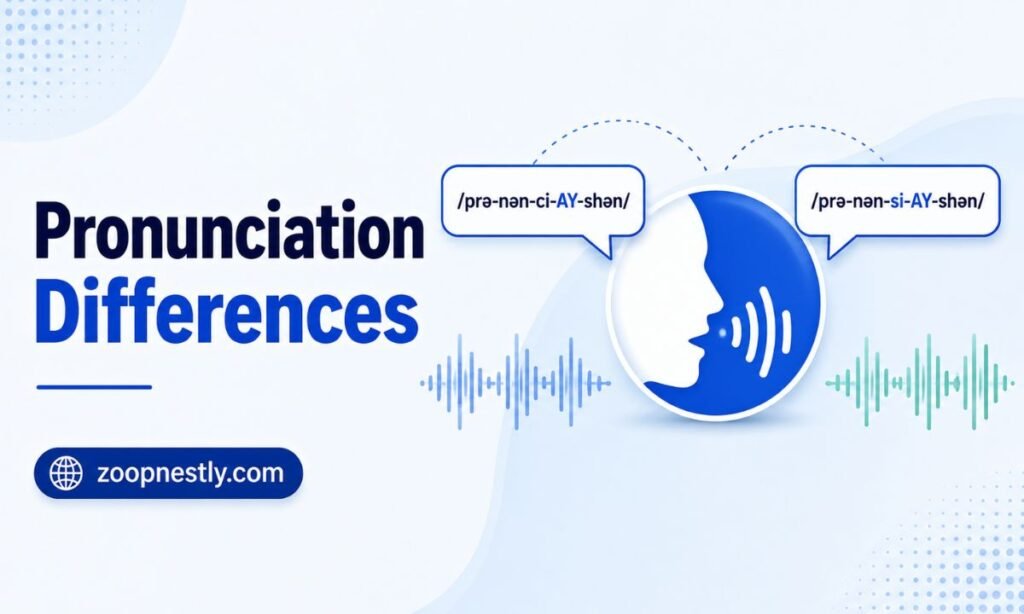
Though they look similar, “stared” and “starred” are pronounced almost the same way in most American English accents, both ending in a soft “d” sound (rhyming with “spared” and “starred”). The real difference lies in spelling and context, not sound. This is exactly why relying on your ear alone won’t help you choose the right word. You need to think about the meaning of the sentence instead.
A Simple Memory Trick
Here’s an easy way to lock in the difference for good:
- Stare has an “e,” and eyes stare. Think: “e” for “eyes.”
- Star has no “e,” and actors become stars. Think: no “e,” think “celebrity.”
If your sentence is about eyes or attention, go with the version that has the silent “e” root (stared). If it’s about fame, roles, or marking something important, go with the doubled-consonant version (starred).
Practice: Test Yourself
Fill in the Blanks
- The audience _______ in silence during the final scene.
- Meryl Streep has _______ in dozens of critically acclaimed films.
- I _______ the important documents so I wouldn’t forget them.
- He _______ at the strange noise coming from the attic.
Answers: 1. stared, 2. starred, 3. starred, 4. stared
Multiple Choice
Which sentence is correct? A) She stared in the school play last year. B) She starred in the school play last year.
Answer: B
Context-Based Practice
Read the sentence and decide if it needs “stared” or “starred”:
“The cat _______ at the laser pointer for ten straight minutes.”
Answer: stared (this describes fixed attention, not a role or marking)
Frequently Asked Questions
Is “stared” the same as “starred”?
No. Stared means looked fixedly, while starred means featured in a leading role or marked with a star. They’re unrelated in meaning despite their similar spelling.
Why does “starred” have two r’s?
Because the base verb “star” ends in a single vowel followed by a consonant, English spelling rules require doubling the final consonant before adding “-ed.”
Can “starred” be used outside of acting?
Yes. Starred also means marking something with a star symbol, like flagging an important email or highlighting a favorite item on a list.
What is the correct past tense of “stare”?
The correct past tense is stared, formed by dropping the silent “e” and adding “-d.”
Do “stared” and “starred” sound different when spoken?
Not really. They’re pronounced almost identically in casual American English, which is part of why people mix them up in writing even when they know the difference in meaning.
Conclusion
The difference between stared and starred comes down to one simple question: is the sentence about looking at something, or about being featured in something? Once you connect “stared” to eyes and attention, and “starred” to roles and recognition, the choice becomes automatic. A quick mental check of the spelling rule, silent “e” for stare, doubled consonant for star, will keep your writing accurate every time.

James Walker is a content writer and language researcher with over 5 years of experience in meanings, definitions, and language-related topics. He enjoys simplifying complex terms into clear, easy-to-understand explanations. Through ZoopNestly.com, he helps readers find accurate and reliable information.