Unaffected vs Uneffected: The Ultimate Spelling Guide
You’re halfway through an email, typing out a sentence about how something didn’t change anything, and your fingers freeze. Is it “unaffected” or “uneffected”? Spellcheck isn’t flagging either one clearly, and now you’re second-guessing a word you’ve used a hundred times. This mix-up trips up even confident writers, mostly because affect and effect already cause enough confusion on their own. The good news: once you see the pattern, unaffected vs uneffected stops being a guessing game.
Quick Answer
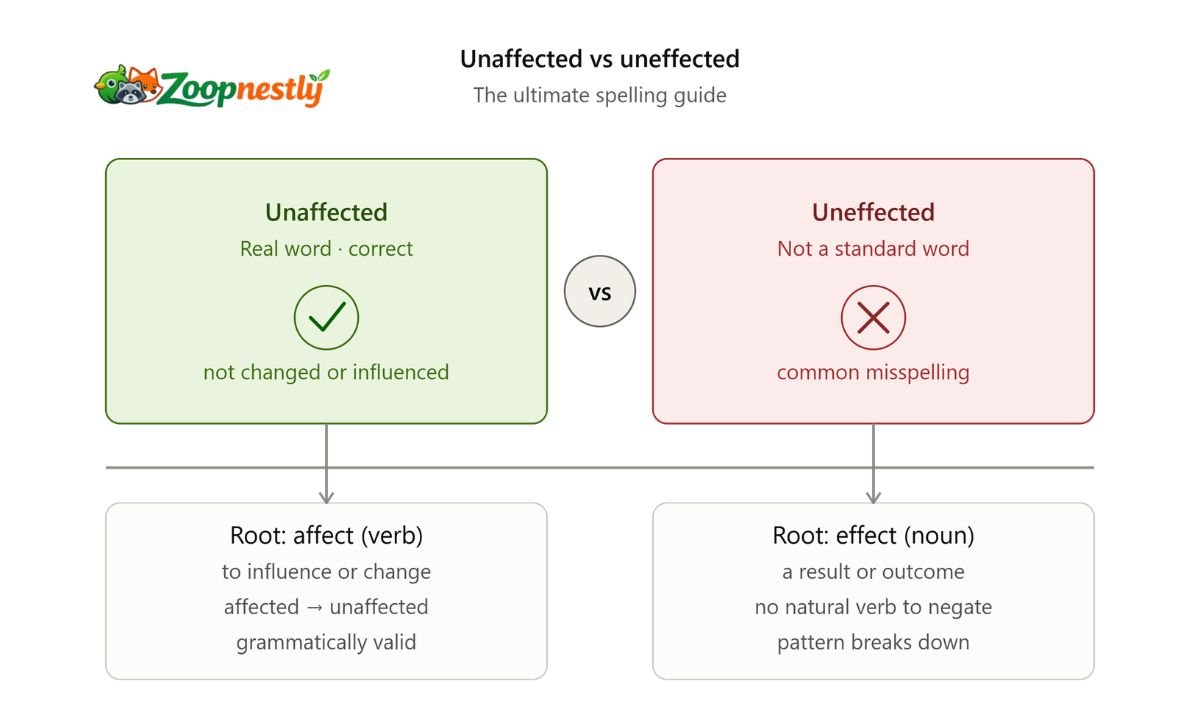
Unaffected is the correct word. It means not influenced or changed by something. Uneffected is not a standard English word and should not be used in formal or everyday writing. If you’re unsure which to type, always choose “unaffected.”
Unaffected vs Uneffected: The Short Version
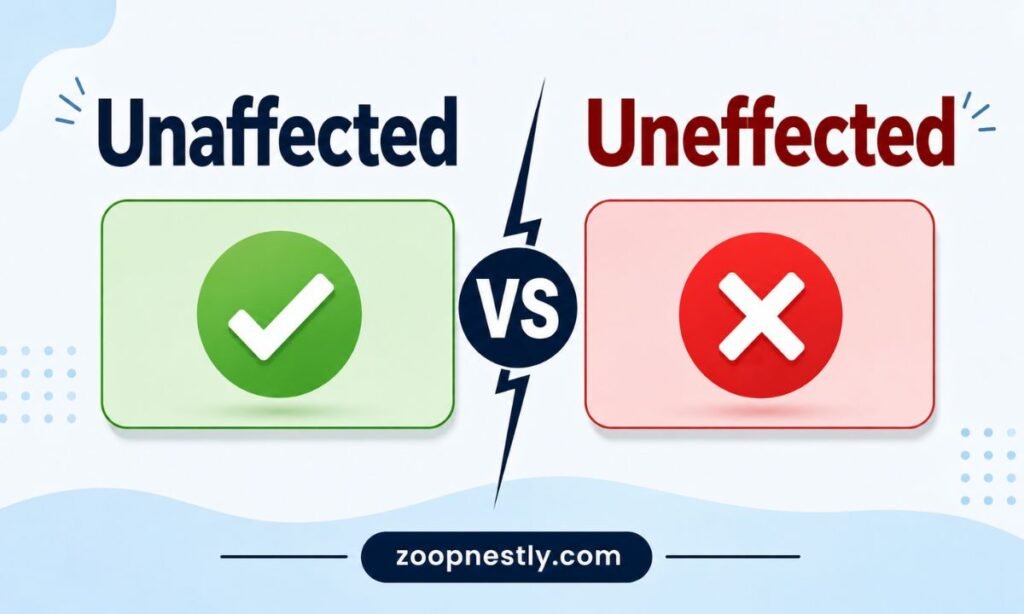
Here’s the core issue in plain terms: only one of these two words exists in standard English.
Unaffected is a real, widely used adjective. Uneffected is essentially a misspelling that happens when people confuse “affect” with “effect” and then try to build a negative form of the wrong root word. Dictionaries don’t recognize “uneffected” as standard usage, and you won’t find it in style guides or reputable grammar references.
So the comparison isn’t really “word A vs word B.” It’s “correct word vs common error.”
What Does Unaffected Mean?
Unaffected means something or someone has not been changed, influenced, or altered by an event, situation, or emotion. It’s built from the prefix “un-” (not) plus “affected,” the past participle of the verb “affect.”
Think of “affect” as an action verb: something acts on something else and causes a change. “Unaffected” simply reverses that. Nothing changed.
Example sentences:
- The old oak tree remained unaffected by the storm.
- Her calm expression stayed unaffected even after the bad news.
- Sales in the region were largely unaffected by the price increase.
- He seemed completely unaffected by the criticism.
Notice the pattern: in every case, something had the potential to cause change, and it simply didn’t.
Why Uneffected Isn’t Correct
To understand why “uneffected” fails, it helps to look at how “effect” behaves grammatically. Effect is almost always a noun (a result or outcome), not a verb. You don’t typically “effect” something in everyday speech, so there’s no natural verb form to attach “un-” to in the first place.
Contrast that with “affect,” which is a true action verb. It makes grammatical sense to describe something as “affected” (changed by an action) and then negate it as “unaffected” (not changed).
“Uneffected” tries to copy that pattern using the wrong base word, and the result isn’t standard English. If you search major dictionaries, you won’t find a legitimate entry for it as a recognized synonym of “unaffected.”
Unaffected vs Uneffected: Comparison Table
| Feature | Unaffected | Uneffected |
| Standard word? | Yes | No |
| Part of speech | Adjective | Not applicable |
| Meaning | Not changed or influenced | No accepted meaning |
| Root word | Affect (verb) | Effect (noun) |
| Dictionary status | Listed in standard dictionaries | Not listed as standard usage |
| Correct to use in writing? | Yes | No |
How to Remember Which One Is Right

A simple trick: affect is an Action. When you’re describing something that was or wasn’t influenced by an action, you want the “affect” family of words, which gives you “unaffected.”
If you catch yourself typing “uneffected,” stop and swap it for “unaffected.” There’s no context, formal or casual, where “uneffected” is the preferred or accepted choice.
DISCOVER MORE : Stared vs Starred: Common Mistakes and How to Avoid Them
Affected vs Unaffected vs Effected: Clearing Up the Whole Group
Since this confusion often spreads across related words, here’s a quick breakdown of the full family.
| Word | Meaning | Example |
| Affect | To influence or change (verb) | The rain affected our plans. |
| Affected | Changed or influenced (adjective/past tense) | The crops were affected by drought. |
| Unaffected | Not changed or influenced | The schedule remained unaffected. |
| Effect | A result or outcome (noun) | The medicine had a strong effect. |
| Effected | Brought about or accomplished (rare verb usage) | The new policy effected real change. |
Effected does exist, but it’s used far less often and usually appears in formal or legal writing, meaning “caused to happen.” It is not interchangeable with “unaffected.”
Common Mistakes to Avoid
Writers usually stumble in one of these ways:
- Using “uneffected” instead of “unaffected.” This is the most frequent error and the main reason this comparison gets searched.
- Confusing “affect” and “effect” first, which then leads to the wrong negative form.
- Assuming “uneffected” is a rare but valid variant. It isn’t a recognized alternative spelling; it’s simply incorrect.
- Overcorrecting into overly formal language by reaching for “effected” when “unaffected” or “unchanged” fits the sentence better.
A fast way to check yourself: read the sentence aloud and ask, “Was something influenced or not?” If the answer involves influence or change, “affected” and “unaffected” are almost always the words you need.
Real-World Examples in Context
Seeing the word in different settings makes the meaning stick.
- News writing: “Coastal towns north of the storm’s path were unaffected by the flooding.”
- Business writing: “Our supply chain remained unaffected despite the shortage.”
- Everyday conversation: “She looked unaffected by the long flight, ready to go straight to dinner.”
- Legal or formal writing: “The contract terms are unaffected by this amendment.”
Across all these examples, “unaffected” consistently signals stability or the absence of change.
Synonyms for Unaffected
Depending on context, several words can substitute for “unaffected”:
- Unchanged
- Untouched
- Unmoved
- Unscathed
- Immune (in a figurative sense)
- Indifferent (when describing emotional reactions)
Choosing among these depends on tone. “Untouched” and “unscathed” often suit physical or literal situations, while “unmoved” and “indifferent” work better for emotional contexts.
When Emotional vs Literal Meaning Matters
“Unaffected” can describe two slightly different situations, and knowing which one you mean sharpens your writing.
Literal or physical sense: Something wasn’t damaged or altered.
- “The building’s foundation was unaffected by the earthquake.”
Emotional or personal sense: Someone didn’t show or feel an emotional reaction.
- “He remained unaffected by the harsh reviews.”
Both uses are correct. Context tells the reader which meaning applies, so there’s no need to add extra qualifiers unless you want additional clarity.
Practice: Test Yourself
Try filling in the blank with the correct word (answers follow).
- The village stayed completely _____ by the power outage.
- Her mood was _____ by the unexpected compliment. (affected/unaffected)
- The new law _____ small businesses more than large ones. (affected)
- His confidence remained _____ despite the setback.
Answers: 1. unaffected, 2. affected, 3. affected, 4. unaffected
If you got these right, you’ve already internalized the pattern better than most first-draft writers.
Frequently Asked Questions
Is “uneffected” ever correct in any dialect of English?
No. “Uneffected” is not recognized as standard usage in American, British, or any other major English dialect. It’s a common misspelling, not a regional variant.
What part of speech is “unaffected”?
Unaffected is an adjective. It describes a noun by indicating that noun was not influenced or changed by something.
Can “unaffected” describe people and things?
Yes. You can describe a person as unaffected (emotionally unmoved) or an object, system, or place as unaffected (physically or functionally unchanged).
What’s the easiest way to avoid mixing up affect and effect?
Remember that affect is usually a verb (an action), while effect is usually a noun (a result). Since “unaffected” comes from the verb “affect,” that connection helps you choose the right word.
Is there a noun form related to “unaffected”?
Not directly. “Unaffected” stays in its adjective form. If you need a noun idea, you’d typically rephrase, such as “the situation showed no effect” rather than forcing a noun version of “unaffected.”
Quick Reference Table
| Question | Answer |
| Correct word | Unaffected |
| Incorrect word | Uneffected |
| Meaning | Not changed or influenced |
| Root verb | Affect |
| Common confusion | Affect vs effect |
| Formal alternative | Unchanged, untouched |
Final Thoughts
The comparison between unaffected vs uneffected really comes down to one simple fact: only “unaffected” belongs in standard English writing. Once you connect it back to the verb “affect,” the spelling and meaning both fall into place naturally. Keep that root-word link in mind, and you’ll never second-guess this one again.

James Walker is a content writer and language researcher with over 5 years of experience in meanings, definitions, and language-related topics. He enjoys simplifying complex terms into clear, easy-to-understand explanations. Through ZoopNestly.com, he helps readers find accurate and reliable information.