Eyeing or Eying: Understanding the Difference and Proper Usage
You spot the perfect pair of sneakers online, and you’re eyeing them for a week before you finally hit buy. Or wait, were you eying them? Your cursor hovers over the spell checker, and suddenly a simple sentence feels like a trap.
This mix-up trips up even confident writers, because both spellings show up in books, articles, and everyday conversation. Here’s the good news: the confusion ends in the next few lines.
Quick Answer
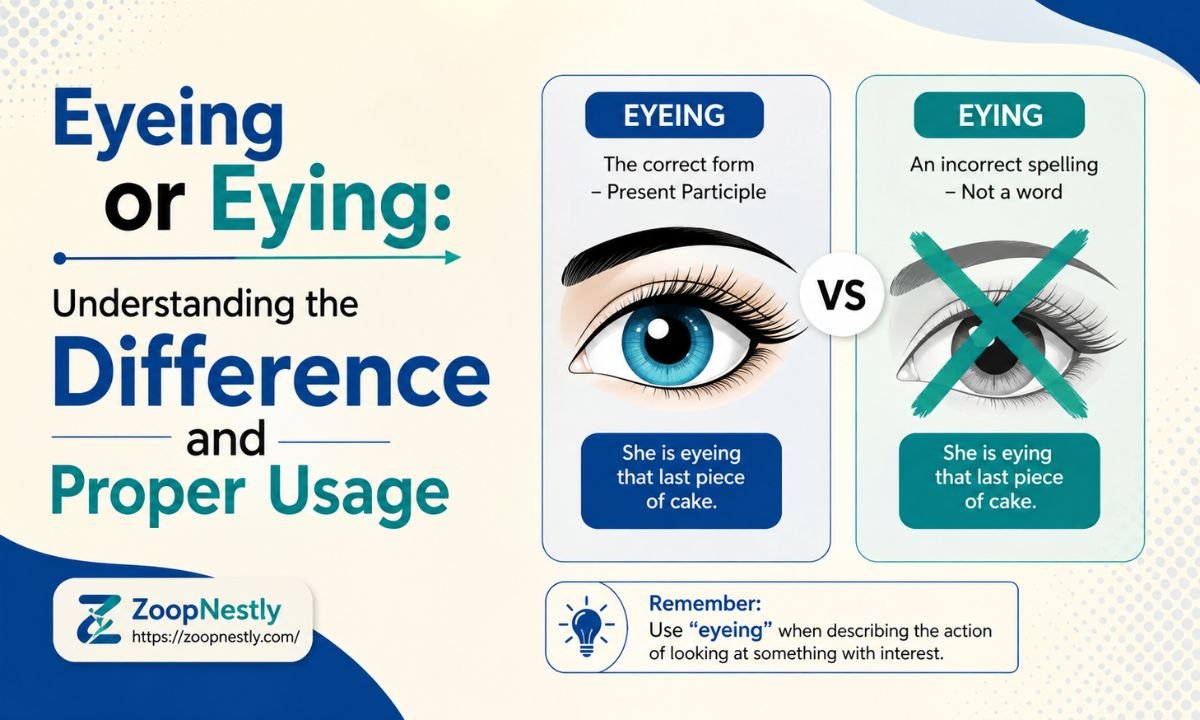
Eyeing is the standard, most widely used spelling of this verb form in American English. Eying is a recognized variant spelling that appears less often but is not incorrect. Both come from the verb eye, meaning to look at or watch something closely. If you only remember one rule, use eyeing for everyday and professional writing.
What Does Eying or Eyeing Actually Mean?
Before choosing a spelling, it helps to nail down the meaning. Eye is a verb that means to look at someone or something carefully, often with interest, suspicion, or desire. When you add the -ing ending to show ongoing action, you get either eyeing or eying.
Some common meanings include:
- Watching something closely (She was eyeing the last slice of pizza.)
- Considering an option (The company is eyeing a merger.)
- Looking at someone with suspicion (The guard kept eying the visitor.)
Both spellings carry the exact same meaning. The difference is purely about spelling, not definition.
Why Do Two Spellings Exist?
English has a general spelling rule: when a verb ends in a silent e, you drop the e before adding -ing. That’s why “make” becomes “making” and “hope” becomes “hoping.”
By that logic, “eye” should become “eing,” which looks strange and is rarely used. So English speakers took two different paths to avoid that awkward result:
- Eyeing keeps the e to preserve the word’s shape and avoid confusion with unrelated words.
- Eying drops the e and follows the standard spelling rule, even though the result looks unusual.
This is one of the few cases in English where breaking the normal spelling pattern actually produces the more popular word. Short, three-letter verbs ending in a vowel-plus-e sound (like “eye,” “dye,” and “singe”) often bend the rules to keep the word recognizable at a glance.
Eying or Eyeing: Which One Should You Use?
For most writing, choose eyeing. It’s the form readers expect, the one style guides favor, and the one that looks correct at a quick glance. Use eying only if you’re matching a specific publication’s house style or writing for a British audience where you’ve seen it used consistently.
If you’re ever unsure while writing, default to eyeing. It will almost never be marked wrong.
British English vs American English Spelling
Unlike words such as “colour” versus “color,” this isn’t a strict British-versus-American split. Eyeing is dominant in both American and British English writing. Eying appears in both varieties too, just less frequently.
That said, general usage patterns show eyeing holds a clear lead across major English-speaking regions, including the US, UK, Canada, and Australia. Neither dictionary treats eying as wrong; it’s simply the less common of the two accepted spellings.
What Do Dictionaries and Style Guides Say?
Major dictionaries, including Merriam-Webster, list both eyeing and eying as correct present participle forms of “eye,” with eyeing typically shown as the primary or more common entry.
For style guide preference, publications that follow AP style generally lean toward eyeing in news writing and editorial content. If you’re writing for a specific outlet, it’s worth checking their internal style guide, but in the absence of specific instructions, eyeing is the safer default.
Comparison Table: Eying vs Eyeing
| Feature | Eyeing | Eying |
| Correctness | Correct | Correct |
| Common usage | More frequently used | Less frequently used |
| Dictionary status | Primary/preferred form | Accepted variant |
| Style guide preference | Preferred in most guides | Rarely recommended |
| Readability | Familiar, easy to read | Can look unusual to some readers |
| Best for | General and professional writing | Matching specific house style |
Eying or Eyeing in Everyday Examples
Seeing both forms in real sentences makes the choice easier to remember.
Using eyeing:
- She’s been eyeing that job promotion for months.
- The cat sat quietly, eyeing the fish tank.
- Investors are eyeing the tech sector for new opportunities.
Using eying:
- He kept eying the exit during the meeting.
- The dog was eying the treat on the counter.
- Buyers are eying the housing market before rates rise.
Notice that the sentences work identically either way. Swapping one spelling for the other doesn’t change the meaning or the grammar, only the visual style of the word.
Common Mistakes with Eying or Eyeing
A few errors show up repeatedly with this word pair. Watch for these:
- Mixing spellings in the same document. Pick one form and stick with it throughout your writing for consistency.
- Confusing it with “eyeballing.” “Eyeballing” means estimating something roughly, which is a different meaning entirely.
- Adding an extra letter. Words like “eyeieng” or “eyieng” are simply typos, not alternate spellings.
- Assuming one form is wrong. Some writers correct eying to eyeing automatically, assuming it’s a mistake. It isn’t, though eyeing remains the safer everyday choice.
DISCOVER MORE : Habbit or Habit Explained: Which Word Should You Use?
Eying or Eyeing: Synonyms Worth Knowing
If you want to vary your word choice, several alternatives capture a similar meaning depending on context:
- Watching – general observation
- Observing – formal or careful attention
- Eyeballing – informal, often for rough estimates
- Scrutinizing – close, critical examination
- Considering – used when the meaning leans toward weighing an option, like a business decision
Choosing a synonym can also help you sidestep the spelling question entirely when you’re unsure which form to use.
How to Use Eying or Eyeing in a Sentence Correctly
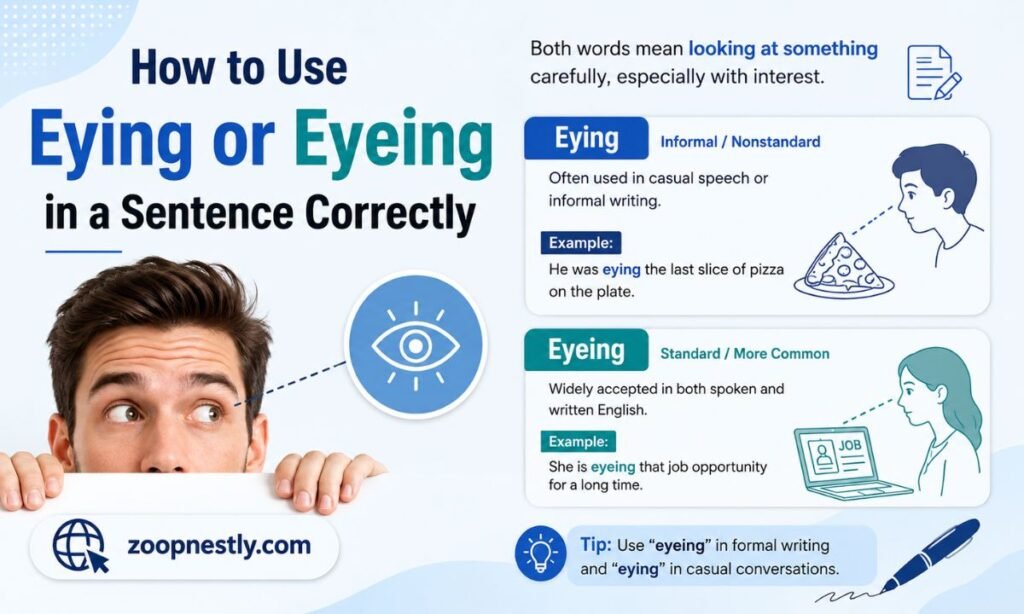
Grammatically, both spellings function the same way. They act as the present participle of “eye” and can be used:
- As part of a continuous verb tense: They are eyeing the property.
- As a gerund: Eyeing your competitors’ pricing is a smart strategy.
- As an adjective-like modifier: The eyeing customer lingered by the display. (less common, but grammatically valid)
The key rule to remember: whichever spelling you pick, keep the subject-verb structure standard, just like any other -ing verb form.
A Simple Way to Remember Which Spelling to Use
Here’s a quick mental trick: think of the phrase “keep an eye, keep the e.” Since eyeing keeps the full word “eye” visible inside it, it’s easier to read and recognize instantly. That visual clarity is a big reason it became the more popular spelling over time.
Frequently Asked Questions
Is eying a real word?
Yes. Eying is a legitimate, dictionary-recognized spelling of the present participle of “eye.” It’s simply used less often than eyeing.
Which spelling does Merriam-Webster prefer?
Merriam-Webster lists eyeing as the primary form, with eying included as an accepted variant spelling.
Can I use eying and eyeing interchangeably?
Yes, both spellings mean the same thing and are grammatically correct. For consistency, pick one spelling and use it throughout the same piece of writing.
Is eyeing the correct AP style spelling?
Publications following AP style typically use eyeing, making it the safer choice for news and professional writing.
Why does eyeing look more natural than eying?
Because eyeing retains the full spelling of “eye” within the word, it’s more immediately recognizable to readers, which is likely why it became the dominant spelling over time.
Conclusion
Both eying and eyeing are correct spellings of the same verb form, so you won’t be grammatically wrong either way. That said, eyeing is the more familiar, more widely accepted, and more style-guide-friendly option for everyday and professional writing. When in doubt, keep the extra e, keep your writing clear, and let eyeing be your default choice.

James Walker is a content writer and language researcher with over 5 years of experience in meanings, definitions, and language-related topics. He enjoys simplifying complex terms into clear, easy-to-understand explanations. Through ZoopNestly.com, he helps readers find accurate and reliable information.