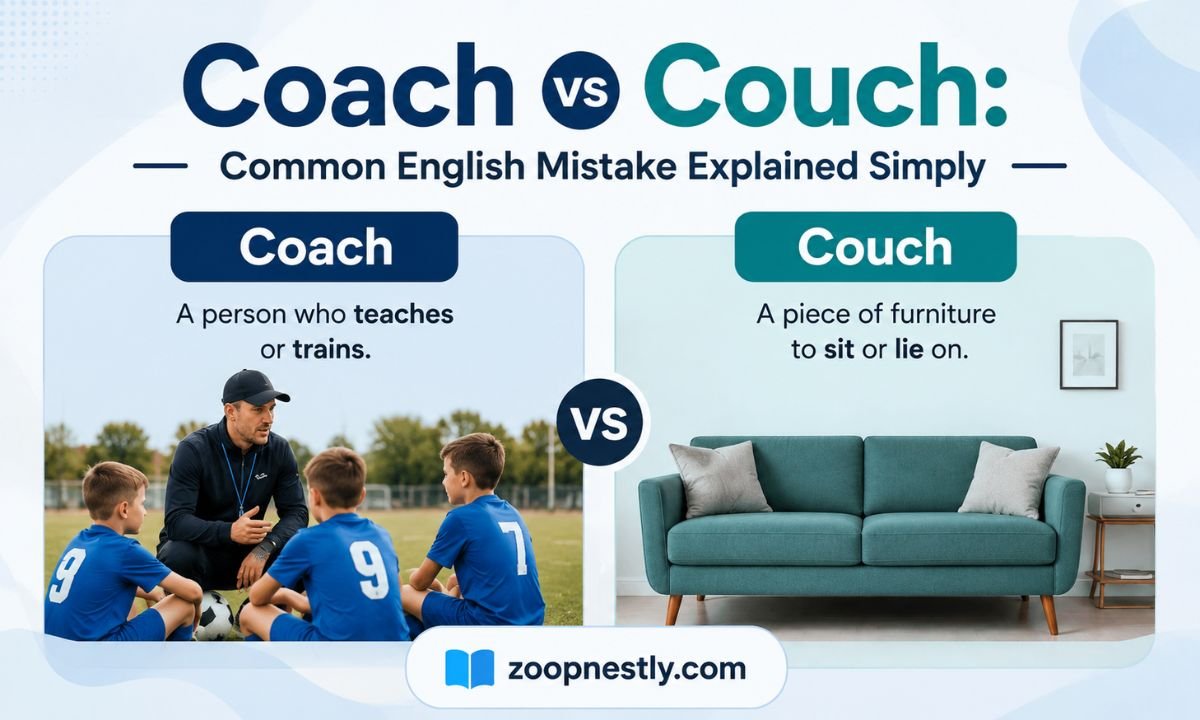
Coach vs Couch: Common English Mistake Explained Simply
You typed a quick text to a friend: “Come over, we can chill on the coach.” Something feels off, but you hit send anyway. If you’ve ever paused mid-sentence wondering whether you meant coach vs couch, you’re not alone.
These two words look similar, sound almost alike in casual speech, and trip up even confident writers. The good news is the difference is easy to lock in once you see it clearly.
Quick Answer
Coach refers to a trainer, instructor, or a type of long-distance bus or train carriage. Couch refers to a piece of furniture you sit or lie on, also called a sofa. They are not interchangeable, even though they sound similar when spoken quickly. Remembering one simple detail, that a couch has a “u” like “you sit on it,” solves most mix-ups instantly.
Coach vs Couch: The Core Difference

The mix-up usually comes down to sound, not meaning. In fast, casual speech, “coach” and “couch” can blur together, especially for non-native English speakers or people typing quickly on a phone. But their meanings don’t overlap at all.
- Coach = a person who trains or guides someone, or a vehicle for transportation
- Couch = a soft seat, usually found in a living room
Here’s a simple way to picture it: a coach helps you improve, while a couch helps you relax. One word is about action, the other is about rest.
Simple Example Sentences
Seeing the words in real sentences makes the difference stick faster than any rule.
Coach:
- Her basketball coach scheduled extra practice before the tournament.
- We booked a coach ticket for the overnight train to Chicago.
- He hired a career coach to help with his job search.
Couch:
- I fell asleep on the couch while watching a movie.
- Please move the couch away from the window.
- The dog isn’t allowed on the couch.
Easy Memory Trick
If you only remember one thing from this article, make it this: couch contains the letter u, just like the word “you.” You sit on a couch. That single visual link is usually enough to stop the confusion for good, even under time pressure.
Where Each Word Comes From

Understanding the origin of these words explains why they look and sound so close, even though they mean completely different things.
Origin of Coach
The word “coach” traces back to the Hungarian town of Kocs, known for producing a style of horse-drawn carriage in the 15th century. That carriage design spread across Europe, and the word evolved to describe vehicles that “carried” people. Over time, the meaning extended to anything that guides or transports someone toward a goal, which is how we ended up with sports coaches, life coaches, and coach class on flights.
Origin of Couch
“Couch” comes from the French word coucher, meaning “to lie down.” That root makes perfect sense once you think about it: a couch is literally furniture built for lying down or reclining. The word entered English centuries ago and has kept its furniture meaning ever since, without picking up any secondary uses like “coach” did.
Why They Sound So Similar
Both words share Latin and French roots buried deep in their history, and their spellings differ by just one letter. That’s purely coincidental rather than a shared meaning, but it’s exactly why the two get confused in speech and in quick typing.
Does British or American English Spell Them Differently?
This is one area where a lot of guides get it wrong. Unlike words such as “colour” versus “color,” coach and couch are spelled the same way in both British and American English. There’s no regional variation to worry about here. The confusion isn’t a US-versus-UK issue; it’s simply a sound-alike issue that affects English speakers everywhere.
Which Word Should You Use? A Practical Breakdown
Use “Coach” When Talking About:
| Situation | Example |
| A sports trainer | The coach benched two players for practice. |
| Long-distance transport | We’re taking a coach from London to Bath. |
| Airline seating | I always fly economy, also called coach class. |
| Mentoring or guidance | She works as an executive coach. |
Use “Couch” When Talking About:
| Situation | Example |
| Living room furniture | We bought a new couch for the apartment. |
| Casual resting | He spent Sunday on the couch binge-watching TV. |
| Idiomatic expressions | Stop being a couch potato and go outside. |
Quick Rule for Any Writer
If the sentence involves training, guiding, or a vehicle, reach for coach. If it involves sitting, lounging, or furniture, reach for couch. When in doubt, ask yourself: is this about movement and improvement, or comfort and rest?
DISCOVER MORE : You Too or You To: Understanding the Correct Usage and Meaning
Common Mistakes People Make

Most coach vs couch errors fall into a few predictable patterns.
- Autocorrect swaps: Phones sometimes “correct” one word into the other, especially in texting apps.
- Typing speed errors: Writers who type fast often drop or add the “u” without noticing.
- Non-native speaker confusion: Learners sometimes rely on how the words sound rather than how they’re spelled.
- Homophone-style thinking: Because the words look close on the page, people assume they’re interchangeable, which they are not.
Why These Mistakes Happen
English has plenty of near-identical word pairs, and the brain sometimes autocompletes based on familiarity rather than checking spelling. Since both words are common in everyday conversation, it’s easy to type one while thinking of the other.
A Simple Fix
Before hitting send or publish, read the sentence back and ask what the word is actually describing. A person or vehicle points to coach. A piece of furniture points to couch. That one-second check catches almost every mistake.
Coach vs Couch in Real-World Writing
Seeing how these words show up outside of textbook examples helps cement the difference.
In a text message: “Can’t talk right now, laying on the couch with a headache.”
In a news headline: “Team Fires Head Coach After Losing Season”
On social media: “Nothing beats a lazy Sunday on the couch with coffee and a good show.”
In a formal email: “Our department has engaged a leadership coach to support the new managers.”
Notice how “couch” always sits in relaxed, personal contexts, while “coach” appears in professional, structured, or travel-related contexts. That pattern holds true almost everywhere you’ll encounter these words.
A Helpful Related Word: “Couched”
One detail competitors often skip is the verb form “couched,” as in “the feedback was couched in polite language.” This comes from the same French root meaning “to lie down” or “to place,” and it means something was phrased carefully or indirectly. It has nothing to do with furniture directly, but understanding it prevents a second layer of confusion when readers encounter it in formal writing.
Coach vs Couch Comparison Table
| Feature | Coach | Couch |
| Part of speech | Noun (also verb: “to coach”) | Noun only |
| Core meaning | Trainer, instructor, or transport vehicle | Furniture for sitting or lying down |
| Word origin | Hungarian town of Kocs | French coucher, “to lie down” |
| British vs American spelling | Same in both | Same in both |
| Common phrases | Coach class, life coach, head coach | Couch potato, on the couch |
| Typical context | Sports, travel, mentoring | Home, furniture, relaxation |
Frequently Asked Questions
Is it “couch” or “coach” potato?
The correct phrase is couch potato, describing someone who spends a lot of time sitting and watching TV instead of being active. “Coach potato” is a common misspelling with no real meaning.
Can “coach” ever mean furniture?
No. “Coach” never refers to furniture in standard English. If someone means a sofa, the correct word is always “couch.”
Why do people confuse coach and couch so often?
The words differ by just one letter and sound similar in fast, casual speech, which makes it easy to type or say the wrong one without noticing.
Is “coach” spelled differently in British English?
No. Both “coach” and “couch” keep the same spelling in British and American English. There’s no regional spelling variation for either word.
What’s an easy way to remember the difference?
Remember that couch has a u, just like “you.” You sit on a couch, which makes the connection easy to recall whenever you’re unsure.
Final Thoughts
Coach and couch may look like close cousins on the page, but they belong to completely different worlds. One is about training, guiding, or traveling. The other is about comfort and rest. Once the small memory trick clicks, mixing them up becomes far less likely, whether you’re writing a quick text, a work email, or a longer article.

James Walker is a content writer and language researcher with over 5 years of experience in meanings, definitions, and language-related topics. He enjoys simplifying complex terms into clear, easy-to-understand explanations. Through ZoopNestly.com, he helps readers find accurate and reliable information.