Grately vs Greatly: Simple Guide to the Correct Spelling
You’re typing a thank-you note or wrapping up a work email, and you pause. Is it “grately appreciated” or “greatly appreciated”? That split second of doubt is more common than you’d think, and it’s easy to see why. The word sounds like it should have a “t” in there somewhere. But spelling by sound alone can trip up even confident writers. The grately vs greatly confusion usually comes down to one thing: only one of these words actually exists.
Quick Answer
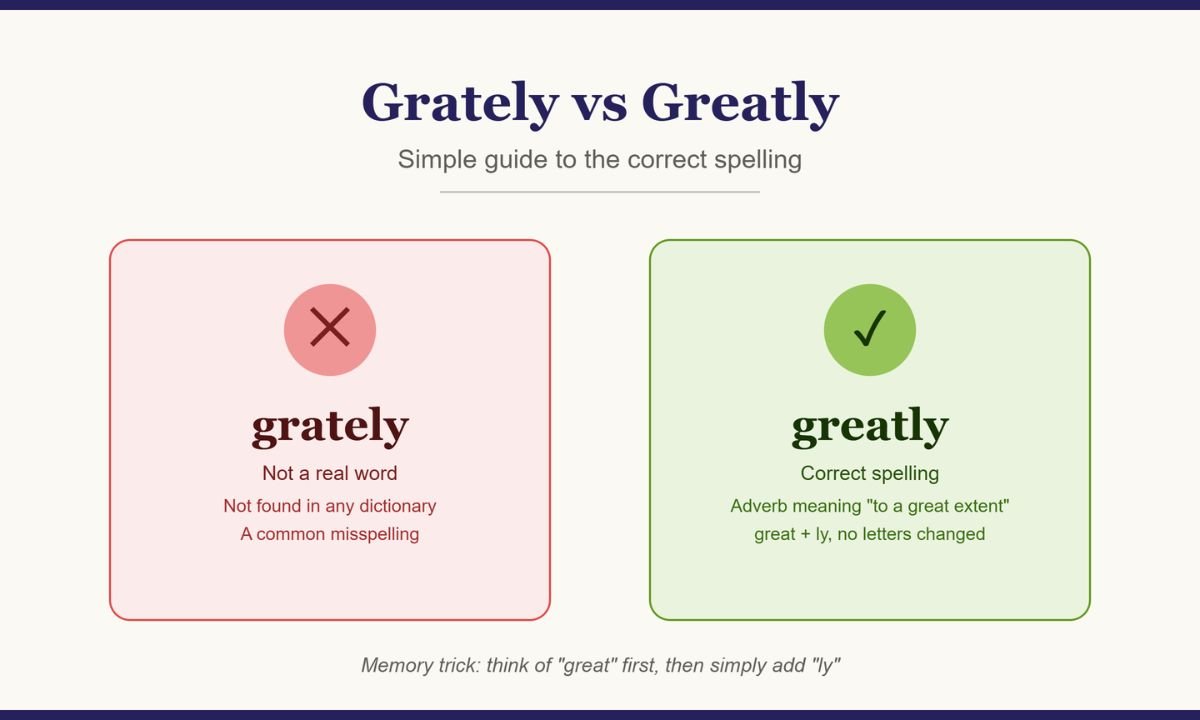
Greatly is the correct spelling. It’s a standard English adverb meaning “to a great extent” or “very much.” Grately is not a real word. It’s a common misspelling that happens because people mishear or misremember how “greatly” is built from the adjective “great.”
Now let’s break down why this mix-up happens so often, and how to make sure you never second-guess it again.
What Does “Greatly” Mean?
“Greatly” is an adverb that modifies verbs, adjectives, or other adverbs to show intensity. It tells you the degree or extent of something, similar to words like “significantly,” “considerably,” or “immensely.”
For example:
- Her performance greatly improved after weeks of practice.
- We greatly value your feedback.
- The new update greatly reduces loading time.
In each case, “greatly” is boosting the strength of the verb it’s attached to.
Why “Grately” Isn’t a Word
“Grately” doesn’t appear in any standard English dictionary, including Merriam-Webster, Cambridge, or Oxford. It’s not a regional variant, an old spelling, or a shortened form. It’s simply an error.
The mix-up usually comes from one of two habits:
- Phonetic spelling. English words don’t always look the way they sound, and “greatly” is a good example. Some writers hear the word and spell it based on pronunciation rather than the actual base word.
- Autocorrect and typing speed. A quick typo, especially swapping the “e” and “t,” can slip past a fast typist or a phone keyboard that doesn’t catch it.
Once you understand where “greatly” comes from, the spelling becomes much easier to lock in.
How “Greatly” Is Built
English regularly turns adjectives into adverbs by adding “-ly” to the end. “Greatly” follows this exact pattern.
| Adjective | Adverb |
| great | greatly |
| quick | quickly |
| sincere | sincerely |
| careful | carefully |
| honest | honestly |
Notice that the adjective’s spelling stays intact, and “-ly” is simply attached to the end. “Great” plus “-ly” gives you “greatly,” with no letters removed or swapped. This same rule explains why “grately” doesn’t work: there’s no adjective called “grate” that means impressive or excellent, so there’s nothing for “-ly” to attach to.
Grately vs Greatly: Side-by-Side Comparison
| Grately | Greatly | |
| Is it a real word? | No | Yes |
| Part of speech | None | Adverb |
| Dictionary listed? | Not found | Yes, in all major dictionaries |
| Correct usage | None | Modifies verbs, adjectives, adverbs |
| Common context | Typing error | Formal and casual writing |
Common Mistakes People Make

Beyond the basic spelling error, a few related mix-ups show up often:
- “Grately appreciated” instead of “greatly appreciated.” This is one of the most searched versions of the mistake, especially in emails and thank-you messages.
- “Grately missed” instead of “greatly missed.” Common in condolence messages or posts about someone who has passed away or moved on.
- Confusing “greatly” with “great.” “Great” is an adjective describing a noun (“a great idea”), while “greatly” is an adverb describing an action or degree (“greatly improved”).
- Confusing “greatly” with “grateful.” These two words look similar but mean different things. “Grateful” expresses thankfulness, while “greatly” expresses intensity.
“Greatly Appreciated”: Getting It Right
This is one of the most common phrases where the error shows up, so it’s worth calling out directly.
- ✅ Correct: Your help is greatly appreciated.
- ❌ Incorrect: Your help is grately appreciated.
The phrase is used constantly in professional emails, customer service replies, and thank-you notes. Getting it wrong in a formal message, especially one going to a client or employer, can look careless even if the rest of the writing is polished. A single misspelled word can pull attention away from an otherwise strong message.
DISCOVER MORE : Manuel vs Manual: Spelling Difference Explained Simply
A Simple Trick to Remember the Spelling
If you want a fast mental check, think of the word “great” on its own first. You already know how to spell that. Then just add “ly” to the end, no changes, no swaps.
Great + ly = greatly
If you ever picture a “t” showing up before the “ly,” stop and picture the word “great” instead. That single-step check clears up the confusion almost every time.
How to Use “Greatly” in a Sentence
“Greatly” fits naturally in a wide range of sentences, from casual to formal. A few real-world examples:
- The team greatly benefited from the new training program.
- I was greatly relieved when the test results came back normal.
- Sales greatly increased after the holiday promotion launched.
- Your support has greatly impacted our small business.
- The city has greatly changed since I last visited.
Notice that “greatly” almost always sits right before the verb it’s modifying, or right after “has” or “was” in a sentence with helping verbs.
Where “Greatly” Fits Best
In professional writing, “greatly” works well in emails, reports, and proposals where you want to express intensity without sounding overly casual. “We greatly appreciate your patience” reads as polished and sincere.
In academic writing, “greatly” is useful for describing the extent of change, impact, or difference in research or analysis, such as “the results greatly varied between groups.”
In casual writing, “greatly” still works, but simpler alternatives like “really” or “so much” often sound more natural in everyday conversation or texting.
Synonyms for “Greatly”
If you find yourself using “greatly” too often in a piece of writing, these alternatives can add variety while keeping the same meaning:
- Significantly
- Considerably
- Immensely
- Substantially
- Extremely
- Enormously
- Highly
Example upgrade: Instead of “The results greatly improved,” try “The results significantly improved” or “The results improved enormously.” Both keep the original meaning while giving your writing a bit more range.
Grately or Greatly in UK English

There’s no difference between American and British English on this one. “Greatly” is the standard spelling in both, and “grately” is not recognized as a valid variant in any English-speaking region. If you’ve seen “grately” used somewhere online, it’s simply a spelling mistake, not a regional preference.
Quick Practice
Test yourself with these before checking the answers below.
- Her confidence has _______ improved since she started public speaking.
- Thank you, your support is _______ appreciated.
- He will be _______ missed by everyone at the office.
Answers: All three should be filled with “greatly.”
Key Takeaways
- Greatly is the correct and only valid spelling.
- Grately is a spelling mistake, not an alternate form.
- Greatly means “to a large or significant extent” and functions as an adverb.
- The word is built simply: great + ly, with no letter changes.
- Always proofread phrases like “greatly appreciated” and “greatly missed,” since these are the most common places the error shows up.
FAQs
Is “grately” ever correct in any context?
No. “Grately” is not recognized in any dictionary or style guide. It’s always a misspelling of “greatly.”
What does “greatly” mean in simple terms?
It means “very much” or “to a large extent.” It’s used to strengthen the meaning of a verb, adjective, or adverb in a sentence.
Is it “greatly appreciate” or “grately appreciate”?
It’s “greatly appreciate.” This phrase is one of the most common places people accidentally write “grately” instead.
Why do people spell “greatly” as “grately”?
It usually happens from typing quickly, mishearing the word, or not connecting it to its root word, “great.” Autocorrect can also introduce the error if it’s not caught.
Is “greatly” formal or informal?
It works in both formal and informal writing. It’s especially common in professional emails, reports, and thank-you messages, but it also fits naturally in everyday conversation.
Final Thoughts
The difference between grately and greatly isn’t really a debate. Only one of them is a real word, and it’s an easy one to remember once you connect it back to “great.” Whenever you’re unsure, picture the base word first, add “ly,” and you’ll spell it correctly every time. A small habit like this saves you from a mistake that’s easy to make but just as easy to avoid.

James Walker is a content writer and language researcher with over 5 years of experience in meanings, definitions, and language-related topics. He enjoys simplifying complex terms into clear, easy-to-understand explanations. Through ZoopNestly.com, he helps readers find accurate and reliable information.