Drier or Dryer: Which Word Should You Use and Why?
You typed a sentence, paused, and stared at the screen. Is it “the towel is drier” or “dryer”? You’re not imagining the confusion. English gives us two nearly identical words that sound alike but do completely different jobs.
Get it wrong in an email or a product listing, and it can look like a typo even when it isn’t. This guide clears up the drier or dryer question for good, with simple rules you’ll actually remember.
Quick Answer
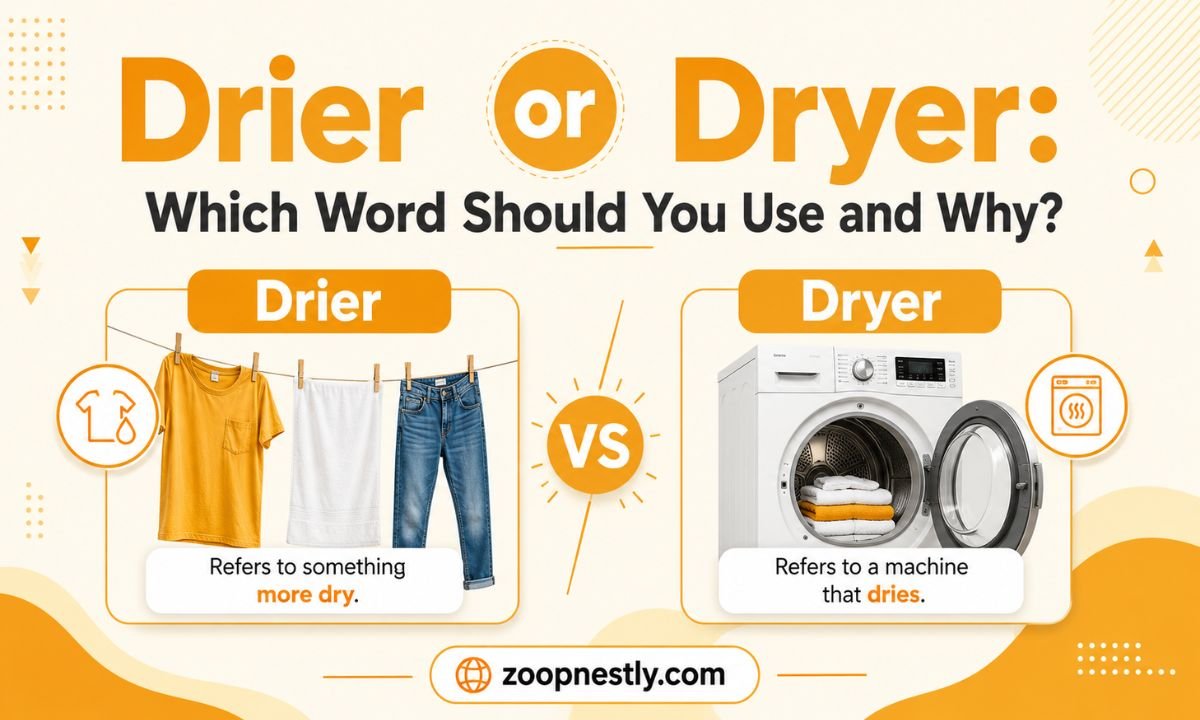
Drier is the comparative form of the adjective “dry” — it means “more dry,” as in “today is drier than yesterday.” Dryer is a noun that refers to a machine, like a clothes dryer or hair dryer. If you can replace the word with “more dry,” use drier. If you’re talking about an appliance, use dryer.
Drier or Dryer: The Core Difference
Both words come from the same root word, “dry,” which is why they trip people up. The spelling split happens because English adds different endings depending on the job the word is doing.
- Drier = adjective, comparative degree (“this climate is drier”)
- Dryer = noun, a device or machine (“put it in the dryer”)
Here’s a simple way to remember it: dryer ends the same way words like “toaster” or “blender” end, because it names a tool. Drier follows the same pattern as “happier” or “busier,” because it’s describing a quality.
Where the Words Come From

Both drier and dryer trace back to the Old English word “dryge,” meaning “free from moisture.” As English evolved, the “-er” suffix took on two separate jobs.
It could turn an adjective into its comparative form (fast becomes faster), or it could turn a verb into a noun for a person or thing that performs an action (bake becomes baker).
“Dry” ended up going both directions, which is how we landed with two spellings that sound identical but serve different grammatical purposes.
Is There a British vs American English Difference?
This is one area where regional spelling doesn’t change much. Unlike words such as “colour” and “color,” drier and dryer follow the same spelling rules in both British and American English. The distinction is grammatical, not regional. A washing machine is called a “tumble dryer” in the UK and a “clothes dryer” in the US, but the underlying spelling logic (adjective vs noun) stays the same on both sides of the Atlantic.
That said, dictionaries do note that “dryer” is sometimes accepted as an alternative comparative spelling in informal contexts. It’s not the preferred form, but you may see it in casual writing.
Comparison Table
| Feature | Drier | Dryer |
| Part of speech | Adjective (comparative) | Noun |
| Meaning | More dry | A machine that dries |
| Example | “The desert air is drier here.” | “I bought a new dryer.” |
| Common use | Describing weather, skin, humor, wine | Appliances (clothes, hair, food) |
| Region | Same in US and UK | Same in US and UK |
Which Spelling Should You Use?
The easiest test: try substituting “more dry” into your sentence. If it still makes sense, you want drier. If you’re naming an object, you want dryer.
Use drier if:
- You’re comparing two things (“this towel is drier than that one”)
- You’re describing weather, climate, or humidity levels
- You’re describing a sense of humor (“a drier wit than his brother”)
- You’re talking about texture, skin, or soil
Use dryer if:
- You’re naming a laundry appliance
- You’re referring to a hair dryer or blow dryer
- You’re talking about industrial or food dehydrating equipment
- The word is functioning as a noun in the sentence
Audience-Based Advice
If you’re writing for a general audience, stick to the standard rule above. If you work in retail, appliance sales, or product copy, “dryer” will show up constantly since it’s a product category. Writers, journalists, and anyone describing weather or tone will lean on “drier” more often. When in doubt, read the sentence aloud and ask whether you’re describing a quality or naming a thing.
DISCOVER MORE : Buses or Busses? Find Out Which One Is Right
Common Mistakes with Drier or Dryer
- Mixing up the comparative with the noun. “Put the clothes in the drier” is a common typo. It should be “dryer” since you’re naming the machine.
- Assuming they’re interchangeable. They’re not synonyms. One is a description, the other is an object.
- Autocorrect confusion. Some spell checkers won’t flag either word since both are technically valid, so the error slips through.
- Overcorrecting in casual writing. Some people force “drier” as the comparative even when a sentence calls for “more dry” phrasing that reads more naturally, like “more dry than expected” instead of “drier than expected.”
Real-World Example Sentences
- The Sahara is far drier than most rainforests.
- She has a drier sense of humor than her coworkers.
- Our new dryer finishes a load in under 30 minutes.
- Pack a travel dryer if the hotel doesn’t provide one.
- This batch of clay feels drier than the last one.
- The dryer vent needs cleaning every few months.
Drier or Dryer in Everyday Writing
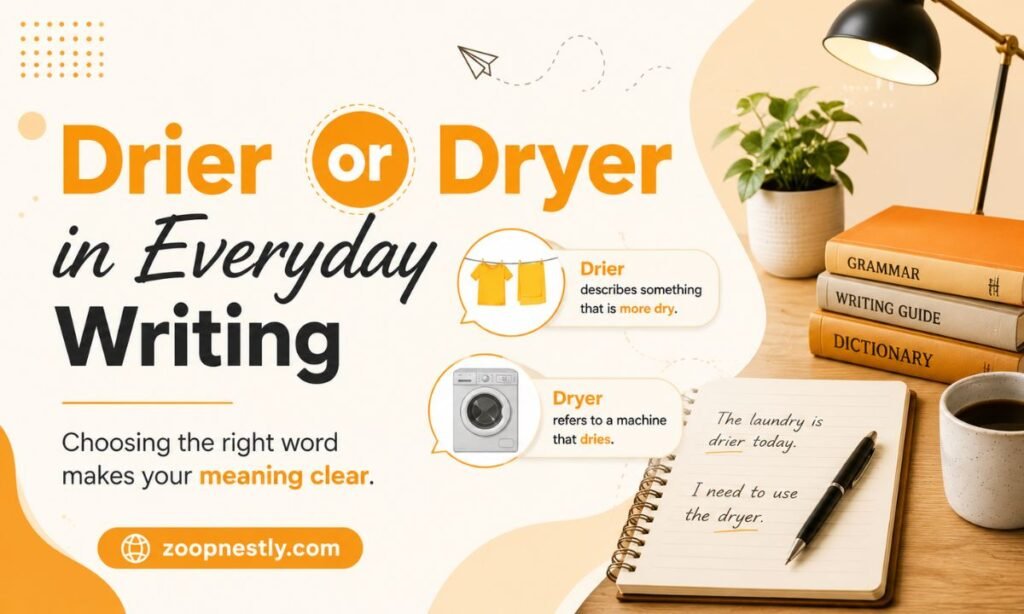
In emails: “The office feels drier since we added the humidifier” versus “The dryer in the break room is broken again.” Both are correct, but they mean very different things.
In news and weather reports: Meteorologists almost always use “drier” when comparing conditions, as in “the region will see drier conditions this week.”
On social media: Casual posts sometimes blur the line, but the same rule still applies. “My skin gets so drier in winter” is a common informal (and technically incorrect) phrasing. The grammatically correct version is simply “My skin gets so dry in winter” or “drier than usual.”
In formal writing: Business and academic writing should always follow the standard rule. Use “drier” for comparisons and “dryer” strictly as a noun for appliances.
Drier or Dryer for Weather
When describing conditions, drier is almost always correct because you’re comparing moisture levels. “This summer has been drier than last year” is a classic comparative structure. You would only use “dryer” here if you were literally talking about a machine used to dry something outdoors, which is rare in weather contexts.
Drier or Dryer for Wine
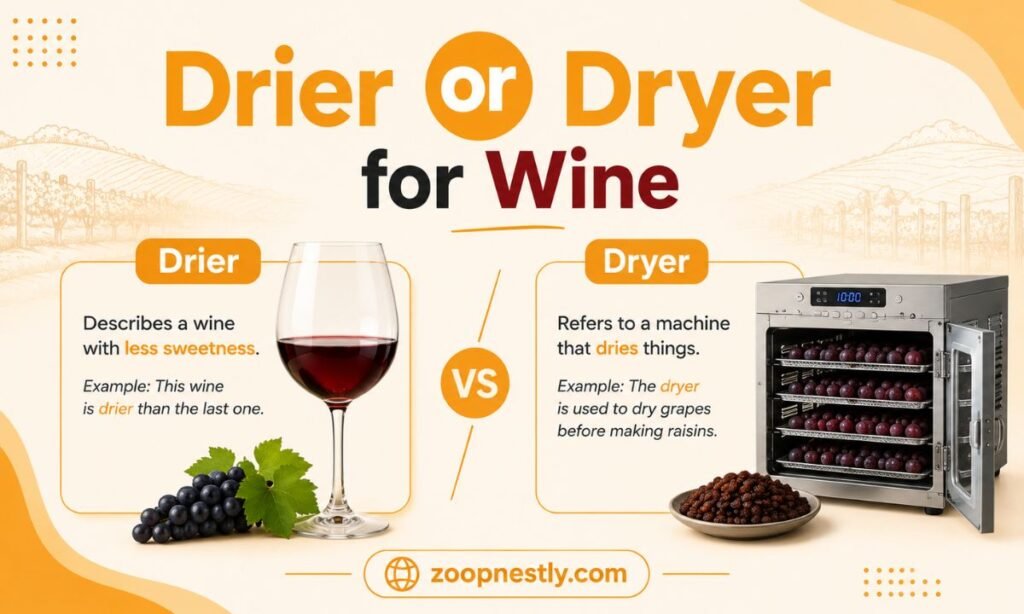
Wine tasting notes commonly use drier to describe a wine with less residual sugar compared to another. “This red is drier than the one we had last night” is a correct and common usage in wine reviews and tasting descriptions. You would never use “dryer” here, since no appliance is involved.
Drier or Dryer for a Washing Machine
This is where dryer always applies. A washing machine dries clothes using a “dryer” or “tumble dryer,” and the word functions purely as a noun naming the appliance. Common product terms include:
- Clothes dryer
- Tumble dryer
- Dryer sheets
- Dryer vent
- Dryer balls
None of these should ever be spelled “drier,” even though people sometimes make that mistake when typing quickly.
A Helpful Trick for Remembering the Difference
Think of the “-er” in dryer the same way you think of “player” or “printer.” All three name something that performs a function. Meanwhile, drier fits the same pattern as “shier” or “sadder,” words that show degree. If your sentence needs a comparison word, go with drier. If it needs an object, go with dryer.
Frequently Asked Questions
Is “drier” ever used as a noun?
Rarely, but yes. In some older or regional usage, “drier” can refer to a substance added to paint or ink to speed up drying. This is a specialized, less common use and shouldn’t be confused with the everyday appliance meaning of “dryer.”
Can “dryer” be used as an adjective?
Not in standard English. “Dryer” is a noun. If you want to describe something as more dry, the correct adjective form is “drier,” not “dryer.”
Which spelling do dictionaries prefer for the comparative form?
Major dictionaries list “drier” as the standard comparative form of “dry.” “Dryer” appears mainly as the noun for the appliance, though some dictionaries note it as an accepted informal variant for the adjective.
Is it “hair drier” or “hair dryer”?
It’s “hair dryer.” Since you’re naming a device, the noun form applies here, not the comparative adjective.
Why do so many people confuse drier and dryer?
The two words are homophones, meaning they sound identical when spoken. The confusion usually shows up in writing, where spelling suddenly matters and spell checkers don’t always catch the mix-up since both spellings are valid English words.
Conclusion
The drier or dryer mix-up comes down to one simple grammar rule: drier describes something becoming more dry, while dryer names the machine that does the drying. Once you connect drier to comparison and dryer to appliances, the confusion disappears. Next time you’re unsure, just ask yourself whether you’re comparing something or naming an object, and the right spelling will follow.

James Walker is a content writer and language researcher with over 5 years of experience in meanings, definitions, and language-related topics. He enjoys simplifying complex terms into clear, easy-to-understand explanations. Through ZoopNestly.com, he helps readers find accurate and reliable information.