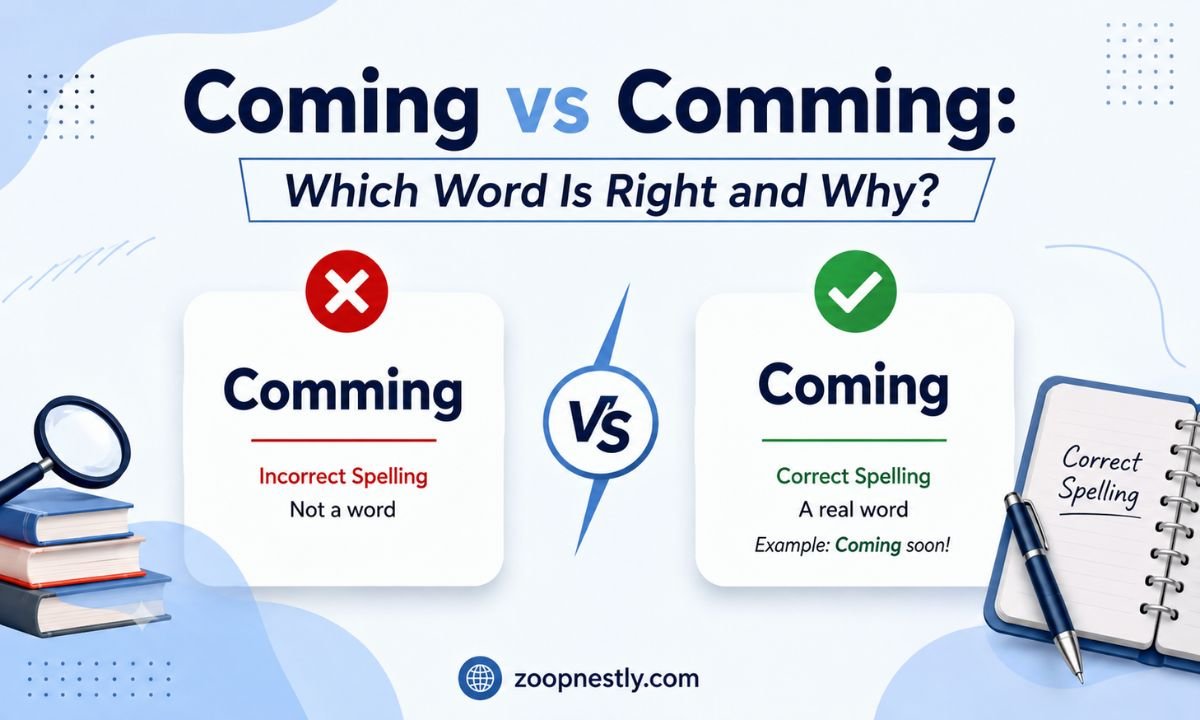
Coming vs Comming: Which Word Is Right and Why?
You typed a text message, hit send, and then froze. Was it “I’m comming over” or “I’m coming over”? That tiny pause happens to more people than you’d think, especially when a word feels longer than it looks.
The confusion around comming or coming trips up native speakers and learners alike, but the fix is simpler than it seems once you understand the spelling rule behind it.
Quick Answer
Coming is the only correct spelling. Comming is a common misspelling and does not exist in standard English. The word “coming” comes from “come” plus “-ing,” and English spelling rules drop the silent e before adding “-ing,” which is why it’s “coming” and not “comeing” or “comming.”
Why Do People Write “Comming” Instead of “Coming”?
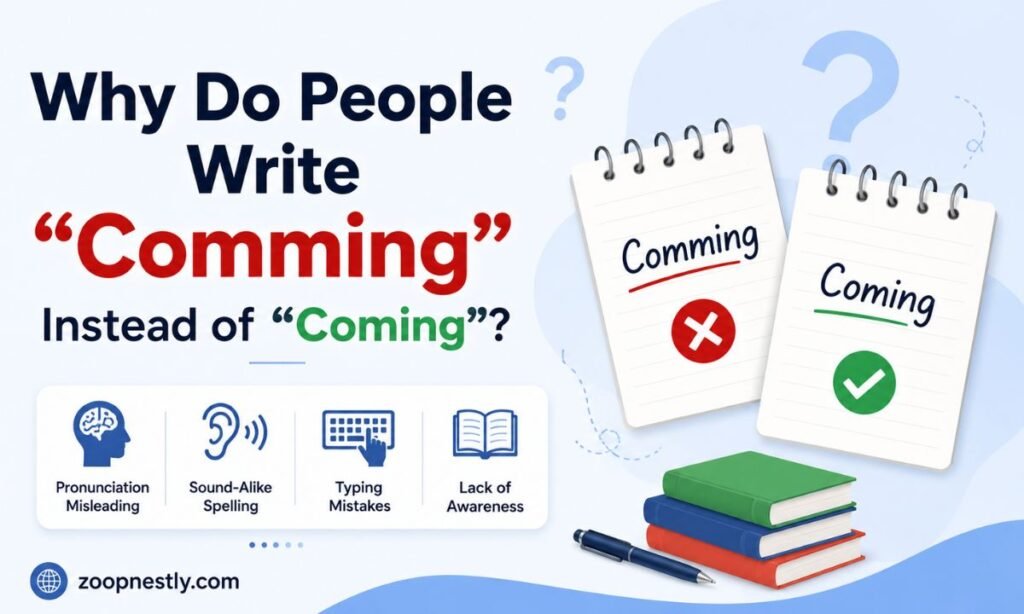
Most spelling mistakes have a logical root, and this one does too. English has a pattern where short vowel sounds often get a doubled consonant before “-ing” (think “running,” “stopping,” or “planning”). Because “coming” sounds like it might follow that same rhythm, people instinctively double the “m.”
But “come” doesn’t follow the doubling rule. It ends in a silent e, and words that end in a silent e simply drop that e before adding “-ing.” No letter gets doubled. That single detail is the whole reason “comming” feels right to the ear but looks wrong on the page.
The Spelling Rule Behind “Coming”
Here’s the rule in plain terms:
- If a word ends in a silent e, drop the e and add “-ing.” Example: come → coming, write → writing, make → making.
- If a word ends in a single vowel + single consonant and the syllable is stressed, double the final consonant. Example: run → running, sit → sitting, stop → stopping.
“Come” falls into the first group, not the second. That’s why “coming” gets one m, while “running” gets two n‘s. Once you separate these two rules in your head, the mix-up mostly disappears.
Comming or Coming: Meaning of the Word
“Coming” is the present participle of the verb “come.” It describes movement toward a place, an event that is about to happen, or something approaching in time.
Examples:
- She is coming to the party tonight.
- Winter is coming early this year.
- The train is coming into the station.
“Comming” has no meaning. It is not a variant spelling, a regional form, or an older version of the word. It’s simply a typo or a spelling error, and dictionaries do not list it as an alternative.
Comming vs Coming: Comparison Table
| Feature | Coming (Correct) | Comming (Incorrect) |
| Standard English spelling | Yes | No |
| Found in dictionaries | Yes | No |
| Root word | Come | Come |
| Rule applied | Drop silent “e,” add “-ing” | Incorrectly doubles “m” |
| Used in formal writing | Yes | Never |
| Used in casual texting | Yes | Sometimes (by mistake) |
Is “Comming” Ever Acceptable?
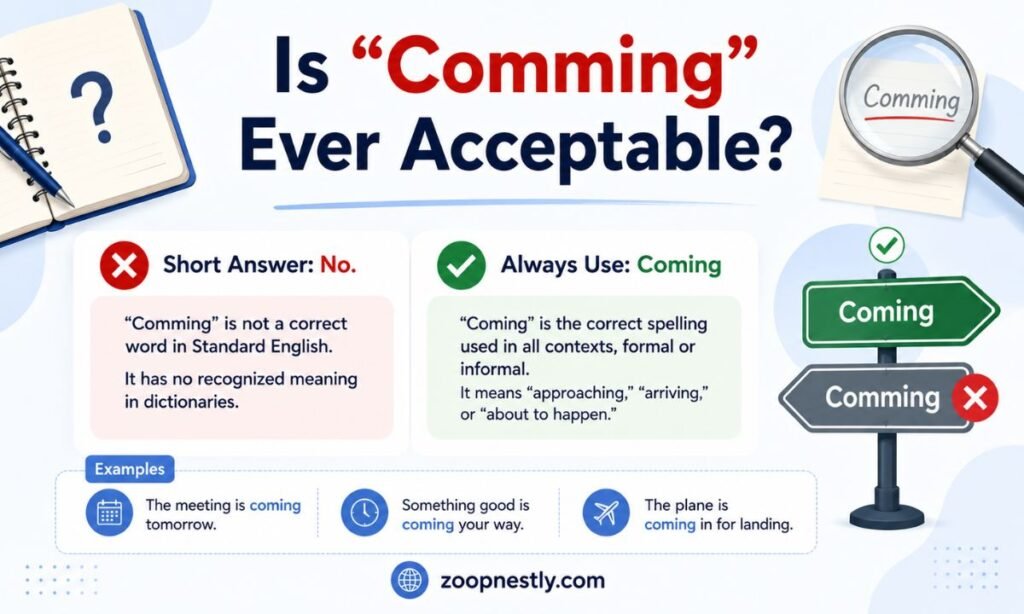
No. Unlike some words that have accepted British and American variants (like “colour” and “color”), “coming” doesn’t have a regional twin spelled with two m’s.
Both British English and American English spell it the exact same way: coming. This is one of the few spelling questions where there’s no dialect debate at all, which makes the correct choice easy to remember.
Common Mistakes People Make With “Coming”
Doubling the Letter “M”
This is the most frequent error. Writers apply the consonant-doubling rule from words like “running” or “getting” without realizing “come” ends in a silent e, not a short stressed vowel-consonant pair.
Confusing It With Similar Words
Some people also mix up “coming” with “comeing,” another incorrect form. Remember: the silent e is dropped, not kept, when adding “-ing.”
Autocorrect and Typing Speed
Fast typing on phones is a major source of this mistake. Your thumb hits the “m” key twice before your brain catches up, and autocorrect doesn’t always flag it because “comming” can look like a plausible word at a glance.
Relying on Sound Instead of Spelling Rules
English spelling isn’t always phonetic. Going by how a word sounds, rather than the rule that governs it, is exactly how errors like “comming or coming” happen in the first place.
DISCOVER MORE : Girlie or Girly: Which Is Correct? Meaning, Usage, and Examples (2026)
How to Remember the Correct Spelling
A simple trick: think of the base word “come” and picture the silent e quietly stepping aside to let “-ing” take its place. One m, one clean swap. If you ever picture two m’s, picture “running” instead, since that’s the word actually built for doubling.
Another quick test: try spelling other silent-e verbs the same way. “Hope” becomes “hoping,” not “hopping” (which actually means something different, since “hopping” comes from “hop”). Applying this same logic to “come” makes “coming” easy to lock in.
“Coming Soon” Meaning and Usage
The phrase “coming soon” is widely used in marketing, entertainment, and business to signal that something will be available or happen shortly. It’s common in:
- Movie trailers and release announcements
- Product launches and app updates
- Website “under construction” pages
- Store openings and menu items
Example: Our new collection is coming soon, so sign up for early access.
Since “coming soon” is a set phrase, the same spelling rule applies here too. It’s always “coming soon,” never “comming soon.”
Real-World Examples of “Coming” in Context
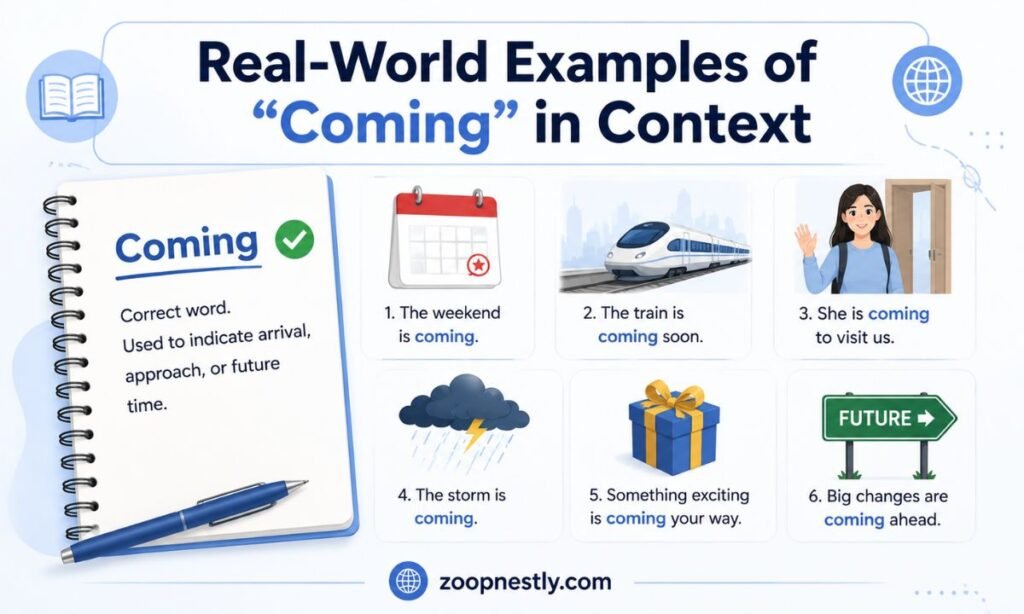
In conversation: “Are you coming to dinner tonight?”
In the workplace: “The quarterly report is coming together nicely.”
On social media: “Big announcement coming this week!”
Incorrect version (avoid this): “I’m comming home late today.” → Should be: “I’m coming home late today.”
Seeing the correct and incorrect forms side by side makes the difference easier to catch in your own writing.
Why This Mistake Is So Common in Casual Writing
Text messages, social media captions, and quick emails are where “comming” shows up most. That’s not a coincidence. These formats are typed fast, rarely proofread, and often skip spell-check entirely.
The mistake rarely appears in books, news articles, or edited content, because those pass through review before publishing. If you notice yourself typing “comming” often, it’s likely a speed habit rather than a real gap in your grammar knowledge, and it’s an easy one to correct with a little awareness.
Quick Checklist Before You Hit Send
- Does the word end in “-ming” with one m? Correct.
- Does it end in “-mming” with two m’s? Incorrect, fix it to one m.
- Are you using it after “be” verbs like “is,” “are,” or “was”? That’s a strong sign you need “coming” (present participle), not another form of “come.”
Frequently Asked Questions
Is “comming” a real word in any dictionary?
No. “Comming” does not appear in any standard English dictionary, including Merriam-Webster or Oxford. It is considered a misspelling of “coming” in every context.
Why does “coming” only have one “m” instead of two?
Because “come” ends in a silent e, English spelling rules require you to drop that e before adding “-ing,” rather than doubling the final consonant. Doubling only applies to short, stressed syllables ending in a single vowel and consonant, which “come” is not.
Is the spelling of “coming” different in British and American English?
No. “Coming” is spelled the same way in both British and American English. This word has no regional variation, unlike words such as “colour/color” or “realise/realize.”
What is the correct way to spell “coming soon”?
It’s always spelled “coming soon,” with one m. This phrase follows the same spelling rule as the standalone word “coming.”
How can I stop making this spelling mistake?
Practice linking “coming” back to its root word “come,” and remind yourself that the silent e is dropped, not doubled. Reading the word slowly a few times, rather than relying on how it sounds when typed quickly, also helps the correct spelling stick.
Final Thoughts
The debate over comming or coming really isn’t a debate at all. “Coming” is the only correct spelling, backed by a clear and consistent English spelling rule that applies in every dialect and every context. Once you connect the word back to its root, “come,” and remember that the silent e gets dropped rather than the consonant getting doubled, the mistake becomes easy to avoid for good.

James Walker is a content writer and language researcher with over 5 years of experience in meanings, definitions, and language-related topics. He enjoys simplifying complex terms into clear, easy-to-understand explanations. Through ZoopNestly.com, he helps readers find accurate and reliable information.