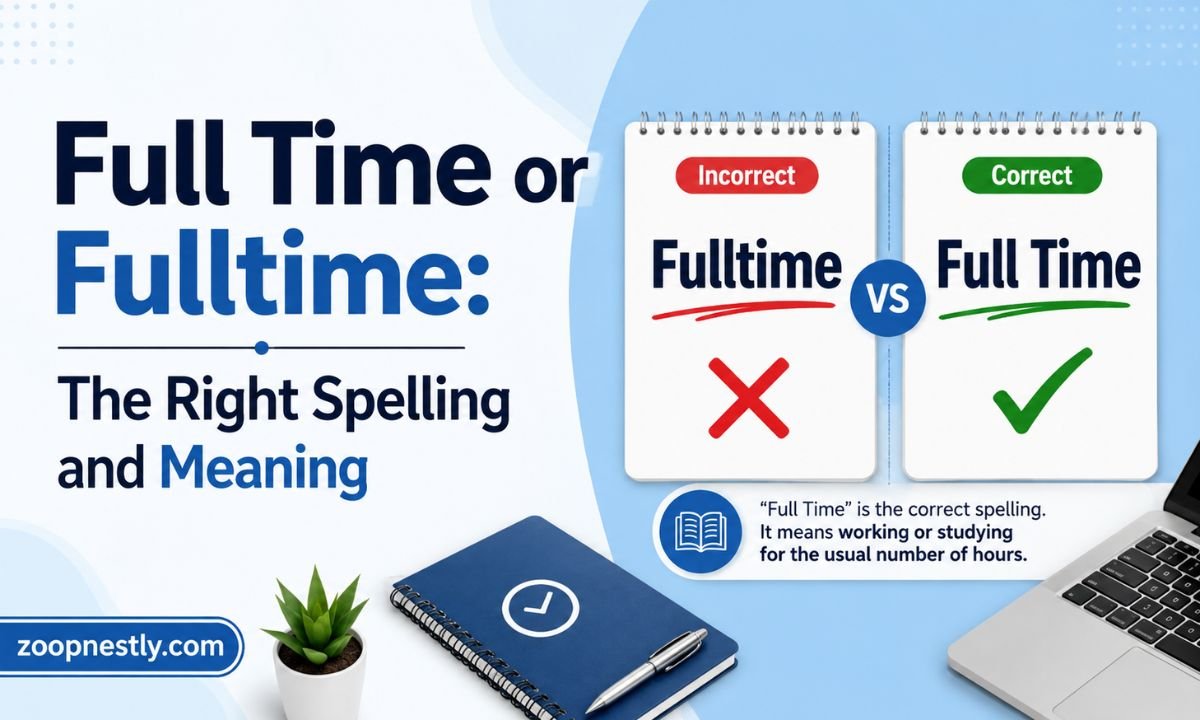
Full Time or Fulltime: The Right Spelling and Meaning
You’re filling out a job application or wrapping up an email, and you pause. Should it be “full time,” “full-time,” or “fulltime”? You’ve seen all three used online, sometimes in the same article.
That inconsistency is confusing, and using the wrong form in a resume or business document can make your writing look careless. The good news is that full time or fulltime has one clear, standard answer once you know the simple rule behind it.
Quick Answer
Full-time (with a hyphen) is correct when it describes a noun, as in “a full-time job.” Full time (two words, no hyphen) is correct when it follows the verb, as in “I work full time.” Fulltime as one solid word is not standard English and should be avoided in formal or professional writing.
Full Time, Full-Time, or Fulltime: The Core Rule
English grammar has a simple pattern for compound modifiers like this one. When two words work together to describe a noun that comes right after them, they’re usually hyphenated. When those same words come after the noun or after a verb, the hyphen disappears.
Here’s how that plays out with “full time”:
- Full-time (adjective, before a noun): “She accepted a full-time position.”
- Full time (adverb, after a verb): “She works full time.”
This is the same pattern you’ll see with other compound terms like “part-time” and “part time,” or “well-known author” versus “the author is well known.”
Correct and Incorrect Examples
Seeing the rule in action makes it much easier to remember.
Correct examples:
- He landed a full-time job at the marketing agency.
- Our team is hiring for a full-time software developer.
- I switched from part-time to full time last spring.
- She’s been studying full time since January.
Incorrect examples:
- ~~He landed a fulltime job.~~
- ~~She works fulltime at the hospital.~~
- ~~We need a full time-employee.~~ (hyphen in the wrong place)
- ~~The position is full time-hours.~~
Notice that “fulltime” as a single word never appears in a correct example. It’s a common typo, not an accepted spelling.
Is “Fulltime” Ever Correct?
No. “Fulltime” is not recognized as standard English by major dictionaries, including Merriam-Webster and Oxford. It shows up often in casual writing, social media captions, and informal messaging, but it’s considered a misspelling in professional, academic, and journalistic contexts. If you’re writing anything that needs to look polished, stick to either “full-time” or “full time” depending on the sentence.
Where the Confusion Comes From
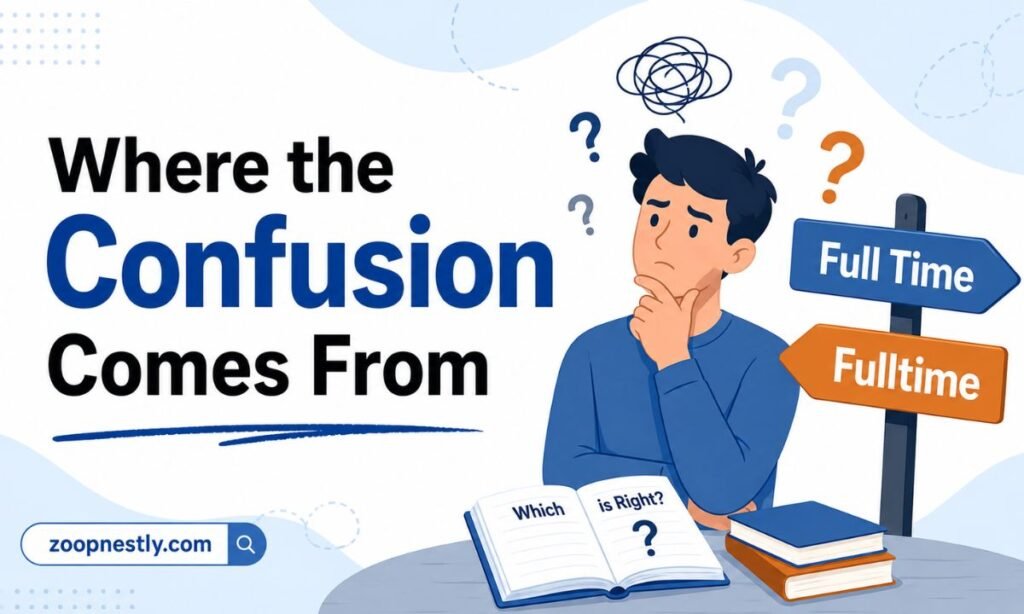
Compound words in English evolve over time. Some start as two words, become hyphenated, and eventually merge into one word, like “e-mail” becoming “email.” “Full time” hasn’t gone through that final stage. It still functions as a two-word phrase or a hyphenated adjective, and language authorities haven’t shifted it toward a single-word form the way they have with other compounds. That’s why “fulltime” feels familiar even though it isn’t technically correct.
American English vs British English
The good news is that this rule doesn’t change much across English dialects. Both American and British English follow the same hyphenation pattern.
American English
US style guides, including AP and Chicago, treat “full-time” as a hyphenated adjective before a noun and “full time” as two words after a verb. This is the standard used in US job postings, resumes, and business writing.
British English
British English follows the identical structure. You’ll see “full-time” used before nouns in UK job listings and “full time” used after verbs, matching American usage almost exactly.
DISCOVER MORE : Coach vs Couch: Common English Mistake Explained Simply
Comparison Table
| Region | Before a Noun | After a Verb |
| American English | full-time job | works full time |
| British English | full-time post | works full time |
| Informal/Incorrect | fulltime job | works fulltime |
Since the rule is essentially the same worldwide, you don’t need to adjust your spelling based on your audience’s location. You just need to know whether the word is modifying a noun or not.
Which Form Should You Use? A Quick Rule
If you’re ever unsure mid-sentence, ask yourself one question: does the phrase come right before a noun?
- If yes, use full-time with a hyphen. Example: “a full-time role.”
- If no, meaning it follows a verb or stands alone, use full time with a space. Example: “I study full time.”
This one test resolves almost every situation you’ll run into.
Common Mistakes People Make
Mistake 1: Writing “Fulltime” as One Word
This is the most frequent error, especially in texting, social media, and casual emails. It’s easy to type quickly, but it isn’t standard in formal writing.
Mistake 2: Dropping the Hyphen Before a Noun
Writing “full time job” instead of “full-time job” is technically a punctuation error. The missing hyphen can momentarily confuse readers about whether “full” and “time” are separate descriptions or one combined idea.
Mistake 3: Adding a Hyphen After the Noun
Some writers overcorrect and hyphenate even when it’s not needed, producing errors like “I work full-time at the office” being fine (correct, since it follows the verb) but mistakenly writing “the job is full-time-based” with an extra unnecessary hyphen.
Mistake 4: Inconsistent Use Within the Same Document
Switching between “full time,” “full-time,” and “fulltime” in one resume or article looks unpolished. Pick the correct form for each sentence based on the rule above and stay consistent.
Full-Time in Real-World Writing

Resumes and Job Applications
Recruiters expect precise language. Use “full-time” before job titles (“full-time graphic designer”) and “full time” when describing your work status (“available to start full time”).
Business and HR Documents
Company policies, contracts, and offer letters almost always use “full-time” as an adjective, since it typically appears right before terms like “employee,” “position,” or “status.”
News and Formal Writing
Journalists and editors follow AP style, which reinforces the hyphenation rule. You’ll consistently see “full-time” before a noun in headlines and articles.
Everyday and Casual Writing
Text messages and social posts are more forgiving, but using the correct form still makes your writing look sharper, especially if you’re networking or job hunting online.
“Full Time” as a Noun Phrase
Beyond its use as an adjective or adverb, “full time” also works as a standalone noun phrase describing a work schedule or status, as in “She’s looking for full time” or “He moved to full time this month.” In this case, no hyphen is needed since it isn’t directly modifying a noun that follows it.
Full-Time Student: How the Rule Applies
The same logic applies to academic contexts. A full-time student typically carries a set minimum number of credit hours per term, often defined by the school or program. Since “full-time” comes directly before the noun “student,” it takes the hyphen. If you rearrange the sentence, the hyphen drops: “She studies full time.”
Full-Time Meaning in a Job Context
In employment terms, full-time generally refers to a work schedule of around 35 to 40 hours per week, though the exact threshold can vary by employer, country, or industry. Full-time roles often come with benefits like health coverage or paid leave that part-time positions may not include. The spelling rule stays the same regardless of the specific hour count.
Synonyms for Full-Time
Depending on context, you might see or want alternatives to “full-time,” such as:
- Permanent (in employment contexts)
- Standard hours
- Regular schedule
- Salaried (though not identical, often implies full-time status)
These aren’t perfect substitutes, but they can help vary your writing when “full-time” starts to feel repetitive.
Frequently Asked Questions
Is it “full time” or “full-time” in a resume?
Use “full-time” before a job title or noun, such as “full-time marketing manager,” and “full time” when describing your availability, such as “seeking full time work.”
Is “fulltime” a real word?
No. “Fulltime” is not listed as a standard spelling in major dictionaries. It’s a common informal spelling that should be avoided in professional writing.
Do the British and American spellings differ?
No. Both British and American English use “full-time” before nouns and “full time” after verbs, following the same hyphenation rule.
What is considered full-time hours?
Full-time hours generally range from 35 to 40 hours per week, but the exact number can depend on the employer, industry, or country.
Is “part-time” spelled the same way as “full-time”?
Yes. “Part-time” follows the identical rule: hyphenated before a noun (“a part-time job”) and unhyphenated after a verb (“she works part time”).
Conclusion
The choice between full time and full-time comes down to one simple grammar rule: hyphenate it when it comes before a noun, and leave it as two words everywhere else. “Fulltime” as a single word isn’t standard, no matter how often you see it online. Once you get comfortable with the noun-versus-verb test, you’ll never second-guess this spelling again, whether you’re writing a resume, a business email, or a quick text to a friend.

James Walker is a content writer and language researcher with over 5 years of experience in meanings, definitions, and language-related topics. He enjoys simplifying complex terms into clear, easy-to-understand explanations. Through ZoopNestly.com, he helps readers find accurate and reliable information.