Cartel vs Mafia: What’s the Real Difference?
You hear both words on the news almost every week, often in the same breath, as if they mean the same thing. But swap one for the other in a research paper, a news report, or even a casual conversation, and someone who knows the terms will notice the mistake. The debate over cartel vs mafia comes down to structure, purpose, and how each organization actually operates in the real world.
Quick Answer
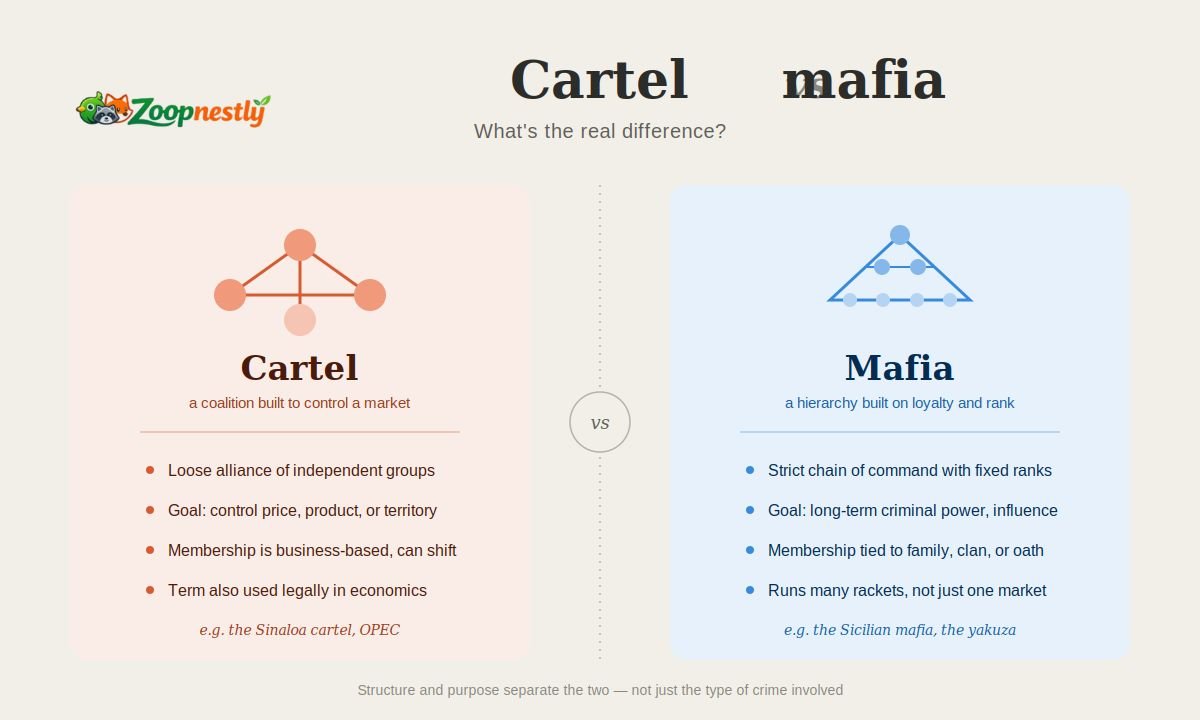
A cartel is a group of independent businesses or criminal operations that coordinate to control a market, most often drug trafficking, by fixing prices or dividing territory. A mafia is a hierarchical criminal organization built on family or clan loyalty, with a fixed chain of command and a broader range of illegal activities beyond a single market. Cartels are about market control; mafias are about organized, structured crime across many sectors.
Cartel vs Mafia: The Core Difference in One Table
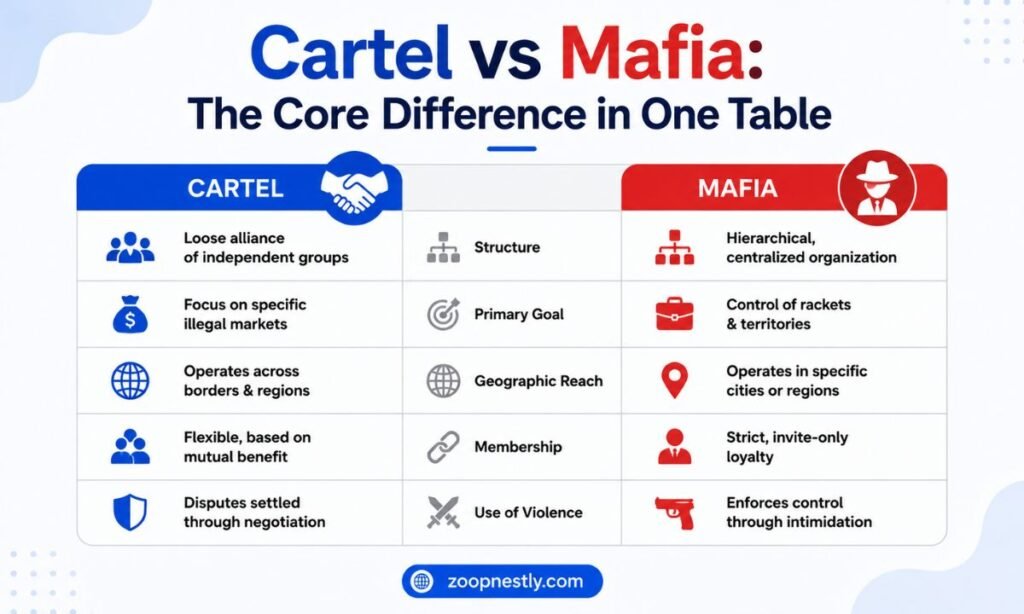
| Feature | Cartel | Mafia |
| Primary goal | Control a market or product (often drugs) | Long-term criminal power and influence |
| Structure | Loose alliance of independent groups | Strict hierarchy with ranks |
| Membership | Business-based, can shift | Often family, clan, or blood-oath based |
| Main activities | Trafficking, price control, territory splits | Extortion, racketeering, trafficking, corruption |
| Origin of term | Latin American drug trafficking, also legal economics | Sicilian secret societies |
| Legal use of word | Yes (business cartels are a legal/economic term) | Rare, almost always criminal |
| Geographic pattern | Concentrated regional dominance | Family “families” spread across cities or countries |
Basic Definitions
What Is a Cartel?
A cartel is a coalition of independent groups or businesses that agree to work together instead of competing. In legitimate economics, this means companies fixing prices to avoid competition. In criminal contexts, especially drug trafficking, a cartel is a network of producers, transporters, and distributors who cooperate to dominate a market and keep rivals out.
What Is a Mafia?
A mafia is an organized crime group built on a strict internal hierarchy, often rooted in family ties, regional loyalty, or initiation rituals. The term originated with Sicilian secret societies but is now used more broadly for any tightly structured criminal organization, such as the Italian-American mafia, the Russian mafia, or the Japanese yakuza.
Real-World Examples
Example 1: Cartel in Action
The Sinaloa Cartel controls large sections of drug production and smuggling routes across Mexico and into the United States. It operates through semi-independent cells that answer to central leadership but function with a fair amount of autonomy.
Example 2: Mafia in Action
The Sicilian Mafia (Cosa Nostra) is organized into “families,” each controlling a specific territory, with a boss, underboss, and soldiers. Loyalty and secrecy hold the structure together, and membership is tightly controlled.
Example 3: Cartel as a Legal Business Term
Not every cartel is criminal. Oil-producing countries in OPEC are sometimes called a cartel because they coordinate production levels to influence global prices. This is a legal, if controversial, form of the same coordination logic seen in criminal cartels.
Example 4: Mafia as a Criminal Network
When news outlets describe a group running protection rackets, laundering money, and bribing officials across multiple cities under one chain of command, they are describing mafia-style organization, not cartel behavior.
Common Mistakes When Using Cartel vs Mafia
Mistake 1: Using the Terms Interchangeably
Calling any organized crime group a “cartel” or any drug trafficking network a “mafia” blurs an important distinction. Structure and purpose separate the two, not just the type of crime involved.
Mistake 2: Applying “Cartel” to Any Criminal Group
Not every gang or trafficking group is a cartel. The term specifically implies coordination between multiple independent parties to control a market, not just a single group running its own operation.
Mistake 3: Overgeneralizing From One Example
Learning about one cartel or one mafia family and assuming all others work the same way leads to inaccurate assumptions. Structures vary by country, culture, and era.
Mistake 4: Confusing Legal Status
Forgetting that “cartel” has a legitimate legal meaning in economics can lead to confusion when the word appears in business or antitrust contexts rather than crime reporting.
Mistake 5: Misplacing Modifiers in Writing
Sentences like “the Mexican drug cartel violent leader” scramble word order. The correct form is “the violent leader of the Mexican drug cartel,” keeping modifiers close to the nouns they describe.
Who Is More Powerful: Mafia or Cartel?
There’s no single answer, because power depends on region, era, and how you measure it. Modern drug cartels, particularly in Mexico, often control more territory, generate more revenue, and wield more direct influence over local governments than traditional mafias do today. Classic mafias, especially the Sicilian and Italian-American versions, historically held more political and institutional influence in specific cities but have shrunk significantly due to decades of law enforcement pressure.
In short: cartels currently tend to have more raw economic and territorial power, while mafias historically had deeper institutional infiltration. Comparing them directly is a bit like comparing a modern corporation to an old-world guild. Both are powerful, but the kind of power differs.
DISCOVER MORE : “Which One Is You” or “Which One Are You”? Here’s the Correct Phrase
American vs British English Differences
Word Usage and Media Trends
American English uses “cartel” heavily in drug trafficking coverage, especially regarding Latin America. British English uses “mafia” more loosely, sometimes applying it informally to any tight-knit group with outsized influence, even outside of crime (for example, a “political mafia”).
Spelling and Grammar
Both words keep the same spelling in American and British English. No regional variant changes the letters, which is unusual for a word borrowed from another language.
Figurative Uses in Each Variety
In both varieties, “mafia” is used loosely to describe any powerful, insider clique, such as a “tech mafia” running an industry from behind the scenes. “Cartel” is used more narrowly, almost always tied to coordinated market or price control.
Legal and Enforcement Terminology
In American legal contexts, “cartel” appears in antitrust law and drug enforcement reporting. In British and European legal contexts, “cartel” appears mostly in competition law, referring to price-fixing agreements between companies, with far less crime-related usage than in the US.
Do the Mafia and Cartel Get Along?
Historically, mafias and cartels have crossed paths mainly through the drug trade. Italian and American mafia groups moved cocaine supplied by Colombian cartels during the 1970s and 1980s, creating working relationships built on mutual profit rather than alliance or friendship. These relationships were transactional. Neither side merged or adopted the other’s structure. Today, cross-continental trafficking still connects cartels with various organized crime groups worldwide, but these remain business arrangements, not partnerships built on shared identity or loyalty.
Idiomatic Expressions
Cartel in Figurative Language
People use “cartel” to describe any group coordinating to limit competition, such as a “cartel of publishers” keeping book prices high. The word signals coordinated control, not necessarily violence.
Mafia in Figurative Language
“Mafia” gets used for any insular group with strong internal loyalty and outside influence, like a university’s “old boys’ mafia” running hiring decisions. The word signals secrecy and loyalty more than market control.
Mixed Idioms and Collocations
Phrases like “drug cartel,” “crime family,” and “mafia boss” are fixed collocations. Swapping words inside them, such as saying “cartel boss” instead of “cartel leader,” sounds off to fluent speakers even though the meaning is technically clear.
When Figurative Language Becomes Misleading
Using “mafia” for a harmless friend group or “cartel” for a small business partnership can sound like an exaggeration or even an accusation. Reserve these words for situations that genuinely involve coordinated control or organized structure.
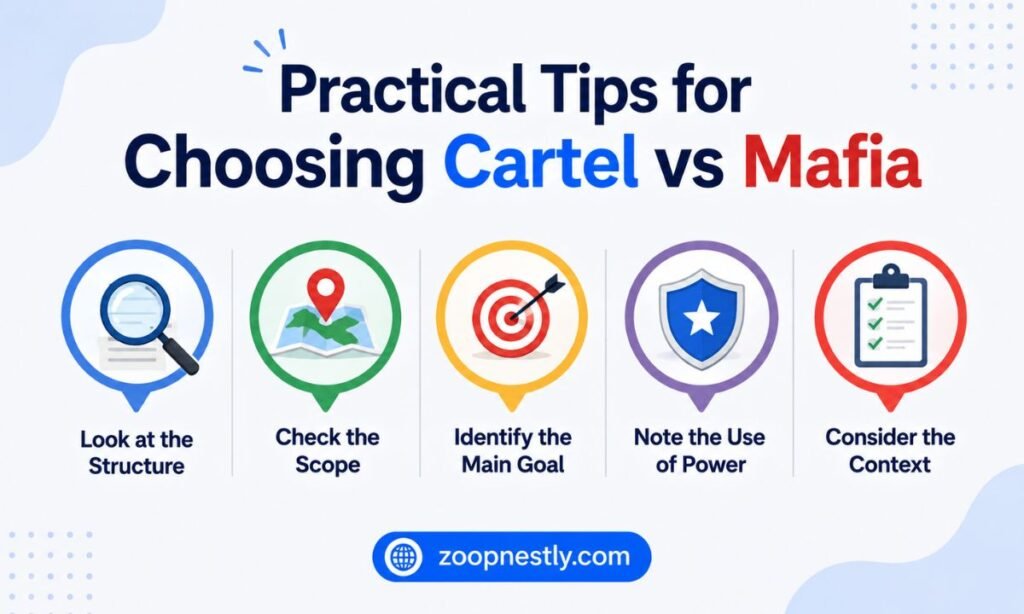
Practical Tips for Choosing Cartel vs Mafia
- Define your term early. If your audience isn’t familiar with the distinction, explain it in your first mention.
- Use specific names when possible. “The Sinaloa Cartel” or “Cosa Nostra” is clearer than a generic label.
- Check verb agreement. Both words are singular nouns: “The cartel controls,” not “the cartel control.”
- Avoid sensationalism. Skip dramatic adjectives unless they’re factually supported.
- Use neutral modifiers when teaching. Words like “structured” or “market-based” work better than loaded language in educational content.
- Respect cultural sensitivity. Both terms carry heavy cultural weight tied to real communities and history.
- Watch your prepositions. People say “a cartel of producers” but “a mafia within the union,” not the reverse.
- Distinguish legal and illegal uses. Clarify whether you mean the criminal or economic sense of “cartel.”
- Use parallel structure in comparisons. “Cartels control markets; mafias control territory” reads cleaner than mismatched phrasing.
- Edit for precision. Cut any sentence that could apply equally to both terms. If it does, the distinction isn’t clear yet.
Revision Examples
Ambiguous: “The group ran the mafia cartel operation.” Clear: “The group operated as a cartel, coordinating with a separate mafia family for distribution.”
Misused figurative language: “Our office is basically a cartel.” Better: “Our office runs like a mafia, everyone protects their own.”
Tense and agreement fix: “The cartels was expanding into new territory.” Correct: “The cartel was expanding into new territory.”
Frequently Asked Questions
Is a cartel the same as a mafia?
No. A cartel focuses on controlling a market through coordination between independent groups, while a mafia is a structured criminal hierarchy, often organized around family or clan loyalty, involved in a wider range of illegal activity.
Which is more dangerous, a cartel or a mafia?
Danger depends on the specific organization and region. Modern drug cartels are often associated with higher levels of violence tied to trafficking routes and territory disputes, while mafias have historically relied more on corruption, intimidation, and quiet influence.
Can the word cartel be used legally?
Yes. In economics and business law, a cartel refers to companies coordinating prices or output, which is illegal under antitrust law in most countries but is a completely different context from drug trafficking cartels.
Why is the mafia associated with Italy?
The term originated with secret societies in Sicily in the 19th century. Italian immigration later spread the structure and name to the United States, where it evolved into the Italian-American mafia.
Do cartels have a boss like mafias do?
Cartels often have leadership figures, but their structure tends to be looser, with semi-independent cells or groups cooperating rather than answering to one strict chain of command the way mafia families typically do.
Conclusion
The line between cartel vs mafia comes down to structure and purpose. Cartels coordinate to control markets, whether that market is drugs or oil. Mafias organize around loyalty and hierarchy, running a broader mix of criminal enterprises. Knowing this difference helps you use both terms accurately, whether you’re writing, reading the news, or just trying to follow a conversation without mixing up two very different kinds of organizations.

James Walker is a content writer and language researcher with over 5 years of experience in meanings, definitions, and language-related topics. He enjoys simplifying complex terms into clear, easy-to-understand explanations. Through ZoopNestly.com, he helps readers find accurate and reliable information.