Apposed or Opposed? Learn the Key Difference in English
You typed “apposed” into a sentence, then stared at it, wondering if autocorrect just tricked you. You meant to say two things stand against each other, but now you’re second guessing your own spelling. That small hesitation is exactly why the apposed vs opposed mix-up trips up so many writers. One letter changes the entire meaning, and getting it wrong can make a sentence say the opposite of what you intended.
Quick Answer
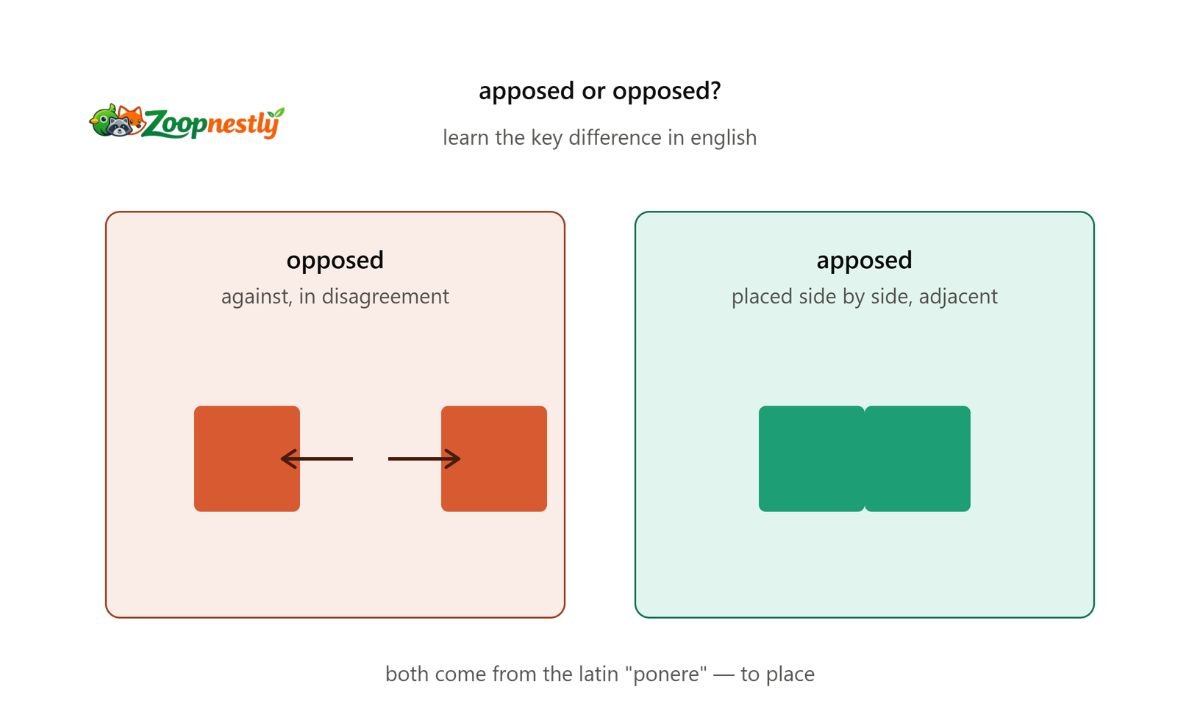
Opposed means to be against something or in disagreement with it. Apposed means placed side by side or next to something. They are not synonyms and cannot be swapped. If you mean “disagree” or “against,” use opposed. If you mean “placed next to” or “adjacent,” use apposed.
What Does “Opposed” Mean?
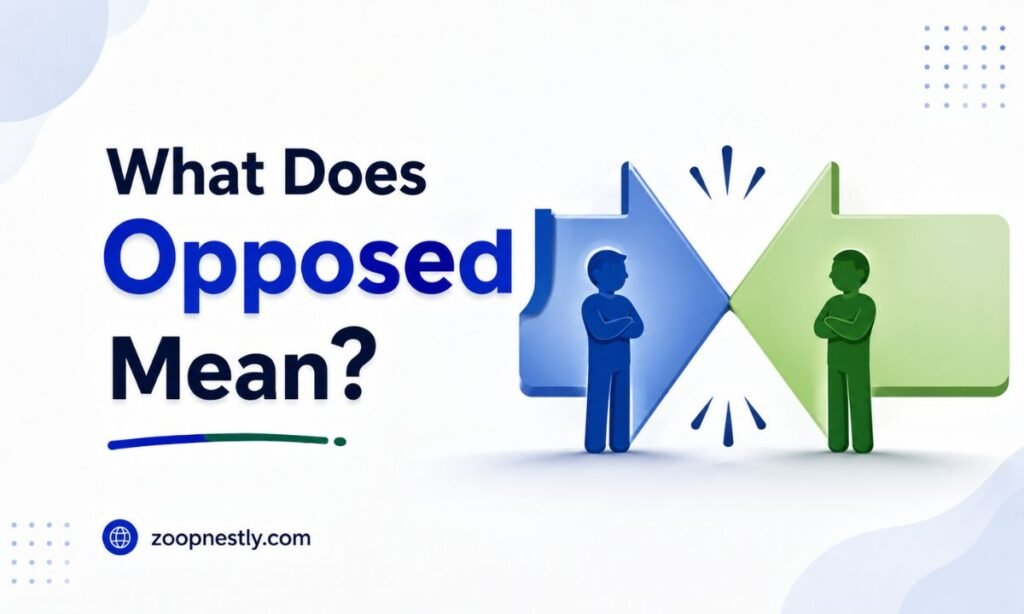
Opposed is the past tense and past participle of the verb “oppose.” It means to resist, disagree with, or stand against someone or something.
You’ll see it in everyday contexts like politics, debates, personal opinions, and conflict.
Example: She opposed the new company policy during the meeting.
Example: Many residents are opposed to the construction project.
This is the word almost everyone means to use. It’s common, familiar, and shows up constantly in news articles, workplace emails, and casual conversation.
What Does “Apposed” Mean?
Apposed is far less common. It comes from the verb “appose,” meaning to place things side by side or next to each other, often so they touch or align.
You’ll mostly find this word in scientific, medical, and anatomical writing.
Example: The surgeon apposed the wound edges before suturing.
Example: In the diagram, the two cell walls are apposed along their entire length.
If you’re not writing about anatomy, biology, or a technical process involving physical alignment, you almost certainly don’t need this word.
Apposed vs Opposed: Key Differences at a Glance
| Feature | Opposed | Apposed |
| Meaning | Against, in disagreement | Placed side by side, adjacent |
| Root verb | Oppose | Appose |
| Common use | Everyday, general writing | Medical, scientific, technical writing |
| Frequency | Very common | Rare |
| Example | He opposed the merger | The bones are apposed at the joint |
| Opposite meaning | Support, agree | Separated, apart |
Grammar Rules Behind Each Word
Both words follow standard English verb patterns, but they come from different root words with different prefixes.
Oppose breaks down as “ob-” (against) plus “pose” (to place), giving you the idea of placing something against another thing in a confrontational sense.
Appose breaks down as “ad-” (toward or near) plus “pose” (to place), giving you the idea of placing something close to another thing.
That shared root, “pose,” meaning “to place,” is exactly why these words look so similar. The prefix is doing all the work of changing the meaning.
How to Use “Opposed” in a Sentence
Use opposed whenever you’re describing disagreement, resistance, or a contrasting stance.
- The board opposed the budget cuts.
- She has always opposed unnecessary regulations.
- As opposed to last year’s numbers, this quarter looks strong.
- He remains firmly opposed to the idea.
Notice the phrase “as opposed to.” This is a fixed expression meaning “in contrast to,” and it’s one of the most common places writers accidentally use “apposed” instead. It should always be “as opposed to,” never “as apposed to.”
How to Use “Apposed” in a Sentence
Use apposed only when describing physical placement, typically in a medical, biological, or technical context.
- The dentist apposed the fractured tooth fragments.
- The two membranes remain closely apposed during development.
- Researchers apposed the samples to compare surface reactions.
If you try to use “apposed” outside of these physical or scientific contexts, the sentence usually sounds confusing or simply wrong to most readers.
Common Mistakes to Avoid
The biggest mistake is using “apposed” when you mean “opposed,” almost always inside the phrase “as opposed to.” Spell checkers sometimes miss this because “apposed” is a real word, just a rare one.
Another mistake is assuming these words are interchangeable synonyms. They aren’t. They come from opposite-meaning prefixes: “against” versus “toward.”
A smaller mistake is misusing the related noun forms. “Opposition” refers to resistance or disagreement, while “apposition” refers to placement next to something, including a grammatical term for a noun phrase that renames another noun right beside it (like “my friend, the doctor”).
Why People Confuse These Two Words
The confusion happens for three simple reasons. First, the words look nearly identical, differing by only one letter. Second, “apposed” is rarely used, so most readers have little familiarity with it, making it easy to mistake for a typo of the more common word. Third, both words share the Latin root “pose,” meaning “to place,” so they feel related even though their meanings point in opposite directions.
DISCOVER MORE : Is Used vs Has Been Used vs Was Used: What’s the Difference?
Simple Trick to Remember the Difference
Here’s an easy way to lock in the difference for good.
Think of opposed as connected to “opposite.” Both words share that “op” beginning, and both deal with things standing against each other.
Think of apposed as connected to “adjacent.” Both start with a vowel-adjacent sound, and both describe things placed close together.
If your sentence is about disagreement, reach for the word tied to “opposite.” If your sentence is about physical closeness, reach for the word tied to “adjacent.”
Quick Verification Test
Before you hit publish, ask yourself one question: am I describing a disagreement or a physical position?
- Disagreement, conflict, resistance, contrast: use opposed.
- Side by side, touching, adjacent, aligned: use apposed.
If you’re still unsure, try replacing the word with “against” in your sentence. If the sentence still makes sense, you want “opposed.” If it doesn’t, and “next to” fits better instead, you want “apposed.”
Word Origins and Etymology
Both words trace back to the Latin verb “ponere,” meaning “to place” or “to put.”
Oppose entered English through Old French “opposer,” combining the Latin prefix “ob-” (against) with “ponere.” The sense of standing against something has stayed consistent since it entered the language.
Appose also traces to “ponere,” this time combined with the prefix “ad-” (toward). It kept a narrower, more technical meaning and never became part of everyday vocabulary the way “oppose” did.
Understanding this shared origin helps explain why the words look alike without meaning the same thing. They were built from the same base word, just pointed in different directions.
Synonyms for Opposed and Apposed
Alternatives for “Opposed”
- Against
- Resistant to
- In disagreement with
- Contrary to
- Hostile to
Alternatives for “Apposed”
- Adjacent
- Side by side
- Juxtaposed
- Placed next to
- Aligned with
Note that “juxtaposed” is the closest everyday cousin of “apposed,” and it’s far more common in general writing when you want to describe things placed together for comparison.
When to Choose Each Term

Choose opposed in nearly every general writing situation, including business, politics, casual conversation, essays, and journalism. It’s the word people expect to see.
Choose apposed only when you’re writing in a medical, anatomical, biological, or highly technical field where the physical placement of two structures or objects matters. Outside of that narrow context, “apposed” will likely confuse your reader rather than clarify your point.
If you’re ever in doubt about which context you’re in, default to “opposed.” It’s correct far more often, and it’s the word your reader is actually expecting.
Frequently Asked Questions
Is “apposed” a real word?
Yes. Apposed is a real English word meaning placed next to or adjacent to something. It’s used mainly in medical, scientific, and technical writing, and it’s much less common than “opposed.”
Is it “as opposed to” or “as apposed to”?
The correct phrase is always “as opposed to.” This expression means “in contrast to” and has nothing to do with physical placement, so “apposed” is never correct here.
What is the opposite of “opposed”?
The opposite of opposed is typically “supportive,” “in favor,” or “agreeable.” If someone is not opposed to an idea, they generally support or accept it.
Can “apposed” and “juxtaposed” be used interchangeably?
They’re closely related but not identical. Apposed usually implies direct physical contact or immediate closeness, while juxtaposed often just means placed together for comparison, without necessarily touching.
Why does spell check not catch “apposed” as an error?
Spell check tools don’t flag it because apposed is a legitimate English word, just a rare one. Since it’s spelled correctly, the checker has no reason to mark it, even when it’s the wrong word for your sentence.
Conclusion
The difference between apposed and opposed comes down to one simple question: are you talking about disagreement or physical placement? Opposed covers resistance, conflict, and contrast, and it belongs in almost every kind of everyday writing. Apposed is a narrow, technical term reserved for describing things placed directly next to each other, mostly in medical and scientific contexts. Keep that distinction in mind, watch out for the phrase “as opposed to,” and you’ll never mix these two up again.

James Walker is a content writer and language researcher with over 5 years of experience in meanings, definitions, and language-related topics. He enjoys simplifying complex terms into clear, easy-to-understand explanations. Through ZoopNestly.com, he helps readers find accurate and reliable information.