Sais vs Says: What’s the Difference and Which Is Right?
You’re typing a text, you pause, and your fingers hover over the keyboard. Does your friend “sais” something or “says” something? Autocorrect isn’t flagging it, so now you’re second-guessing yourself. This mix-up trips up more people than you’d think, and it usually comes down to one word bleeding into another from a completely different language. Let’s clear up sais vs says for good.
Quick Answer
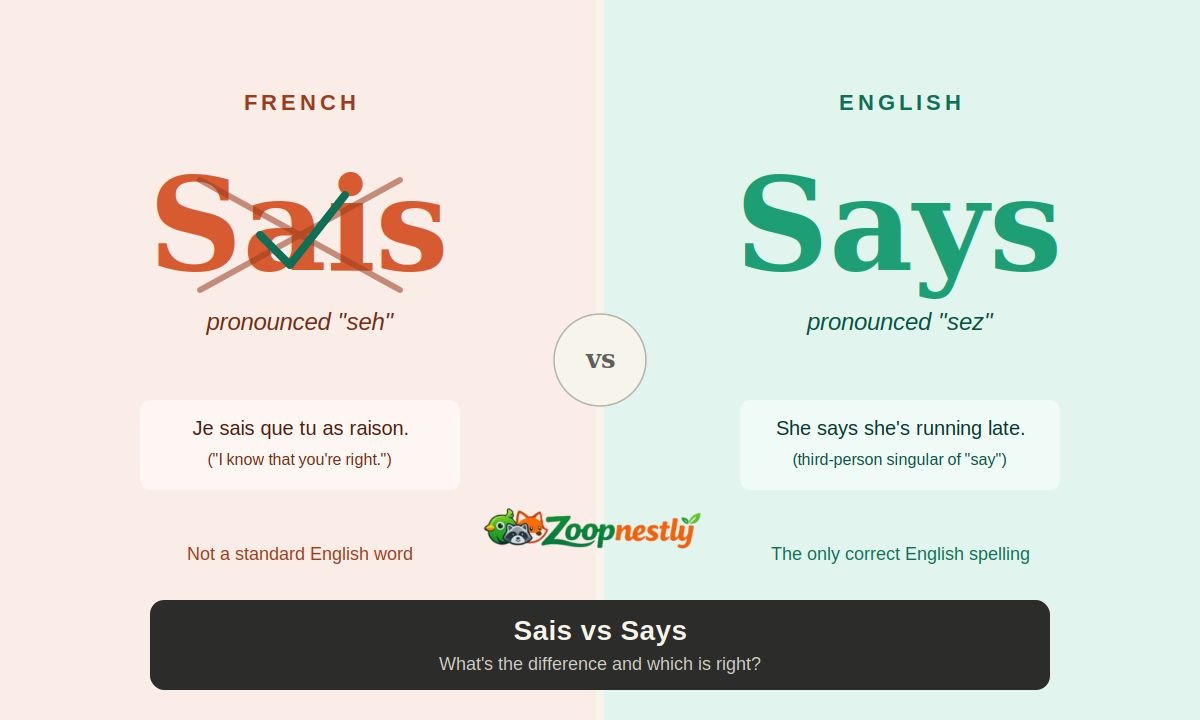
“Says” is the correct English spelling. It’s the third-person singular present tense of “say,” used for he, she, or it (example: She says hello). “Sais” is not a standard English word. It only appears as the first- and second-person singular form of the French verb savoir (“to know”), or occasionally as a surname.
Sais vs Says: The Core Difference
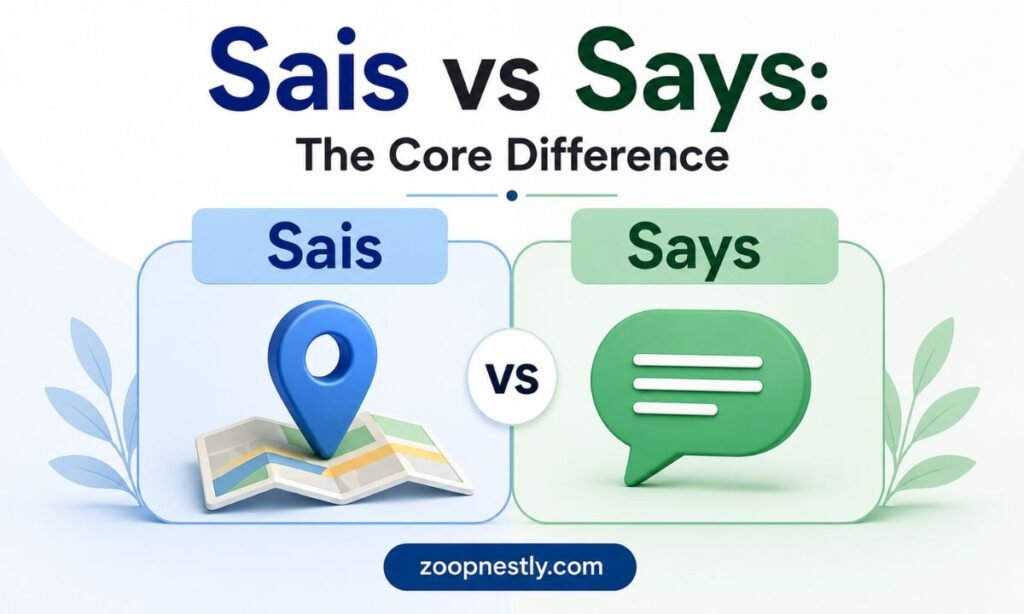
The confusion here isn’t really a grammar debate. It’s a spelling mix-up between two languages that happen to look alike.
Says belongs to English. It’s how you conjugate “say” when the subject is a single third person. Think “he says,” “the sign says,” “my mom always says.”
Sais belongs to French. It shows up in sentences like Je sais (“I know”) or Tu sais (“You know”). It has nothing to do with speaking or saying anything, and it isn’t used in English writing at all, aside from as a rare proper noun (there’s a city in Egypt historically called Sais, and it appears as a surname in some cultures).
So when someone writes “she sais,” they’ve accidentally borrowed a French verb form to spell an English one. It happens because the two words sound almost identical when spoken quickly, and English spelling doesn’t always match phonetic instinct.
Is “Sais” Ever Correct in English?
Almost never. There are exactly three situations where you’d legitimately see “sais” in English text:
- Quoting or referencing French. If you’re writing about French language lessons or quoting a French sentence, “sais” is correct in that context (e.g., In French class, we learned “je sais pas” means “I don’t know.”)
- A proper noun. Sais was an ancient city in the Nile Delta, and “Sais” also exists as a last name.
- A typo. By far the most common reason you’ll see it, and the one this article is here to fix.
Outside of those cases, “sais” is not a word you want in your English sentence.
Sais vs Says at a Glance
| Sais | Says | |
| Language | French | English |
| Part of speech | Verb form (savoir) | Verb form (say) |
| Meaning | “know” (I know / you know) | “say” (he/she/it says) |
| Correct in English writing? | No (except proper nouns or quoting French) | Yes |
| Pronunciation | “seh” | “sez” |
| Example | Je sais que tu as raison. | He says he’s running late. |
Sais vs Says: Grammar Basics
“Say” is an irregular verb in terms of pronunciation, though its spelling actually follows a regular pattern. To form the third-person singular present tense, English usually adds -s to a verb (walk → walks, run → runs). “Say” follows that same rule: say → says.
The trick is that it’s pronounced “sez,” not “sayz” the way it looks. That mismatch between spelling and sound is exactly what opens the door for spelling errors, including the jump to “sais.”
Here’s the full present-tense conjugation for reference:
- I say
- You say
- He/she/it says
- We say
- They say
Only the third-person singular takes the -s ending. Everywhere else, it’s just “say.”
DISCOVER MORE : Propose or Purpose? Learn the Correct Meaning and Usage
Says or Sais Pronunciation
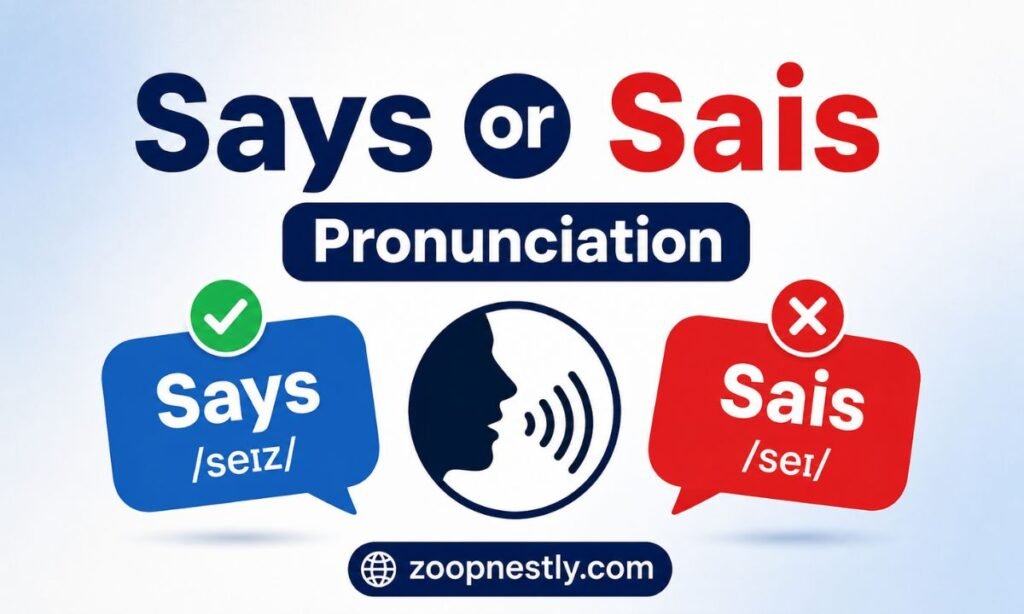
This is where a lot of the confusion starts. “Says” is pronounced “sez” (rhymes with “fez”), not “sayz” like you might expect from the spelling. Meanwhile, “sais” in French is pronounced closer to “seh” (rhymes with “may” without the y-glide, roughly like the English word “say” without the z sound at the end).
Because “says” doesn’t sound the way it looks, people sometimes reach for a spelling that feels more phonetically honest, and “sais” happens to be sitting right there, especially if they’ve studied French or seen the word before.
Why Do Writers Keep Spelling Says Wrong?
A few things are working against you here:
- Pronunciation mismatch. “Says” looks like it should rhyme with “days” or “rays,” but it doesn’t.
- French exposure. Anyone who’s taken French classes has seen “sais” repeatedly in phrases like “je sais” and “tu sais,” which makes it feel familiar and available.
- Muscle memory from similar words. Words like “pais” or “dais” (a raised platform) exist in English, so “sais” doesn’t look obviously wrong at a glance.
- Autocorrect gaps. Some spell-checkers won’t flag “sais” because it’s a real word in their dictionary, just not the one you meant.
None of this means the writer doesn’t know English. It’s a spelling collision, not a grammar failure.
Sais vs Says: Examples Across Real Contexts
Correct Usage: “Says” in Practice
- The recipe says to bake it for twenty minutes.
- My sister says she’s coming to the party.
- The report says sales increased last quarter.
- He always says the same joke at dinner.
- The label says “keep refrigerated.”
Incorrect Usage and Corrections
| Incorrect | Correct |
| She sais she’ll be late. | She says she’ll be late. |
| The sign sais no parking. | The sign says no parking. |
| Everyone sais he’s talented. | Everyone says he’s talented. |
| He sais it’s fine. | He says it’s fine. |
Context Variations: How the Rule Holds Across Registers
Whether you’re writing a formal email, a text message, a novel, or a work report, “says” is the only correct spelling when you mean “to say” in the third-person singular. Casual writing doesn’t change the rule. Even in dialogue tags in fiction (“she says, twirling her pen”), it’s still “says,” never “sais.”
Sais Meaning (When It’s Actually Used)
If you do encounter “sais” in a legitimate context, here’s what it means:
- In French: sais is the first- and second-person singular conjugation of savoir, meaning “to know.” Je sais means “I know.” Tu sais means “you know.”
- As a place name: Sais was an ancient Egyptian city in the Nile Delta, known in antiquity as a religious and political center.
- As a surname: Sais appears as a last name in various cultures, unrelated to the French verb.
None of these meanings connect to “saying” something out loud or in writing, which is exactly why using “sais” instead of “says” changes the word’s meaning entirely, not just its spelling.
Which Memory Trick Works Best for Spelling “Says”?

Here are a few tricks that actually help the spelling stick:
- Say it, spell it the same way. “Say” plus “s” equals “says.” No extra letters, no swaps. If you can spell “say,” you can spell “says.”
- Sais needs an explanation, says doesn’t. If you’d have to explain that you’re using a French word, you’re using the wrong one.
- Picture the sentence subject. “Says” always pairs with a single third-person subject (he, she, it, or a name). If your subject is “I” or “you,” you wouldn’t use “says” at all, which is a useful check when you’re unsure.
- Say it out loud slowly. Reminding yourself it sounds like “sez” and not “sayz” helps break the instinct to spell it phonetically as “sais.”
Common Mistakes to Avoid
- Don’t use “sais” as a general substitute for “says.” It’s not a stylistic choice or regional spelling; it’s simply incorrect in English.
- Don’t confuse “sais” with “dais.” A dais is a raised platform, and while it looks similar, it’s an entirely different English word with its own valid use.
- Don’t assume spell-check will catch it. Because “sais” is a real word (in French), some checkers won’t flag it in an English sentence.
FAQs
Is “sais” a real word?
Yes, but not in English. It’s a real French verb form meaning “I know” or “you know,” used with savoir. It’s also a historical place name and a surname. It is not an accepted spelling of the English word “says.”
How do you spell “says” correctly?
It’s spelled s-a-y-s. It’s the third-person singular present tense of “say,” formed the same way most English verbs add -s for he/she/it (walk becomes walks, say becomes says).
Why does “says” sound like “sez” instead of “sayz”?
This comes down to English pronunciation quirks rather than spelling rules. “Says” is one of several common words where the vowel sound shifted over time while the spelling stayed the same, similar to how “said” is pronounced “sed,” not “sayd.”
Is “sais” ever correct in a French sentence?
Yes. In French, “sais” is correctly used with “je” (I) and “tu” (you) when conjugating savoir, such as “je sais” (I know) or “tu sais” (you know). It has no connection to speaking or saying something.
What’s an easy way to remember not to write “sais” in English?
Remember that “says” is just “say” plus an s, with no extra vowels or spelling changes. If a word needs explaining or feels borrowed from another language, it’s probably not the English spelling you want.
Conclusion
“Says” is the only correct choice when you’re writing in English, and “sais” belongs to French, not to your sentence. The mix-up is common because of how “says” sounds versus how it’s spelled, plus a little cross-language confusion for anyone who’s studied French. Once you remember that “says” is simply “say” with an added s, the spelling stops being a guessing game.

James Walker is a content writer and language researcher with over 5 years of experience in meanings, definitions, and language-related topics. He enjoys simplifying complex terms into clear, easy-to-understand explanations. Through ZoopNestly.com, he helps readers find accurate and reliable information.