Accross vs Across: Which Spelling Is Correct and Why?
You’re typing a text or finishing an email, and your fingers pause at one word. Is it “accross” or “across”? You type it both ways, stare at the screen, and neither one looks quite right anymore.
This mix-up trips up more writers than you’d think, and it’s an easy trap because the double “c” feels like it should belong there. The truth about accross vs across comes down to one simple spelling rule that clears up the confusion for good.
Quick Answer
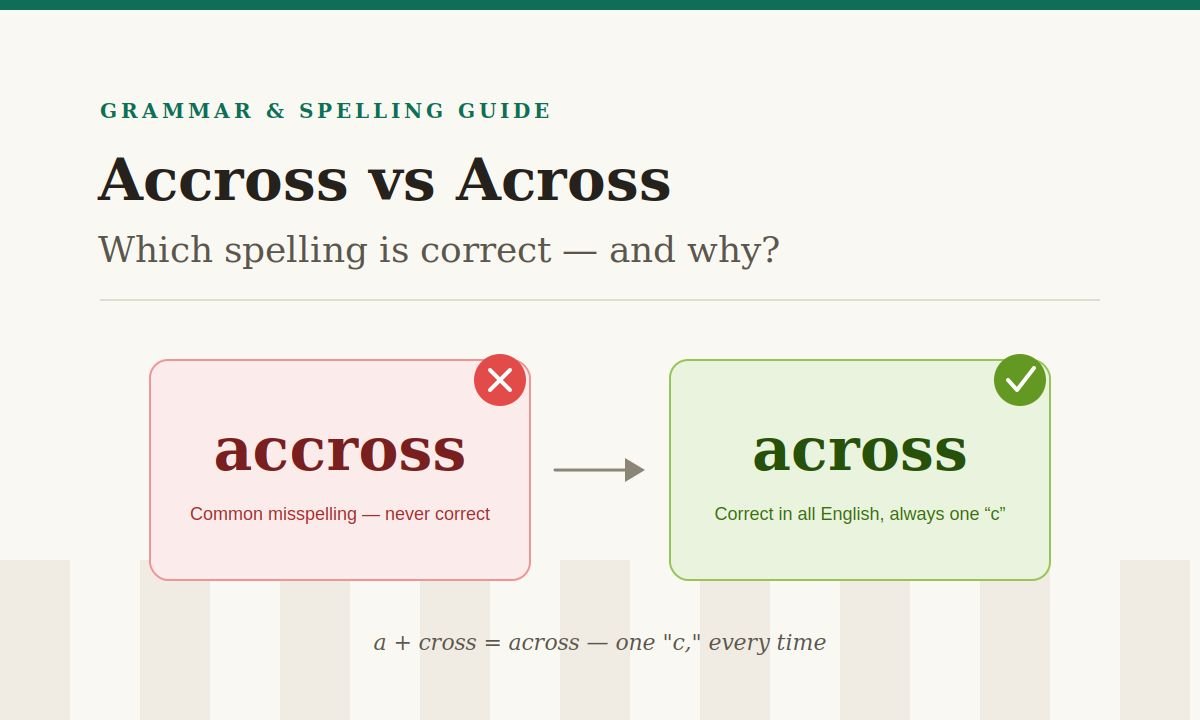
Across is the correct spelling, always with one “c.” Accross is a common misspelling and is never correct in standard English. The word comes from “a-” plus “cross,” which explains the single “c.” If you remember that it’s built from the word “cross,” you’ll never misspell it again.
The Correct Spelling: Across, Not Accross
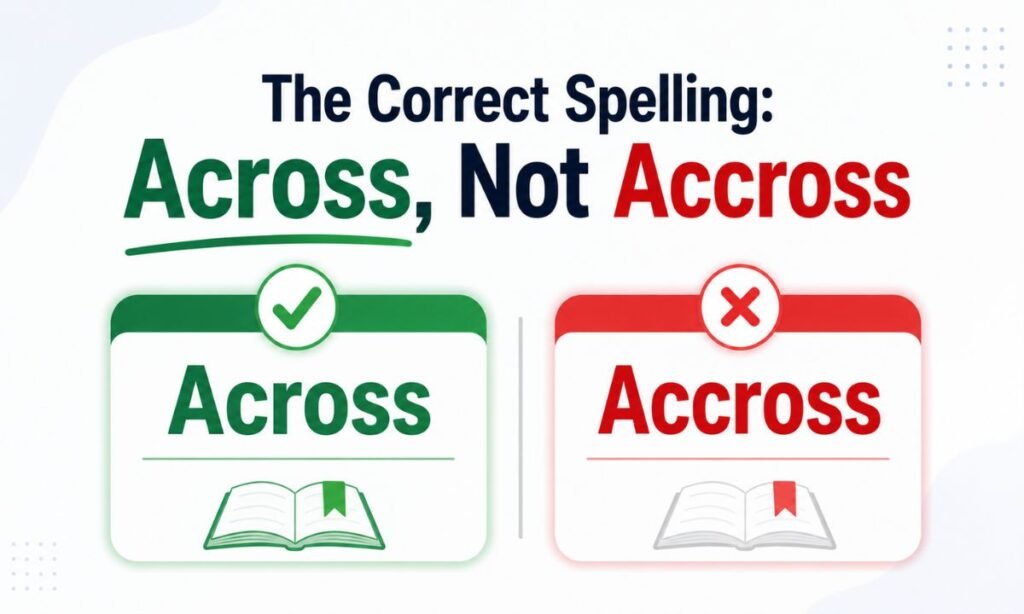
There’s no debate here and no exception to look out for. Across is the only accepted spelling in both American and British English. You’ll find it this way in every dictionary, style guide, and grammar resource that exists.
“Accross” isn’t an alternate spelling, a regional variant, or an old-fashioned form. It’s simply a typo that happens to look like a real word, which is exactly why it spreads so easily in casual writing.
Why Across Has Only One “C”
The confusion makes sense once you see where the word comes from. Across is formed from the prefix “a-” attached to the word cross. Since “cross” already has one “c,” adding “a-” in front doesn’t double it. You get a-cross, not ac-cross.
Compare it to other words built the same way:
- a + live = alive
- a + round = around
- a + cross = across
None of these words double the first letter of the root word, and “across” follows the same pattern. Once this clicks, the spelling stops feeling random.
Why People Spell It “Accross” by Mistake
This mistake usually comes from one of a few habits:
- Sound association: Some people mentally link “across” to words like “accept” or “accuse,” which do have double consonants, and the pattern bleeds over.
- Typing speed: Fast typing or autocorrect lag can duplicate letters without you noticing.
- Visual memory: If you’ve seen the misspelling in a text message, forum post, or social media comment, your brain can quietly file it away as “normal.”
None of these reasons make “accross” correct, but they explain why the error is so common, even among confident writers.
What Across Means
Across is a preposition and adverb that describes movement or position from one side of something to the other.
As a preposition, it shows movement or location relative to a space:
- She walked across the street.
- The bridge stretches across the river.
As an adverb, it describes a state or measurement without naming the object directly:
- The park is just across from my house.
- The table measures three feet across.
In both uses, the core idea stays the same: spanning from one point to another.
How to Use Across in a Sentence
Here are a few natural examples showing across in everyday contexts:
- We drove across the country in five days.
- He glanced across the room and smiled.
- The news spread across social media within hours.
- Plant the seeds across the entire row, not just one spot.
- Her influence reaches across several industries.
Notice that across works with physical spaces (a street, a room), abstract ideas (influence, information), and measurements (three feet across). That flexibility is part of why it shows up so often in writing.
Across vs Through vs Over: What’s the Difference?
These three words often get mixed up because they all describe movement, but they aren’t interchangeable.
| Word | Meaning | Example |
| Across | From one side to the other, on a surface | She swam across the lake. |
| Through | Moving inside or within something, entering and exiting | She walked through the tunnel. |
| Over | Above something, or moving past a barrier | She jumped over the fence. |
A quick way to remember it: across stays on a surface, through goes inside something, and over involves height or clearance. Swapping these words can change the meaning of a sentence, so picking the right one matters more than it seems.
Common Mistakes When Using Across
Beyond the “accross” spelling error, a few other mistakes show up regularly:
- Confusing across with along: “Along” follows a line (walk along the path), while “across” crosses from side to side (walk across the path).
- Missing the preposition entirely: Saying “he walked the room” instead of “he walked across the room” changes the meaning and sounds incomplete.
- Overusing across in formal writing: In some sentences, “throughout” or “spanning” fits better than “across,” especially when describing time rather than space.
Reading your sentence back and asking “does this describe crossing a space?” usually clears up which word you need.
Is There a Difference Between US and UK Spelling?
No. Unlike words such as “colour/color” or “favourite/favorite,” across doesn’t change between American and British English. It’s spelled the same way, with one “c,” in both regions. This makes it one of the more reliable words in English, since you don’t need to adjust your spelling based on your audience.
Synonyms and Related Words
Depending on context, these words can work as alternatives to across:
- Over (for crossing with elevation)
- Throughout (for spanning time or space broadly)
- Spanning (formal, often used for bridges or ranges)
- Opposite (for describing position, not movement)
Choosing the right synonym depends on whether you’re describing motion, position, or scope. “Across the board” and “spanning the board” don’t mean quite the same thing, so context matters.
DISCOVER MORE : Meating vs Meeting: Which Spelling Is Actually Correct?
How to Pronounce Across
Across is pronounced uh-KRAWS (/əˈkrɔːs/), with the stress on the second syllable. It rhymes with “boss” and “loss” in most American accents. There’s no silent letter and no tricky sound shift, which makes the pronunciation far more straightforward than the spelling confusion suggests.
A Simple Way to Remember the Spelling

If you tend to second-guess yourself, try this memory trick: think of the phrase “a crosswalk.” Since “cross” only has one “c,” and “across” is just “a” plus “cross,” the spelling writes itself once you picture the word split in half. This trick works well because it ties the spelling to the word’s actual origin instead of asking you to memorize an arbitrary rule.
Quick Practice
Try filling in the blank with the correct spelling:
- The dog ran ______ the yard to greet us.
- Her reputation is known ______ the entire company.
- We built a small bridge ______ the creek.
(Answer: across in every sentence.)
Frequently Asked Questions
Is “accross” ever an acceptable spelling?
No. “Accross” is always incorrect, in any form of English, in any context. There’s no informal or regional use where it’s considered correct.
Why do people keep spelling across with two C’s?
It usually comes from confusing across with double-consonant words like “accept” or “accident,” or from repeating a misspelling seen elsewhere without noticing the error.
Is across a preposition or an adverb?
It can be both, depending on the sentence. As a preposition, it connects to a noun (“across the street”). As an adverb, it stands alone to describe distance or position (“the room is wide across”).
What’s an easy way to remember the correct spelling?
Break the word into its parts: “a” plus “cross.” Since “cross” has one “c,” across does too. Picturing a crosswalk can help this stick.
Does spelling across incorrectly affect how professional my writing looks?
Yes, small spelling errors like “accross” can make writing look rushed or careless, especially in resumes, emails, and professional documents. Spell checkers usually catch it, but it’s worth knowing the rule so you’re not relying on autocorrect every time.
Final Takeaway
The choice between accross vs across really isn’t a choice at all. Across is the only correct spelling, built simply from “a” plus “cross.” Once you connect the word to its root, the single “c” makes sense, and the mistake becomes much easier to catch before you hit send.

James Walker is a content writer and language researcher with over 5 years of experience in meanings, definitions, and language-related topics. He enjoys simplifying complex terms into clear, easy-to-understand explanations. Through ZoopNestly.com, he helps readers find accurate and reliable information.