Totalling vs Totaling: Which Word Should You Use?
You’re finishing a report, typing the word out, and suddenly it looks wrong. One “L” or two? Your spell checker underlines one version, your coworker swears by the other, and now you’re stuck second-guessing a word you’ve typed a hundred times. This mix-up trips up even experienced writers. The good news: totalling vs totaling comes down to a simple regional rule, not a grammar error, and once you know it, you’ll never hesitate again.
Quick Answer
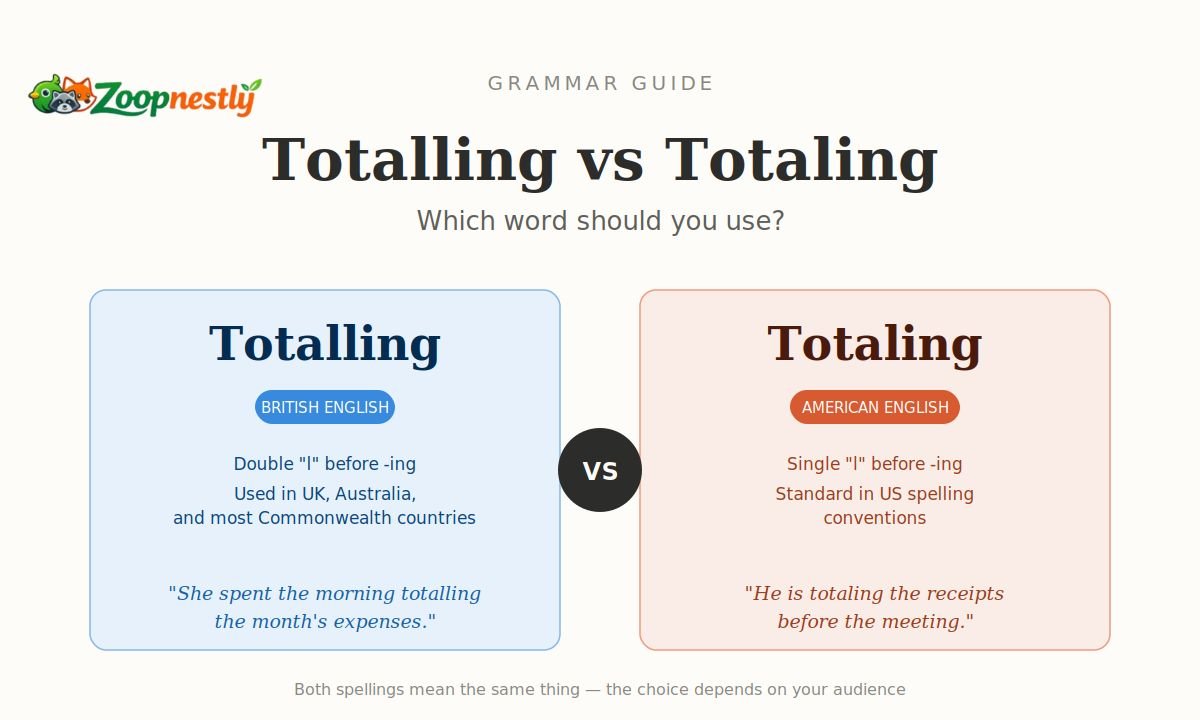
Totalling (double L) is the British English spelling, while totaling (single L) is the American English spelling. Both are correct, and both mean the same thing: adding up to a sum or amounting to a certain figure. The version you should use depends on your audience, not on which one is “more correct.”
What’s the Difference Between Totalling and Totaling?
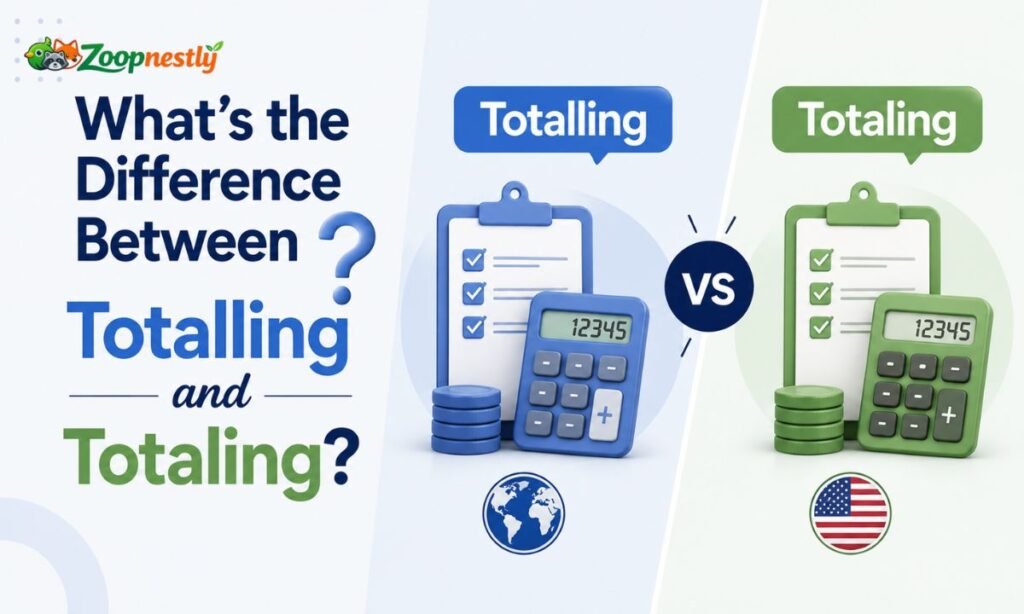
The difference isn’t about meaning. It’s purely about spelling convention based on where the English is written.
- Totalling — used in the UK, Australia, Canada (mostly), and other Commonwealth countries
- Totaling — used in the United States
Both words come from the same root, total, and both function as the present participle or gerund form of the verb “to total.” So “the costs are totalling $500” and “the costs are totaling $500” describe the exact same thing. Only the spelling style changes.
Example Sentences
- British English: The invoice is totalling more than we expected.
- American English: The invoice is totaling more than we expected.
- British English: Her expenses were totalling nearly £2,000 by June.
- American English: Her expenses were totaling nearly $2,000 by June.
The Grammar Rule Behind the Spelling Difference
This isn’t a random quirk. It comes from a well-documented pattern in English spelling reform.
The British Rule
In British English, when a verb ends in a single vowel followed by a single consonant (like the “l” in “total”), that final consonant gets doubled before adding “-ing” or “-ed,” even when the syllable isn’t stressed. This is why you also get travelling, cancelling, and modelling in British spelling.
The American Rule
American English generally follows a stricter version of the doubling rule: the final consonant only doubles if the stress falls on the last syllable. Since “total” is stressed on the first syllable (TO-tal, not to-TAL), American English does not double the “l.” That gives you traveling, canceling, and modeling as well.
Why the Difference Exists
This split traces back to spelling reforms in American English during the 19th century, most notably associated with lexicographer Noah Webster, who favored simpler, more phonetic spellings compared to traditional British forms. Over time, American publishing and education settled on the single-consonant pattern for words like this, while British English kept the older doubling convention.
Totalling vs Totaling: Side-by-Side Comparison
| Feature | Totalling | Totaling |
| Region | British English (UK, Australia, etc.) | American English (US) |
| Consonant | Double “L” | Single “L” |
| Root word | Total | Total |
| Meaning | Same | Same |
| Used in | UK newspapers, British style guides | US newspapers, AP Style, US style guides |
| Related word pattern | Travelling, cancelling | Traveling, canceling |
Which Should You Choose?
Pick your spelling based on who’s reading, not personal preference:
- Writing for a US audience, US company, or US publication? Use totaling.
- Writing for a UK, Australian, or Commonwealth audience? Use totalling.
- Writing for a global audience with no clear regional lean? Pick one and stay consistent throughout the entire document.
The biggest mistake isn’t choosing the “wrong” spelling. It’s switching between the two in the same piece of writing.
A Real-World Example: Why This Matters in Business Writing

Imagine a US-based finance team sends a quarterly report to international investors, and half the document uses “totalling” while the other half uses “totaling.” It’s a small detail, but inconsistent spelling can make a document look unpolished or rushed, especially in financial, legal, or academic writing where precision builds trust. Style consistency signals attention to detail, and readers notice when it’s missing, even if they can’t always explain why.
DISCOVER MORE : Long Term or Longterm: Common Mistakes and Correct Spelling
How to Choose the Right Spelling: A Practical Guide
Step 1: Identify Your Audience
Ask where most of your readers are located. A US-based blog, app, or business should default to American spelling. A UK-based publication should use British spelling.
Step 2: Follow a Style Guide
If you’re writing professionally, check whether your company or publication follows a specific style guide, such as AP Style (American) or Oxford style (British). Most style guides specify a regional spelling standard for words like this.
Step 3: Stay Consistent
Once you pick a version, use it throughout the entire document, website, or brand voice. Don’t switch mid-article.
Step 4: Set Your Writing Tools to Match
Most word processors and browsers let you set a language and region (e.g., “English (US)” vs “English (UK)”). Setting this correctly means your spell checker will flag the spelling you don’t want, saving you from manual proofreading later.
Common Mistakes Writers Make
Mixing British and American Spellings
This is the most frequent error. Writers who read content from both regions sometimes default to whichever spelling they saw most recently, creating inconsistency within a single piece.
Ignoring Audience Expectations
Using “totalling” for a strictly American audience (or vice versa) can look like a typo to readers, even though it’s technically correct somewhere else in the world.
Relying Solely on Spell Check
Spell checkers often default to whatever language setting is active on the device, not the one appropriate for the target audience. Always double-check your tool’s language setting before trusting its suggestions.
Related Word Patterns to Know
This same British-versus-American doubling rule applies to several other common words, which is useful to recognize since it’s not limited to “total”:
| British (double L) | American (single L) |
| Travelling | Traveling |
| Cancelling | Canceling |
| Modelling | Modeling |
| Labelling | Labeling |
| Fuelling | Fueling |
Recognizing this pattern helps you spot and correct similar spelling choices quickly, rather than treating each word as a separate rule to memorize.
Many writers get tripped up by totalling vs totaling, unsure which spelling is correct in their context.
Totalling vs Totaling: Meaning
There’s no difference in meaning at all. Both spellings describe the act of adding numbers together to reach a sum, or something amounting to a specific figure. The pronunciation is also identical in both versions. The only variation is the written form.
Totaling or Totalling: Synonyms
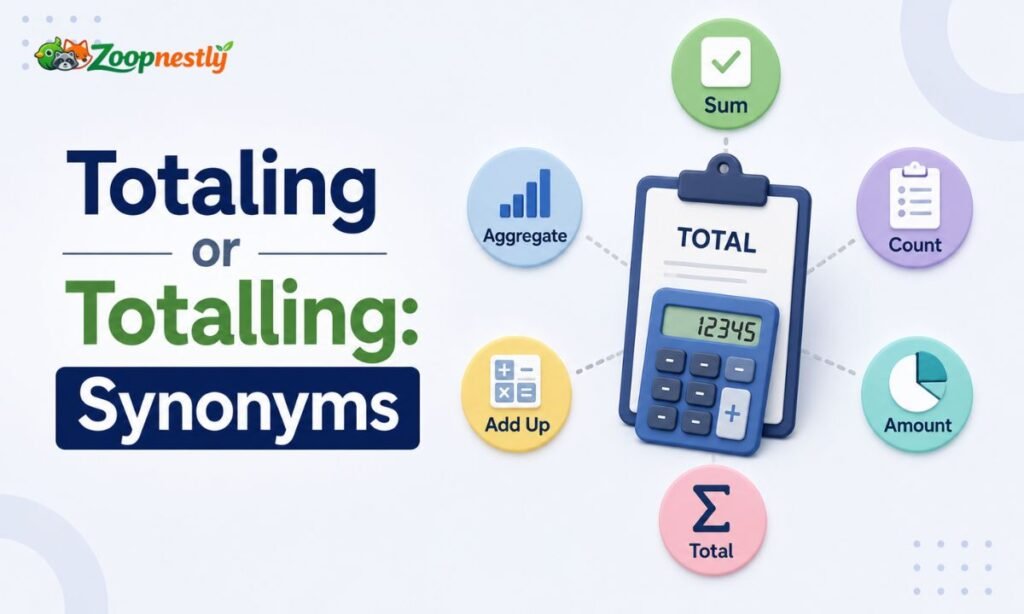
Depending on context, you can often substitute:
- Adding up to (e.g., “expenses adding up to $500”)
- Amounting to (e.g., “costs amounting to $2,000”)
- Summing to (more common in technical or mathematical writing)
- Reaching (e.g., “sales reaching $10,000”)
These alternatives work well when you want to avoid repeating “totaling” or “totalling” multiple times in the same paragraph.
Totaling Pronunciation
Both spellings are pronounced the same way: TOH-tuh-ling. The spelling difference has no effect on how the word sounds when spoken aloud, which is part of why the mix-up is so common. Native speakers rarely notice the spelling variation unless they’re actively writing or editing.
Frequently Asked Questions
Is “totalling” or “totaling” correct?
Both are correct. Totalling is correct in British English, and totaling is correct in American English. Neither one is a misspelling; they’re regional variants of the same word.
Which spelling should I use in a business email?
Match your recipient’s region. If you’re emailing a US company, use “totaling.” If you’re emailing a UK or Australian company, use “totalling.”
Does Microsoft Word or Google Docs flag one as wrong?
Yes, if your document’s language setting is “English (US),” it will flag “totalling” as a misspelling, and vice versa if set to “English (UK).” This is a setting issue, not a correctness issue.
Can I use both spellings in the same article?
You shouldn’t. Mixing spellings within one piece of writing looks inconsistent and unprofessional, even though each word is correct on its own.
Is there a difference in meaning between totalling and totaling?
No. Both words mean exactly the same thing: adding up to a sum or amounting to a certain total. Only the spelling changes based on regional English conventions.
Conclusion
The choice between totalling and totaling isn’t about right or wrong. It’s about knowing your audience and staying consistent. American English drops the second “l,” while British English keeps it, following the same pattern you’ll see in words like “traveling” and “cancelling.” Once you match your spelling to your reader’s region and stick with it throughout your writing, this small detail stops being a source of hesitation and becomes second nature.

James Walker is a content writer and language researcher with over 5 years of experience in meanings, definitions, and language-related topics. He enjoys simplifying complex terms into clear, easy-to-understand explanations. Through ZoopNestly.com, he helps readers find accurate and reliable information.