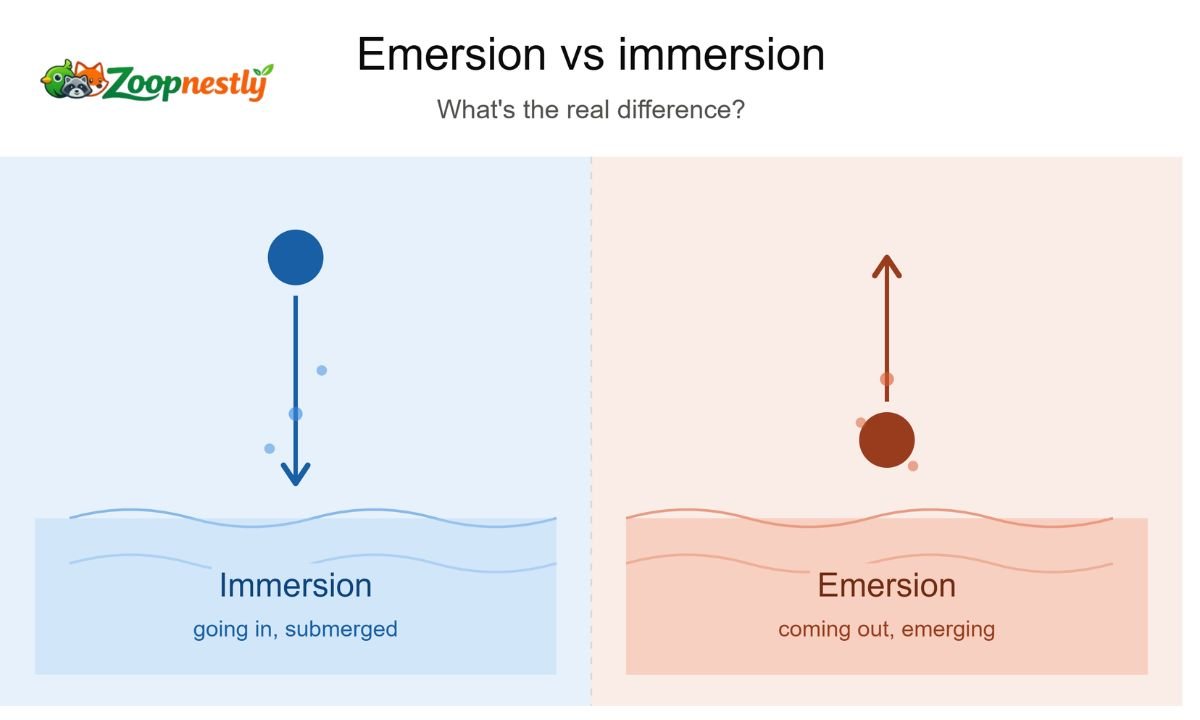
Emersion vs Immersion: What’s the Real Difference?
You’re halfway through writing an email or a school paper, and suddenly you freeze. Is it “emersion” or “immersion”? Spell check isn’t flagging either one, and now you’re second-guessing a word you’ve used a hundred times. That small hesitation is exactly why so many writers mix these two up. The confusion is understandable, since emersion vs immersion looks like a simple typo issue but actually involves two words with almost opposite meanings.
Quick Answer
Immersion means being fully submerged or absorbed in something, like water, a language, or an experience. Emersion means coming out or emerging from something, especially in scientific contexts like astronomy. The two words are near opposites: one is about going in, the other is about coming out.
Emersion vs Immersion: A Quick Comparison
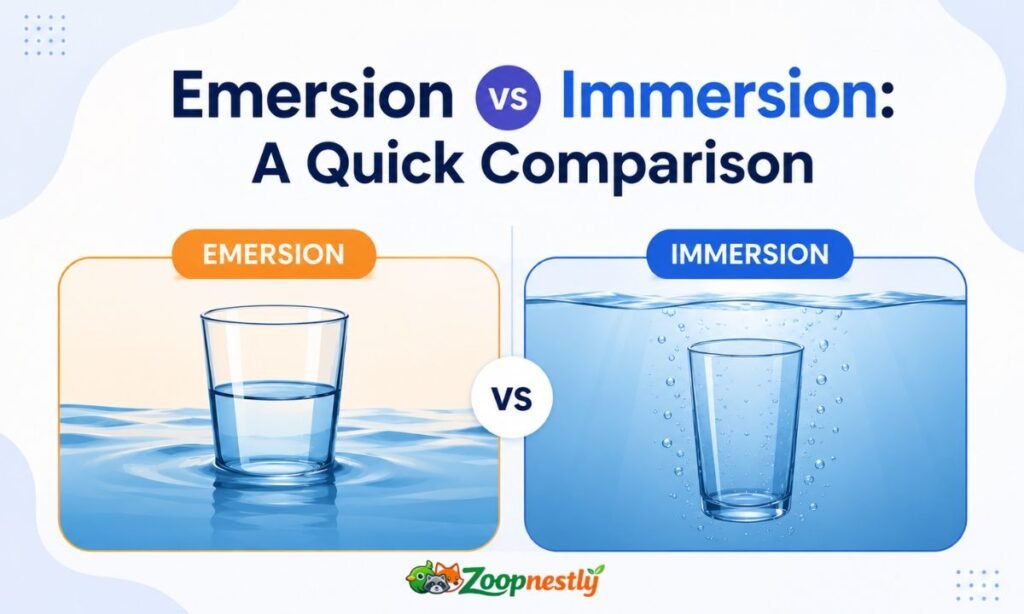
Before getting into definitions and examples, here’s a side by side look at how these two words differ.
| Feature | Emersion | Immersion |
| Core meaning | Coming out or emerging | Going in or being submerged |
| Common usage | Rare, mostly scientific | Common, everyday and technical |
| Direction | Outward | Inward |
| Typical fields | Astronomy, marine biology | Language learning, VR, culture, water |
| Example | Emersion of the moon from eclipse shadow | Immersion in a foreign language |
What Does Emersion Mean?
Emersion refers to the act of emerging or coming out from something, especially a liquid, shadow, or hidden state. It’s the opposite of submersion. You’ll rarely hear this word in casual conversation, but it shows up regularly in science writing.
Where Emersion Is Used
Astronomy. Emersion describes the moment a celestial body reappears after being eclipsed or occulted. For example, astronomers talk about the emersion of a star after the moon passes in front of it.
Marine biology and tidal science. Emersion refers to when organisms or land are exposed after being underwater, such as during low tide. Intertidal creatures experience regular cycles of immersion and emersion as tides rise and fall.
Environmental and earth science. Researchers use emersion to describe land or sediment becoming exposed as water levels drop, such as during drought or seasonal changes.
Outside of these fields, emersion is uncommon, which is part of why it’s so often mistaken for immersion.
What Does Immersion Mean?
Immersion is the far more familiar word. It means being fully absorbed, surrounded, or submerged in something, whether that’s water, an activity, or an emotional or mental state.
Physical Immersion
This is the literal sense: submerging an object or a person in liquid. Think of immersion blenders, or dipping a tea bag fully into hot water.
Mental and Experiential Immersion
Immersion also describes deep mental engagement. When someone says they were “immersed” in a book or a project, they mean they were completely absorbed and lost track of time. This sense extends into learning, entertainment, and technology.
Immersion in Technology and Learning

Immersion shows up constantly in modern contexts, which is another reason it’s the word most people reach for by default.
Virtual reality. VR headsets are designed to create a sense of immersion, making users feel like they’re inside a digital environment rather than watching it from the outside.
Gaming. Game designers talk about immersion as the feeling of being pulled into a game’s world, story, or mechanics so completely that the outside world fades away.
Language learning. Immersion programs place learners in an environment where only the target language is spoken, forcing rapid adaptation. This is considered one of the fastest ways to build fluency because it removes the option of falling back on a native language.
Cultural immersion through travel. Travelers seeking cultural immersion try to live like locals rather than tourists, eating local food, speaking the local language, and participating in daily routines instead of just visiting landmarks.
DISCOVER MORE : Courtesy vs Curtesy: The Ultimate Spelling Guide
Emersion vs Immersion: The Key Differences
The clearest way to separate these words is by direction and frequency.
Direction of experience. Immersion moves inward, someone or something enters a state or substance. Emersion moves outward, someone or something exits or reappears.
Stage of experience. Immersion usually marks the beginning or the middle of an experience, the act of entering. Emersion marks the end, the act of leaving or reappearing.
Frequency of use. Immersion is common in everyday language, education, and technology. Emersion is specialized and mostly limited to scientific writing.
Emersion vs Immersion in Psychology
In psychology, immersion describes a state of deep focus or absorption, sometimes linked to what researchers call “flow,” where a person is fully engaged in a task and loses awareness of time or surroundings.
Emersion doesn’t have a strong standalone presence in psychology literature. When writers use it in this context, they typically mean the process of coming back to normal awareness after a deeply immersive or focused state, similar to resurfacing from deep concentration. This usage is more metaphorical than clinical, so it’s worth treating carefully rather than assuming it’s a recognized psychological term.
Real World Examples
Seeing both words in context makes the difference easier to remember.
Examples of Emersion
- The emersion of the planet from the shadow marked the end of the eclipse.
- Barnacles go through repeated immersion and emersion as the tide moves in and out.
- Scientists recorded the emersion of the reef as the water receded.
Examples of Immersion
- She chose full language immersion to learn Spanish faster.
- The VR demo offered an impressive level of immersion.
- He was in such deep immersion in his work that he missed dinner.
Immersion vs Submersion
These two are also frequently confused. Submersion means being completely covered by liquid, with no distinction between mental or physical states. Immersion can be physical or figurative, but submersion is almost always literal and complete. A submarine is submerged, but a student can be immersed in a subject without any water involved at all.
Common Mistakes Writers Make

Using immersion when emersion is correct. Since emersion is rare, many writers default to immersion even in scientific writing where emersion is the accurate term, such as describing a moon reappearing from eclipse.
Assuming the words are interchangeable. They aren’t. Immersion and emersion describe opposite directions of movement, not variations of the same idea.
Confusing immersion with submersion. Immersion doesn’t always mean full physical coverage, while submersion does.
A Simple Memory Trick
Here’s an easy way to keep these straight:
- Immersion starts with “im,” like “in.” Think in–mersion, going in.
- Emersion starts with “e,” like “exit.” Think exit-mersion, coming out.
If you remember that “im” means in and “e” points to exit, you’ll rarely mix them up again.
Key Takeaways
Emersion means emerging or coming out, most often used in astronomy, marine biology, and environmental science.
Immersion means going in or being fully absorbed, used constantly in everyday language, education, technology, and psychology.
Frequently Asked Questions
Is emersion a real word?
Yes. Emersion is a real English word meaning the act of emerging or coming out from something, particularly used in scientific fields like astronomy and marine biology.
What is an immersion student?
An immersion student is someone enrolled in a program where instruction happens primarily or entirely in a second language, helping them build fluency through constant exposure rather than traditional classroom translation.
Which word is more commonly used, emersion or immersion?
Immersion is far more common. It appears in everyday conversation, education, technology, and psychology, while emersion is mostly limited to specialized scientific writing.
Can immersion and emersion happen in the same context?
Yes. In tidal science, for example, the same organism experiences both immersion, when covered by water, and emersion, when exposed as the tide goes out.
What is the easiest way to remember the difference?
Link “immersion” with “in” for going inward, and “emersion” with “exit” for coming outward. This simple association makes the distinction easy to recall.
Final Thoughts
Emersion and immersion may look nearly identical on the page, but they point in opposite directions. Immersion is about diving in, whether that’s into water, a language, or a story. Emersion is about coming back out, most often used in scientific settings like eclipses and tides. Once you connect “immersion” with “in” and “emersion” with “exit,” the confusion tends to disappear for good.

James Walker is a content writer and language researcher with over 5 years of experience in meanings, definitions, and language-related topics. He enjoys simplifying complex terms into clear, easy-to-understand explanations. Through ZoopNestly.com, he helps readers find accurate and reliable information.