It Is Must or It Is a Must: What’s the Difference?
You’re typing a message to your boss. You want to say something is required, so you write “attendance is must.” Something feels off, but you’re not sure why. You second-guess yourself, delete it, and try again. This tiny grammar snag trips up even confident English speakers. The debate over it is must vs it is a must comes down to one missing word, and that word changes everything.
Quick Answer
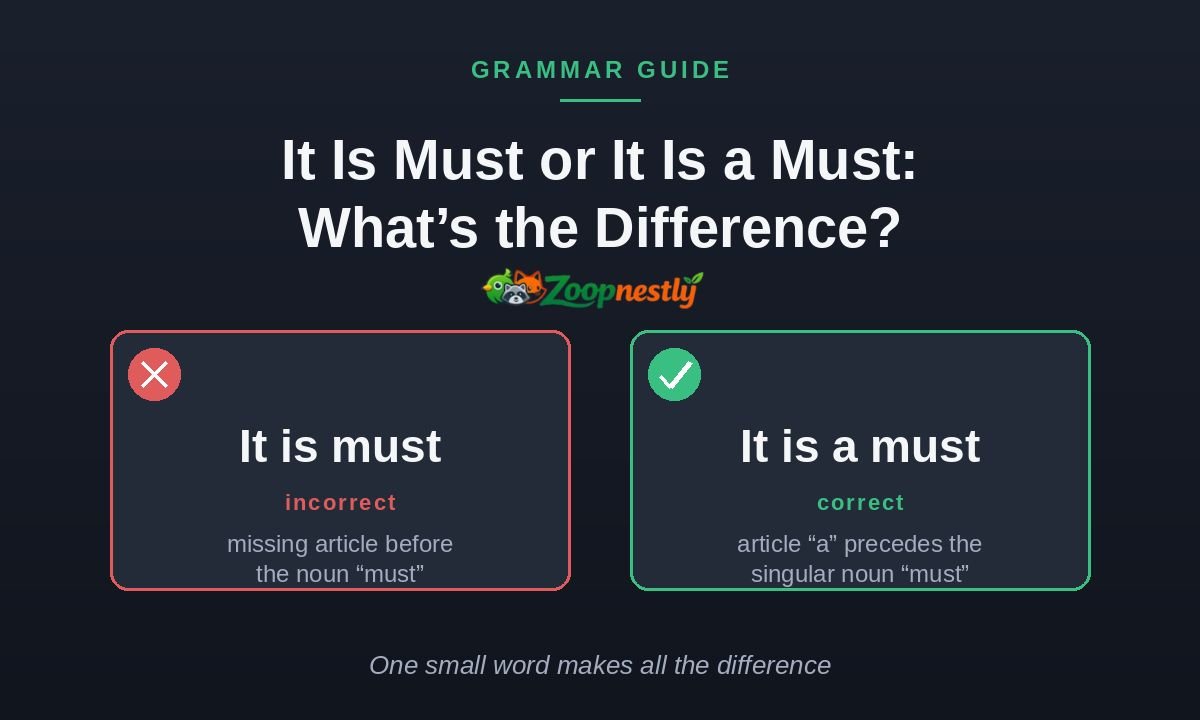
“It is a must” is correct. “It is must” is grammatically wrong because must is a modal verb here being used as a noun, and singular nouns in English need an article like a, an, or the in front of them. Say “it is a must,” not “it is must.”
Why “It Is a Must” Is the Correct Phrase
The confusion starts because must does double duty in English. Most of the time, it’s a modal verb, as in “you must finish your homework.” But in the phrase “it is a must,” must is functioning as a noun. It means something like “a requirement” or “an essential item.”
Once you treat must as a noun, normal grammar rules kick in. Singular countable nouns almost always need an article before them. You wouldn’t say “she has book” or “it is problem.” You’d say “she has a book” and “it is a problem.” The same rule applies here: “it is a must.”
Why “It Is Must” Is Wrong
“It is must” fails because it drops the article that a singular noun requires. Without “a,” the sentence reads as if must is still working as a modal verb, but modal verbs can’t follow “is” directly in that way. The sentence structure simply doesn’t hold together.
Think of it like this: “must” as a noun behaves exactly like “necessity” or “requirement.” Nobody says “it is necessity.” They say “it is a necessity.” Must follows the same pattern.
It Is a Must: Meaning and Usage
When someone says “it is a must,” they mean the item, action, or step is essential, non-negotiable, or highly recommended. It’s a casual but firm way to stress importance without sounding overly formal.
Example sentences:
- Sunscreen is a must if you’re heading to the beach this weekend.
- A good pair of hiking boots is a must for this trail.
- Reading the contract carefully is a must before you sign anything.
- Backing up your files is a must before updating your operating system.
Notice that “a must” usually follows “is,” “was,” or “would be,” and it typically comes at the end of a sentence or clause.
Synonyms for “A Must”
If you want variety in your writing, several words and phrases carry a similar meaning:
| Synonym | Example |
| essential | Sunscreen is essential at the beach. |
| necessity | A good pair of boots is a necessity here. |
| required | Reading the fine print is required before signing. |
| non-negotiable | Backing up files is non-negotiable before an update. |
| mandatory | Attendance is mandatory for the meeting. |
These alternatives work well when you don’t want to repeat “must” too many times in the same paragraph.
“It’s a Must” vs “Is a Must”
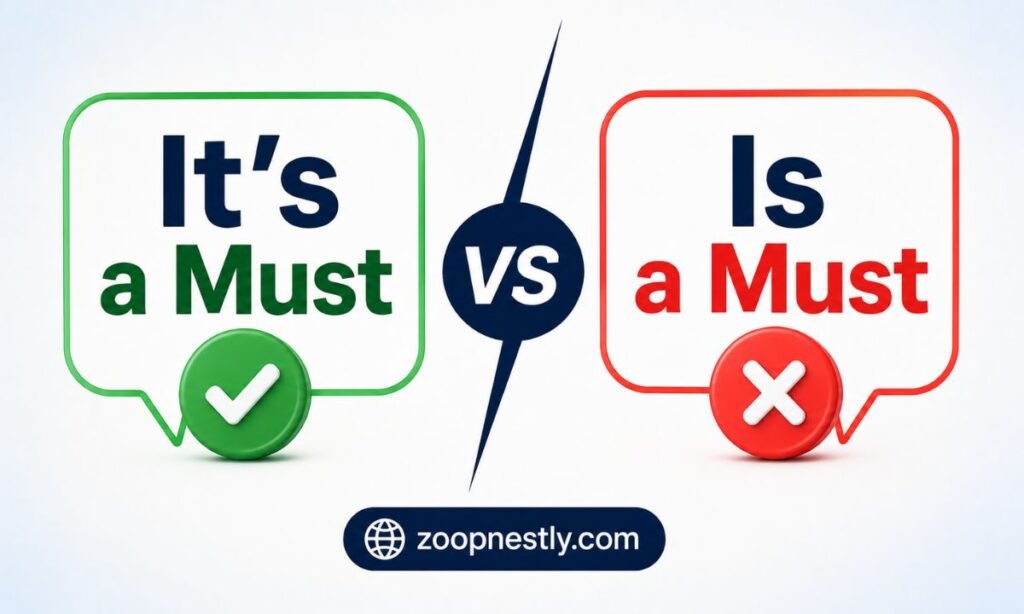
Both forms are correct, and the choice depends on sentence structure.
- “It’s a must” is the contracted subject-plus-verb form. Use it when “it” is the subject: “It’s a must to check the weather before hiking.”
- “Is a must” appears when the subject comes before it, often a noun phrase: “A raincoat is a must for this trip.”
The meaning doesn’t change. Only the sentence structure decides which form fits.
“A Must” in Different Contexts
The phrase “a must” flexes across different situations, and the surrounding words shift slightly depending on the context.
In Travel and Packing
“A must” often describes essential items or destinations.
Example: “Visiting the old town is a must if you’re in Prague for even one day.”
In Business and Professional Writing
Here, “a must” signals a requirement tied to policy, compliance, or expectation.
Example: “Submitting the report by Friday is a must for all team leads.”
In Reviews and Recommendations
“A must” often appears as “a must-have,” “a must-read,” or “a must-see,” where it becomes part of a compound adjective.
Example: “This documentary is a must-see for anyone interested in ocean life.”
Notice that when “must” combines with another word using a hyphen, it acts as an adjective instead of a noun, and the article rule shifts depending on what follows.
DISCOVER MORE : Its Self or Itself: The Simple Grammar Rule You Need to Know
Common Mistakes People Make
Even after learning the rule, a few related errors still show up often.
- Dropping the article entirely: “It is must you arrive early.” Should be: “It is a must that you arrive early.”
- Using “the” instead of “a”: “It is the must for this job.” This sounds unnatural. Stick with “a” unless referring to one specific, previously mentioned must.
- Confusing “must” the noun with “must” the verb in the same sentence: “You must a must do this.” This mixes both uses incorrectly. Pick one role for must per sentence.
- Overusing “must-have” as a plain noun: “This is must have for travelers” instead of “This is a must-have for travelers.”
How to Remember Which Form Is Correct
A simple trick: replace “must” with “requirement” in your sentence. If “requirement” needs an article to sound right, “must” needs one too.
- “It is requirement.” — sounds wrong.
- “It is a requirement.” — sounds right.
- “It is must.” — sounds wrong for the same reason.
- “It is a must.” — sounds right.
This substitution test works because both words function as singular countable nouns in these sentences.
Is “It Is a Must” Formal or Informal?
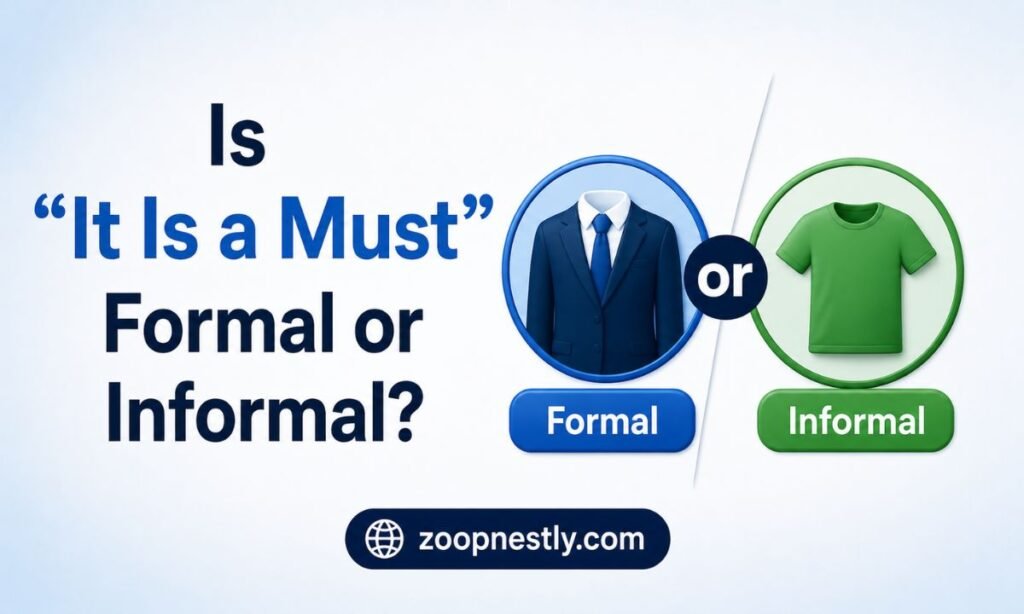
“It is a must” sits comfortably in both casual and semi-formal writing. You’ll see it in blog posts, marketing copy, casual emails, and everyday conversation. It’s slightly less formal than saying “it is essential” or “it is required,” which fit better in legal documents, academic writing, or strict corporate policy.
For formal reports or official documentation, consider swapping “a must” for “mandatory,” “required,” or “essential.” For everyday communication, “a must” works fine and sounds natural.
Quick Reference Table
| Phrase | Correct? | Why |
| It is must | No | Missing article before singular noun |
| It is a must | Yes | Article correctly precedes the noun |
| It’s a must | Yes | Contracted subject form |
| This is a must-have | Yes | Compound adjective, no separate article needed for “have” |
| It is the must | No | Wrong article choice for general statements |
Frequently Asked Questions
Is “it is must” ever correct in any dialect of English?
No. Standard English, whether American, British, Australian, or any other major variety, requires an article before a singular countable noun. “It is must” isn’t accepted in formal grammar or casual speech in any standard dialect.
Can “must” be used without an article in other sentence structures?
Yes, when must functions as a modal verb rather than a noun. For example, “You must finish this today” uses must correctly without an article because it’s acting as a verb, not a noun.
What’s the difference between “a must” and “must-have”?
“A must” is a standalone noun phrase meaning something essential. “Must-have” is a compound adjective, often used to describe a noun directly, as in “a must-have item” or “must-have skills.”
Why do non-native speakers commonly drop the article in this phrase?
Many languages don’t require articles before nouns the way English does. Speakers of those languages sometimes carry that pattern into English, which leads to phrases like “it is must” instead of “it is a must.”
Is “it is a must” acceptable in academic writing?
It’s better to use more formal alternatives like “essential,” “necessary,” or “required” in academic papers. “A must” leans conversational, so it fits blogs, emails, and everyday writing better than research papers or formal reports.
Final Thoughts
The rule behind it is must vs it is a must comes down to one small but important grammar principle: singular countable nouns need an article. Once you treat “must” as a noun meaning “requirement,” the correct form becomes easy to remember. Say “it is a must,” and your sentence will sound natural every time.

James Walker is a content writer and language researcher with over 5 years of experience in meanings, definitions, and language-related topics. He enjoys simplifying complex terms into clear, easy-to-understand explanations. Through ZoopNestly.com, he helps readers find accurate and reliable information.