Excited vs Exited: Commonly Confused Words Explained
You’re typing a quick message to a friend about your new job, and your fingers move faster than your brain. “I’m so exited to start Monday!” Something looks off, but you can’t quite place it. That single missing letter is the whole story behind excited vs exited, two words that sound almost identical but mean completely different things. Mixing them up is an easy mistake, and it’s one spell check won’t always catch.
Quick Answer
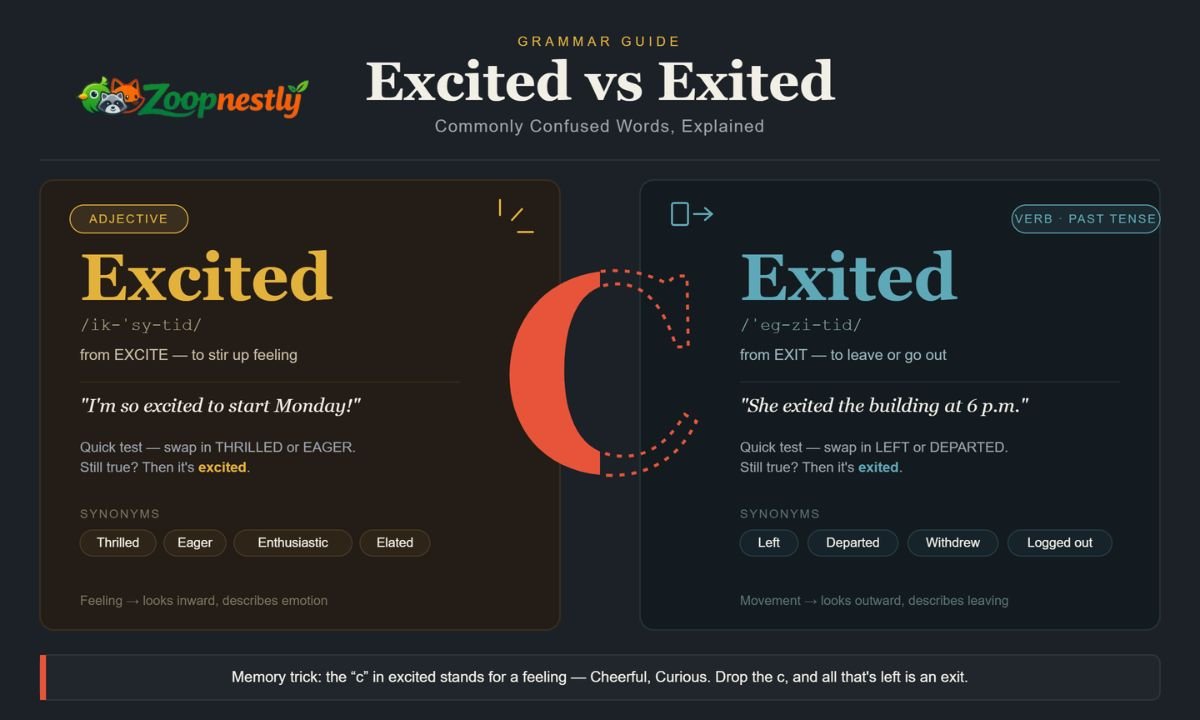
Excited is an adjective that describes strong feelings of enthusiasm or eagerness, as in “I’m excited for the trip.” Exited is the past tense of the verb “exit,” meaning to leave or go out of a place, as in “She exited the building.” The words differ by one letter (the “c”) but have entirely different meanings and grammatical roles.
Excited vs Exited: The Core Difference

The confusion between these two words comes down to one letter and one sound. “Excited” has a hard “c” that creates a “ks” sound, while “exited” skips that sound entirely. Because people often speak quickly or type on autopilot, the “c” gets dropped, turning a feeling into an action by accident.
Here’s the simplest way to remember it: excited describes an emotion, and exited describes a movement. If you’re talking about how someone feels, you want “excited.” If you’re talking about someone leaving a room, building, or vehicle, you want “exited.”
What Does “Excited” Mean?
Excited is an adjective that describes a state of eager anticipation, enthusiasm, or heightened emotion. It comes from the verb “excite,” meaning to stir up feelings or energy in someone.
You feel excited before a vacation, a big announcement, or a first date. It’s a word about internal emotion, not physical movement.
Example sentences:
- The kids were excited to open their birthday presents.
- I’m excited about the new project at work.
- She got excited when she heard the good news.
What Does “Exited” Mean?
Exited is the past tense and past participle of the verb “exit,” which means to leave or go out of a place. It’s a straightforward action word describing physical departure.
Unlike “excited,” which is only an adjective, “exited” is strictly a verb form. It has no emotional meaning at all.
Example sentences:
- He exited the meeting early.
- The passengers exited the plane in an orderly line.
- She exited the app before saving her work.
Exited Pronunciation
One reason people mix up these words is pronunciation. Here’s how each one sounds:
- Excited: ik-SY-tid (three syllables, with a hard “ks” sound at the start)
- Exited: EG-zi-tid or IG-zi-tid (three syllables, with a soft “gz” sound)
Say them slowly and you’ll notice “excited” has that extra punch from the “c,” while “exited” flows more smoothly. Practicing the pronunciation out loud is one of the fastest ways to stop confusing the spelling.
Side-by-Side Comparison
| Feature | Excited | Exited |
| Part of speech | Adjective | Verb (past tense) |
| Meaning | Feeling enthusiastic or eager | Left or went out of a place |
| Root word | Excite | Exit |
| Example | She was excited for the concert. | She exited the concert hall. |
| Common context | Emotions, reactions, anticipation | Physical movement, leaving a space |
How to Use Excited and Exited Correctly

Getting comfortable with these words is mostly about matching them to the right situation. Use this quick test: if you can replace the word with “thrilled” or “eager,” you need “excited.” If you can replace it with “left” or “walked out,” you need “exited.”
Using Excited in Sentences
“Excited” usually follows a form of “to be” (is, was, are, were) and pairs with words like “about,” “for,” or “to.”
- We’re excited about the upcoming launch.
- He was excited to see his old friends.
- I get excited every time it snows.
Using Exited in Sentences
“Exited” often follows a subject directly and pairs with a location or object.
- The employee exited the parking garage at 6 p.m.
- The program exited unexpectedly due to an error.
- They exited the highway at the wrong ramp.
Common Mistakes and How to Avoid Them
The most frequent error is writing “exited” when you mean the emotional state, especially in casual texting or fast typing. A second, less common mistake is using “excited” when describing a technical process, like a computer program closing.
A simple trick: read your sentence back and ask whether you’re describing a feeling or a location. Feelings need the “c.” Locations don’t.
Advanced Usage Notes
In technical and computing contexts, “exited” is standard. You’ll see phrases like “the program exited with an error code” or “the user exited the session.” This usage has nothing to do with emotion, so don’t second-guess it just because “excited” looks similar.
In formal writing, “excited” can also appear in the passive voice, such as “The crowd was excited by the announcement.” Here, something external causes the excitement, which is a slightly different structure worth noticing if you write professionally.
Excited vs Exited in a Sentence: More Real-World Examples
Seeing both words used naturally, side by side, helps cement the difference.
- Excited: The team was excited about the record-breaking sales numbers.
- Exited: The sales team exited the boardroom after the presentation.
- Excited: My dog gets excited every time I grab the leash.
- Exited: The dog exited through the side gate.
Notice how “excited” always connects to a feeling, while “exited” always connects to a physical exit point.
Excited vs Exited Synonyms
Knowing related words can help you choose the right term faster and avoid repeating the same word too often.
Synonyms for excited:
- Thrilled
- Eager
- Enthusiastic
- Elated
- Pumped (informal)
Synonyms for exited:
- Left
- Departed
- Withdrew
- Walked out
- Logged out (in digital contexts)
Excited vs Exited in Different Contexts

These words show up differently depending on the setting, and knowing the context helps you avoid mistakes.
In everyday conversation, “excited” dominates because people talk about feelings far more often than they describe leaving a room. In technical writing, “exited” is more common, especially in software documentation, error logs, and instructional manuals. In travel and transportation writing, “exited” refers to leaving vehicles, stations, or routes, such as “the driver exited the freeway.”
Recognizing which context you’re writing in makes the correct word choice almost automatic.
Exceptions and Special Cases
There aren’t grammatical exceptions here since these are two distinct words with fixed meanings. However, one tricky case involves the word “exit” used as a noun, as in “take the next exit.” In that case, neither “excited” nor “exited” applies at all. Another edge case is British versus American spelling, but both dialects treat “excited” and “exited” identically, so region doesn’t change the rule.
DISCOVER MORE : Kinesthesiology vs Kinesiology: Which Word Is Correct?
Practice Exercises
Test yourself with these quick fill-in-the-blank sentences. Choose “excited” or “exited” for each blank.
- She was so _______ about her acceptance letter that she called everyone she knew.
- The last guest _______ the party around midnight.
- He couldn’t hide how _______ he was for the game.
- The software _______ unexpectedly during the update.
- They _______ the store just as it started to rain.
Answers: 1. excited, 2. exited, 3. excited, 4. exited, 5. exited
Conclusion
The difference between excited vs exited comes down to one small letter with a big impact on meaning. “Excited” describes how you feel, while “exited” describes where you’ve been. Once you connect “excited” to emotion and “exited” to exit, the mix-up becomes much harder to make. A quick mental check before you hit send can save you from an easy, avoidable typo.
Frequently Asked Questions
Is “exited” a real word?
Yes. “Exited” is the past tense and past participle of the verb “exit,” meaning to leave or go out of a place. It’s commonly used in both everyday writing and technical contexts.
Can “excited” ever mean the same thing as “exited”?
No. “Excited” only refers to emotional enthusiasm, while “exited” only refers to physical departure or leaving. They never overlap in meaning, despite looking similar.
Why do people confuse excited and exited?
The two words look and sound alike, differing by only one letter. Fast typing, autocorrect errors, and similar pronunciation patterns make it easy to drop the “c” by accident.
Is “excited” a verb or an adjective?
“Excited” functions as an adjective in most sentences, describing a state of feeling. Its root verb, “excite,” means to stir up emotion, but “excited” itself describes the resulting feeling.
How can I remember the difference between excited and exited?
Think of the “c” in “excited” as standing for “cheerful” or “curious,” both emotional words. If there’s no “c,” as in “exited,” the word is about leaving, not feeling.

James Walker is a content writer and language researcher with over 5 years of experience in meanings, definitions, and language-related topics. He enjoys simplifying complex terms into clear, easy-to-understand explanations. Through ZoopNestly.com, he helps readers find accurate and reliable information.