Enable or Inable? Learn the Correct Spelling and Meaning
You typed “inable” into a sentence, paused, and something felt off. Maybe spellcheck flagged it in red, or maybe it just looked wrong sitting next to “enable.” You’re not alone. This mix-up trips up even confident writers because the words sound so similar. The truth about enable vs inable is simpler than you think, and once you see it clearly, you’ll never second-guess it again.
Quick Answer
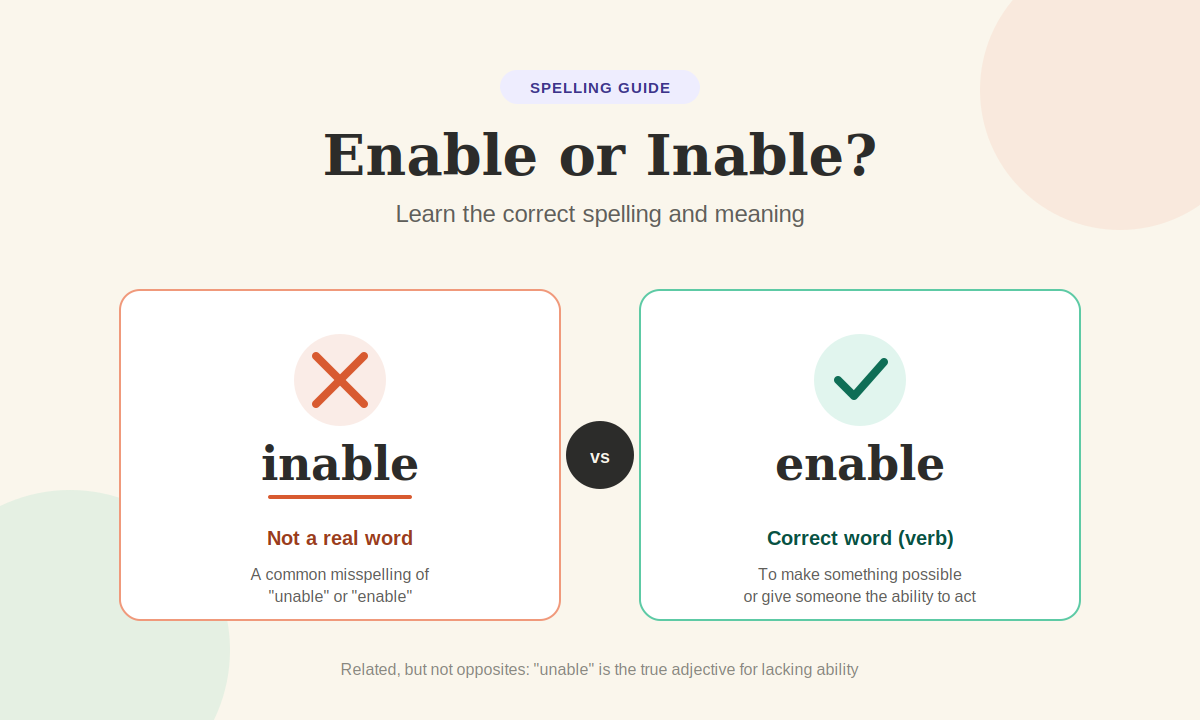
“Inable” is not a real English word. The correct term is unable, meaning “not able to do something.” Enable, on the other hand, means “to make something possible.” They aren’t opposites of each other in a strict grammatical sense, but they’re often confused because of how similar they sound when spoken quickly.
Is “Inable” a Word?
No. “Inable” does not exist in standard English dictionaries. It’s a spelling error, not an alternate form of any recognized word. People usually mean one of two things when they type it: unable or enable.
Why Does “Inable” Seem Correct?
The confusion makes sense once you break it down. English has plenty of words that use the prefix “in-” to mean “not,” like inactive, incomplete, or inconsistent. So your brain naturally assumes “in” plus “able” should work the same way. It doesn’t. English didn’t standardize that pattern for this particular word, and instead settled on unable as the negative form of “able.”
The Correct Word
If you’re describing a lack of ability, the word you want is unable. If you’re describing the act of making something possible, you want enable. Neither of these is spelled with an “i” at the start.
Quick Clarity Table
| Word | Correct Spelling? | Meaning |
| Inable | ❌ Not a word | N/A |
| Unable | ✅ Correct | Not able to do something |
| Enable | ✅ Correct | To make something possible |
What Does “Enable” Mean?
Enable is a verb that means to give someone the ability, permission, or means to do something. It’s about creating opportunity or capability where it didn’t exist before.
Core Concept
Think of enable as a bridge. It connects a person or a system to an outcome that wasn’t reachable before. A tool, a setting, a policy, or even a person’s support can enable an action.
Examples:
- Turning on airplane mode does not enable calls, but turning on Wi-Fi calling does.
- Her mentor’s advice enabled her to negotiate a better salary.
- The new software update enables faster file sharing.
How to Use “Enable” in a Sentence
Common Pattern
The most natural structure is: [subject] + enables + [object] + to + [verb].
For example: “This app enables users to track their spending in real time.”
Practical Examples
- The scholarship enabled him to attend college without debt.
- Better lighting enables the camera to capture sharper photos.
- The new policy enables remote employees to claim home office expenses.
Professional Context
In workplace writing, “enable” often shows up in product descriptions, technical documentation, and process explanations. “This feature enables teams to collaborate across time zones” is a typical example you’d see in a software release note.
Simple Analogy
Picture a locked door. A key doesn’t walk through the door for you, but it enables you to open it. That’s the core function of the word: it removes a barrier so something else can happen.
Enable Synonym, Antonym, and Related Terms
Enable Synonym
Words that carry a similar meaning include allow, permit, empower, facilitate, and equip.
Enable Antonym (Opposite of Enable)
The direct opposite of enable is disable, which means to remove the ability or turn something off. Other related opposites include prevent, hinder, and block.
Enable vs Disable
These two are true opposites and are commonly used together in technology contexts. You enable a setting to turn it on, and you disable it to turn it off. For example: “You can enable notifications in the app settings, or disable them if they become distracting.”
What Does “Unable” Mean in English?
Unable Definition
Unable is an adjective meaning lacking the ability, power, or means to do something. It always pairs with “to” plus a verb.
Core Idea
Where enable creates possibility, unable describes its absence. It’s a statement about limitation, whether that limitation is physical, situational, or circumstantial.
How to Use “Unable” in a Sentence
Common Structure
The typical pattern is: [subject] + is/was + unable + to + [verb].
Examples of Unable in Sentences
- She was unable to attend the meeting due to a scheduling conflict.
- The printer is unable to connect to the network right now.
- He felt unable to finish the project alone, so he asked for help.
Formal vs Informal Tone
“Unable” tends to sound more formal than casual alternatives like “can’t” or “couldn’t.” You’ll see it more often in business emails, reports, and official notices than in everyday conversation. “I’m unable to make it to the call” reads more professionally than “I can’t make the call.”
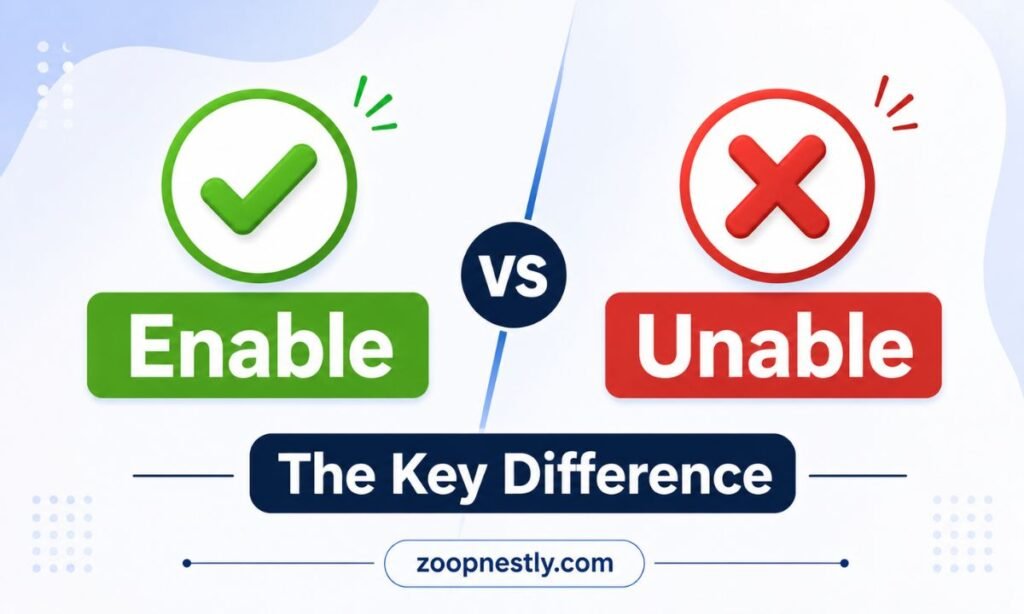
Enable vs Unable: The Key Difference
Fundamental Distinction
Despite looking like a matched pair, enable and unable are not true grammatical opposites. Enable is a verb describing an action that creates capability. Unable is an adjective describing a state of lacking capability. They belong to different parts of speech, which is part of why comparing them directly can feel a little misleading.
Side-by-Side Comparison
| Feature | Enable | Unable |
| Part of speech | Verb | Adjective |
| Meaning | Makes something possible | Lacks the ability to do something |
| Example | The app enables editing. | I am unable to edit the file. |
| Common opposite | Disable | Able |
Simple Explanation
If you remember that enable is something you do to a situation, and unable is something you are in a situation, the difference becomes much easier to hold onto.
Enable vs Able: Are They the Same?
Key Difference
Able is an adjective meaning capable of doing something. Enable is the verb that creates that capability. So “able” describes a state, while “enable” describes the action that leads to that state.
Example
“The training enabled her to become able to manage the entire team independently.” Notice how enable is the action and able is the resulting condition.
Clear Takeaway
Enable causes the state of being able. They’re related, but they aren’t interchangeable in a sentence.
DISCOVER MORE : Unaffected vs Uneffected: The Ultimate Spelling Guide
Why Do People Say “Inable” Instead of “Unable”?
Common Reasons
Most people type “inable” simply because “un-” and “in-” are both common negative prefixes in English, and the ear doesn’t always catch which one applies to which word. Fast typing, autocorrect gaps, and phonetic spelling all play a role too.
Comparable Mistakes
This is similar to other prefix mix-ups, like irregardless instead of regardless, or unpossible instead of impossible. English prefixes don’t follow one universal rule, so mistakes like this are common even among fluent speakers.
Common Mistakes in Enable and Unable Usage
Mistake 1: Using “Inable”
This word simply doesn’t exist. Always replace it with either enable or unable, depending on the intended meaning.
Mistake 2: Confusing Enable With Incapable
“Incapable” is an adjective similar to “unable,” not a substitute for “enable.” Saying “this setting incapables faster loading” is incorrect. The right choice is “this setting enables faster loading.”
Mistake 3: Misusing Enable vs Disable
Writers sometimes use “enable” when they mean “disable,” especially in technical writing where both actions are discussed close together. Double-check which direction the action is going before finalizing a sentence.
Quick Rules to Avoid Confusion
The 3-Step Rule
- If you’re talking about making something possible, use enable.
- If you’re talking about a lack of ability, use unable.
- If you’re about to type “inable,” stop and pick one of the two above.
Memory Trick
Think “En-able” as entering ability, and “Un-able” as un-doing ability. The prefix tells you the direction the meaning is moving.
Words Related to Ability and Inability
Words for Ability
Capable, competent, skilled, qualified, proficient.
Words for Inability
Incapable, incompetent, powerless, ill-equipped.
These related terms can help you vary your writing while keeping the same meaning, especially in professional or academic contexts where repeating “unable” too often can feel repetitive.
Enabling Behavior: A Deeper Perspective

Enabling Behavior Meaning
Outside of grammar, “enabling” also has a specific meaning in psychology and relationships. Enabling behavior refers to actions that unintentionally support or excuse someone else’s harmful habits, such as covering for a person’s substance use or repeatedly making excuses for their poor choices.
Example
A family member who lends money to someone struggling with addiction, without addressing the root issue, may be engaging in enabling behavior, even though the intention is to help.
This meaning is worth knowing because “enabling” shows up often in everyday conversation with this emotional weight, separate from its technical or grammatical use.
Practice: Test Your Understanding
Fill in the Blanks
- The new law will _______ small businesses to apply for grants. (enable/unable)
- She was _______ to reach her phone during the meeting. (enable/unable)
- This cable _______ faster charging for your device. (enable/unable)
Answers: 1. enable, 2. unable, 3. enables
Choose the Correct Word
- I am (unable / inable) to attend tomorrow’s event.
- This update will (enable / inable) dark mode on your screen.
Answers: unable, enable
FAQs
Is “inable” a real word in English?
No, “inable” is not a recognized English word. Writers who use it usually mean either “unable” or “enable,” depending on context.
What is the opposite of enable?
The most direct opposite of enable is disable. Words like prevent and hinder also work as related opposites depending on context.
Can “unable” and “enable” be used interchangeably?
No. They belong to different parts of speech and carry opposite general meanings. Enable is a verb that creates ability, while unable is an adjective that describes a lack of ability.
Why do people confuse enable and unable?
The two words share several letters and sound somewhat similar, especially in fast speech. Confusing prefixes like “en-” and “un-” is a common source of the mix-up.
What does “enabling behavior” mean outside of grammar?
In psychology, enabling behavior describes actions that unintentionally support someone else’s harmful habits, such as making excuses for their choices instead of addressing the underlying problem.
Key Takeaways
- “Inable” is not a word. Always replace it with either enable or unable.
- Enable is a verb meaning to make something possible.
- Unable is an adjective meaning lacking the ability to do something.
- Enable and disable are true opposites, while enable and unable are different parts of speech entirely.
- “Enabling behavior” has an additional meaning in psychology, separate from its grammatical use.
Conclusion
The debate between enable vs inable really comes down to one simple fact: only one of those words actually exists. Once you separate enable from unable by remembering that one creates ability and the other describes its absence, the confusion disappears for good. Keep the quick rules and examples above nearby, and you’ll spell both words correctly without a second thought.

James Walker is a content writer and language researcher with over 5 years of experience in meanings, definitions, and language-related topics. He enjoys simplifying complex terms into clear, easy-to-understand explanations. Through ZoopNestly.com, he helps readers find accurate and reliable information.