Encorporate vs Incorporate: Which Word Should You Use?
You’re typing an email, a resume line, or a business plan, and you pause. Is it “encorporate” or “incorporate”? Spell check hasn’t flagged anything yet, but something feels off. This tiny mix-up trips up more writers than you’d think, and using the wrong version in a formal document or business filing can make you look careless. The good news: encorporate vs incorporate has a simple, permanent answer, and you’re about to learn it for good.
Quick Answer
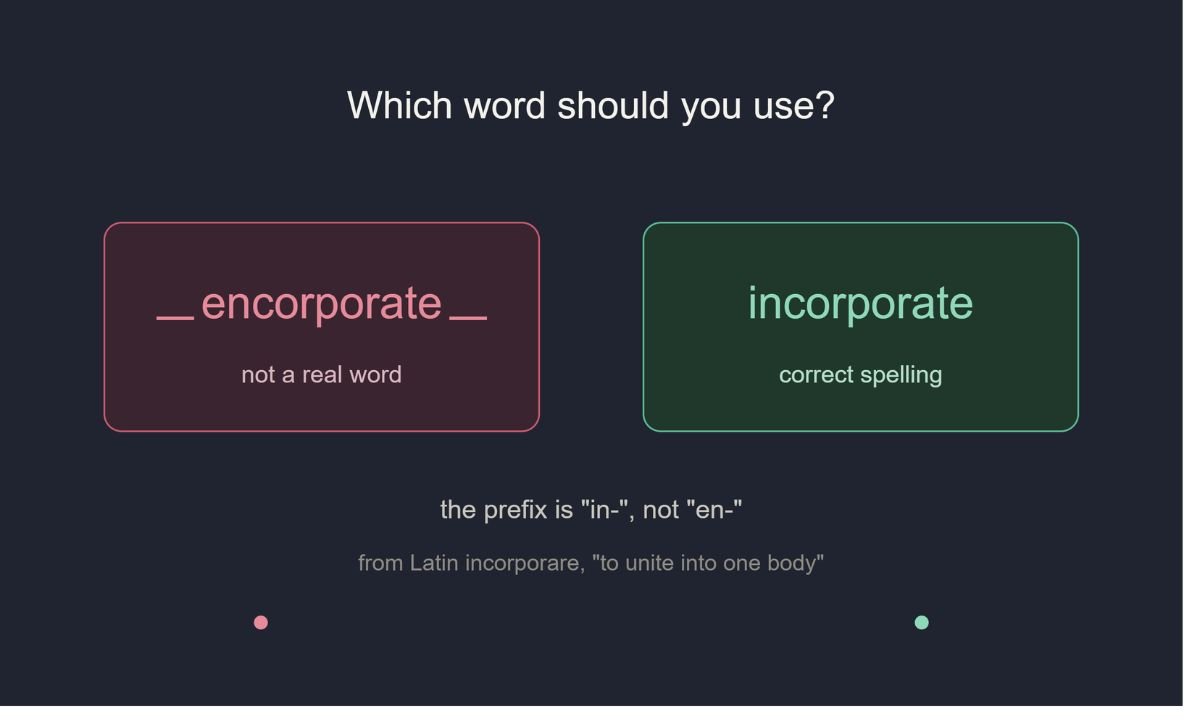
Incorporate is the correct word. Encorporate is not a real word in standard English, it’s simply a common misspelling caused by confusing the prefixes “en-” and “in-.” Whether you mean combining ideas or legally forming a company, “incorporate” is always the right spelling to use.
What Does “Incorporate” Mean?
At its core, incorporate means to combine something into a larger whole, or to include one thing as part of another. It comes from the Latin incorporare, meaning “to embody” or “unite into one body.” That root explains a lot: when you incorporate something, you’re literally bringing it into the “body” of something bigger.
The word works as a verb in two main situations:
- General use: combining, including, or blending elements together
- Legal/business use: forming a company as a recognized legal entity
Both meanings share the same idea of unification, just applied in different contexts.
Simple Examples
- The chef decided to incorporate fresh herbs into the sauce.
- Her thesis incorporates research from three different studies.
- The team plans to incorporate customer feedback into the next update.
Incorporate in Business: What It Really Means

In a business setting, to incorporate means to legally establish a company as its own separate entity, distinct from its owners. Once a business is incorporated, it can own property, enter contracts, sue or be sued, and pay taxes independently of the people who run it.
This process typically involves:
- Filing articles of incorporation with a state or government agency
- Choosing a business structure (like a C-corp or S-corp)
- Receiving legal protections such as limited liability for owners
Example: “After two years as a freelancer, Maria decided to incorporate her design studio to protect her personal assets.”
This is one of the most searched contexts for the word, and it’s also where getting the spelling wrong matters most, since legal paperwork with an error can cause real delays.
Is “Encorporate” a Real Word?
No. Encorporate is not listed in any major dictionary, including Merriam-Webster, Cambridge, or Oxford. It’s a spelling error, not an alternate or regional spelling. There’s no historical version of English where “encorporate” was standard usage.
If you search for it, you’ll likely land on pages (like this one) explaining why it’s wrong, not definitions treating it as valid. Autocorrect tools usually catch it and suggest “incorporate” instead.
Why Do People Confuse Encorporate and Incorporate?
This mix-up isn’t random. A few patterns explain why it happens so often.
The “en-” prefix trap: English has plenty of real words starting with “en-,” like enclose, encounter, enable, and entail. Because these are common, the brain sometimes auto-applies the same pattern to “incorporate,” swapping “in-” for “en-” without noticing.
Similar-sounding words: Words like encapsulate and enclose share a rhythm with “encorporate,” which reinforces the false spelling through sound association.
Fast typing and autocorrect gaps: On mobile keyboards, typos slip through more easily, and not every autocorrect system catches the error immediately.
Key insight: The confusion is almost always about the prefix, not the rest of the word. Once you lock in that it’s “in-” and not “en-,” the mistake tends to disappear for good.
Encorporate vs Incorporate: Side-by-Side Comparison
| Feature | Incorporate | Encorporate |
| Valid English word | Yes | No |
| Found in dictionaries | Yes (Merriam-Webster, Cambridge, Oxford) | No |
| Correct prefix | in- | en- (incorrect here) |
| Common usage | Writing, business, academics | None (misspelling only) |
| Recommended use | Always | Never |
How to Spell Incorporate Correctly (And Keep It That Way)
The correct spelling is i-n-c-o-r-p-o-r-a-t-e. It breaks down as:
- in- (into)
- corpor (from corpus, meaning body)
- -ate (verb-forming suffix)
Put together, it literally means “to bring into the body of something.”
Common mistakes to avoid:
- Encorporate (wrong prefix)
- Incorperate (wrong vowel)
- Incorporeate (extra letter)
Memory trick: Think of the word corporation. You’d never spell that “encorporation,” right? Since “incorporate” and “corporation” share the same root, remembering one helps you remember the other.
Incorporate vs Include vs Integrate: What’s the Difference?
These three verbs often get used interchangeably, but they carry slightly different shades of meaning.
| Word | Meaning | Example |
| Incorporate | To combine something so it becomes part of a whole | “We incorporated your feedback into the design.” |
| Include | To contain something as one part among others | “The package includes a warranty card.” |
| Integrate | To combine parts so they work together smoothly as a unified system | “The new software integrates with our existing tools.” |
In short: “Include” is the simplest, just meaning something is present. “Incorporate” implies blending something in more deliberately. “Integrate” goes a step further, implying the parts now function as one cohesive system.
Example showing the difference: A recipe includes salt as an ingredient. A chef incorporates the salt evenly into the dough. A smart kitchen system integrates the oven and timer so they work together automatically.
DISCOVER MORE : Sponser vs Sponsor: Common Spelling Mistake Explained
Useful Synonyms for Incorporate
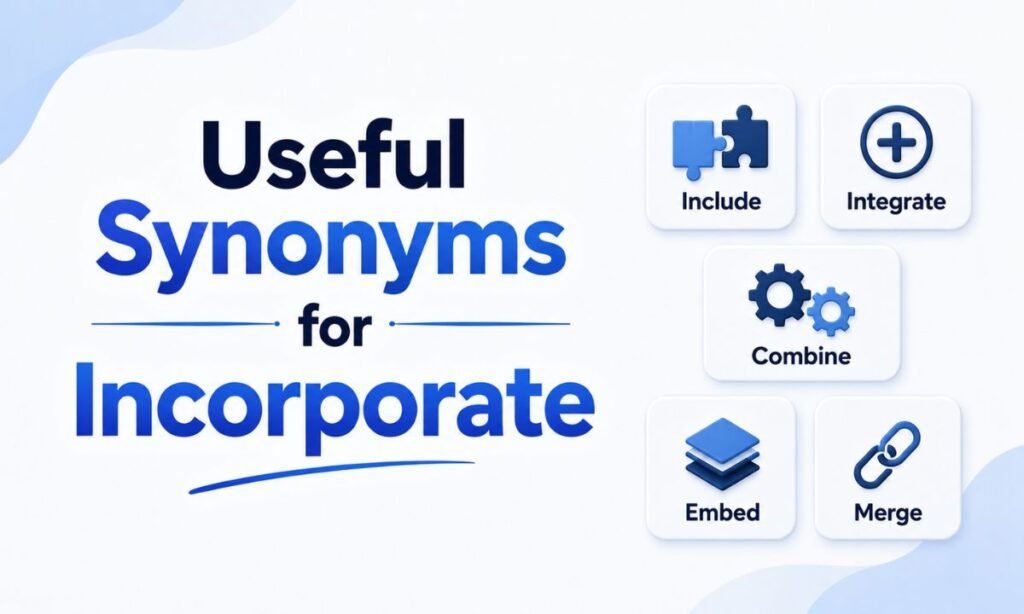
Using the same word repeatedly can make writing feel flat. Depending on context, you can swap “incorporate” for:
- Combine
- Merge
- Embed
- Include
- Absorb
- Blend
- Unify
- Assimilate
Example: Instead of writing “We incorporated the new logo into every page,” you could say “We embedded the new logo into every page” for variety, as long as the meaning still fits.
Incorporate vs Incorporated: What Changes?
Incorporate is the verb, describing the action of combining or legally forming a company. Incorporated is typically the past tense of that verb, or an adjective describing a company that has already completed that legal process (often abbreviated as “Inc.” in a business name).
Example: “The founders incorporated the business in Delaware, and it now operates as Bright Path Solutions, Incorporated.”
Common Mistakes Writers Make
Beyond the spelling itself, a few related errors show up often:
- Writing “encorporate” out of habit, especially in fast, informal typing where autocorrect isn’t active.
- Using “incorporate” when “include” would be simpler, which can make sentences feel overly formal for casual writing.
- Misapplying the business meaning, such as saying a freelancer “incorporated” when they simply registered a sole proprietorship, which is a different legal structure entirely.
A Quick Real-World Scenario
Problem: A student writes, “This essay will encorporate three sources to support the argument.”
Correct version: “This essay will incorporate three sources to support the argument.”
Why it matters: In academic or professional writing, a misspelled key verb can distract a reader or grader from otherwise strong content, and it signals a lack of proofreading.
Where Incorporate Shows Up Most

- Academic writing: combining research, sources, or ideas into an essay or thesis
- Business and legal contexts: forming a company as a recognized legal entity
- Technical and product writing: blending new features or feedback into a system or design
- Everyday communication: describing how you’re combining habits, ingredients, or ideas into daily life
Quick Practice
Fill in the blank: “The company plans to _______ new safety features into next year’s model.” (incorporate)
Fix the sentence: “She wants to encorporate more color into her paintings.” → She wants to incorporate more color into her paintings.
Key Takeaways
- Incorporate is the only correct spelling; encorporate is always a mistake.
- The word means to combine or include something as part of a larger whole.
- In business, it also refers to the legal process of forming a company.
- The prefix “in-” (not “en-“) is the part people get wrong most often.
- Related words like include and integrate carry similar but distinct meanings worth knowing.
Frequently Asked Questions
Is encorporate ever correct in any dialect of English?
No. There’s no British, Canadian, Australian, or other English variant where “encorporate” is accepted. Across all standard dictionaries, “incorporate” is the only recognized spelling.
What part of speech is incorporate?
It’s primarily a verb. A related adjective form, “incorporated,” is also common, especially in business names (as in “Inc.”).
Can I use incorporate and include interchangeably?
Sometimes, but not always. “Include” simply means something is present as part of a group, while “incorporate” suggests actively blending something into a whole. In casual writing, they often overlap, but “incorporate” tends to sound more formal.
Why does incorporate mean both “combine” and “form a company”?
Both meanings trace back to the same root idea of bringing something into a unified “body.” Combining ideas creates one unified piece of writing; forming a company creates one unified legal entity. The core concept of unification stays the same.
How can I stop misspelling incorporate as encorporate?
Focus on the prefix. Remember that it starts the same way as “into,” since “incorporate” literally means bringing something into a body or whole. Linking it to the word “corporation,” which nobody misspells with “en-,” also helps the correct spelling stick.
Final Thoughts
The debate between encorporate vs incorporate isn’t really a debate at all. “Incorporate” is the correct, dictionary-recognized word, while “encorporate” is simply a spelling slip caused by prefix confusion. Once you connect the word to its root meaning, bringing something into a whole, the correct spelling becomes second nature, whether you’re writing an essay, updating a business plan, or just texting a colleague.

James Walker is a content writer and language researcher with over 5 years of experience in meanings, definitions, and language-related topics. He enjoys simplifying complex terms into clear, easy-to-understand explanations. Through ZoopNestly.com, he helps readers find accurate and reliable information.