Babys or Babies: Which Spelling Is Correct?
You’re writing a caption, a card, or a work email, and you pause on one word. Is it babys or babies? Autocorrect might not save you, and guessing wrong in a public post is embarrassing. This mix-up trips up even confident writers because English plural rules aren’t always obvious. The good news is the fix takes ten seconds once you know the rule, and you’ll never second-guess it again.
Quick Answer
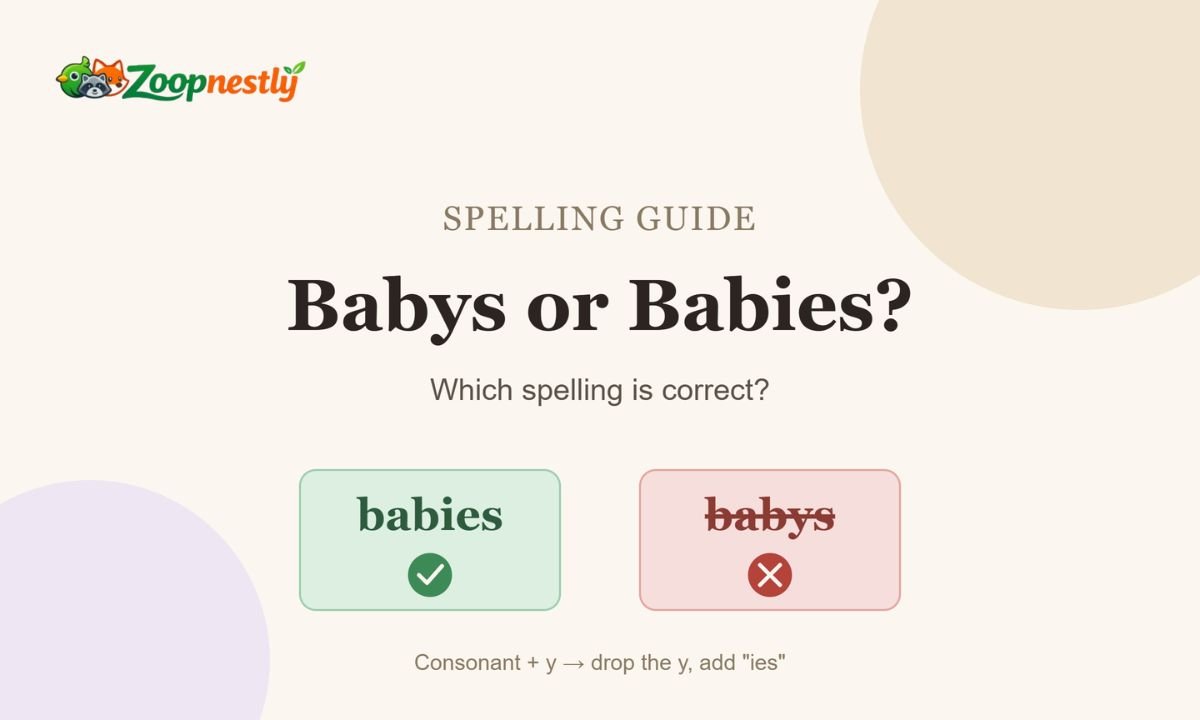
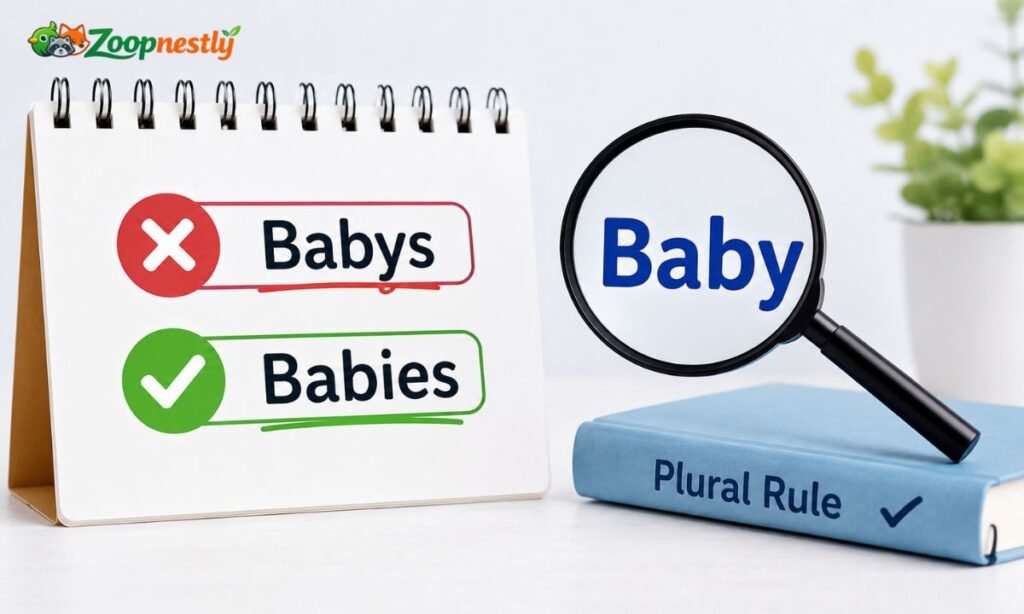
Babies is the correct plural of baby. Babys is a spelling mistake. When a noun ends in a consonant plus “y,” you drop the y and add “ies.” Since baby ends in “b” (a consonant) followed by “y,” the plural becomes babies, not babys.
Why “Babies” Is Correct: The Spelling Rule
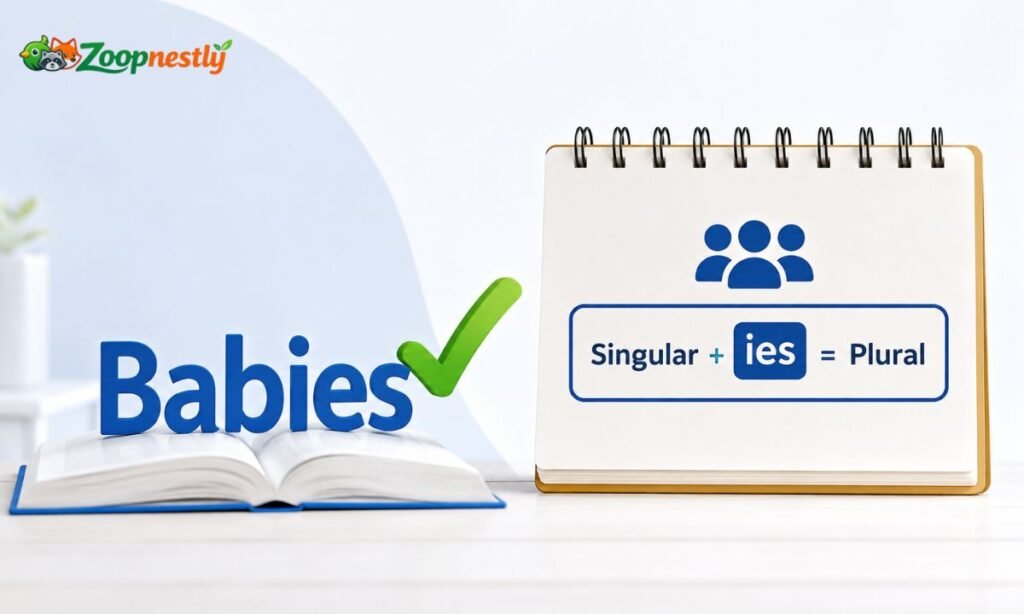
English has a consistent rule for nouns ending in “y”:
- If the letter before the final y is a consonant, drop the y and add -ies.
- If the letter before the final y is a vowel, just add -s.
Baby ends in “a-b-y.” The letter right before the y is b, a consonant. That triggers the y-to-ies change, giving you babies. This isn’t a random exception. It’s the same pattern you see in dozens of everyday words.
Compare that to a word like “toy.” The letter before the y is “o,” a vowel, so you simply add s: toys. No spelling change needed. That contrast is exactly why babys feels tempting but is wrong.
Babys or Babies: Example Sentences
Seeing the word in context makes the rule stick faster than memorizing it alone.
- The nursery had three babies sleeping in matching cribs.
- Both of my sisters had babies this year.
- The daycare center cares for twelve babies under one year old.
- Doctors recommend regular checkups for newborn babies.
- We watched a documentary about how animal babies learn to walk.
None of these sentences would work with “babys.” If you’re ever unsure while writing, try substituting a simpler y-ending word like “city” or “party” and check if you’d write “citys” or “partys.” You wouldn’t, and that same logic applies here.
Comparison Table: Babys vs Babies
| Form | Correct? | Use Case |
| Babies | ✅ Yes | Standard plural noun (“two babies”) |
| Babys | ❌ No | Common misspelling, always incorrect |
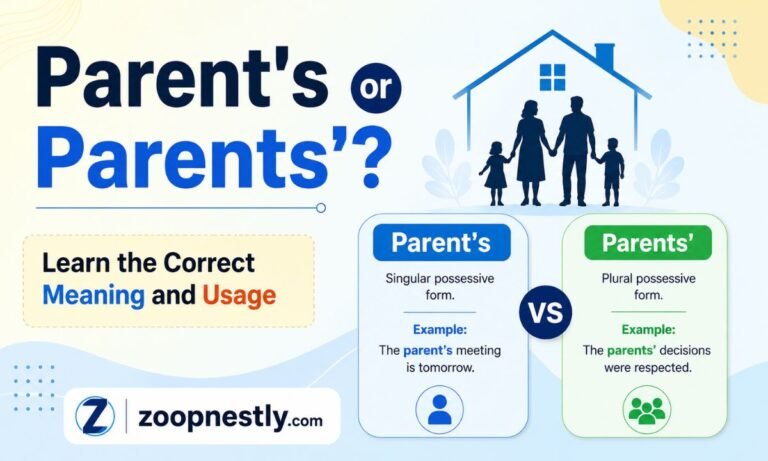
| Baby’s | ✅ Yes | Singular possessive (“the baby’s bottle”) |
| Babies’ | ✅ Yes | Plural possessive (“the babies’ toys”) |
| Baby’s | ⚠️ Context-dependent | Also used in casual contractions like “baby’s asleep” (baby is asleep) |
American English vs British English
Some spelling questions do differ between American and British English, like “color” versus “colour.” This isn’t one of them. Both American and British English follow the identical rule for consonant-plus-y nouns, so babies is correct on both sides of the Atlantic. You won’t find a regional exception here, which makes this an easier rule to lock in than many others in English spelling.
Common Mistakes When Pluralizing “Baby”
1. Adding Only “S”
The most frequent error is writing “babys” by simply tacking an s onto the end, the way you would with a regular noun like “cats” or “dogs.” Baby doesn’t follow that pattern because of the consonant-plus-y rule above.
2. Mixing Up Plural and Possessive
Writers sometimes confuse babies (more than one baby) with baby’s (belonging to one baby) or babies’ (belonging to more than one baby). An apostrophe changes the meaning entirely, so placement matters.
3. Misapplying the Rule to Vowel Endings
Once people learn the y-to-ies rule, they sometimes overapply it to words like “day” or “boy,” turning them into “dies” or “bois.” Remember, the rule only kicks in when a consonant comes before the y. Day and boy end in a vowel before the y, so they just take an s: days, boys.
Baby’s, Babies’, or Babies? Possessive Forms Explained
This is where most remaining confusion lives, so here’s a clean breakdown:
- Baby’s (singular possessive): something belonging to one baby. The baby’s blanket was soft.
- Babies’ (plural possessive): something belonging to more than one baby. The babies’ cribs were lined up in a row.
- Babies (plural, no apostrophe): simply more than one baby, no ownership involved. The babies were napping.
A quick trick: if you can rewrite the sentence as “belonging to,” you need an apostrophe. “The blanket belonging to the baby” becomes “the baby’s blanket.” If there’s no ownership, skip the apostrophe entirely.
DISCOVER MORE : Diddo or Ditto: Common Mistake and Correct Usage Guide
Words That Follow the Same Rule as Baby
Baby isn’t an isolated case. Recognizing the pattern in other words builds confidence fast.
| Singular | Plural |
| Baby | Babies |
| City | Cities |
| Party | Parties |
| Story | Stories |
| Lady | Ladies |
| Country | Countries |
| Family | Families |
All of these end in a consonant plus y, so they all take the same -ies ending. Once this clicks for one word, it applies to the rest automatically.
Babys or Babies in Real-World Writing
Seeing correct usage in different formats helps reinforce the rule in practical settings.
In an email: “Please note our clinic now offers extended hours for appointments with newborn babies.”
In a headline: “Local Hospital Welcomes 50 Babies in a Single Week”
In social media captions: “Baby shower season is here! So many friends having babies this spring 🍼”
In formal or academic writing: “The study tracked developmental milestones in premature babies over a twelve-month period.”
Across every one of these contexts, babies is the only correct choice. There’s no format, tone, or platform where babys becomes acceptable.
Baby Plural in Other Languages
If you’re curious how this compares outside English, some readers searching this topic are also translating content. In German, for example, the word for baby is typically pluralized as Babys, following German grammar conventions where many loanwords simply add an “s.” This is a completely separate language rule and has no bearing on English spelling. If you’re writing in English, always use babies regardless of how the word behaves in another language.
Why This Mistake Happens So Often
Baby is one of the first “irregular-feeling” plurals many English learners and native speakers encounter, since most nouns just need a simple s. The visual similarity between “toys,” “boys,” and “keys” (all correct with just an s) versus “babies,” “cities,” and “parties” creates a pattern clash. The deciding factor is always the letter sitting directly before the final y, not how the word looks or sounds.
Frequently Asked Questions
Is “babys” ever correct in English?
No. Babys is not a standard or accepted spelling in English. The only correct plural form is babies.
What is the plural of babies?
Babies is already the plural form of baby. There is no further plural, since “babies” refers to more than one baby by definition.
How do you make baby possessive?
Use baby’s for one baby (the baby’s toy) and babies’ for more than one baby (the babies’ toys).
Why does baby become babies and not babys?
Because baby ends in a consonant (“b”) followed by “y.” English spelling rules require changing y to i and adding es in that situation, unlike words that end in a vowel plus y.
Is “babies” used the same way in British and American English?
Yes. Babies is the standard spelling in both British and American English, with no regional variation for this particular word.
Final Thoughts
The babys or babies question comes down to one reliable spelling rule: consonant plus y becomes ies. Baby follows that pattern, which is why babies is correct and babys is not. Once you connect this rule to similar words like city, party, and story, the spelling becomes second nature. The next time you’re writing about newborns, nurseries, or family news, you can type babies with full confidence.

James Walker is a content writer and language researcher with over 5 years of experience in meanings, definitions, and language-related topics. He enjoys simplifying complex terms into clear, easy-to-understand explanations. Through ZoopNestly.com, he helps readers find accurate and reliable information.