Sponser vs Sponsor: Common Spelling Mistake Explained
You typed it fast, hit spellcheck, and now there’s a red squiggly line under one of your words. Was it “sponser” or “sponsor”? You’re not alone. This mix-up shows up in emails, resumes, and even business proposals, and it can quietly chip away at how professional your writing looks. The good news is that fixing the sponser vs sponsor confusion takes less than two minutes once you know the rule.
Quick Answer
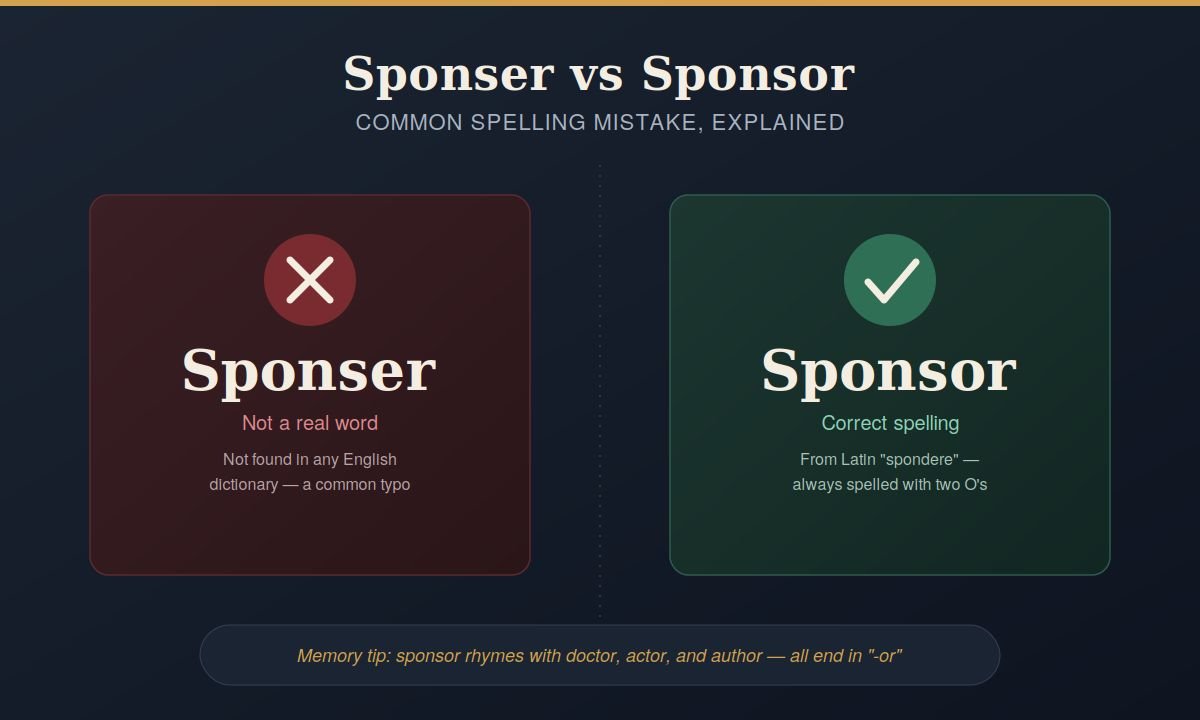
Sponsor is the only correct spelling. Sponser is a common misspelling with no dictionary standing in English. The word comes from the Latin root spondere, meaning “to promise,” and it’s spelled with an “o,” not an “e,” in the second syllable. If you remember one thing, remember this: sponsor always has two O’s.
What Sponsor Actually Means

A sponsor is a person, group, or company that supports someone or something, usually by providing money, resources, or endorsement in exchange for recognition or a specific outcome. Sponsorship can be financial, such as a brand funding a sports event, or personal, such as someone vouching for another person’s membership or recovery.
At its core, sponsoring involves three things:
- Support: giving money, time, or resources
- Responsibility: standing behind someone or something
- Exchange: often expecting visibility, goodwill, or a positive result in return
Why “Sponser” Feels Right (But Isn’t)
Plenty of English words end in “-er,” like teacher, writer, and driver. That pattern trains our brains to expect “-er” endings on almost anything that describes a role or a doer. Since a sponsor is someone who “does” the sponsoring, it’s natural for the brain to default to “sponser.”
But English spelling doesn’t always follow logic. Sponsor keeps its Latin-based “-or” ending, similar to words like doctor, actor, and supervisor. These words describe a role too, yet they never take the “-er” spelling. Once you group sponsor with that family of words, the correct spelling starts to feel natural.
Sponsor vs Sponser: Side-by-Side Comparison
| Feature | Sponsor | Sponser |
| Correct English word | Yes | No |
| Found in dictionaries | Yes | No |
| Word origin | Latin spondere | None (misspelling) |
| Used in formal writing | Yes | Never |
| Common typo cause | Confusion with “-er” endings | N/A |
There’s no version of English, US or UK, where “sponser” is accepted. It’s simply a spelling error, not a regional variant.
Simple Ways to Remember the Correct Spelling
If the spelling keeps slipping your mind, try one of these tricks:
- Think “-or” like doctor: Sponsor rhymes with words that end in “-or,” such as author and investor.
- Break it into sounds: SPON-SOR, not SPON-SER. Say it out loud slowly.
- Link it to “sponsorship”: The longer word “sponsorship” makes the “-or” spelling more obvious since “sponsership” looks visibly wrong.
- Use spellcheck as a backup, not a crutch: Tools catch the error, but knowing the rule means you won’t need to double-check every time.
How to Use Sponsor Correctly in a Sentence
Sponsor can work as both a noun and a verb, and the meaning shifts slightly depending on the sentence.
As a noun:
- The marathon’s main sponsor covered all the event costs.
- She thanked her sponsor for believing in her project.
As a verb:
- The company decided to sponsor the local youth soccer league.
- He asked his uncle to sponsor his visa application.
Notice that the spelling never changes based on the part of speech. It’s always sponsor, whether it’s an action or a person.
Sponsor Definition Across Different Industries
The word carries slightly different weight depending on the setting.
Business and marketing: A brand pays to have its name attached to an event, show, or team in exchange for exposure. Think of a company logo on a race car or a streaming platform funding a podcast.
Education: A school, teacher, or organization may sponsor a student’s scholarship, exchange program, or extracurricular activity.
Immigration and legal contexts: A sponsor takes on legal or financial responsibility for another person, such as a family member sponsoring a relative’s visa application.
Recovery programs: In programs like Alcoholics Anonymous, a sponsor is a more experienced member who personally guides and supports someone working through recovery. This relationship is built on trust and accountability rather than money.
DISCOVER MORE : Accross vs Across: Which Spelling Is Correct and Why?
Types of Sponsors You’ll Encounter
Not all sponsors play the same role. Here’s a quick breakdown:
- Financial sponsor: Provides money or funding, common in events and startups
- Corporate sponsor: A business that backs an event or organization for brand exposure
- Personal sponsor: An individual who supports another person, common in visas or recovery programs
- Media sponsor: Provides advertising space or coverage instead of cash
- Title sponsor: Gets top billing, often having the event named after their brand
Words Related to Sponsor
Building a wider vocabulary around sponsor can help you write with more variety and precision:
- Backer: someone who supports a project financially
- Patron: a supporter, often of the arts
- Benefactor: someone who gives generously, often without expecting much in return
- Underwriter: financially backs an event or risk, often in insurance or publishing
- Endorser: publicly supports a product or cause, though not always with money
These words overlap with sponsor but aren’t always interchangeable, so context matters.
Sponsor vs Sponsee: What’s the Difference
This pair confuses people almost as much as the spelling issue. A sponsor is the one giving support, guidance, or funding. A sponsee is the person receiving it. This term shows up most often in recovery programs, where the sponsee is the individual being mentored through the process by their sponsor. Outside of recovery contexts, “sponsee” is rarely used, and terms like “recipient” or “beneficiary” often take its place.
Is “Sponser” a Word?
No. Sponser is not recognized in Merriam-Webster, Oxford, Cambridge, or any other standard English dictionary. It’s a spelling mistake, not a regional spelling, slang term, or informal variant. If you see it in writing, including on official-looking websites, it’s an error worth correcting.
What’s the Plural of Sponsor?
The plural of sponsor is simply sponsors. It follows the regular English rule of adding an “s” to the end, with no spelling changes to the base word.
- One sponsor funded the event last year.
- This year, three sponsors are covering the costs.
Common Mistakes People Make With Sponsor
- Misspelling it as “sponser”: the most frequent error, caused by the “-er” ending pattern
- Confusing sponsor with “sponsorer”: there’s no such word; sponsor already covers the role
- Mixing up sponsor and sponsee: remember, the sponsor gives support, the sponsee receives it
- Overusing “sponsorship” when “sponsor” fits better: not every sentence needs the longer noun form
Quick Practice: Test Yourself
Try filling in the blanks before checking your answers.
- The company agreed to ______ the charity run. (sponsor / sponser)
- Her ______ helped her get through the program. (sponsor / sponser)
- Correct the error: “We are looking for a sponser for our event.”
Answers: 1. sponsor 2. sponsor 3. “We are looking for a sponsor for our event.”
Frequently Asked Questions
Is sponser a real word?
No. Sponser is a common misspelling of sponsor and doesn’t appear in any standard English dictionary.
What is the correct spelling, sponsor or sponser?
The correct spelling is sponsor, spelled with two O’s and no E in the second syllable.
What does sponsor mean in simple terms?
A sponsor is someone or something, often a company or individual, that provides financial support, resources, or guidance to a person, event, or cause.
What is the difference between a sponsor and a sponsee?
A sponsor provides support or guidance, while a sponsee is the person receiving that support, a term most common in recovery programs.
Can sponsor be used as both a noun and a verb?
Yes. As a noun, it refers to the supporting person or entity. As a verb, it describes the act of providing that support, as in “to sponsor an event.”
Conclusion
The debate over sponser vs sponsor really isn’t a debate at all. Sponsor is the only correct spelling, backed by its Latin root and consistent use across every English dictionary and industry. Whether you’re writing about a corporate sponsor, a scholarship sponsor, or a sponsor in a recovery program, the spelling stays the same. Once the “-or” ending clicks in your memory, you won’t second-guess it again.

James Walker is a content writer and language researcher with over 5 years of experience in meanings, definitions, and language-related topics. He enjoys simplifying complex terms into clear, easy-to-understand explanations. Through ZoopNestly.com, he helps readers find accurate and reliable information.