In-Person vs In Person: A Complete Guide to Correct Usage
You typed “in-person meeting” into an email, then two lines later wrote “let’s meet in person,” and now you’re second-guessing both. That tiny hyphen feels like it shouldn’t matter, but it changes how a sentence reads and whether it looks polished or careless.
The good news: in-person vs in person comes down to one simple grammar rule you can apply in seconds, and this guide walks you through it.
Quick Answer
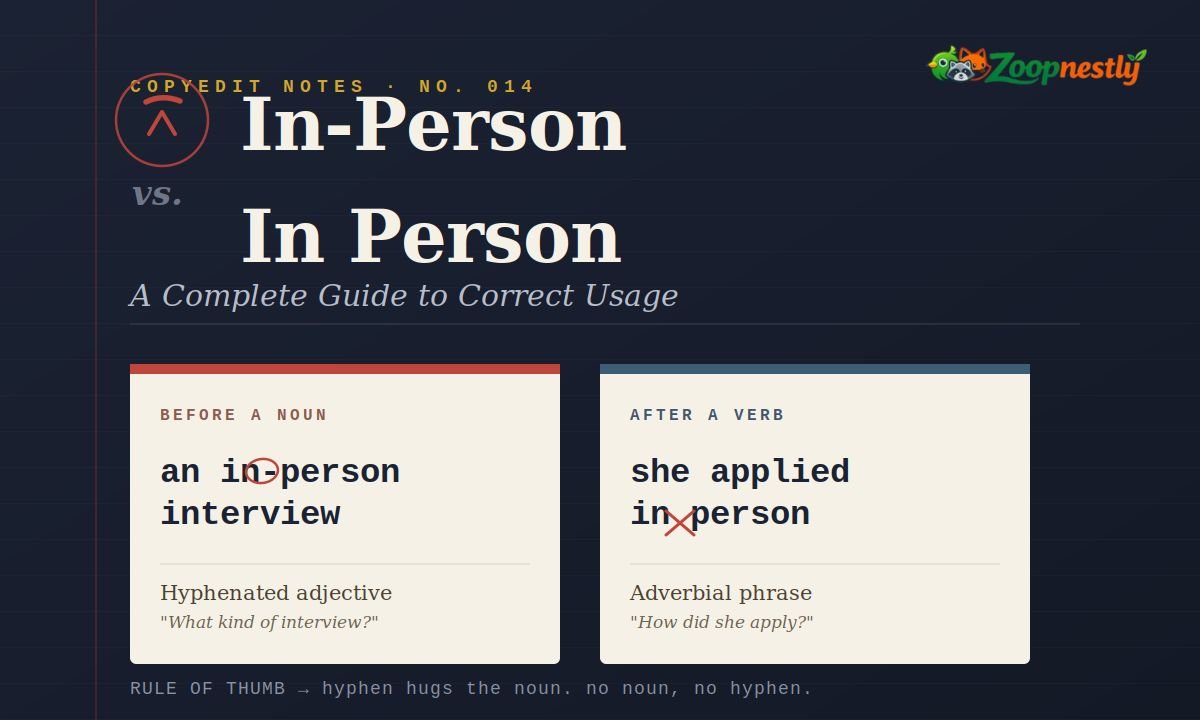
In-person (with a hyphen) is an adjective that describes a noun, as in “an in-person interview.” In person (no hyphen) is an adverbial phrase that describes an action, as in “she applied in person.” If the phrase sits right before a noun, hyphenate it. If it comes after a verb, drop the hyphen.
Why This Distinction Actually Matters

A hyphen might look small, but it signals meaning. “In-person meeting” and “in person meeting” read differently to a careful eye, and inconsistent usage can make professional writing, résumés, or business emails look sloppy. Getting this right is a small habit that adds up to cleaner, more credible writing across emails, reports, job postings, and everyday communication.
In-Person: The Adjective Form
In-person works as a compound adjective. Compound adjectives that come before a noun typically get hyphenated in English, and this phrase follows that exact pattern.
When to use it: Use “in-person” directly before a noun it modifies, such as meeting, interview, event, class, or appointment.
Example sentences:
- The company scheduled an in-person orientation for new hires.
- We prefer in-person conversations for sensitive topics.
- The clinic offers both virtual and in-person appointments.
The pattern: in-person + noun. If you can point to the word right after it and that word is a noun, the hyphen belongs there.
In Person: The Adverbial Phrase
In person describes how an action happens. It modifies a verb, not a noun, so no hyphen is needed.
When to use it: Use “in person” after a verb, especially verbs like meet, attend, apply, visit, or speak.
Example sentences:
- Please attend in person if you can make it.
- I’d rather explain this in person than over email.
- She met the client in person for the first time yesterday.
The pattern: verb + in person. If the phrase answers “how” or “in what way” something was done, it stays unhyphenated.
In-Person vs In Person: Side-by-Side Comparison
| Feature | In-Person | In Person |
| Part of speech | Adjective | Adverbial phrase |
| Position in sentence | Before a noun | After a verb |
| Hyphenated? | Yes | No |
| Example | in-person training | trained in person |
| Answers | “What kind?” | “How?” |
Memory trick: If a noun follows immediately, add the hyphen. No noun right after it, no hyphen. Think “hyphen hugs the noun.”
How Businesses Actually Use These Terms

Job listings often advertise “in-person interview required,” using the hyphenated adjective before the noun interview. Customer service pages, on the other hand, might say “visit us in person for faster support,” where the phrase follows the verb visit. Retailers, healthcare providers, and schools all switch between the two forms constantly, and getting it right keeps official communication looking sharp. Style guides used by newsrooms and publishers, including the AP Stylebook, generally support hyphenating compound modifiers before a noun, which lines up with how “in-person” is treated here.
DISCOVER MORE : Defence vs Defense: Which One Should You Use in Writing?
How Usage Has Shifted in Recent Years
Since 2020, both forms have appeared far more often in everyday writing, largely because remote and hybrid work made the distinction between virtual and physical interactions worth naming. Job postings, event pages, and internal memos now use “in-person” constantly to contrast with “remote” or “virtual.” This surge means more people are writing the phrase than ever, and more people are also getting the hyphen wrong. Search engines and AI writing tools increasingly flag or correct this exact pair, which is a sign of how common the mix-up has become.
Why this matters: As hybrid work stays normal, this phrase isn’t going anywhere. Getting comfortable with the rule now saves you from repeated mistakes in emails, job descriptions, and reports.
Common Mistakes Writers Make
Mistake 1: Using “In Person” Before a Noun
Wrong: an in person meeting Right: an in-person meeting The phrase sits directly before the noun “meeting,” so it needs the hyphen.
Mistake 2: Using “In-Person” After a Verb
Wrong: we met in-person Right: we met in person There’s no noun immediately after the phrase here, only the end of the sentence, so no hyphen is needed.
Mistake 3: Hyphenating Every Instance Automatically
Some writers hyphenate the phrase out of habit, even when it functions as an adverb. Always check what comes right after the phrase before deciding.
Mistake 4: Inconsistent Usage Within the Same Document
Switching between “in-person” and “in person” incorrectly within one email or report is one of the most common issues. Pick the correct form for each instance based on its position in the sentence, not on convenience.
A Simple Rule You Can Apply Every Time

Use “In-Person” If:
- It comes right before a noun
- It’s describing a thing (meeting, class, visit, interview)
- You could replace it with another adjective like “virtual” or “remote”
Use “In Person” If:
- It comes after a verb
- It’s describing how something happens
- You could replace it with an adverb like “personally” or “directly”
One-sentence formula: Before a noun, hyphenate. After a verb, don’t.
“In-Person Meeting” vs “Meet in Person”
These two phrases confuse people constantly because they use the same root words in a different order. “In-person meeting” is a noun phrase describing the type of meeting. “Meet in person” is a verb phrase describing the action of meeting. Neither is more correct than the other; they simply serve different grammatical roles in a sentence.
Frequently Asked Questions
Is it “meet in person” or “meet in-person”?
It’s “meet in person,” without a hyphen. “Meet” is a verb, and “in person” describes how the meeting happens, so no hyphen is needed.
Is “in-person” always hyphenated?
No. It’s only hyphenated when it functions as an adjective directly before a noun, such as “in-person training.” After a verb, it’s written as two words with no hyphen.
Can “in person” ever come before a noun?
Generally no. When the phrase appears before a noun, English convention treats it as a compound adjective, which calls for the hyphen.
Is “in-person” one word, two words, or hyphenated?
It’s always two words joined by a hyphen when used as an adjective: “in-person.” It’s never written as a single word like “inperson.”
Does AP Style hyphenate “in-person”?
Yes, when used as a compound modifier before a noun. This follows the general AP Stylebook guidance on hyphenating compound adjectives that precede the word they modify.
Quick Self-Check
Try filling in the blank correctly:
- The school is offering ___ classes again this fall. (in-person)
- We’d rather discuss this ___ than by phone. (in person)
- She attended the ___ workshop last week. (in-person)
- He prefers to apologize ___ instead of texting. (in person)
If you got these right, the rule has clicked.
Conclusion
The difference between in-person and in person isn’t complicated once you know what to look for. Check what comes right after the phrase: a noun means hyphenate, a verb means leave it open. Whether you’re writing a job posting, an email, or a quick text, this one habit keeps your writing consistent and easy to trust.

James Walker is a content writer and language researcher with over 5 years of experience in meanings, definitions, and language-related topics. He enjoys simplifying complex terms into clear, easy-to-understand explanations. Through ZoopNestly.com, he helps readers find accurate and reliable information.