You Too or You To: Understanding the Correct Usage and Meaning
You just typed “you to” in a text and your phone didn’t flag it. Now you’re second-guessing yourself. Is it you too or you to? This tiny mix-up shows up everywhere, from work emails to birthday texts, and getting it wrong can make a message look careless.
The good news is that you too or you to is one of the easiest grammar mix-ups to fix once you know the simple difference between them.
Quick Answer
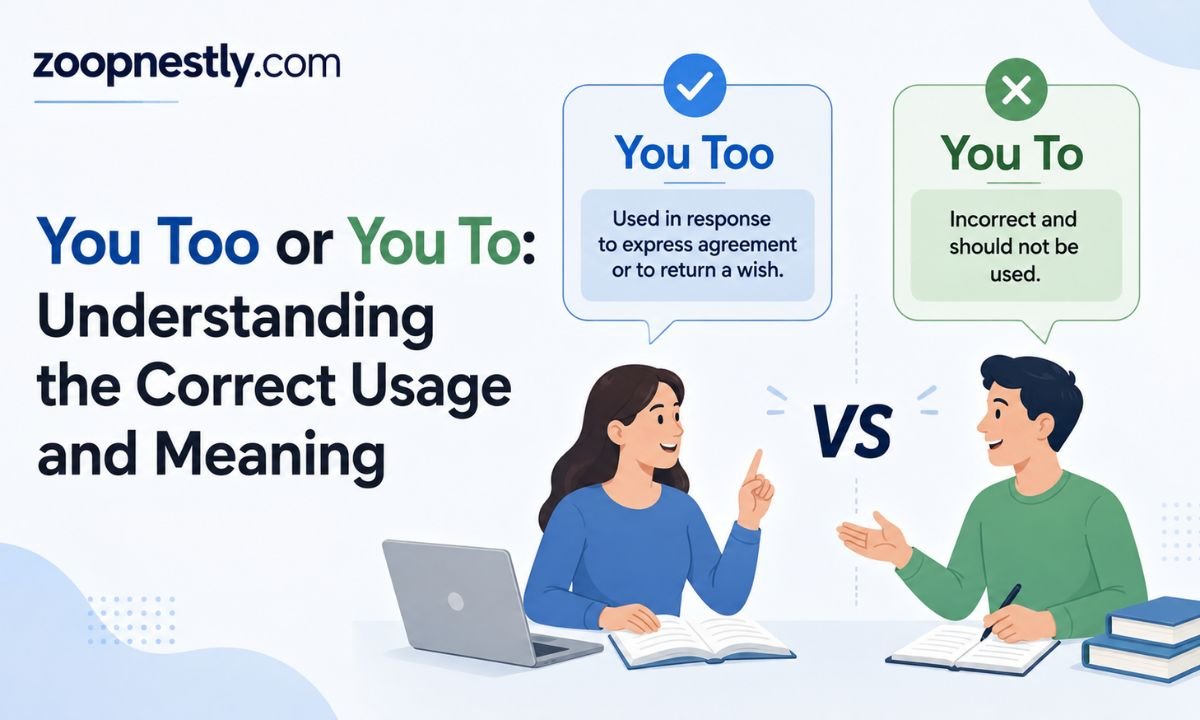
“You too” means “you as well” or “also” — it’s the phrase you want in almost every situation (“Have a great weekend! You too!”). “You to” is not a standalone phrase; “to” only appears as part of a longer sentence, usually before a verb (“I need you to call me”). If you’re replying to someone or adding “also” to a sentence, the correct choice is always you too.
What Does “You Too” Mean?
“Too” is an adverb that means also or as well. You add it to the end of a sentence, or right after the word it’s emphasizing, to show that something applies to more than one person or thing.
Examples:
- “I had a great time. You too!”
- “She’s coming to the party, and her brother is too.”
- “Nice job on the presentation. You too, honestly.”
If you can replace the word with “also” and the sentence still makes sense, you need too.
What Does “You To” Mean?
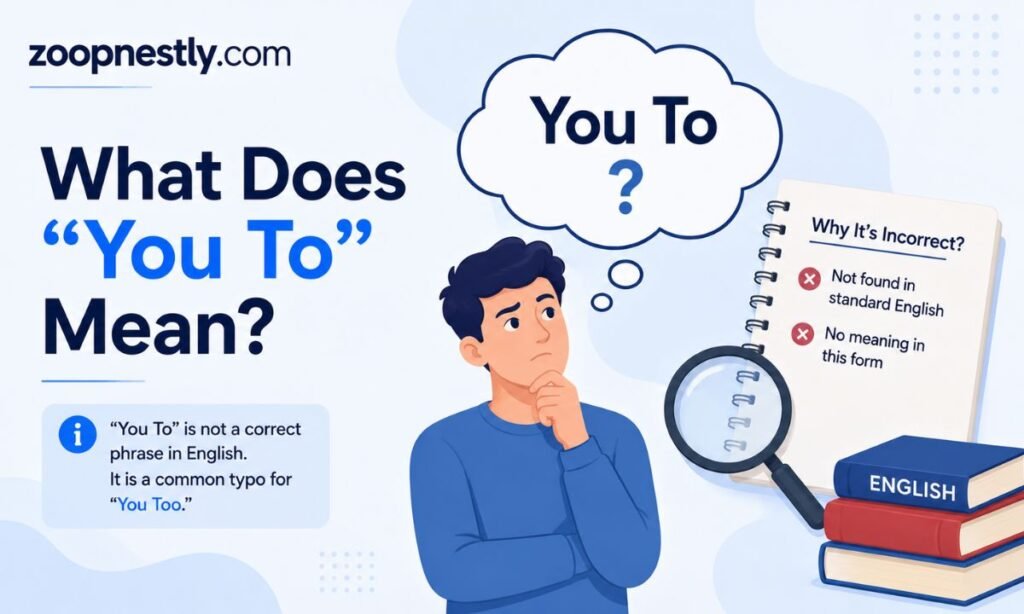
Here’s the part most articles skip: “you to” isn’t really a phrase on its own. It only shows up because “to” is doing its normal job as a preposition or part of an infinitive verb (like “to call,” “to help,” “to see”). The words “you” and “to” just happen to land next to each other.
Examples:
- “I want you to know how much this means.”
- “The teacher asked you to submit the form.”
- “It’s up to you to decide.”
In every one of these, “to” is connecting to a verb (“to know,” “to submit,” “to decide”). Remove “you” and the sentence still needs “to.” That’s your clue it’s not the “also” word.
The Simple Rule to Tell Them Apart
Here’s a quick mental test you can run in two seconds:
- Ask: does this word mean “also”? If yes, use too.
- Ask: is a verb coming right after it? If yes, use to (“to go,” “to eat,” “to finish”).
- Try removing the word. If the sentence still makes sense without it, it was probably “too” (an extra, optional word). If the sentence breaks without it, it’s “to.”
Example test: “Can you call me too?” Remove “too” — “Can you call me?” Still works, so “too” is correct because it’s extra information.
Now try: “I need you to call me.” Remove “to” — “I need you call me.” That’s broken, so “to” is required here.
Real-World Example Sentences
Seeing these side by side makes the pattern click faster than any rule.
| Sentence | Correct Word | Why |
| “Good luck on the exam! You ___, right?” | too | Means “also” |
| “I told you ___ finish your homework.” | to | Comes before a verb |
| “She wants ___ join the team.” | to | Infinitive verb (“to join”) |
| “We’re heading out ___. Want to come?” | too | Means “also” |
| “He asked you ___ wait outside.” | to | Before the verb “wait” |
Common Mistakes with You Too and You To
Mistake 1: Replying “You to” Instead of “You too”
This is the most common error, especially in texting. Someone says “Have a good night!” and the reply comes back “You to!” That’s incorrect. Since it means “also,” it needs the second O: “You too!”
Mistake 2: Adding an Extra “Too” Before a Verb
The opposite mistake happens too. Writing “I want you too call me” is wrong because “call” is a verb that needs the infinitive “to,” not the extra word “too.”
Mistake 3: Relying on Autocorrect
Autocorrect often won’t catch this error because both “to” and “too” are real, correctly spelled words. Spell check only flags misspelled words, not wrong-word errors, so you have to catch this one yourself.
Mistake 4: Rushing Casual Messages
Quick texts and social media comments are where this mistake shows up most. Slowing down for one extra second before hitting send catches almost every one of these slips.
DISCOVER MORE : Wellbeing vs Well-Being: Which Version Should You Use?
Is “You To” Ever Correct as a Standalone Reply?
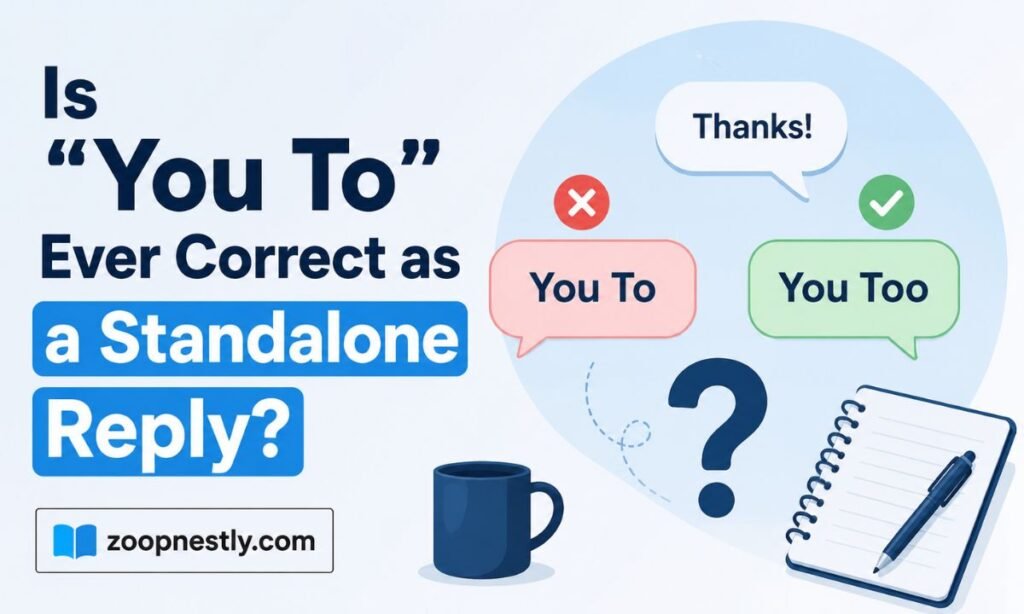
No. This is worth stating clearly because it’s the exact question most people are searching for. If someone says “Nice to meet you” and you want to say the same back, the correct reply is always “You too,” never “You to.” As a short reply meaning “also” or “same here,” “to” is never the right choice.
You Too or You To in Different Situations
In Texting and Casual Chats
Casual writing is where mistakes happen fastest because people type quickly. “Miss you! You too!” is correct. “Miss you! You to!” is not.
In Emails and Professional Writing
Business communication should always use the full, correct spelling. “Thank you for the update. Please let me know if you need anything too” is a clean, professional sentence. A typo like “you to” in a client email can look like a careless mistake.
In Formal or Academic Writing
Formal writing rarely uses these words as a short reply at all. Instead, you’ll see full infinitive structures like “The committee asked the applicant to submit additional documents,” where “to” is doing its normal grammatical job.
Why This Mix-Up Happens So Often
Both words sound identical when spoken, which is called a homophone pair. English has plenty of these (their/there/they’re is another classic example), and the brain often reaches for the shorter or more familiar spelling first. Since “to” appears far more often in everyday sentences than “too,” some writers default to it out of habit, even when “also” is the intended meaning.
Does British English Spell It Differently?
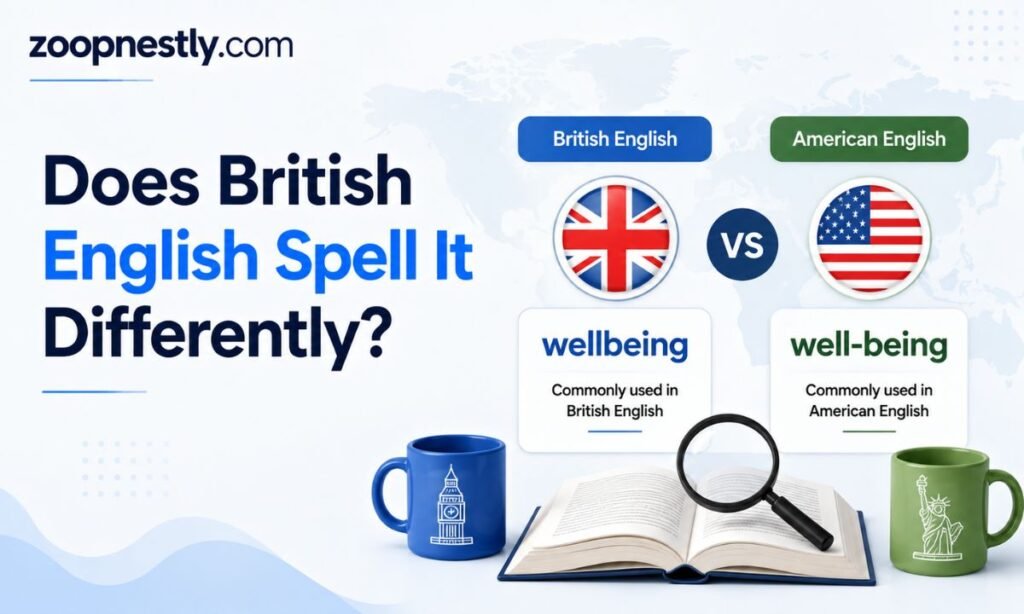
No. This is one grammar point where British and American English agree completely. “Too” meaning “also” and “to” as a preposition or infinitive marker are spelled the same way on both sides of the Atlantic. The confusion isn’t regional, it’s simply a spelling habit that affects writers everywhere English is used.
A Fast Trick to Remember the Difference
Think of the extra O in “too” as standing for “one more” — one more person, one more thing, one more idea added to the sentence. Two O’s, one extra idea. If you’re adding something extra (“me too,” “him too,” “you too”), you need that second O. If a verb follows right after, drop the extra O and use plain “to.”
Frequently Asked Questions
Is it “nice to meet you too” or “nice to meet you to”?
It’s “nice to meet you too.” The word “too” here means “also,” matching the greeting the other person just gave you. “To” would be grammatically incorrect in this spot since no verb follows it.
How do I know when to use “to” before a verb?
Use “to” whenever it directly precedes a base verb to form an infinitive, such as “to run,” “to write,” or “to decide.” This structure is called an infinitive verb, and “too” can never replace “to” in that position.
Can “too” ever come at the start of a sentence?
Yes, though it’s less common. “Too many people showed up” uses “too” as an intensifier meaning “excessively,” which is a slightly different use from the “also” meaning but still spelled with two O’s.
Why doesn’t spell check catch “you to” as an error?
Spell checkers look for misspelled words, not wrong-word choices. Since “to,” “too,” and “two” are all correctly spelled, real words, most basic spell checkers won’t flag using the wrong one in context.
Is “you too” always the correct reply to a compliment?
Yes, if you’re returning the same sentiment. If someone says “You look great today,” replying “You too” correctly means “you also look great.” Just make sure the context actually supports the “also” meaning before using it.
Conclusion
The difference between you too or you to comes down to one simple question: are you adding something extra, or is a verb coming next? Use too when you mean “also,” and use to when it’s paired with a verb like “to go” or “to help.” Once that rule clicks, you’ll never second-guess a reply text or email sign-off again.

James Walker is a content writer and language researcher with over 5 years of experience in meanings, definitions, and language-related topics. He enjoys simplifying complex terms into clear, easy-to-understand explanations. Through ZoopNestly.com, he helps readers find accurate and reliable information.