Studder vs Stutter: Which Word Should You Use?
Ever typed a word, stared at it, and thought “that doesn’t look right”? That’s exactly what happens with studder vs stutter. You hear the word spoken, you sit down to write it, and suddenly you’re second-guessing every letter. This mix-up trips up native speakers and learners alike, and it usually comes from how the word sounds rather than how it’s spelled. The good news is the fix takes less than a minute to understand.
Quick Answer
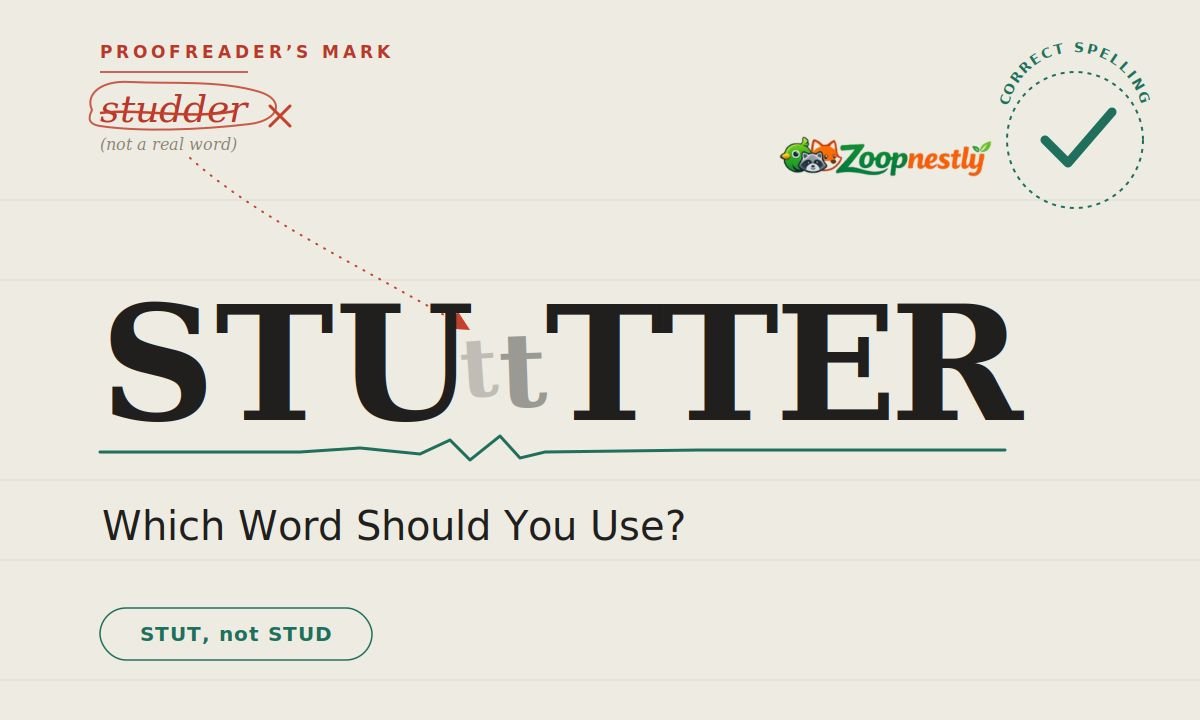
Stutter is the correct spelling. Studder is not a real word in standard English dictionaries; it’s a common misspelling that happens because people mishear or mistype the “t” sound in the middle of “stutter.” If you’re talking about repeating sounds or getting stuck while speaking, stutter is always the word you want.
Studder vs Stutter: The Core Difference
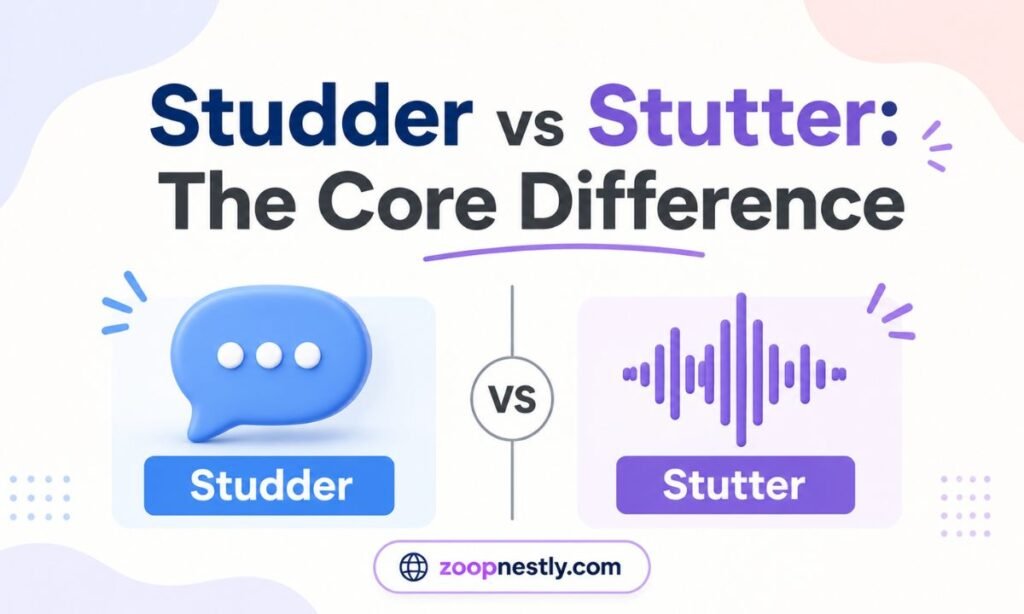
There isn’t really a “difference” between these two in the sense of two valid words with separate meanings. Stutter is the real, dictionary-recognized word. Studder is simply an incorrect spelling of it. No major dictionary, whether Merriam-Webster, Oxford, or Cambridge, lists “studder” as a standalone entry.
Think of it like “definately” versus “definitely.” One is a common typo pattern; the other is the actual word. The same logic applies here.
| Feature | Stutter | Studder |
| Recognized in dictionaries | Yes | No |
| Correct spelling | Yes | No |
| Meaning | To repeat or block on sounds while speaking | Not an official word |
| Common usage | Everyday English, speech pathology, casual talk | Typing error or mishearing |
What Does Stutter Mean?
Stutter is a verb and a noun. As a verb, it means to speak with involuntary pauses, repeated sounds, or stretched-out syllables. As a noun, it refers to the speech pattern itself, sometimes called a speech disorder or speech disfluency.
Example sentences:
- “He started to stutter when he got nervous during the interview.”
- “Her stutter became less noticeable as she relaxed.”
- “The engine stuttered before it finally started.” (used here for a mechanical, non-speech context)
That last example shows something useful: stutter isn’t only about human speech. It can describe anything that starts and stops in an uneven, hesitant way, including engines, video playback, or even a stock market that “stutters” before a rally.
Why Do People Write Studder Instead of Stutter?
This mix-up usually comes down to three things:
- Sound confusion. In fast, casual speech, the “t” in the middle of “stutter” can sound close to a “d.” Say the word quickly and you’ll notice the middle consonant softens. That soft sound gets mistaken for a “d” when someone writes it from memory.
- Autocorrect and typing speed. People typing quickly sometimes swap nearby letters or misremember the exact sequence.
- Lack of a familiar reference word. Unlike common words with clear roots, “stutter” doesn’t have an obvious spelling pattern to lean on, so people guess based on sound alone.
None of this makes “studder” acceptable in writing, whether it’s an email, an essay, or a website. If accuracy and credibility matter, stutter is the only choice.
How to Spell Stutter Correctly
Break it down: S-T-U-T-T-E-R. Two syllables, double “t” in the middle, ending in “-er.”
A simple way to lock it in: think of the phrase “stutter starts with STUT, not STUD.” Saying the full word slowly, syllable by syllable (STUT-TER), can also help you feel the correct consonant sound instead of guessing at it.
Stutter Pronunciation: American vs British English
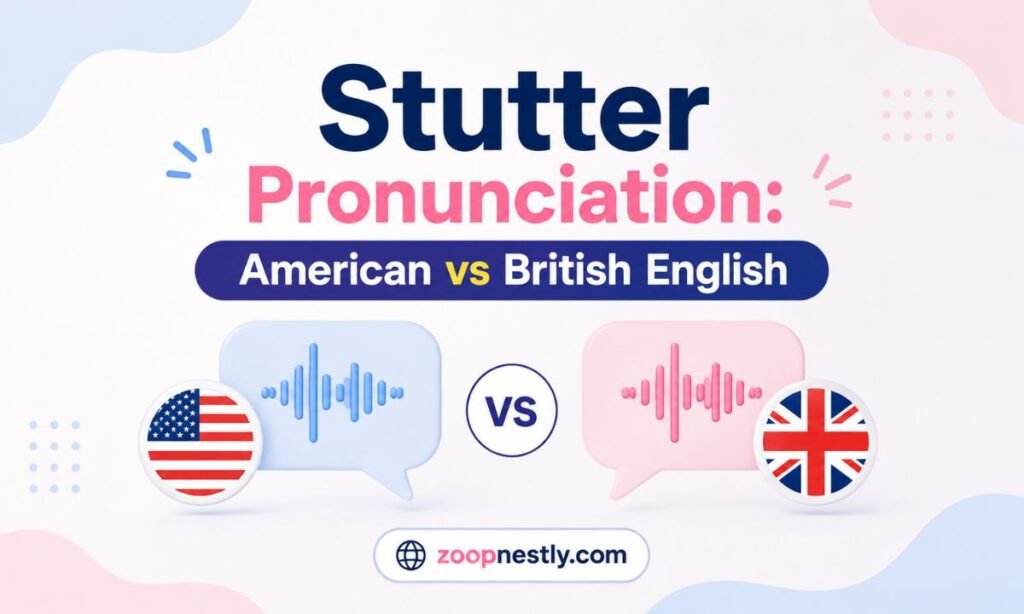
Pronunciation stays fairly consistent across American and British English, though there are subtle differences:
- American English: /ˈstʌtər/ — the ending often sounds like “-er,” with a soft, almost silent “r.”
- British English: /ˈstʌtə/ — the final “r” is typically dropped or barely pronounced, giving it a slightly clipped ending.
In both versions, the stress falls on the first syllable (“STUT-ter”), and the double “t” is pronounced as a single, quick sound rather than two separate taps.
Is Studder a Real Word Anywhere?
No standard English dictionary recognizes “studder” as a word. It doesn’t appear in Merriam-Webster, Cambridge Dictionary, or Oxford English Dictionary as a valid entry. If you search for it, most results will actually be spelling-correction pages pointing you back to “stutter,” which tells you everything you need to know.
Occasionally, “Studder” shows up as a surname or brand name, but that’s a proper noun, not a common English word describing speech patterns.
DISCOVER MORE : Stich vs Stitch: Common Spelling Mistake Explained
Stutter vs Stammer: What’s the Actual Difference?
This is a real comparison worth knowing, since these two words are often used interchangeably but have a slight regional and technical distinction.
- Stutter is the more common term in American English and is also the preferred clinical term in speech pathology.
- Stammer is used more frequently in British English and refers to the same general speech pattern.
Both describe involuntary repetitions, prolongations, or blocks in speech. There’s no major difference in meaning; it’s mostly a regional preference in everyday language, similar to “elevator” versus “lift.”
Stutter Synonyms and Related Words
Depending on context, these words can work as alternatives or related terms:
- Stammer (speech-related, more British)
- Falter (broader, includes hesitation in actions or words)
- Halt (used for interruptions in speech or motion)
- Sputter (mechanical or speech, implies short bursts)
- Disfluency (clinical term used by speech-language pathologists)
Each carries a slightly different shade of meaning, so they’re not always perfect substitutes. “Falter,” for example, works well for hesitation in general, while “sputter” leans more toward short, choppy bursts, often mechanical.
The Science Behind Stuttering
Stuttering is recognized as a speech disorder that affects the flow of speech. It typically begins in early childhood, often between ages two and six, and can involve repeated sounds, syllables, or words, prolonged sounds, or brief silent blocks where no sound comes out at all.
Researchers generally understand stuttering as involving differences in how the brain coordinates the muscles used for speech, though the exact cause isn’t fully understood and likely varies between individuals. Genetics can play a role, since stuttering often runs in families.
It’s worth noting that stuttering is not caused by nervousness, low intelligence, or poor parenting, despite outdated myths that still circulate. Many people who stutter are just as articulate, capable, and confident as anyone else.
Can Stuttering Be Treated or Improved?
Yes, in many cases. Speech-language pathologists work with children and adults to build techniques that improve speech flow and reduce the impact of stuttering on daily communication. Approaches vary by age and individual needs and can include:
- Slowing speech rate deliberately
- Breathing and pacing techniques
- Building confidence in speaking situations
- Early intervention for young children, which tends to show strong results
Not everyone who stutters wants or needs treatment, and many people communicate confidently while still stuttering occasionally. The goal of therapy is usually improved communication and comfort, not eliminating every disfluency.
Common Writing Mistakes: Studder Instead of Stutter
Beyond the basic misspelling, a few related mistakes show up often:
- Writing “stuter” (missing a “t”)
- Writing “studder” (swapping “t” for “d”)
- Writing “stuttar” (wrong ending)
- Using “stutter” and “stammer” interchangeably in formal writing where consistency matters, such as academic or medical content
If you’re writing for a blog, resume, or professional document, running a quick spell-check catches most of these, but it’s worth knowing the correct form so you’re not relying on software every time.
Why Correct Spelling Actually Matters Here
This might seem like a small detail, but spelling errors like “studder” can affect how readers perceive your writing, especially in professional, academic, or medical contexts. If you’re writing content about speech disorders, education, or health topics, accuracy builds trust. A misspelled core term can make even well-researched content look careless.
For anyone searching for information about speech difficulties, whether for themselves or a family member, finding accurate terminology also makes it easier to locate reliable resources and connect with the right professionals.
A Simple Memory Trick
Here’s an easy way to remember the correct spelling for good: “Stutter has STUT, not STUD.”
Picture someone getting “stuck” mid-sentence, the word “stuck” and “stutter” both start with “stu,” and both involve a pause or block. That small mental link can help the correct spelling stick.
FAQs
Is “studder” ever correct in any context?
No. “Studder” is not a recognized English word in any standard dictionary. The correct spelling in every context is stutter.
What is the correct spelling: stutter or studder?
Stutter is correct. It’s the word recognized in dictionaries and used in everyday English, education, and speech pathology.
What does it mean when someone stutters?
It means they experience involuntary interruptions in speech, such as repeated sounds, stretched-out syllables, or brief pauses where words get stuck.
Is stutter the same as stammer?
They describe the same general speech pattern. Stutter is more common in American English, while stammer is more common in British English.
Can adults develop a stutter, or does it only start in childhood?
Stuttering most often begins in early childhood, but it can occasionally develop later in life due to neurological conditions, injury, or other factors. This is sometimes called acquired or neurogenic stuttering and is different from developmental stuttering.
Conclusion
When it comes to studder vs stutter, there’s really only one correct answer: stutter. “Studder” is a misspelling that comes from how the word sounds rather than how it’s actually written. Now that you know the correct spelling, the pronunciation differences, and how stutter relates to terms like stammer, you can use the word confidently and correctly, whether you’re writing an email, an article, or just double-checking yourself mid-sentence.

James Walker is a content writer and language researcher with over 5 years of experience in meanings, definitions, and language-related topics. He enjoys simplifying complex terms into clear, easy-to-understand explanations. Through ZoopNestly.com, he helps readers find accurate and reliable information.