Signer vs Signor: Understanding the Difference
You’re filling out a legal document, and you pause. Is the person putting their name on the dotted line called a signer or a signor? Both look correct. Both sound similar when you say them out loud. This tiny spelling confusion trips up even careful writers, especially in contracts and formal letters. The truth is simpler than you’d expect, and getting it right takes less than a minute once you know the rule.
Quick Answer
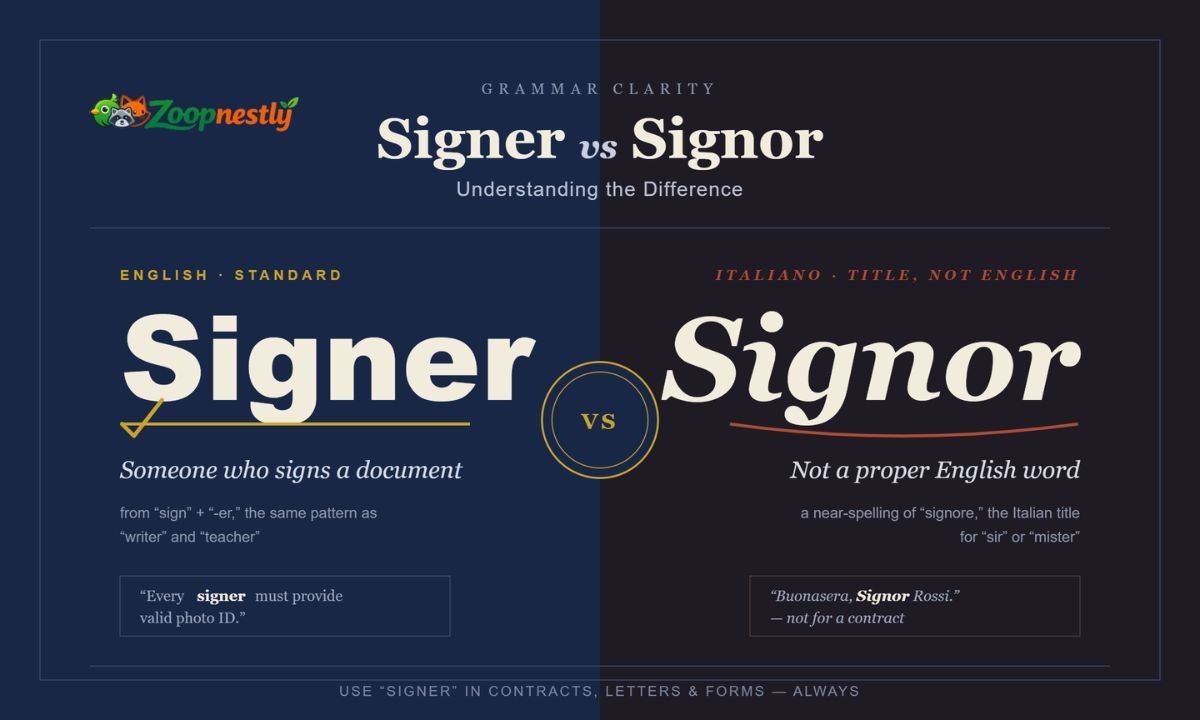
Signer is the correct, standard English word for someone who signs a document. Signor is not a proper English word on its own, though it closely resembles “signore,” an Italian title of respect similar to “Mister.” If you’re writing in English, always use signer.
Signer vs Signor: The Core Difference
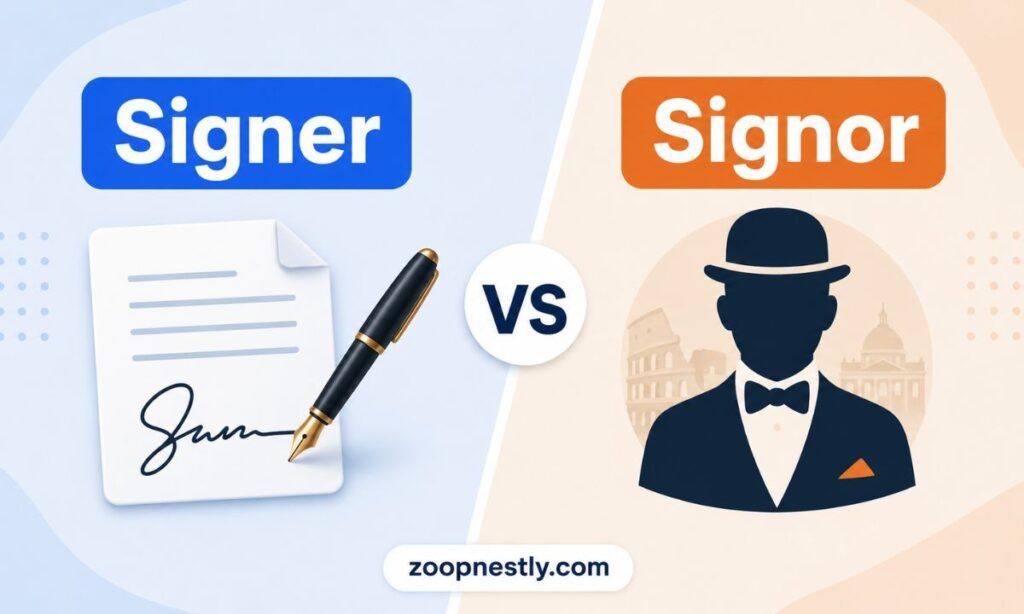
Here’s the short version. “Signer” comes from the verb “sign,” plus the suffix “-er,” which turns an action into a person who does that action. It follows the same pattern as “writer,” “teacher,” or “runner.”
“Signor,” on the other hand, isn’t a native English word. It’s a near-miss spelling of the Italian word “signore,” a polite title used before a man’s name, roughly equivalent to “sir” or “mister” in English. People sometimes drop the final “e” out of habit or confuse it with “signer” because the words look and sound alike.
So when someone asks which one to use in a business letter, contract, or email, the answer is always signer.
| Feature | Signer | Signor |
| Language origin | English | Borrowed from Italian (“signore”) |
| Part of speech | Noun | Not standard English; used as a title |
| Meaning | Person who signs something | Italian title of respect (like “sir”) |
| Correct in English writing | Yes | No, unless referencing Italian language or culture |
| Common context | Legal, business, formal documents | Historical or foreign-language text |
Where Each Word Comes From
Understanding the origin makes the difference easy to remember for good.
Signer traces back to the Old French word “signer” and the Latin “signare,” meaning to mark or seal. English absorbed the root and added the standard “-er” ending used for countless agent nouns. It’s a straightforward, functional word built the same way English builds hundreds of similar terms.
Signor has a completely different path. It comes from Italian, where “signore” was originally a term of feudal respect, similar to “lord,” before it softened into a general polite title like “mister” or “sir.” English speakers occasionally see “signor” in older texts, opera librettos, or Italian-set literature, which is likely why the spelling feels vaguely familiar even though it isn’t part of everyday English vocabulary.
How to Use Signer in a Sentence
Since “signer” is the word you’ll actually use, here are some natural examples across different contexts:
- The signer of the lease must provide a valid photo ID.
- Both parties acted as signers on the joint bank account.
- She was the first signer of the petition, setting an example for her neighbors.
- Every signer received a copy of the signed agreement by email.
- The notary confirmed the identity of each signer before the document was finalized.
Notice how “signer” always refers to a person taking an action, not a title or form of address.
Word Type and Grammar Notes
“Signer” is a countable common noun. That means it follows regular English grammar rules without exception.
- Singular: signer
- Plural: signers
- Possessive: signer’s (one signer) or signers’ (multiple signers)
It doesn’t require capitalization unless it starts a sentence or appears in a title. There’s no irregular spelling to worry about, no silent letters, and no exceptions. Add “-s” for plural, and you’re done.
“Signor,” by contrast, behaves like a foreign-language title. If you ever do use it correctly, it functions similarly to “Mr.” and typically appears capitalized before a name, such as “Signor Rossi.” It isn’t pluralized or used as a common noun the way “signer” is.
Is Signer Actually a Word?
Yes. “Signer” is a fully recognized English word listed in standard dictionaries, including Merriam-Webster and Oxford. It’s used constantly in legal, financial, and everyday writing to describe anyone who puts their signature on a document. There’s no ambiguity here. If you’ve been second-guessing whether “signer” is correct, you can stop worrying. It is.
Why the Confusion Happens
The mix-up usually comes down to three things:
- Visual similarity. The words differ by just one letter’s position, which makes them easy to misread or mistype.
- Autocorrect and spell-check gaps. Some spell checkers don’t flag “signor” as an error because it’s a valid word in other contexts (like referencing an Italian gentleman), so the mistake slips through.
- Unfamiliarity with foreign loanwords. Many people have seen “signor” in movies, books, or historical writing without knowing its actual meaning, so it gets misapplied as an alternate spelling of “signer.”
Once you know “signor” belongs to Italian, not English documentation, the confusion tends to disappear.
Signer in Legal and Financial Contexts
This is where getting the word right actually matters. In contracts, loan agreements, wills, and official forms, “signer” refers to the specific person authorized or required to provide a signature.
Some related terms you’ll often see alongside it:
- Authorized signer: someone with legal permission to sign on behalf of an account, company, or another individual, such as a bank account co-signer.
- Co-signer: a second person who signs a loan or lease, sharing responsibility with the primary signer.
- Countersigner: someone who signs after the original signer, often to verify authenticity.
- Signatory: a more formal synonym, common in international agreements and treaties.
Financial institutions, in particular, use “authorized signer” frequently. This person has legal power to make transactions or decisions on an account, distinct from the account owner in some cases.
DISCOVER MORE : Choosing vs Chosing: The Ultimate Grammar Guide
Synonyms and Related Terms
If you want variety in your writing, or you’re looking for the right word for a specific context, here are solid alternatives to “signer”:
- Signatory — more formal, common in legal and diplomatic writing
- Endorser — used specifically for signing checks or endorsing financial documents
- Witness — someone who signs to confirm they observed another person’s signature
- Co-signer — a joint signer sharing legal responsibility
Each of these has a slightly different shade of meaning, so they aren’t perfect substitutes, but they’re useful when “signer” doesn’t quite fit the sentence.
Antonyms and Contrasts
There’s no single perfect opposite of “signer,” but depending on context, these words contrast with it:
- Non-signer: someone who did not sign the document
- Recipient: the person receiving a signed document, rather than producing the signature
- Witness (in some contexts): observes rather than commits to the agreement itself
Common Mistakes and How to Avoid Them
Here are the errors people make most often, along with quick fixes:
| Mistake | Correction |
| “Please have the signor complete the form.” | “Please have the signer complete the form.” |
| “Signors” as a plural | “Signers“ |
| Using “signor” in business emails | Replace with signer or signatory |
| Confusing “signor” with “senior” | These are unrelated; “senior” refers to age or rank |
A simple trick: if you’re writing in English and the word refers to someone signing something, it’s always signer. If you’re translating from or referencing Italian, “signor” (or properly, “signore”) is the word you want, and it means “sir,” not “one who signs.”
Practice: Signer vs Signor
Test what you’ve learned with a few quick exercises.
Fill in the blank: The bank requires two ______ on this account. (signer/signor)
Multiple choice: Which word means “a person who signs a document”? a) Signor b) Signer c) Both
Sentence correction: “The signor needs to initial each page.” — What’s wrong with this sentence?
Answers: 1) signers, 2) b, 3) “signor” should be “signer.”
Signer Plural and Possessive Forms
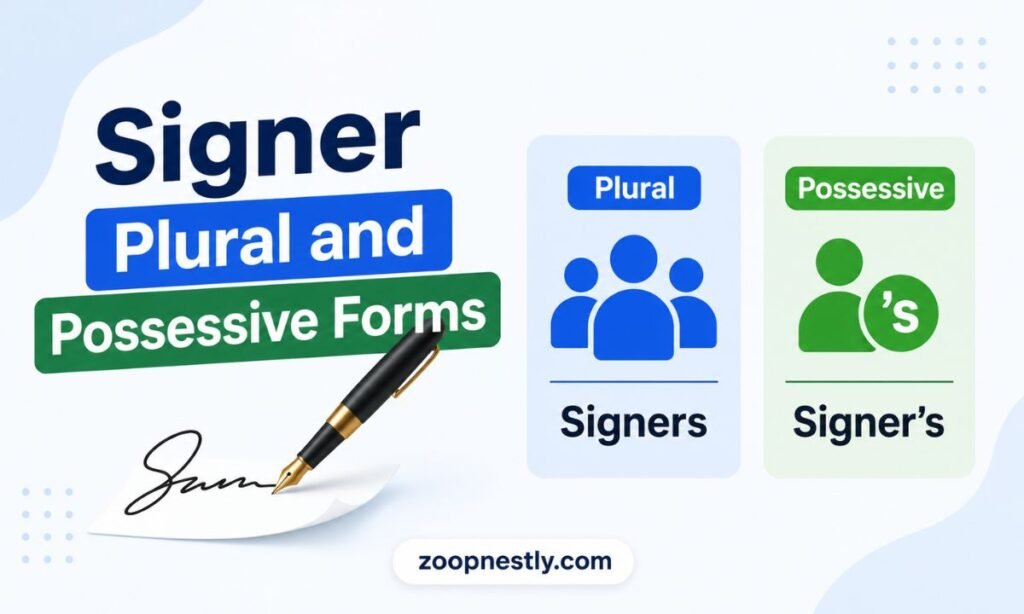
Since this trips people up occasionally, here’s the full breakdown:
- One person: signer
- Multiple people: signers
- Belonging to one signer: signer’s signature
- Belonging to multiple signers: signers’ signatures
There are no irregular forms to memorize. Standard English pluralization rules apply throughout.
Key Takeaways
- Signer is the correct English word for someone who signs a document.
- Signor is not standard English; it’s a near-spelling of the Italian “signore,” meaning “sir” or “mister.”
- “Signer” is a regular noun: signer, signers, signer’s, signers’.
- In legal and financial writing, related terms like signatory, co-signer, and authorized signer are useful and accurate alternatives.
- The confusion mostly comes from visual similarity and unfamiliarity with the Italian loanword.
FAQs
Is “signor” a misspelling of “signer”?
Not exactly. “Signor” is a real word, just not an English one in this context. It’s a shortened or altered form associated with the Italian title “signore.” It becomes a mistake only when someone uses it in place of “signer” in English writing.
Which word should I use in a legal document?
Always use signer. It’s the standard, dictionary-recognized term for someone who signs a legal document in English.
Can “signor” ever be correct in English writing?
Yes, if you’re referring to an Italian man by his title, such as “Signor Bianchi,” similar to saying “Mr. Bianchi.” It should not be used to mean “one who signs.”
What’s the plural of “signer”?
The plural is signers. Just add an “s,” following standard English noun rules.
Is “signatory” the same as “signer”?
They’re closely related. “Signatory” tends to sound more formal and is common in legal, diplomatic, or international documents, while “signer” works in everyday and general writing.
Conclusion
The difference between signer and signor comes down to language origin, not personal preference. Signer is the word you want any time you’re writing about someone who puts their name on a document, whether it’s a lease, a contract, or a petition. Signor belongs to Italian, not English, and means something entirely different. Once that distinction clicks, you won’t second-guess the spelling again.

James Walker is a content writer and language researcher with over 5 years of experience in meanings, definitions, and language-related topics. He enjoys simplifying complex terms into clear, easy-to-understand explanations. Through ZoopNestly.com, he helps readers find accurate and reliable information.