Togather vs Together: Correct Word, Meaning, and Examples
You’re typing a text, an email, or a caption, and you pause. Does it look right? Something about the word feels off, but you can’t put your finger on why. This mix-up trips up more writers than you’d expect, especially since one version sounds exactly like the other when spoken out loud. If you’ve ever typed togather and wondered whether it belongs, or second-guessed yourself mid-sentence, you’re about to get a clear, permanent answer.
Quick Answer
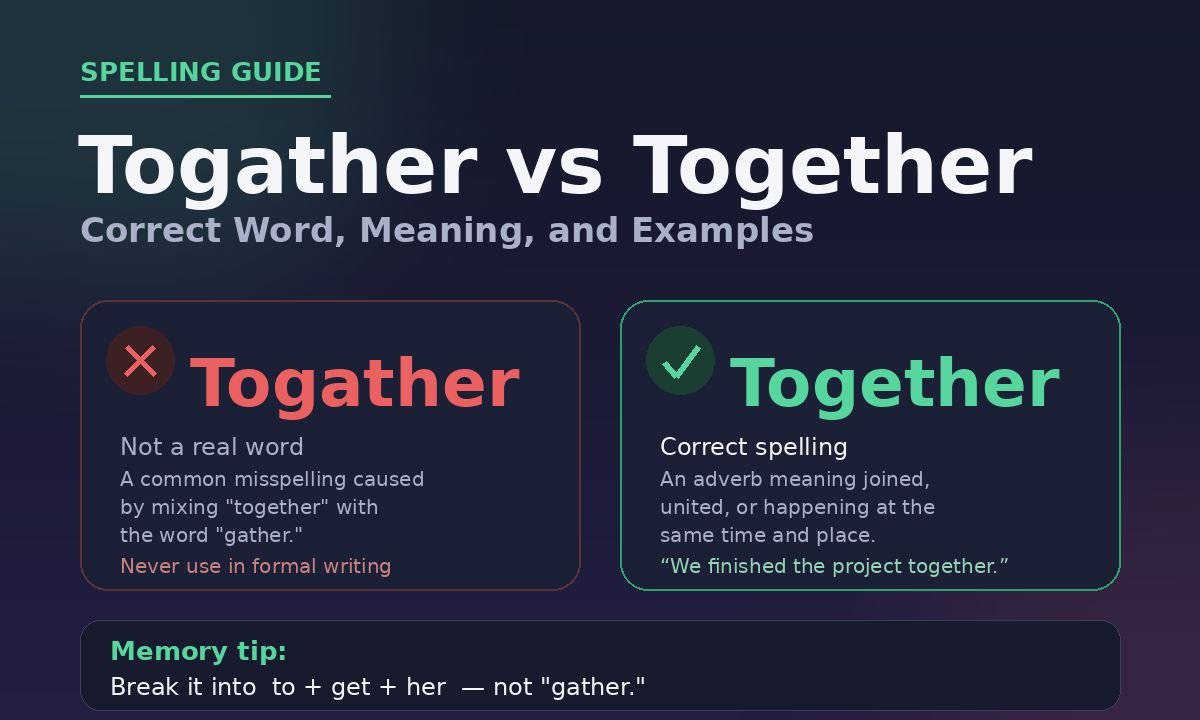
Together is the correct spelling in English. Togather is a common misspelling with no place in standard writing, dictionaries, or formal English. The confusion happens because both words sound almost identical when spoken, but only “together” carries the real meaning of being united, joined, or in the same place at the same time.
Togather vs Together: The Correct Spelling
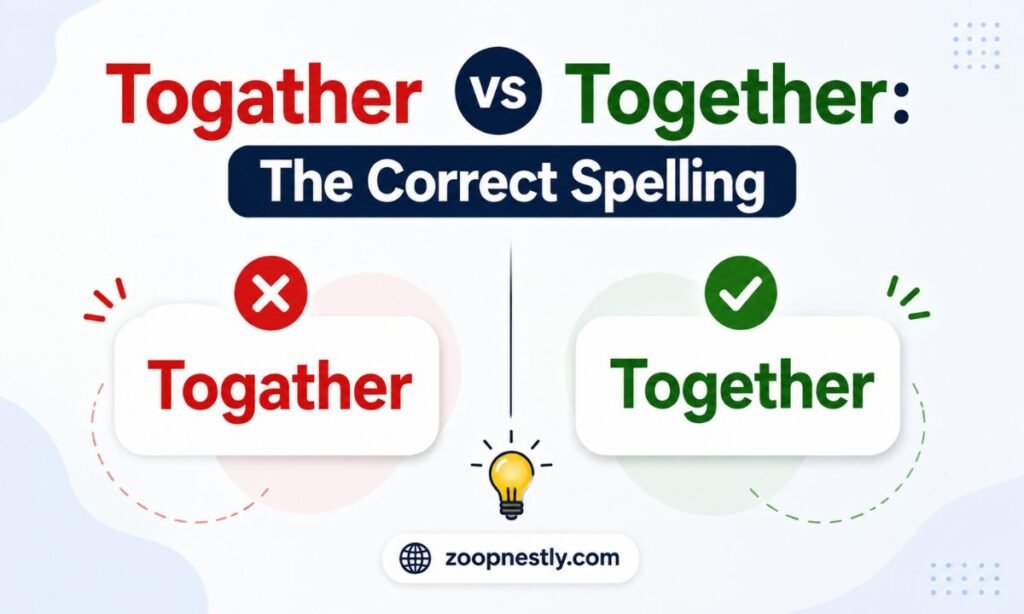
There’s no ambiguity here. Together is a real, standard English word. Togather is not a word at all, it’s simply a spelling error that happens to look plausible.
If you check any major dictionary, including Merriam-Webster or Cambridge Dictionary, you’ll find “together” listed with its full definition, pronunciation guide, and usage history. You won’t find “togather” anywhere except in error logs and spell-check flags.
So whenever you’re unsure which one to write, the answer is always the same: use together.
What Does “Together” Actually Mean?
“Together” is an adverb that describes two or more people, things, or actions being joined, combined, or happening at the same time and place.
At its core, it expresses unity, connection, or shared presence. It can describe physical closeness (“sitting together”), emotional bonds (“staying together through hard times”), or simultaneous action (“we finished the project together”).
Example sentences:
- We watched the movie together.
- The team worked together to hit the deadline.
- Mix the flour and sugar together before adding eggs.
- They’ve been together for six years.
Notice how the meaning shifts slightly depending on context, but the core idea of connection stays constant.
Why Do So Many People Write “Togather” Instead?
This isn’t random. There’s a clear pattern behind why this specific error shows up so often, even among confident writers.
1. Phonetic Confusion
English spelling doesn’t always match pronunciation. When people sound out “together” quickly, the unstressed middle vowel can blur, making “gather” seem like the more natural-looking chunk to plug in.
2. The Word “Gather” Gets Borrowed
“Gather” is a common, familiar word on its own, meaning to collect or bring things into one place. Since “together” already carries a similar idea of things coming into one place, the brain sometimes substitutes the more familiar spelling of “gather” into “together” without noticing.
3. Fast Typing and Autocorrect Gaps
On phones especially, quick typing without reviewing leads to small errors that slip past. Not every keyboard flags “togather” as wrong, particularly if predictive text has learned from a prior mistake.
4. Simplifying an Unfamiliar Pattern
For non-native speakers and early learners, breaking “together” into smaller, known pieces (to + gather) feels logical. It’s a reasonable guess, just not the correct one.
Where “Together” Comes From
Understanding the word’s origin makes the correct spelling easier to remember. “Together” traces back to Old English “togædere,” formed from “to” plus “gædere,” related to the idea of being gathered or united. Over centuries, the spelling evolved into the modern “together” we use today.
This history actually explains the confusion. “Gather” and “together” share the same ancient root, which is exactly why they still sound related. But English spelling froze “together” into its own distinct form, separate from modern “gather.”
Memory tip: Think of “to” + “get” + “her.” Reading it as three small chunks (to-get-her) makes the correct letters stick far better than trying to force “gather” into the word.
Pronunciation vs Spelling: Why This Keeps Happening
“Together” is pronounced roughly as tuh-GEH-thur, with the stress landing on the second syllable. That unstressed first syllable (“tuh”) is the exact spot where confusion creeps in, because it doesn’t clearly sound like “to.”
This is a classic example of English spelling not perfectly mirroring speech. Plenty of English words behave this way, where the way we hear a word and the way we write it don’t fully match.
Practical fix: Instead of relying on how the word sounds, focus on its visual shape. Spell it out slowly a few times: t-o-g-e-t-h-e-r. Repetition trains your eyes, not just your ears.
Common Misspellings Related to “Together”
“Togather” isn’t the only variation people accidentally create. Here are others worth knowing:
| Misspelling | Correct Word | Note |
| Togather | Together | Most frequent error |
| Togeter | Together | Missing letter |
| Togehter | Together | Letters swapped |
| Toghether | Together | Extra letter inserted |
If you ever see any of these in your own writing, treat it as a signal to slow down and double-check before hitting send.
How to Use “Together” Correctly in Different Contexts
Seeing the word in real situations makes it easier to apply correctly.
Everyday life:
- Let’s cook dinner together tonight.
Workplace:
- The two departments collaborated together to launch the new product.
Relationships:
- No matter what happens, we’ll face it together.
Instructions or recipes:
- Combine the wet and dry ingredients together, then stir gently.
Across all these examples, “together” always signals connection, whether that’s physical, emotional, or collaborative.
Together vs Altogether vs All Together
These three often get mixed up, and each one means something different.
- Together means jointly or in the same place (“We arrived together”).
- Altogether means completely or entirely (“The plan was altogether different”).
- All together means everyone or everything in one group, all at once (“Let’s sing all together now”).
Quick Comparison Table
| Word | Meaning | Example |
| Together | Jointly, in unity | They studied together for the exam. |
| Altogether | Completely, entirely | That’s an altogether different problem. |
| All together | Everyone/everything gathered as one | Put the papers all together in one file. |
A simple test: if you can replace the word with “entirely” and the sentence still makes sense, you probably need “altogether,” not “together.”
Synonyms for “Together”
Depending on context, you can swap “together” for words like:
- Jointly
- Collectively
- In unison
- As one
- Side by side
- In collaboration
Example: “The band played in unison” carries nearly the same meaning as “the band played together,” just with a slightly more formal tone.
DISCOVER MORE : Comment vs Coment: Which Word Should You Use?
Antonyms of “Together”
The opposite of “together” depends on whether you’re describing physical separation or lack of coordination. Common antonyms include:
- Apart
- Separately
- Individually
- Alone
- Disconnected
Example: “They worked separately on different sections of the report” is the direct opposite of “they worked together on the report.”
Simple Strategies to Stop Misspelling “Together”
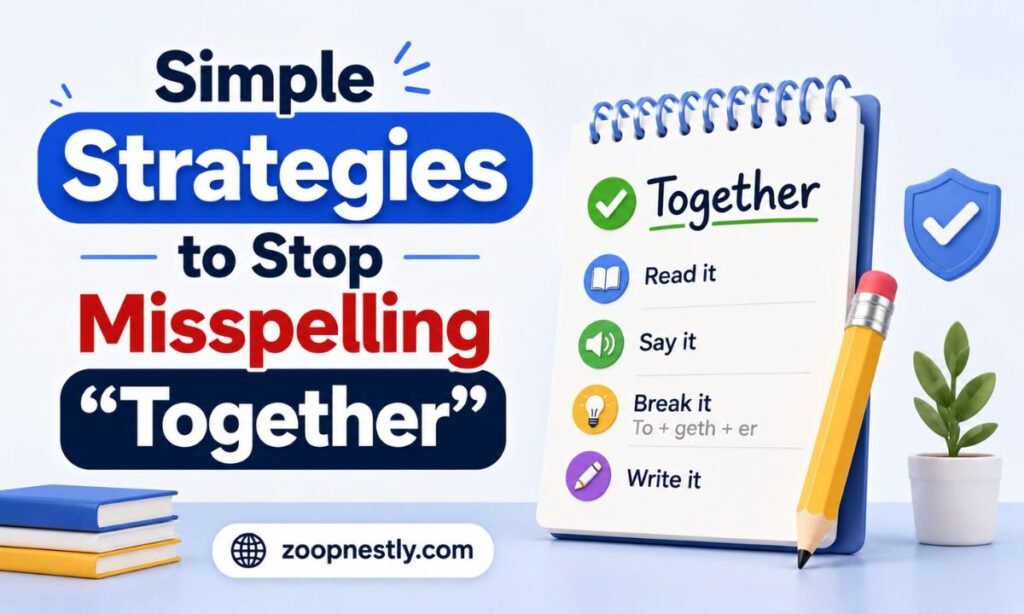
- Break it into syllables: to-geth-er, said slowly while writing it out.
- Use the “get” trick: remember that “together” contains “get,” not “gather.”
- Read before you send: a five-second scan catches most typos.
- Turn on spell-check, but don’t fully trust it: some tools miss real-word-adjacent errors, especially on mobile keyboards trained on your past typos.
- Write the word by hand occasionally: physically writing it helps lock in the correct spelling for visual learners.
Quick Practice: Fill in the Blanks
Try completing these with the correct word, then check your answers below.
- We should stick _______ through this.
- The kids sang _______ during the show.
- Let’s put the pieces _______.
Answers: 1. together, 2. together, 3. together
If “togather” crossed your mind for any of these, that’s completely normal, and now you know exactly why.
Frequently Asked Questions
Is “togather” ever correct in any form of English?
No. “Togather” is not a recognized word in any standard, formal, or informal English dictionary. It’s always a misspelling of “together.”
Why does “togather” look correct even though it isn’t?
Because it borrows the familiar spelling of “gather,” a real word with a related meaning (to collect or bring together). The visual similarity tricks the brain into accepting it.
What part of speech is “together”?
“Together” primarily functions as an adverb, though it can also act as an adjective in certain phrases, such as “a together person” in casual speech.
How can I quickly remember the correct spelling?
Break it into “to + get + her.” This small mental trick avoids the “gather” trap entirely and reinforces the correct letter order.
Does autocorrect always fix “togather” automatically?
Not always. Some keyboards, especially on mobile devices, may not flag it if it’s been typed and accepted before. Manual proofreading is still the safest habit.
Final Takeaway
“Together” is the only correct spelling, and “togather” is simply a common typing slip rooted in how the word sounds and how it visually resembles “gather.” Once you understand the word’s origin, pronunciation quirks, and a few memory tricks, this mistake becomes easy to avoid for good. The next time your fingers hesitate over the keyboard, you’ll know exactly which version to trust.

James Walker is a content writer and language researcher with over 5 years of experience in meanings, definitions, and language-related topics. He enjoys simplifying complex terms into clear, easy-to-understand explanations. Through ZoopNestly.com, he helps readers find accurate and reliable information.